Recognition: unknown
Sign Embedding Quantum Algorithms for Matrix Equations and Matrix Functions
Pith reviewed 2026-05-07 16:42 UTC · model grok-4.3
The pith
Sign embedding produces explicit block-encodings for Sylvester solutions with linear query complexity in conditioning parameters.
A machine-rendered reading of the paper's core claim, the machinery that carries it, and where it could break.
Core claim
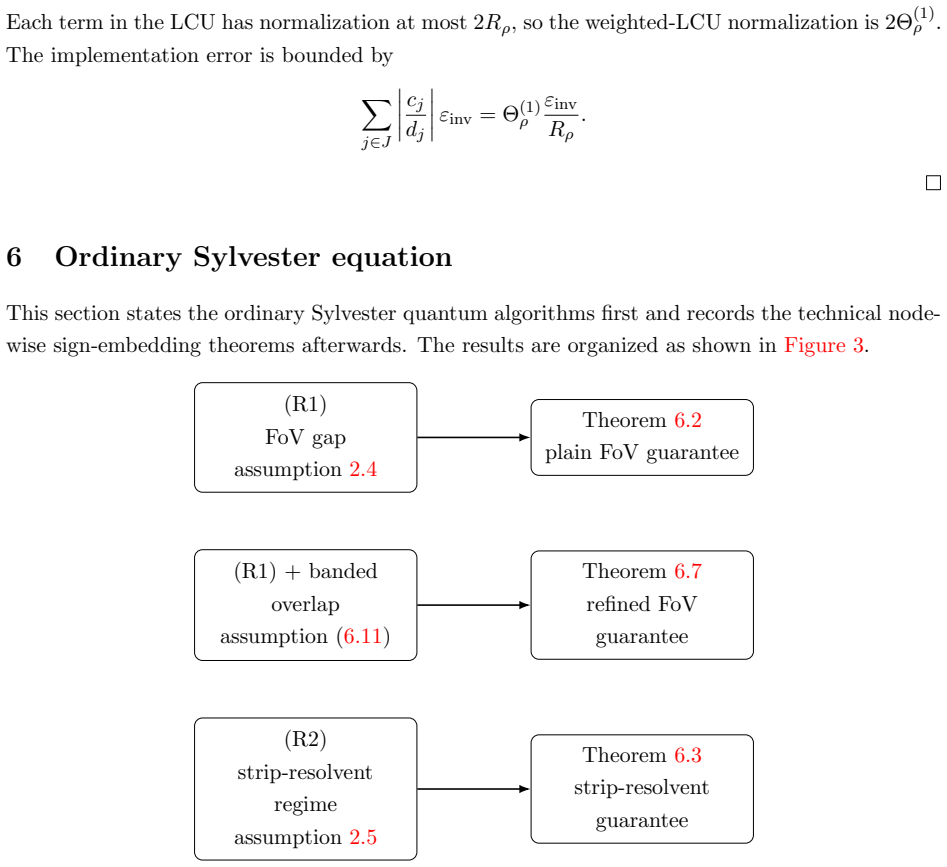
We construct a logarithmic-sinc approximation to the half-plane sign operator and combine it with scaled multiplexing and nodewise rebalancing to produce block-encodings of solutions to ordinary Sylvester equations. The resulting algorithm has query complexity linear in the inverse-conditioning parameters and logarithmic in the target error, under field-of-values gap or strip-resolvent hypotheses, and extends the same normalization to generalized Sylvester, Lyapunov, principal square roots, geometric means, and continuous-time algebraic Riccati equations.
What carries the argument
The matrix-sign embedding of an augmented matrix M, which compresses the target operator as a block of sign(M) or (I - sign(M))/2, combined with logarithmic-sinc approximation and nodewise rebalancing.
If this is right
- Explicit block-encodings for solutions to generalized Sylvester equations follow from the same overlap-based normalization.
- Principal square roots and inverse square roots can be obtained via the same sign-embedding route.
- Continuous-time algebraic Riccati equations admit similar quantum algorithms under the stated hypotheses.
- Matrix geometric means become accessible through the projector form of the sign function.
Where Pith is reading between the lines
- These techniques might extend to other matrix functions whose sign or projector forms admit efficient approximations.
- Testing the framework on non-normal matrices with known FoV gaps would validate the linear scaling claims.
- Connections to classical contour-integral methods could reveal trade-offs in quantum versus classical resource use.
Load-bearing premise
The field-of-values gap or strip-resolvent hypotheses must hold to prevent exponential blow-up in the number of terms or the condition number during the logarithmic-sinc approximation and rebalancing.
What would settle it
Observe a non-normal Sylvester equation lacking a field-of-values gap and check whether the number of terms in the sign approximation or the condition number of shifted inverses grows exponentially as the target error tolerance decreases.
Figures

read the original abstract
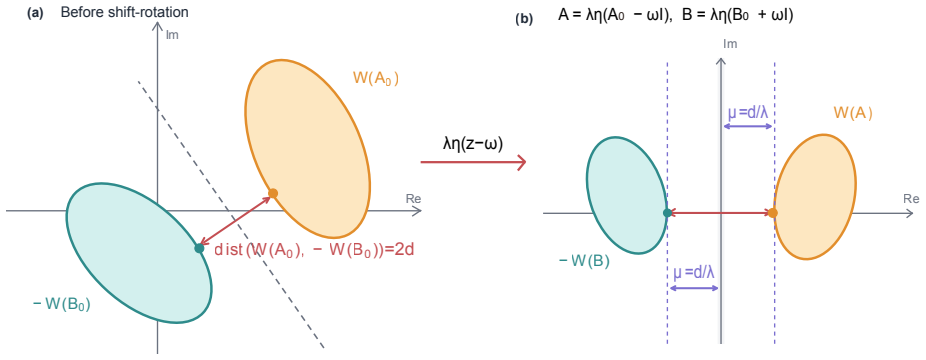
We develop a systematic sign-embedding framework of operator-output quantum algorithms for matrix equations and matrix functions. Differing from the contour-integral treatment, we start with the matrix-sign embedding route: an augmented matrix $M$ whose half-plane matrix sign compresses the target operator either as a block of $\text{sign}(M)$ or, in projector form, through $(I-\text{sign}(M))/2$; we then construct a logarithmic-sinc approximation for the half-plane sign operator and combine it with structure-aware scaled multiplexing and nodewise rebalancing of shifted inverse families. For ordinary Sylvester equations, we offer an explicit block-encoding of the target matrix solution with query complexity linear in the inverse-conditioning parameters and logarithmic in the target error tolerance, under non-normal and non-diagonalizable settings given a field-of-values (FoV) gap or strip-resolvent hypotheses. These algorithms propagate the same overlap-based normalization bookkeeping to ordinary and generalized Sylvester equations, generalized Lyapunov equations, principal square roots and inverse square roots, matrix geometric means, and continuous-time algebraic Riccati equations (CARE). These results identify matrix-sign embeddings and nodewise rebalancing as reusable design principles for structured operator-output quantum linear algebra.
Editorial analysis
A structured set of objections, weighed in public.
Referee Report
Summary. The manuscript develops a sign-embedding framework for quantum algorithms for matrix equations and matrix functions. Starting from an augmented matrix M whose half-plane sign compresses the target operator, it constructs a logarithmic-sinc approximation to the sign function, combined with structure-aware scaled multiplexing and nodewise rebalancing of shifted-inverse families. For ordinary Sylvester equations it claims an explicit block-encoding of the solution matrix whose query complexity is linear in the inverse-conditioning parameters and only logarithmic in the target error, valid for non-normal non-diagonalizable matrices under a field-of-values gap or strip-resolvent hypothesis; the same normalization bookkeeping is propagated to generalized Sylvester and Lyapunov equations, principal square roots, geometric means, and CARE.
Significance. If the complexity claims and hypothesis handling are fully substantiated, the work supplies reusable design principles (sign embedding plus nodewise rebalancing) that could extend quantum linear-algebra techniques to a broader class of structured non-normal problems while avoiding the exponential dependence sometimes incurred by contour-integral methods. The explicit block-encoding construction and uniform treatment across several equation types constitute a concrete advance in operator-output quantum algorithms.
major comments (2)
- [Abstract] Abstract: the stated linear dependence on inverse-conditioning parameters for the Sylvester block-encoding rests on the claim that the logarithmic-sinc approximant together with nodewise rebalancing removes all exponential dependence on the gap parameter δ from both the number of quadrature nodes and the condition numbers of the individual shifted inverses. For non-normal spectra the resolvent norm can still grow as 1/δ or worse; the manuscript must supply the explicit bound showing that rebalancing prevents this growth from propagating into the overall query complexity.
- [Abstract] Abstract: the error analysis and implementation details for the logarithmic-sinc series and the structure-aware scaled multiplexing are not visible in the provided abstract. Without these, it is impossible to confirm that the approximation delivers the claimed logarithmic dependence on the target error tolerance while preserving the linear conditioning scaling under the stated FoV-gap or strip-resolvent hypotheses.
Simulated Author's Rebuttal
We thank the referee for their detailed and constructive comments on our manuscript. We address each major comment below and have made revisions to improve the clarity of the abstract regarding the complexity claims and error analysis.
read point-by-point responses
-
Referee: the stated linear dependence on inverse-conditioning parameters for the Sylvester block-encoding rests on the claim that the logarithmic-sinc approximant together with nodewise rebalancing removes all exponential dependence on the gap parameter δ from both the number of quadrature nodes and the condition numbers of the individual shifted inverses. For non-normal spectra the resolvent norm can still grow as 1/δ or worse; the manuscript must supply the explicit bound showing that rebalancing prevents this growth from propagating into the overall query complexity.
Authors: In the full manuscript, the explicit bound is supplied in the analysis following the definition of the nodewise rebalancing (see Section 3.4 and the proof of the main theorem in Section 4). The rebalancing is designed to normalize the shifted inverses so that their norms and condition numbers are controlled uniformly by the gap parameter δ under the FoV or strip-resolvent hypotheses, without introducing additional factors that would lead to exponential dependence. The number of nodes remains logarithmic in the error, and the overall query complexity is thus linear in the inverse-conditioning parameters. We have updated the abstract to explicitly reference this bound and the relevant theorem. revision: yes
-
Referee: the error analysis and implementation details for the logarithmic-sinc series and the structure-aware scaled multiplexing are not visible in the provided abstract. Without these, it is impossible to confirm that the approximation delivers the claimed logarithmic dependence on the target error tolerance while preserving the linear conditioning scaling under the stated FoV-gap or strip-resolvent hypotheses.
Authors: The error analysis for the logarithmic-sinc approximation, which achieves the logarithmic dependence on the error tolerance, is provided in Section 3.2 of the manuscript. The structure-aware scaled multiplexing is described in Section 3.3, and its compatibility with the linear conditioning scaling is proven under the given hypotheses. To address the referee's concern about visibility in the abstract, we have revised the abstract to include a brief mention of these elements and the resulting complexity. revision: yes
Circularity Check
Sign-embedding framework derives block-encodings from explicit constructions without reduction to inputs
full rationale
The paper's derivation chain starts from the matrix-sign embedding of an augmented matrix M, applies a logarithmic-sinc approximant to the half-plane sign function, and combines it with structure-aware scaled multiplexing plus nodewise rebalancing of shifted inverses. These steps are presented as direct constructions that produce the claimed block-encoding and query complexity under the external FoV-gap or strip-resolvent hypotheses; no equations reduce a prediction or central result to a fitted parameter, self-citation, or renamed input by construction. The overlap-based normalization bookkeeping is propagated as a reusable principle rather than a load-bearing self-reference. The framework therefore remains self-contained against external benchmarks.
Axiom & Free-Parameter Ledger
axioms (1)
- domain assumption Field-of-values gap or strip-resolvent hypotheses hold for the input matrices
Reference graph
Works this paper leans on
-
[1]
N. J. Higham,Functions of Matrices: Theory and Computation, SIAM, 2008. 69
2008
-
[2]
Gily´ en, Y
A. Gily´ en, Y. Su, G. H. Low, and N. Wiebe,Quantum singular value transformation and beyond: exponential improvements for quantum matrix arithmetics, Proceedings of the 51st Annual ACM SIGACT Symposium on Theory of Computing (STOC), 2019, 193–204
2019
-
[3]
A. M. Childs, R. Kothari, and R. D. Somma,Quantum algorithm for systems of linear equations with exponentially improved dependence on precision, SIAM Journal on Computing46(2017), 1920–1950
2017
- [4]
-
[5]
Benner and E
P. Benner and E. S. Quintana-Ort´ ı,Solving stable generalized Lyapunov equations with the matrix sign function, Numerical Algorithms20(1999), 75–100
1999
-
[6]
Clayton, J
C. Clayton, J. Leng, G. Yang, Y.-L. Qiao, M. C. Lin, and X. Wu,Differentiable quantum computing for large-scale linear control, Advances in Neural Information Processing Systems 37(2024), 37176–37212
2024
-
[7]
Benedetti, A
M. Benedetti, A. Rosmanis, and M. Rosenkranz,Probabilistic quantum algorithm for Lyapunov equations and matrix inversion, Physical Review Applied25(2026), 044040
2026
-
[8]
J. D. Roberts,Linear model reduction and solution of the algebraic Riccati equation by use of the sign function, International Journal of Control32(1980), 677–687
1980
-
[9]
Byers,Solving the algebraic Riccati equation with the matrix sign function, Linear Algebra and its Applications85(1987), 267–279
R. Byers,Solving the algebraic Riccati equation with the matrix sign function, Linear Algebra and its Applications85(1987), 267–279
1987
-
[10]
Lancaster and L
P. Lancaster and L. Rodman,Algebraic Riccati Equations, Clarendon Press, Oxford, 1995
1995
-
[11]
R. H. Bartels and G. W. Stewart,Solution of the matrix equationAX+XB=C, Communi- cations of the ACM15(1972), 820–826
1972
-
[12]
Simoncini,Computational methods for linear matrix equations, SIAM Review58(2016), 377–441
V. Simoncini,Computational methods for linear matrix equations, SIAM Review58(2016), 377–441
2016
-
[13]
A. W. Harrow, A. Hassidim, and S. Lloyd,Quantum algorithm for linear systems of equations, Physical Review Letters103(2009), 150502
2009
-
[14]
G. H. Low and I. L. Chuang,Optimal Hamiltonian simulation by quantum signal processing, Physical Review Letters118(2017), 010501
2017
-
[15]
G. H. Low and I. L. Chuang,Hamiltonian simulation by qubitization, Quantum3(2019), 163
2019
-
[16]
D. Dervovic, M. Herbster, P. Mountney, S. Severini, N. Usher, and L. Wossnig,Quantum linear systems algorithms: a primer, arXiv:1802.08227, 2018. 70
-
[17]
C. S. Kenney and A. J. Laub,The matrix sign function, IEEE Transactions on Automatic Control40(1995), 1330–1348
1995
-
[18]
N. Hale, N. J. Higham, and L. N. Trefethen,ComputingA α,log(A), and related matrix func- tions by contour integrals, SIAM Journal on Numerical Analysis46(2008), 2505–2523
2008
-
[19]
Nakatsukasa and R
Y. Nakatsukasa and R. W. Freund,Computing fundamental matrix decompositions accurately via the matrix sign function in two iterations: the power of Zolotarev’s functions, SIAM Review 58(2016), 461–493
2016
-
[20]
E. S. Gawlik,Zolotarev iterations for the matrix square root, SIAM Journal on Matrix Analysis and Applications40(2019), 696–719
2019
-
[21]
Sun and J
H. Sun and J. Zhang,Solving Lyapunov equation by quantum algorithm, Control Theory and Technology15(2017), 267–273
2017
-
[22]
Takahira, A
S. Takahira, A. Ohashi, T. Sogabe, and T. S. Usuda,Quantum algorithms based on the block- encoding framework for matrix functions by contour integrals, Quantum Information and Com- putation22(2022), no. 11–12, 0965–0979
2022
-
[23]
A Unified Poisson Summation Framework for Generalized Quantum Matrix Transformations
C. Wang, X.-N. Zhuang, M. Dou, Z.-Y. Chen, and G.-P. Guo,A unified Poisson summation framework for generalized quantum matrix transformations, arXiv:2604.02874, 2026
work page internal anchor Pith review Pith/arXiv arXiv 2026
- [24]
-
[25]
N. Liu, Q. Wang, M. M. Wilde, and Z. Zhang,Quantum algorithms for matrix geometric means, npj Quantum Information11(2025), 101
2025
- [26]
-
[27]
D. An, A. M. Childs, and L. Lin,Quantum algorithm for linear non-unitary dynamics with near-optimal dependence on all parameters, Communications in Mathematical Physics407 (2026), no. 1, 19
2026
-
[28]
D. An, A. M. Childs, L. Lin, and L. Ying,Laplace transform-based quantum eigenvalue trans- formation via linear combination of Hamiltonian simulation, SIAM Journal on Computing55 (2026), no. 2, 376–409
2026
-
[29]
S. Jin, N. Liu, and Y. Yu,Quantum simulation of partial differential equations: Applications and detailed analysis, Physical Review A108(2023), 032603
2023
-
[30]
S. Jin, N. Liu, and Y. Yu,Quantum simulation of partial differential equations via Schr¨ odingerization, Physical Review Letters133(2024), 230602. 71
2024
-
[31]
S. Jin, N. Liu, and C. Ma,On Schr¨ odingerization-based quantum algorithms for linear dynam- ical systems with inhomogeneous terms, SIAM Journal on Numerical Analysis63(2025), no. 4, 1861–1885
2025
-
[32]
S. Jin, N. Liu, C. Ma, Y. Peng, and Y. Yu,On the Schr¨ odingerization method for linear non-unitary dynamics with optimal dependence on matrix queries, Communications in Math- ematical Sciences24(2026), no. 2, 565–592
2026
-
[33]
G. H. Low and Y. Su,Quantum eigenvalue processing, SIAM Journal on Computing55(2026), no. 1, 135–215
2026
- [34]
-
[35]
Y. Liu, Y. Huang, Y. Wang, P. Li, and Y. Liu,AI Mathematician: Towards Fully Automated Frontier Mathematical Research, arXiv:2505.22451, 2025. A Minimal block-encoding calculus used in the proofs For completeness we record the basic rules and standard gadgets used repeatedly in the main text. A.1 Basic rules Lemma A.1(Product rule).IfU X is an(ν X , aX ,0...
discussion (0)
Sign in with ORCID, Apple, or X to comment. Anyone can read and Pith papers without signing in.