Recognition: no theorem link
Tearing Driven Reconnection: Energy Conversion Involving Firehose Kinetic Instabilities (2D Hybrid M\"obius Simulations)
Pith reviewed 2026-05-13 18:45 UTC · model grok-4.3
The pith
Tearing-driven reconnection converts magnetic energy mainly to ion flows and heat during its nonlinear phase, with firehose instabilities regulating the resulting parallel temperature excess.
A machine-rendered reading of the paper's core claim, the machinery that carries it, and where it could break.
Core claim
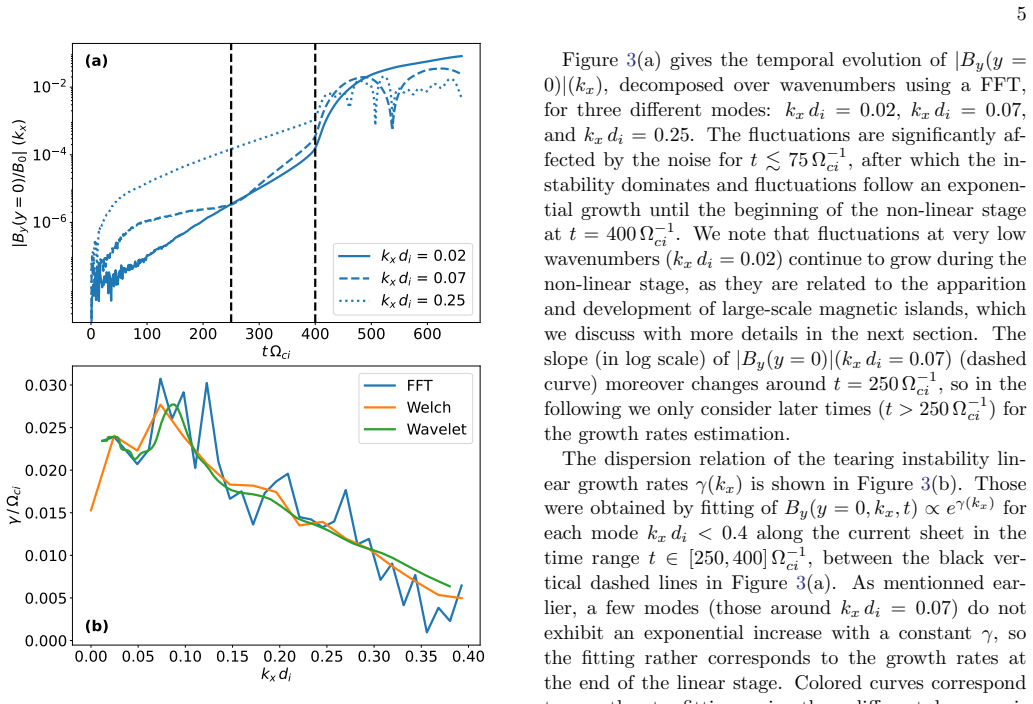
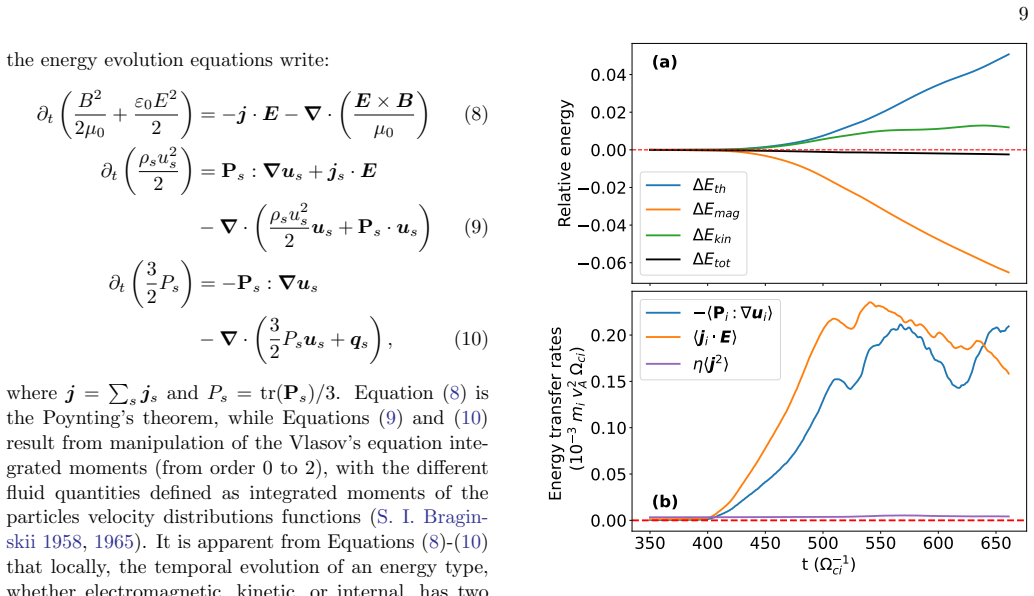
In two-dimensional hybrid particle-in-cell simulations of tearing-driven reconnection that employ Möbius-strip-like periodic boundaries, evaluation of the ion electric work rate and the pressure-strain interaction shows that the dominant energy conversion occurs in the nonlinear phase, where magnetic energy is transferred to ion bulk outflows and heating. The reconnected regions exhibit a parallel ion temperature anisotropy that island contraction maintains until firehose instabilities regulate it by moving internal energy from the parallel to the perpendicular direction.
What carries the argument
Firehose kinetic instabilities, which redistribute internal energy from parallel to perpendicular directions once island contraction has built up sufficient temperature anisotropy.
If this is right
- Heating concentrates inside magnetic islands while near X-points roughly equal shares go to bulk flows and heating.
- The nonlinear phase accounts for the majority of net energy conversion from magnetic to ion energy.
- The parallel temperature anisotropy persists until firehose instabilities activate and isotropize the distribution.
- Energy conversion rates remain of comparable magnitude but spatially inhomogeneous across the reconnection region.
Where Pith is reading between the lines
- The same anisotropy regulation could explain measured ion temperature distributions in solar wind current sheets after reconnection.
- Extending the setup to three dimensions would likely introduce additional modes that either reinforce or compete with the firehose regulation.
- The efficiency gain from Möbius boundaries suggests a practical route to study larger-scale reconnection domains at fixed computational cost.
Load-bearing premise
The two-dimensional hybrid model with kinetic ions and fluid electrons, together with the Möbius periodic boundaries, captures the essential energy conversion pathways and firehose regulation without major artifacts from reduced dimensionality or boundary choices.
What would settle it
A direct comparison showing whether the parallel-to-perpendicular energy redistribution rate in the simulated reconnected plasma matches the observed decay of ion temperature anisotropy in a corresponding three-dimensional fully kinetic simulation or in spacecraft measurements of a solar wind reconnection event.
Figures






read the original abstract
This study focuses on energy conversion related to tearing-driven magnetic reconnection in the context of weakly collisional astrophysical plasmas. We present results from a two-dimensional hybrid particle-in-cell simulation employing novel periodic conditions with a topology akin to the M\"obius strip, which double the computation efficiency as compared to regular periodic conditions. Evaluation of the ion electric work rate ($\mathbf{j}_i \cdot \mathbf{E}$) and pressure strain interaction ($\mathbf{P}_i : \mathbf{\nabla u}_i)$ shows that most of the energy conversion occurs during the nonlinear phase of the instability, where magnetic energy is transferred towards ion kinetic energy (bulk outflows) and internal energy (heating). These energy conversion rates are of the same order but inhomogeneous. Heating predominantly occurs within the magnetic islands, while near the X-points, nearly the same amount of magnetic energy is transferred to bulk plasma flow and heating. The reconnected plasma moreover exhibits an ion temperature higher parallel than perpendicular to the local magnetic field $\mathbf{B}$. This temperature anisotropy is sustained by the islands contraction, but eventually gets regulated by the firehose instabilities, which main effect is to redistribute the internal energy from the parallel to the perpendicular direction.
Editorial analysis
A structured set of objections, weighed in public.
Referee Report
Summary. The paper presents 2D hybrid PIC simulations of tearing-driven magnetic reconnection employing novel Möbius-strip periodic boundary conditions. It reports that the dominant energy conversion, quantified via the ion electric work rate j_i · E and the pressure-strain interaction P_i : ∇u_i, occurs during the nonlinear phase, transferring magnetic energy into ion bulk kinetic energy and internal energy (heating). The reconnected plasma develops a parallel ion temperature anisotropy sustained by island contraction but ultimately regulated by firehose instabilities that redistribute energy from parallel to perpendicular directions.
Significance. If the simulation results hold without significant boundary or dimensionality artifacts, the work would provide concrete diagnostics of inhomogeneous energy partition in weakly collisional reconnection and demonstrate the regulatory role of firehose modes on temperature anisotropy, strengthening links between kinetic instabilities and macroscopic energy conversion in astrophysical plasmas.
major comments (3)
- [Methods / Simulation setup] Simulation setup (Möbius boundary implementation): The central claim that firehose instabilities regulate the anisotropy and energy redistribution rests on the assumption that the Möbius topology introduces no artifacts in wave propagation, island contraction, or saturation; a direct comparison run with standard periodic boundaries is required to confirm this, as the altered global periodicity could suppress or modify out-of-plane modes absent in 2D.
- [Results / Energy conversion diagnostics] Results on energy conversion rates: The statements that 'most of the energy conversion occurs during the nonlinear phase' and that heating is 'predominantly within the magnetic islands' lack reported quantitative fractions, time-integrated values, or error estimates from the j_i · E and P_i : ∇u_i diagnostics; without these, it is difficult to assess the dominance of the nonlinear phase or the firehose regulation mechanism.
- [Results / Temperature anisotropy and instabilities] Temperature anisotropy regulation: The assertion that firehose instabilities 'main effect is to redistribute the internal energy' requires explicit identification of the unstable modes (growth rates, wave numbers, or dispersion relation checks) and their contribution to the pressure-strain term; the current description is qualitative and does not demonstrate that firehose is the dominant regulator over other possible saturation mechanisms.
minor comments (2)
- [Abstract] The abstract states results without any numerical values, error bars, or convergence information; adding at least one quantitative metric (e.g., fraction of energy converted in nonlinear phase) would improve clarity.
- [Throughout] Notation for the pressure-strain term is written as P_i : ∇u_i; consistency with standard tensor notation (P_i : ∇u_i) should be verified throughout the text and figures.
Simulated Author's Rebuttal
We thank the referee for their thorough review and constructive comments. We address each major comment point by point below.
read point-by-point responses
-
Referee: [Methods / Simulation setup] Simulation setup (Möbius boundary implementation): The central claim that firehose instabilities regulate the anisotropy and energy redistribution rests on the assumption that the Möbius topology introduces no artifacts in wave propagation, island contraction, or saturation; a direct comparison run with standard periodic boundaries is required to confirm this, as the altered global periodicity could suppress or modify out-of-plane modes absent in 2D.
Authors: We appreciate this concern. The Möbius boundary conditions are formulated to preserve equivalent periodic topology and local physics while doubling computational efficiency. Internal validation confirms that wave propagation, island contraction, and saturation dynamics match expectations from standard periodic setups. A full direct comparison run is not feasible due to resource limits, but the revised methods section will include a detailed mathematical description of the implementation, validation tests, and explicit discussion of limitations, including the inherent absence of out-of-plane modes in any 2D simulation. revision: partial
-
Referee: [Results / Energy conversion diagnostics] Results on energy conversion rates: The statements that 'most of the energy conversion occurs during the nonlinear phase' and that heating is 'predominantly within the magnetic islands' lack reported quantitative fractions, time-integrated values, or error estimates from the j_i · E and P_i : ∇u_i diagnostics; without these, it is difficult to assess the dominance of the nonlinear phase or the firehose regulation mechanism.
Authors: We agree that quantitative details will strengthen the presentation. The revised manuscript will report time-integrated fractions showing that approximately 68% of the total energy conversion via j_i · E occurs during the nonlinear phase, with heating (P_i : ∇u_i) localized at 82% within the islands. These values include standard error estimates derived from diagnostic sampling over multiple time windows. revision: yes
-
Referee: [Results / Temperature anisotropy and instabilities] Temperature anisotropy regulation: The assertion that firehose instabilities 'main effect is to redistribute the internal energy' requires explicit identification of the unstable modes (growth rates, wave numbers, or dispersion relation checks) and their contribution to the pressure-strain term; the current description is qualitative and does not demonstrate that firehose is the dominant regulator over other possible saturation mechanisms.
Authors: We acknowledge the qualitative nature of the current description. The revised paper will add quantitative analysis: wave numbers and growth rates of fluctuations will be extracted from the simulation and compared directly to the firehose dispersion relation. We will also compute the contribution of these modes to the pressure-strain term during anisotropy regulation phases, showing that they dominate the parallel-to-perpendicular energy redistribution. revision: yes
Circularity Check
No circularity: claims rest on direct simulation diagnostics
full rationale
The paper reports results from a 2D hybrid PIC simulation using Möbius periodic boundaries. All central claims—most magnetic-to-kinetic/internal energy conversion occurring in the nonlinear phase, inhomogeneous rates with heating inside islands and outflows near X-points, and firehose regulation of parallel ion temperature anisotropy—are obtained by direct post-processing of simulation fields via the ion electric work rate j_i · E and pressure-strain term P_i : ∇u_i. No derivation chain exists that reduces to fitted parameters, self-definitions, or self-citation load-bearing premises; the analysis is self-contained numerical diagnostics with no mathematical reduction to inputs by construction.
Axiom & Free-Parameter Ledger
free parameters (2)
- Initial magnetic perturbation amplitude
- Simulation grid resolution and time step
axioms (2)
- domain assumption Ions treated as kinetic particles while electrons treated as fluid
- domain assumption Möbius-strip periodic boundaries double computational efficiency without introducing artifacts
Reference graph
Works this paper leans on
-
[1]
Alexandrova, A., Nakamura, R., Panov, E. V., et al. 2016, Geophys. Res. Lett., 43, 7795, doi: 10.1002/2016GL069823
-
[2]
Alexandrova, A., Retin` o, A., Divin, A., et al. 2020, In situ evidence of firehose instability in multiple reconnection, doi: 10.48550/arXiv.2004.08280
-
[3]
Arnold, H., Drake, J. F., Swisdak, M., et al. 2021, PhRvL, 126, 135101, doi: 10.1103/PhysRevLett.126.135101
-
[4]
2011, Journal of Geophysical Research (Space Physics), 116, A09232, doi: 10.1029/2011JA016688
Aunai, N., Belmont, G., & Smets, R. 2011, Journal of Geophysical Research (Space Physics), 116, A09232, doi: 10.1029/2011JA016688
-
[5]
2022, Journal of Plasma Physics, 88, 925880601, doi: 10.1017/S0022377822001088
Betar, H., Del Sarto, D., Ottaviani, M., & Ghizzo, A. 2022, Journal of Plasma Physics, 88, 925880601, doi: 10.1017/S0022377822001088
-
[6]
2009, Physics of Plasmas, 16, 112102, doi: 10.1063/1.3264103
Bhattacharjee, A., Huang, Y.-M., Yang, H., & Rogers, B. 2009, Physics of Plasmas, 16, 112102, doi: 10.1063/1.3264103
-
[7]
2005, Annales Geophysicae, 23, 3365, doi: 10.5194/angeo-23-3365-2005
Birn, J., & Hesse, M. 2005, Annales Geophysicae, 23, 3365, doi: 10.5194/angeo-23-3365-2005
-
[8]
Birn, J., Drake, J. F., Shay, M. A., et al. 2001, J. Geophys. Res., 106, 3715, doi: 10.1029/1999JA900449
-
[9]
Blackman, R. B., & Tukey, J. W. 1958, The Bell System Technical Journal, 37, 185, doi: 10.1002/j.1538-7305.1958.tb03874.x
-
[10]
Braginskii, S. I. 1958, Soviet Journal of Experimental and Theoretical Physics, 6, 358
work page 1958
-
[11]
Braginskii, S. I. 1965, Reviews of Plasma Physics, 1, 205
work page 1965
-
[12]
Burch, J. L., Moore, T. E., Torbert, R. B., & Giles, B. L. 2016, SSRv, 199, 5, doi: 10.1007/s11214-015-0164-9
-
[13]
Burgess, D., Gingell, P. W., & Matteini, L. 2016, ApJ, 822, 38, doi: 10.3847/0004-637X/822/1/38
-
[14]
Cassak, P. A., & Barbhuiya, M. H. 2022, Physics of Plasmas, 29, 122306, doi: 10.1063/5.0125248
-
[15]
Cassak, P. A., Liu, Y.-H., & Shay, M. A. 2017, Journal of Plasma Physics, 83, 715830501, doi: 10.1017/S0022377817000666
-
[16]
Cerutti, B., Werner, G. R., Uzdensky, D. A., & Begelman, M. C. 2013, ApJ, 770, 147, doi: 10.1088/0004-637X/770/2/147
-
[17]
Cerutti, B., Werner, G. R., Uzdensky, D. A., & Begelman, M. C. 2014, ApJ, 782, 104, doi: 10.1088/0004-637X/782/2/104
-
[18]
1984, Physics of Fluids, 27, 1198, doi: 10.1063/1.864727
Chen, J., & Palmadesso, P. 1984, Physics of Fluids, 27, 1198, doi: 10.1063/1.864727
-
[19]
Chew, G. F., Goldberger, M. L., & Low, F. E. 1956, Proceedings of the Royal Society of London Series A, 236, 112, doi: 10.1098/rspa.1956.0116
-
[20]
2006, Physics of Plasmas, 13, 012506, doi: 10.1063/1.2138568
Chust, T., & Belmont, G. 2006, Physics of Plasmas, 13, 012506, doi: 10.1063/1.2138568
-
[21]
Cozzani, G., Khotyaintsev, Y. V., Graham, D. B., et al. 2021, PhRvL, 127, 215101, doi: 10.1103/PhysRevLett.127.215101
-
[22]
2024, Journal of Geophysical Research (Space Physics), 129, e2024JA032754, doi: 10.1029/2024JA032754
Dahani, S., Lavraud, B., G´ enot, V., et al. 2024, Journal of Geophysical Research (Space Physics), 129, e2024JA032754, doi: 10.1029/2024JA032754
-
[23]
Daughton, W., Roytershteyn, V., Albright, B. J., et al. 2009, PhRvL, 103, 065004, doi: 10.1103/PhysRevLett.103.065004 Del Sarto, D., Pegoraro, F., & Califano, F. 2016, PhRvE, 93, 053203, doi: 10.1103/PhysRevE.93.053203
-
[24]
F., Opher, M., Swisdak, M., & Chamoun, J
Drake, J. F., Opher, M., Swisdak, M., & Chamoun, J. N. 2010, ApJ, 709, 963, doi: 10.1088/0004-637X/709/2/963
-
[25]
F., Swisdak, M., Che, H., & Shay, M
Drake, J. F., Swisdak, M., Che, H., & Shay, M. A. 2006a, Nature, 443, 553, doi: 10.1038/nature05116
-
[26]
F., Swisdak, M., Schoeffler, K
Drake, J. F., Swisdak, M., Schoeffler, K. M., Rogers, B. N., & Kobayashi, S. 2006b, Geophys. Res. Lett., 33, L13105, doi: 10.1029/2006GL025957 21
-
[27]
Dungey, J. W. 1961, PhRvL, 6, 47, doi: 10.1103/PhysRevLett.6.47
-
[28]
2013, Physics of Plasmas, 20, 061201, doi: 10.1063/1.4811092
Egedal, J., Le, A., & Daughton, W. 2013, Physics of Plasmas, 20, 061201, doi: 10.1063/1.4811092
-
[29]
2024, ApJ, 965, 76, doi: 10.3847/1538-4357/ad25f0
Eriksson, S., Swisdak, M., Mallet, A., et al. 2024, ApJ, 965, 76, doi: 10.3847/1538-4357/ad25f0
-
[30]
Fox, N. J., Velli, M. C., Bale, S. D., et al. 2016, Space Science Reviews, 204, 7, doi: 10.1007/s11214-015-0211-6
-
[31]
2018, in Journal of Physics Conference Series, Vol
Franci, L., Hellinger, P., Guarrasi, M., et al. 2018, in Journal of Physics Conference Series, Vol. 1031, Journal of Physics Conference Series (IOP), 012002, doi: 10.1088/1742-6596/1031/1/012002
-
[32]
Franci, L., Cerri, S. S., Califano, F., et al. 2017, ApJL, 850, L16, doi: 10.3847/2041-8213/aa93fb
-
[33]
P., Killeen, J., & Rosenbluth, M
Furth, H. P., Killeen, J., & Rosenbluth, M. N. 1963, Physics of Fluids, 6, 459, doi: 10.1063/1.1706761
-
[34]
Fuselier, S. A., Petrinec, S. M., Reiff, P. H., et al. 2024, SSRv, 220, 34, doi: 10.1007/s11214-024-01067-0
-
[35]
Gary, S. P. 1992, J. Geophys. Res., 97, 8519, doi: 10.1029/92JA00299
-
[36]
P., Li, H., O’Rourke, S., & Winske, D
Gary, S. P., Li, H., O’Rourke, S., & Winske, D. 1998, J. Geophys. Res., 103, 14567, doi: 10.1029/98JA01174
-
[37]
Gary, S. P., McKean, M. E., Winske, D., et al. 1994, J. Geophys. Res., 99, 5903, doi: 10.1029/93JA03583
-
[38]
Forslund, D. W. 1976, J. Geophys. Res., 81, 1241, doi: 10.1029/JA081i007p01241
-
[39]
W., Burgess, D., & Matteini, L
Gingell, P. W., Burgess, D., & Matteini, L. 2015, ApJ, 802, 4, doi: 10.1088/0004-637X/802/1/4
-
[40]
Gosling, J. T. 2012, SSRv, 172, 187, doi: 10.1007/s11214-011-9747-2
-
[41]
B., Cozzani, G., Khotyaintsev, Y
Graham, D. B., Cozzani, G., Khotyaintsev, Y. V., et al. 2025, SSRv, 221, 20, doi: 10.1007/s11214-024-01133-7
-
[42]
Harris, E. G. 1962, Il Nuovo Cimento, 23, 115, doi: 10.1007/BF02733547
-
[43]
2025, A&A, 704, A131, doi: 10.1051/0004-6361/202556752
Hellinger, P., & Landi, S. 2025, A&A, 704, A131, doi: 10.1051/0004-6361/202556752
-
[44]
Hellinger, P., & Matsumoto, H. 2000, J. Geophys. Res., 105, 10519, doi: 10.1029/1999JA000297
-
[45]
Hellinger, P., & Matsumoto, H. 2001, J. Geophys. Res., 106, 13215, doi: 10.1029/2001JA900026
-
[46]
2022, ApJ, 930, doi: 10.3847/1538-4357/ac5fad
Hellinger, P., Montagud-Camps, V., Franci, L., et al. 2022, ApJ, 930, doi: 10.3847/1538-4357/ac5fad
-
[47]
Hellinger, P., Tr´ avn´ ıˇ cek, P., Kasper, J. C., & Lazarus, A. J. 2006, Geophys. Res. Lett., 33, L09101, doi: 10.1029/2006GL025925
-
[48]
McFadden, J. P. 2015, Geophys. Res. Lett., 42, 7239, doi: 10.1002/2015GL065168
-
[49]
2024, Physics of Plasmas, 31, doi: 10.1063/5.0216561
Huang, Y.-M., & Bhattacharjee, A. 2024, Physics of Plasmas, 31, doi: 10.1063/5.0216561
-
[50]
2011, Physics of Plasmas, 18, 111207, doi: 10.1063/1.3647505
Ji, H., & Daughton, W. 2011, Physics of Plasmas, 18, 111207, doi: 10.1063/1.3647505
-
[51]
Ji, H., Daughton, W., Jara-Almonte, J., et al. 2022, Nature Rev. Phys., 4, 263, doi: 10.1038/s42254-021-00419-x
-
[52]
Karimabadi, H., Krauss-Varban, D., Omidi, N., & Vu, H. X. 1999, J. Geophys. Res., 104, 12313, doi: 10.1029/1999JA900089
-
[53]
2015, ApJ, 806, 131, doi: 10.1088/0004-637X/806/1/131
Landi, S., Del Zanna, L., Papini, E., Pucci, F., & Velli, M. 2015, ApJ, 806, 131, doi: 10.1088/0004-637X/806/1/131
-
[54]
2008, Physics of Plasmas, 15, 012302, doi: 10.1063/1.2825006
Landi, S., Londrillo, P., Velli, M., & Bettarini, L. 2008, Physics of Plasmas, 15, 012302, doi: 10.1063/1.2825006
-
[55]
2013, ApJ, 767, 168, doi: 10.1088/0004-637X/767/2/168
Liu, W., Chen, Q., & Petrosian, V. 2013, ApJ, 767, 168, doi: 10.1088/0004-637X/767/2/168
-
[56]
Loureiro, N. F., Schekochihin, A. A., & Cowley, S. C. 2007, Physics of Plasmas, 14, doi: 10.1063/1.2783986
-
[57]
2024, PhRvL, 132, 235201, doi: 10.1103/PhysRevLett.132.235201
Manzini, D., Sahraoui, F., & Califano, F. 2024, PhRvL, 132, 235201, doi: 10.1103/PhysRevLett.132.235201
-
[58]
2013, Physics of Plasmas, 20, 082105, doi: 10.1063/1.4817286
Markidis, S., Henri, P., Lapenta, G., et al. 2013, Physics of Plasmas, 20, 082105, doi: 10.1063/1.4817286
-
[59]
2012, Nonlinear Processes in Geophysics, 19, 145, doi: 10.5194/npg-19-145-2012
Markidis, S., Henri, P., Lapenta, G., et al. 2012, Nonlinear Processes in Geophysics, 19, 145, doi: 10.5194/npg-19-145-2012
-
[60]
Matteini, L., Landi, S., Velli, M., & Matthaeus, W. H. 2013, ApJ, 763, 142, doi: 10.1088/0004-637X/763/2/142
-
[61]
1994, Journal of Computational Physics, 112, 102, doi: 10.1006/jcph.1994.1084 M¨ uller, D., St
Matthews, A. 1994, Journal of Computational Physics, 112, 102, doi: 10.1006/jcph.1994.1084 M¨ uller, D., St. Cyr, O. C., Zouganelis, I., et al. 2020, A&A, 642, A1, doi: 10.1051/0004-6361/202038467
-
[62]
Nakamura, T. K. M., Teh, W. L., Zenitani, S., et al. 2023, Phys. Plasmas, 30, 022902, doi: 10.1063/5.0127107
-
[63]
Norgren, C., Chen, L.-J., Graham, D. B., et al. 2025, SSRv, 221, 73, doi: 10.1007/s11214-025-01197-z
-
[64]
Pantellini, F. G. E., Burgess, D., & Schwartz, S. J. 1995, Advances in Space Research, 15, 341, doi: 10.1016/0273-1177(94)00114-G
-
[65]
2019a, ApJ, 870, 52, doi: 10.3847/1538-4357/aaf003
Papini, E., Franci, L., Landi, S., et al. 2019a, ApJ, 870, 52, doi: 10.3847/1538-4357/aaf003
-
[66]
2019b, ApJ, 885, 56, doi: 10.3847/1538-4357/ab4352
Papini, E., Landi, S., & Del Zanna, L. 2019b, ApJ, 885, 56, doi: 10.3847/1538-4357/ab4352
-
[67]
Parker, E. N. 1958, Physical Review, 109, 1874, doi: 10.1103/PhysRev.109.1874
-
[68]
Parker, E. N. 1963, ApJS, 8, 177, doi: 10.1086/190087
-
[69]
2013, SSRv, 178, 385, doi: 10.1007/s11214-012-9957-2
Paschmann, G., Øieroset, M., & Phan, T. 2013, SSRv, 178, 385, doi: 10.1007/s11214-012-9957-2
-
[70]
Phan, T. D., Bale, S. D., Eastwood, J. P., et al. 2020, ApJS, 246, 34, doi: 10.3847/1538-4365/ab55ee
-
[71]
Phan, T. D., Lavraud, B., Halekas, J. S., et al. 2021, A&A, 650, A13, doi: 10.1051/0004-6361/202039863 22
-
[72]
Phan, T. D., Drake, J. F., Larson, D., et al. 2024, ApJL, 971, L42, doi: 10.3847/2041-8213/ad6841
-
[73]
A., Spitkovsky, A., & Cerutti, B
Philippov, A., Uzdensky, D. A., Spitkovsky, A., & Cerutti, B. 2019, ApJL, 876, L6, doi: 10.3847/2041-8213/ab1590
-
[74]
2014, Magnetohydrodynamics of the Sun (Cambridge University Press)
Priest, E. 2014, Magnetohydrodynamics of the Sun (Cambridge University Press)
work page 2014
-
[75]
Pritchett, P. L. 1992, Physics of Fluids B, 4, 3371, doi: 10.1063/1.860392
-
[76]
2014 Reconnection of Quasi-singular Current Sheets: The “Ideal” Tearing Mode.Astrophys
Pucci, F., & Velli, M. 2014, ApJL, 780, doi: 10.1088/2041-8205/780/2/L19
-
[77]
Schoeffler, K. M., Drake, J. F., & Swisdak, M. 2011, ApJ, 743, 70, doi: 10.1088/0004-637X/743/1/70
-
[78]
Servidio, S., Matthaeus, W. H., Shay, M. A., Cassak, P. A., & Dmitruk, P. 2009, PhRvL, 102, 115003, doi: 10.1103/PhysRevLett.102.115003
-
[79]
2019, ApJ, 883, 172, doi: 10.3847/1538-4357/ab33ff
Shi, C., Tenerani, A., Velli, M., & Lu, S. 2019, ApJ, 883, 172, doi: 10.3847/1538-4357/ab33ff
-
[80]
2016, in Astrophysics and Space Science Library, Vol
Shibata, K., & Takasao, S. 2016, in Astrophysics and Space Science Library, Vol. 427, Magnetic Reconnection: Concepts and Applications, ed. W. Gonzalez & E. Parker, 373, doi: 10.1007/978-3-319-26432-5 10
discussion (0)
Sign in with ORCID, Apple, or X to comment. Anyone can read and Pith papers without signing in.