Recognition: no theorem link
A Boolean encoding of the Most Permissive semantics for Boolean networks
Pith reviewed 2026-05-13 18:25 UTC · model grok-4.3
The pith
Each component of a Boolean network is encoded as three Boolean variables whose asynchronous updates exactly reproduce Most Permissive attainability.
A machine-rendered reading of the paper's core claim, the machinery that carries it, and where it could break.
Core claim
Representing each component by a triplet of Boolean variables and deriving the corresponding extended logical functions produces an asynchronous state graph whose reachable configurations are exactly the attainable states of the original network under Most Permissive semantics.
What carries the argument
The triplet representation of each component together with the derived logical functions that govern transitions among the three variables.
Load-bearing premise
The three Boolean variables and their update rules capture every intermediate activity level and transition allowed by Most Permissive semantics without adding or losing reachable states.
What would settle it
A concrete Boolean network and initial state for which some configuration reachable under Most Permissive semantics is unreachable in the asynchronous dynamics of the triplet-encoded network.
Figures
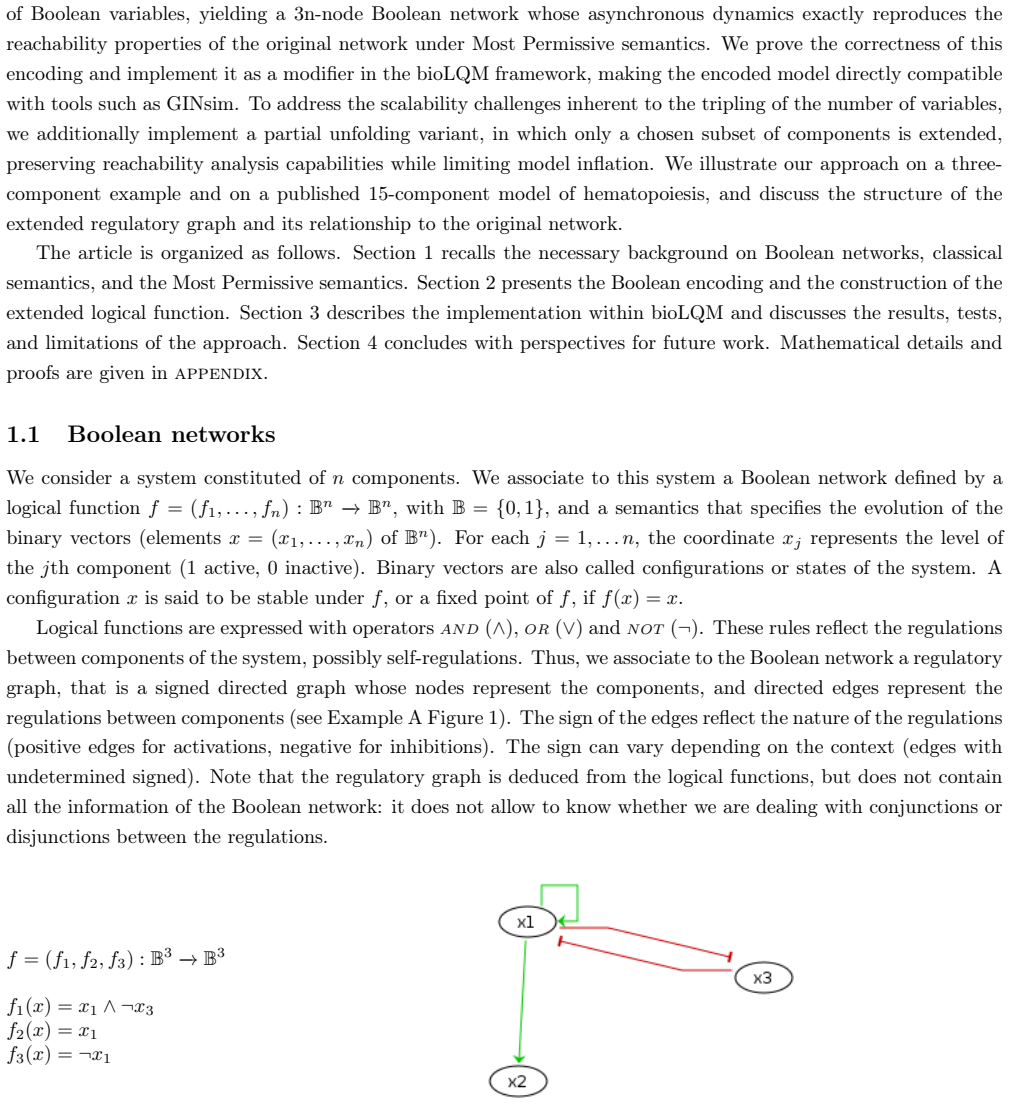
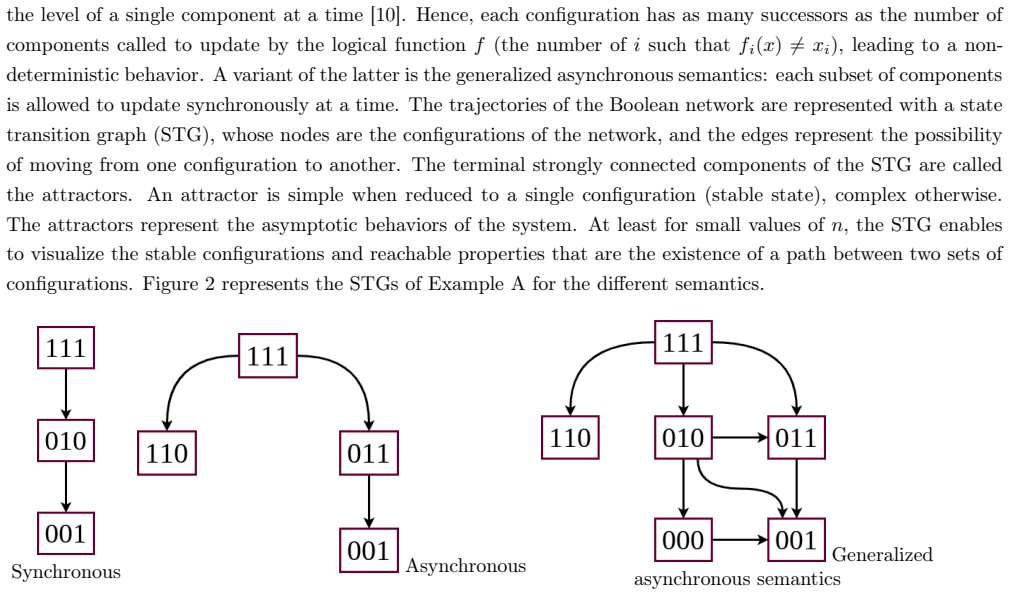


read the original abstract
Boolean networks are widely used to model biological regulatory networks and study their dynamics. Classical semantics, such as the asynchronous semantics, do not always accurately capture transient or asymptotic behaviors observed in quantitative models. To address this limitation, the Most Permissive semantics was introduced by Paulev\'e et al., extending Boolean dynamics with intermediate activity levels that allow components to transiently activate or inhibit their targets during transitions. In this work, we provide a Boolean encoding of the Most Permissive semantics: each component of the original network is represented by a triplet of Boolean variables, and we derive the extended logical function governing the resulting network. We prove that the asynchronous dynamics of the encoded network exactly reproduces the attainability properties of the original network under Most Permissive semantics. This encoding is implemented as a modifier within the bioLQM framework, making it directly compatible with existing tools such as GINsim. To address scalability limitations, we further extend the tool to support partial unfolding, restricted to a user-defined subset of components.
Editorial analysis
A structured set of objections, weighed in public.
Referee Report
Summary. The paper claims to provide a Boolean encoding of the Most Permissive semantics for Boolean networks. Each original component is represented by a triplet of Boolean variables, from which extended logical functions are derived for an encoded network. The central result is a proof that the asynchronous dynamics of this encoded network exactly reproduce the attainability properties of the original network under Most Permissive semantics. The encoding is implemented as a modifier in the bioLQM framework (compatible with GINsim) and extended with partial unfolding for selected components to address scalability.
Significance. If the equivalence holds, the encoding would enable direct use of existing Boolean-network tools and algorithms to compute Most Permissive reachability and attractors, without re-implementing the permissive semantics. This is practically useful for biological modeling where transient intermediate levels matter, and the bioLQM integration plus partial-unfolding option lowers the barrier to adoption.
major comments (1)
- [Construction of the logical functions for the triplet variables] The proof that the derived update functions for the three Boolean variables per component preserve exactly the Most Permissive attainability relations (abstract and main construction) must be checked for non-monotonic regulatory functions. The triplet representation and logical-function derivation may implicitly rely on a fixed ordering of activity levels; for a non-monotonic target function the intermediate transitions allowed under Most Permissive semantics could become unreachable or new spurious paths could appear after projection back to the original components. An explicit general argument or a set of non-monotonic test cases with full state-space enumeration is required.
minor comments (1)
- [Abstract] The abstract states that a proof is given but does not cite the theorem number or section containing the formal statement and proof of equivalence.
Simulated Author's Rebuttal
We thank the referee for the positive evaluation of the significance of our contribution and for the detailed comment on the logical-function construction. We address the concern point by point below.
read point-by-point responses
-
Referee: [Construction of the logical functions for the triplet variables] The proof that the derived update functions for the three Boolean variables per component preserve exactly the Most Permissive attainability relations (abstract and main construction) must be checked for non-monotonic regulatory functions. The triplet representation and logical-function derivation may implicitly rely on a fixed ordering of activity levels; for a non-monotonic target function the intermediate transitions allowed under Most Permissive semantics could become unreachable or new spurious paths could appear after projection back to the original components. An explicit general argument or a set of non-monotonic test cases with full state-space enumeration is required.
Authors: The proof and construction are formulated for arbitrary Boolean functions and do not rely on monotonicity. The triplet variables encode the three activity levels (0, 1, 2) permitted under Most Permissive semantics, and the update functions are obtained by determining, for every combination of input levels, the possible output levels that the original function can produce under the Most Permissive rules. These rules are defined directly from the Boolean function without any monotonicity hypothesis; the ordering 0 < 1 < 2 is part of the semantics itself and does not restrict the set of admissible transitions for non-monotonic targets. Consequently, no spurious paths are introduced and no valid Most Permissive transitions are lost upon projection. To make this explicit, the revised manuscript adds a clarifying paragraph immediately after the main theorem stating that the argument holds for any Boolean function, together with an appendix containing two fully enumerated non-monotonic examples (a single-component non-monotonic function and a two-component network containing a non-monotonic regulator) that confirm exact agreement between the encoded asynchronous dynamics and the Most Permissive attainability relation. revision: yes
Circularity Check
Encoding and proof are self-contained; no reduction to inputs or self-citations
full rationale
The paper defines a triplet encoding for each component, derives the extended logical functions from the original regulatory functions, and proves equivalence of asynchronous dynamics to Most Permissive attainability properties. This is a direct constructive mapping and proof rather than any fitted parameter, self-definitional loop, or load-bearing self-citation. The cited Most Permissive semantics originates from independent prior work (Paulevé et al.), and the central claim does not reduce by construction to its own inputs or prior author results. The derivation stands as independent content against the stated semantics.
Axiom & Free-Parameter Ledger
axioms (1)
- standard math Standard Boolean algebra and asynchronous update semantics apply to the encoded network
invented entities (1)
-
Triplet of Boolean variables per original component
no independent evidence
Reference graph
Works this paper leans on
-
[1]
RefiningBooleanmodelswiththepartialmostpermissivescheme
NadineBenBoinaetal.“RefiningBooleanmodelswiththepartialmostpermissivescheme”.In:Bioinformatics 41.4 (Mar. 2025), btaf123.issn: 1367-4811.doi:10 . 1093 / bioinformatics / btaf123. eprint:https : / / academic.oup.com/bioinformatics/article-pdf/41/4/btaf123/62523863/btaf123.pdf.url:https: //doi.org/10.1093/bioinformatics/btaf123
-
[2]
Logical Modelling of Gene Regulatory Networks with GINsim
Claudine Chaouiya, Aurélien Naldi, and Denis Thieffry. “Logical Modelling of Gene Regulatory Networks with GINsim.” In:Methods in molecular biology (Clifton, N.J.)Vol. 804. 2012 2012, pp. 463–79
work page 2012
-
[3]
Claudine Chaouiya et al. “SBML qualitative models: a model representation format and infrastructure to foster interactions between qualitative modelling formalisms and tools”. In:BMC Systems Biology. 2013
work page 2013
-
[4]
A novel Boolean network inference strategy to model early hematopoiesis aging
Léonard Hérault et al. “A novel Boolean network inference strategy to model early hematopoiesis aging”. In: bioRxiv(2022).doi:10.1101/2022.02.08.479548. eprint:https://www.biorxiv.org/content/early/ 2022/05/08/2022.02.08.479548.full.pdf.url:https://www.biorxiv.org/content/early/2022/05/ 08/2022.02.08.479548
-
[6]
Réseaux booléens : méthodes formelles et outils pour la modélisation en biologie
Loïc Paulevé. “Réseaux booléens : méthodes formelles et outils pour la modélisation en biologie”. Habilitation à diriger des recherches. Université Paris-Saclay, Sept. 2020.url:https://tel.archives-ouvertes.fr/tel- 03150976
work page 2020
-
[7]
Reconciling Qualitative, Abstract, and Scalable Modeling of Biological Networks
Loïc Paulevé et al. “Reconciling Qualitative, Abstract, and Scalable Modeling of Biological Networks”. In: (Mar. 2020).doi:10.1101/2020.03.22.998377
-
[8]
2022.doi: 10.48550/ARXIV.2206.12729.url:https://arxiv.org/abs/2206.12729
Théo Roncalli and Loïc Paulevé.Variable-Depth Simulation of Most Permissive Boolean Networks. 2022.doi: 10.48550/ARXIV.2206.12729.url:https://arxiv.org/abs/2206.12729
work page doi:10.48550/arxiv.2206.12729.url:https://arxiv.org/abs/2206.12729 2022
-
[9]
Continuous time Boolean modeling for biological signaling: application of Gillespie algo- rithm
Gautier Stoll et al. “Continuous time Boolean modeling for biological signaling: application of Gillespie algo- rithm.” In: (Aug. 2012).doi:10.1186/1752-0509-6-116
-
[10]
Boolean formalization of genetic control circuits
René Thomas. “Boolean formalization of genetic control circuits”. In:Journal of Theoretical Biology42.3 (1973), pp. 563–585.issn: 0022-5193.doi:https : / / doi . org / 10 . 1016 / 0022 - 5193(73 ) 90247 - 6.url: https://www.sciencedirect.com/science/article/pii/0022519373902476. 12 APPENDIX 0 - The Most Permissive dynamics of Example A We give the list of...
discussion (0)
Sign in with ORCID, Apple, or X to comment. Anyone can read and Pith papers without signing in.