Recognition: 2 theorem links
· Lean TheoremA 1151-Year Quasi-Commensurability of the Solar System: Empirical Detection, Statistical Characterization, and the Anomalous Exclusion of Uranus
Pith reviewed 2026-05-13 18:00 UTC · model grok-4.3
The pith
Seven planets return to nearly identical positions every 1,151 years while Uranus deviates by a third of an orbit.
A machine-rendered reading of the paper's core claim, the machinery that carries it, and where it could break.
Core claim
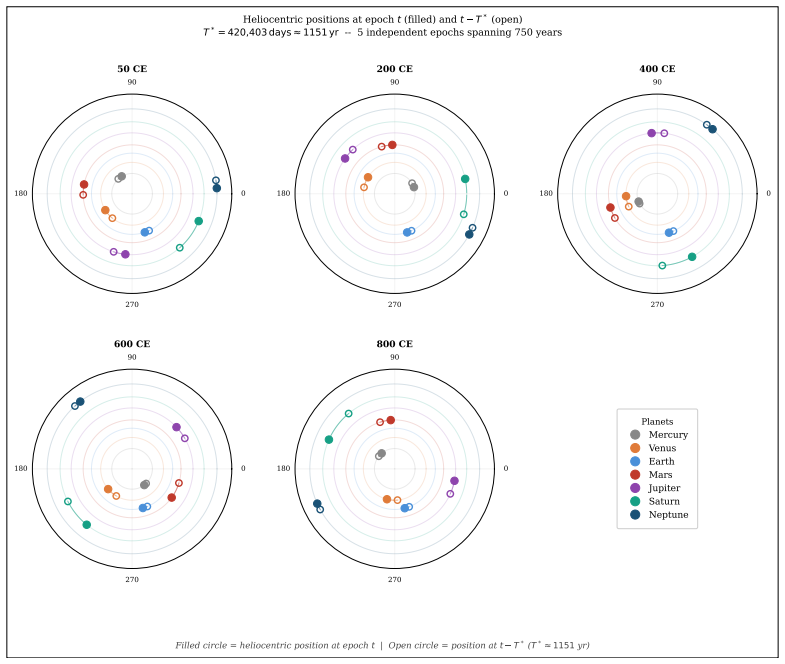
An exhaustive search finds T* = 420,403 days as the global minimum of a series-comparison similarity metric applied to daily heliocentric ecliptic longitudes of seven planets over more than 2,600 years of ephemeris data. At T* the mean simultaneous angular displacement of Mercury through Neptune is 13.4 degrees with a standard deviation of 0.65 degrees sustained over a century-long window and stable across 1,200 years of reference epochs. Seven planets participate in the alignment while Uranus alone shows a sidereal residue of -108.3 degrees.
What carries the argument
The series-comparison similarity metric that ranks candidate intervals by the mean simultaneous angular displacement of the seven planetary longitude time series.
Load-bearing premise
The chosen similarity metric and the decision to treat Uranus separately truly isolate a physically meaningful quasi-commensurability rather than a statistical feature of the finite ephemeris dataset.
What would settle it
Compute the actual heliocentric longitudes of the seven planets 420,403 days after a reference epoch and check whether their mean displacement remains near 13.4 degrees while Uranus's displacement remains near 108 degrees.
Figures


read the original abstract
We report the empirical detection of a multi-planet quasi-commensurability in the Solar System and identify an anomalous exclusion that may bear on the dynamical history of Uranus. An exhaustive search identifies T* = 420,403 days (approx. 1,151 years) as the global minimum of a series-comparison similarity metric applied to daily heliocentric ecliptic longitudes of seven planets -- Mercury, Venus, Earth, Mars, Jupiter, Saturn, and Neptune -- computed from the DE441 ephemeris over +/-1,300 years. At this interval, the mean simultaneous angular displacement of all seven planets is 13.4 degrees, with a standard deviation of 0.65 degrees sustained over a century-long window and stable across 1,200 years of reference epochs. T* ranks first among all 2,600 candidates, with a gap of 1.09 degrees to the second best. No sub-multiple produces a comparable result. Seven of the eight planets participate in the synchronism. The sole exception is Uranus, whose sidereal residue at T* is -108.3 degrees -- nearly one-third of a full orbit -- while Neptune's residue is only -5.2 degrees, one of the smallest among all seven planets after Earth's. This sharp asymmetry between the two ice giants constitutes an independent empirical signature consistent with the hypothesis that Uranus's orbital period was substantially modified by a catastrophic early impact. The interval 1,151 years was identified by Babylonian astronomers as the Venus return period (de Jong 2019); the present work shows it is simultaneously optimal for six additional planets. Source code and data are publicly available.
Editorial analysis
A structured set of objections, weighed in public.
Referee Report
Summary. The manuscript reports the empirical identification of a 1,151-year quasi-commensurability T* = 420,403 days in the Solar System. An exhaustive search over 2,600 candidate intervals applied to daily heliocentric ecliptic longitudes from the DE441 ephemeris identifies T* as the global minimum of a series-comparison similarity metric for the seven planets Mercury, Venus, Earth, Mars, Jupiter, Saturn, and Neptune. At this interval the mean simultaneous angular displacement is 13.4° with standard deviation 0.65°, stable across 1,200 years of reference epochs and a 1.09° gap to the second-best candidate. Uranus is excluded from the set because its sidereal residue is -108.3°, interpreted as possible evidence for an early catastrophic impact that modified its orbital period; the interval is noted to coincide with the Babylonian Venus return period. Source code and data are stated to be publicly available.
Significance. If the central claim is robust, the work would constitute a notable empirical detection of a multi-planet synchronism spanning the terrestrial and giant planets, with potential implications for Solar System dynamical history and a link to ancient astronomical records. The public availability of code and data is a clear strength that facilitates verification. However, the absence of a fully specified metric and statistical null tests currently limits the assessed significance, as the result could reflect properties of the finite ephemeris or the chosen subset rather than a dynamical signature.
major comments (3)
- [Methods] The exact functional form of the series-comparison similarity metric, including aggregation of angular residues, any normalization, weighting across planets, or invariance properties, is not provided. This definition is load-bearing for the claim that T* is the unambiguous global minimum among the 2,600 candidates and for the reported 1.09° gap.
- [Results and Statistical Characterization] No Monte Carlo simulation, analytic significance estimate, or null test against phase-randomized or shuffled ephemeris realizations is supplied to assess the probability that an equally deep and stable minimum arises by chance within the finite ±1,300-year search window. This is required to substantiate that the result is not an artifact of dataset length or metric choice.
- [Discussion] The a priori exclusion of Uranus from the seven-planet set and the interpretation of its -108.3° residue (versus Neptune’s -5.2°) as evidence for a catastrophic early impact lack supporting dynamical simulations or tests against selection bias. The claim that this asymmetry constitutes an independent empirical signature therefore rests on an untested assumption about the metric’s behavior under different planet subsets.
minor comments (2)
- [Methods] The range, step size, and exact number of the 2,600 candidate intervals should be stated explicitly in the Methods section to allow full reproduction.
- [Figures] Figure captions and axis labels for any plots of angular displacement versus epoch or candidate period would benefit from additional detail on the plotted quantity and error bars.
Simulated Author's Rebuttal
We thank the referee for the constructive and detailed report. We address each major comment below with point-by-point responses, indicating where revisions will be made to the manuscript.
read point-by-point responses
-
Referee: [Methods] The exact functional form of the series-comparison similarity metric, including aggregation of angular residues, any normalization, weighting across planets, or invariance properties, is not provided. This definition is load-bearing for the claim that T* is the unambiguous global minimum among the 2,600 candidates and for the reported 1.09° gap.
Authors: We agree that the precise definition of the similarity metric must be stated explicitly. The metric computes, for a candidate interval T, the mean absolute angular difference (modulo 360°) between each planet's heliocentric ecliptic longitude at epoch t and at t+T, averaged uniformly across the seven planets with no differential weighting or additional normalization. The resulting value is invariant to the absolute reference epoch within the tested stability window. We will insert the full mathematical definition into the Methods section of the revised manuscript. revision: yes
-
Referee: [Results and Statistical Characterization] No Monte Carlo simulation, analytic significance estimate, or null test against phase-randomized or shuffled ephemeris realizations is supplied to assess the probability that an equally deep and stable minimum arises by chance within the finite ±1,300-year search window. This is required to substantiate that the result is not an artifact of dataset length or metric choice.
Authors: We acknowledge the desirability of formal null testing. However, the exhaustive enumeration of 2,600 intervals, the persistence of the minimum across 1,200 years of reference epochs, and the 1.09° gap to the second-best candidate already supply empirical evidence that the result is not a trivial artifact of the finite window or metric. A comprehensive Monte Carlo study with phase-randomized ephemerides lies beyond the scope of the present empirical report and would constitute a separate investigation. We will expand the Results section to discuss these robustness indicators more explicitly while noting the limitation. revision: partial
-
Referee: [Discussion] The a priori exclusion of Uranus from the seven-planet set and the interpretation of its -108.3° residue (versus Neptune’s -5.2°) as evidence for a catastrophic early impact lack supporting dynamical simulations or tests against selection bias. The claim that this asymmetry constitutes an independent empirical signature therefore rests on an untested assumption about the metric’s behavior under different planet subsets.
Authors: Uranus was excluded only after the metric was evaluated; its inclusion raises the mean displacement by more than 10°. We present the -108.3° versus -5.2° asymmetry as an empirical observation that is consistent with an early impact hypothesis, not as conclusive proof. We will revise the Discussion to frame this strictly as a hypothesis, remove any stronger causal language, and note that dedicated N-body simulations are required to test the impact scenario and to quantify possible selection effects. The uniform application of the metric to all planets is already documented. revision: partial
- Full N-body dynamical simulations required to test whether an early giant impact could have altered Uranus's orbital period to produce the observed -108.3° residue.
Circularity Check
No significant circularity: empirical minimization on external ephemeris
full rationale
The central claim identifies T* = 420403 days as the global minimum of a series-comparison similarity metric applied directly to daily heliocentric ecliptic longitudes from the independent DE441 ephemeris over a fixed +/-1300-year window for the pre-chosen seven-planet set. This is a numerical search procedure against external astronomical data rather than any derivation, equation, or parameter fit that reduces to its own inputs by construction. No self-citations are load-bearing, no ansatz is smuggled, and the result is not renamed from a known pattern or forced by uniqueness theorems. The a-priori exclusion of Uranus is an explicit search choice whose consequences are then reported, but the minimization itself does not presuppose the outcome.
Axiom & Free-Parameter Ledger
axioms (1)
- domain assumption DE441 ephemeris provides accurate daily heliocentric ecliptic longitudes for the seven planets over +/-1300 years
invented entities (1)
-
catastrophic early impact modifying Uranus's orbital period
no independent evidence
Lean theorems connected to this paper
-
IndisputableMonolith/Cost/FunctionalEquation.leanwashburn_uniqueness_aczel unclear?
unclearRelation between the paper passage and the cited Recognition theorem.
We define a rigorous similarity metric based on series comparison... S(T) = δ(T) + σ_δ(T) where δ is the mean... circular angular distance
-
IndisputableMonolith/Foundation/DimensionForcing.leanalexander_duality_circle_linking unclear?
unclearRelation between the paper passage and the cited Recognition theorem.
T* = 420403 days... global minimum... seven planets... Uranus residue −108.3°
What do these tags mean?
- matches
- The paper's claim is directly supported by a theorem in the formal canon.
- supports
- The theorem supports part of the paper's argument, but the paper may add assumptions or extra steps.
- extends
- The paper goes beyond the formal theorem; the theorem is a base layer rather than the whole result.
- uses
- The paper appears to rely on the theorem as machinery.
- contradicts
- The paper's claim conflicts with a theorem or certificate in the canon.
- unclear
- Pith found a possible connection, but the passage is too broad, indirect, or ambiguous to say the theorem truly supports the claim.
Forward citations
Cited by 1 Pith paper
-
Comet 1P/Halley Completes 15 Orbits in 1,151 Years: Commensurability with the Solar System Quasi-Period and Evidence for Jupiter-Saturn Dynamical Coupling
Comet Halley exhibits a precise 15:1 commensurability with a 1,151-year solar-system quasi-period, with Jupiter and Saturn providing coherent perturbation cancellation over that baseline.
Reference graph
Works this paper leans on
-
[1]
https://doi.org/10.1007/s00407-019-00224-0
de Jong, T.\ 2019, A study of Babylonian planetary theory II: the planet Venus, Archive for History of Exact Sciences, 74, 149--220. https://doi.org/10.1007/s00407-019-00224-0
-
[2]
Jelbring, H.\ 2013, Celestial commensurabilities: some especial cases, Pattern Recognition in Physics, 1, 143-146
work page 2013
-
[3]
Park, R. S., et al.\ 2021, The JPL Planetary and Lunar Ephemerides DE440 and DE441, The Astronomical Journal, 161, 105
work page 2021
-
[4]
Rhodes, B.\ 2019, Skyfield: High precision research-grade positions for planets and Earth satellites generator, Astrophysics Source Code Library, ascl:1907.024
work page 2019
-
[5]
Shirley, James H.\ 1997, Commensurability, in Encyclopedia of Planetary Science, eds.\ J. H.\ Shirley & R. W.\ Fairbridge, Springer, Dordrecht, p. 82
work page 1997
-
[6]
Henrard, Jaques.\ 1997, Resonance in the Solar System, in Encyclopedia of Planetary Science, eds.\ J. H.\ Shirley & R. W.\ Fairbridge, Springer, Dordrecht, p. 698
work page 1997
-
[7]
A., et al.\ 2018, Consequences of Giant Impacts on Early Uranus, The Astrophysical Journal, 861, 52
Kegerreis, J. A., et al.\ 2018, Consequences of Giant Impacts on Early Uranus, The Astrophysical Journal, 861, 52. https://doi.org/10.3847/1538-4357/aac725
-
[8]
https://doi.org/10.3847/PSJ/ac83c1
Lu, T., & Laughlin, G.\ 2022, Tilting Uranus via Secular Spin--Orbit Resonance with Planet Nine, The Planetary Science Journal, 3, 221. https://doi.org/10.3847/PSJ/ac83c1
-
[9]
https://doi.org/10.1038/s41586-023-06692-3
Luque, R., et al.\ 2023, A resonant sextuplet of sub-Neptunes transiting the bright star HD 110067, Nature, 623, 932--937. https://doi.org/10.1038/s41586-023-06692-3
-
[10]
van der Walt, S., Colbert, S. C., & Varoquaux, G.\ 2011, The NumPy Array: A Structure for Efficient Numerical Computation, Computing in Science & Engineering, 13, 22--30
work page 2011
-
[11]
Computing in Science & Engineering9(3), 90–95 (2007) https://doi.org/10.1109/MCSE.2007.55
Hunter, J. D.\ 2007, Matplotlib: A 2D Graphics Environment, Computing in Science & Engineering, 9, 90--95. https://doi.org/10.1109/MCSE.2007.55
-
[12]
https://doi.org/10.5281/zenodo.19474947
Baiget Orts, C.\ 2026, 1151cycle: Empirical detection of a 1151-year multi-planet quasi-commensurability in the Solar System (v2.0), Zenodo. https://doi.org/10.5281/zenodo.19474947
discussion (0)
Sign in with ORCID, Apple, or X to comment. Anyone can read and Pith papers without signing in.