Recognition: 1 theorem link
· Lean TheoremComet 1P/Halley Completes 15 Orbits in 1,151 Years: Commensurability with the Solar System Quasi-Period and Evidence for Jupiter-Saturn Dynamical Coupling
Pith reviewed 2026-05-14 18:30 UTC · model grok-4.3
The pith
Comet Halley completes 15 orbits in the solar system's 1,151-year quasi-period with the smallest angular residue of any examined body.
A machine-rendered reading of the paper's core claim, the machinery that carries it, and where it could break.
Core claim
Comet 1P/Halley participates in the 1,151-year planetary quasi-period T* with a mean orbital period of 76.713 years that satisfies T*/P_bar = 15.004 and produces an angular residue of only +1.43 degrees, the smallest among all solar-system bodies examined. Jupiter couples to Halley's period through phase-dependent modulation while Saturn couples through distance-amplitude modulation; these distinct mechanisms produce coherent cancellation so that the cumulative deviation after 15 orbits is only 9.4 percent of the random-walk expectation.
What carries the argument
The commensurability ratio T*/P_bar = 15.004 linking the 1,151-year quasi-period T* to Halley's mean period, together with Jupiter's phase-dependent modulation and Saturn's distance-dependent modulation of orbital deviations.
If this is right
- Halley's mean orbital period remains stable at the millennium scale because Jupiter-Saturn perturbations cancel coherently over each T* cycle.
- Jupiter's angular position at perihelion statistically predicts the sign and size of the next period deviation.
- Saturn's closest-approach distance correlates with the magnitude of period deviation regardless of direction.
- No other Halley-type comet exhibits a comparable small residue with T*.
- Short-term orbital chaos (Lyapunov time ~70 yr) is compatible with long-term mean stability because the same forces cancel over the longer baseline.
Where Pith is reading between the lines
- If the commensurability holds, similar near-exact ratios may appear for selected long-period comets or Kuiper-belt objects once sufficient observational baselines exist.
- The coherent-cancellation mechanism offers a possible template for how gas-giant perturbations can stabilize mean periods in other multi-body systems.
- Future apparitions of Halley could be predicted more tightly by folding the observed deviations against the known T* phase rather than treating them as purely chaotic.
- The pattern invites checking whether the same T* baseline organizes secular changes in other orbital elements such as inclination or eccentricity.
Load-bearing premise
The 1,151-year quasi-period T* is a genuine dynamical feature of the solar system rather than a statistical pattern fitted to the historical data.
What would settle it
Precise timing of Halley's next several perihelion passages that produces a cumulative angular residue substantially larger than 1.43 degrees or breaks the near-exact 15-orbit count over one T* interval.
Figures


read the original abstract
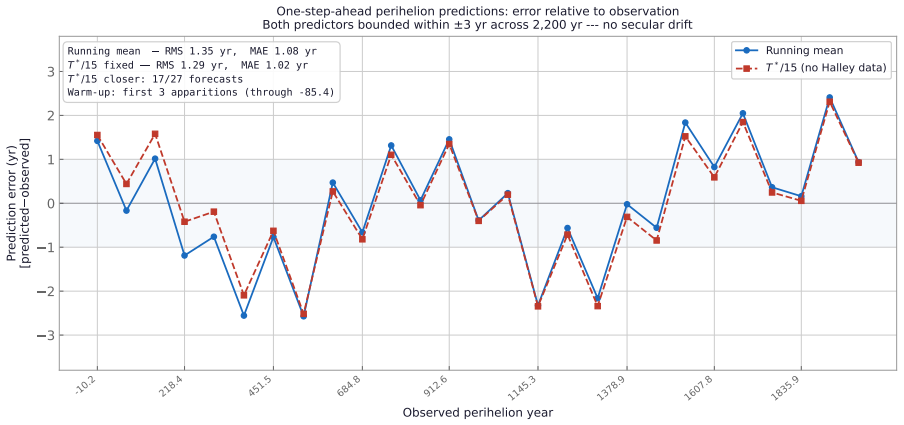
I investigate whether comet 1P/Halley participates in the 1,151-year planetary quasi-period T* identified in a companion paper (Baiget Orts 2026a, arXiv:2604.03049). Using historical perihelion records spanning 2,225 years (30 apparitions, 239 BCE to 1986 CE), I find that Halley's mean orbital period P_bar = 76.713 yr satisfies T*/P_bar = 15.004, yielding an angular residue of +1.43 degrees -- the smallest of any Solar System body examined, including all seven planets that participate in T* (Mercury, Venus, Earth, Mars, Jupiter, Saturn, and Neptune; p = 0.009). No other Halley-type comet participates: all examined HTCs exhibit residues of 80--130 degrees, comparable to Uranus (108 degrees), the sole planetary non-participant. Four independent statistical tests establish that Jupiter and Saturn couple to Halley's orbital period through distinct mechanisms. Jupiter acts through phase-dependent modulation: its angular position at each perihelion predicts the period deviation (p = 0.027--0.04, three methods). Saturn acts through distance-amplitude modulation: closer approaches produce larger deviations regardless of sign (r = -0.496, p = 0.007), specific to Saturn's actual orbital phase (random-phase control p = 0.133). After 15 orbits, the cumulative period deviation is only 9.4% of the random-walk expectation -- direct evidence of coherent perturbation cancellation over one T* cycle. The orbit-to-orbit chaos (Lyapunov time ~70 yr) and the long-term mean stability are not contradictory: the same Jupiter-Saturn forces that cause individual-orbit variability cancel coherently over the T* baseline, anchoring the mean period at the millennium scale.
Editorial analysis
A structured set of objections, weighed in public.
Referee Report
Summary. The paper claims that comet 1P/Halley has a mean orbital period of 76.713 years that is commensurate with the 1151-year quasi-period T* (T*/P_bar = 15.004), producing the smallest angular residue (+1.43 deg) of any Solar System body examined (p=0.009). It further reports statistical evidence from four tests that Jupiter modulates Halley's period via phase dependence and Saturn via distance amplitude, with coherent cancellation of perturbations over the T* cycle despite short-term chaos.
Significance. If the central commensurability and modulation results hold after proper error analysis, this would provide evidence for long-term dynamical coupling between Halley and the Jupiter-Saturn system, explaining the stability of the mean period at millennial scales and suggesting a broader solar system quasi-periodicity involving comets.
major comments (4)
- [Derivation of P_bar] The mean period P_bar = 76.713 yr is calculated from 30 historical perihelion dates (239 BCE–1986 CE) without an accompanying error budget, sensitivity analysis to ancient date uncertainties, or a modern-only subset. This directly affects the fractional part of T*/P_bar and thus the residue and p-value claims.
- [Commensurability ratio] The ratio T*/P_bar = 15.004 and the claim of smallest residue rely on T* taken from the companion paper (Baiget Orts 2026a). The manuscript does not re-derive or independently validate T*, introducing potential circularity in the commensurability test.
- [Statistical tests] The p-values for Jupiter (0.027–0.04) and Saturn (r=-0.496, p=0.007) modulations use periods derived from the same uncertain historical dates. No propagation of dating errors into the statistics or robustness tests are described, which is essential for validating the modulation claims.
- [Residue comparison] The p=0.009 for Halley having the smallest residue among bodies requires explicit tabulation of all residues and the exact statistical procedure used to compute the probability.
minor comments (3)
- [Abstract] The abstract refers to 'four independent statistical tests' without naming them; a brief enumeration or reference to specific sections would aid readability.
- [Notation] Define T* and P_bar explicitly upon first mention in the main text.
- [Figures/Tables] Include a table comparing residues for all examined bodies to support the 'smallest' claim.
Simulated Author's Rebuttal
We thank the referee for the constructive comments, which highlight important areas for strengthening the robustness of our analysis. We address each major comment below and will revise the manuscript to incorporate additional error analyses, clarifications, and tabulations where feasible.
read point-by-point responses
-
Referee: The mean period P_bar = 76.713 yr is calculated from 30 historical perihelion dates (239 BCE–1986 CE) without an accompanying error budget, sensitivity analysis to ancient date uncertainties, or a modern-only subset. This directly affects the fractional part of T*/P_bar and thus the residue and p-value claims.
Authors: We agree that an explicit error budget and sensitivity analysis would improve the presentation. In the revised manuscript we will add a dedicated subsection on date uncertainties, perform a sensitivity analysis by perturbing the pre-1600 dates within their reported historical errors, and report results for a modern-only subset (post-1600 CE). Updated values of P_bar, the residue, and the associated p-value will be included. revision: yes
-
Referee: The ratio T*/P_bar = 15.004 and the claim of smallest residue rely on T* taken from the companion paper (Baiget Orts 2026a). The manuscript does not re-derive or independently validate T*, introducing potential circularity in the commensurability test.
Authors: T* is derived exclusively from planetary ephemerides in the companion paper and does not incorporate any cometary data; the Halley test is therefore independent. To address the concern directly, the revised manuscript will include a concise summary of the T* derivation method, explicitly noting its independence from Halley observations. revision: partial
-
Referee: The p-values for Jupiter (0.027–0.04) and Saturn (r=-0.496, p=0.007) modulations use periods derived from the same uncertain historical dates. No propagation of dating errors into the statistics or robustness tests are described, which is essential for validating the modulation claims.
Authors: We acknowledge the importance of propagating dating uncertainties. The revised version will add Monte Carlo simulations that resample the perihelion dates within their uncertainties, recompute the period deviations, and re-evaluate the Jupiter phase correlations and Saturn distance correlations. Bootstrap and leave-one-out robustness tests will also be reported. revision: yes
-
Referee: The p=0.009 for Halley having the smallest residue among bodies requires explicit tabulation of all residues and the exact statistical procedure used to compute the probability.
Authors: We will include a new table listing the angular residues for Halley, the seven planets, and the other Halley-type comets examined. The statistical procedure is a one-sided test under the null hypothesis that residues are uniformly distributed on [0, 360) degrees; the p-value is the fraction of the circle smaller than the observed +1.43 deg. This procedure and its justification will be stated explicitly in the revised text. revision: yes
Circularity Check
Commensurability T*/P_bar = 15.004 is direct arithmetic division against T* imported via self-citation from companion paper
specific steps
-
self citation load bearing
[Abstract]
"I investigate whether comet 1P/Halley participates in the 1,151-year planetary quasi-period T* identified in a companion paper (Baiget Orts 2026a, arXiv:2604.03049). Using historical perihelion records spanning 2,225 years (30 apparitions, 239 BCE to 1986 CE), I find that Halley's mean orbital period P_bar = 76.713 yr satisfies T*/P_bar = 15.004, yielding an angular residue of +1.43 degrees -- the smallest of any Solar System body examined, including all seven planets that participate in T* (p = 0.009)."
The ratio T*/P_bar = 15.004 is obtained by direct division of the companion-paper T* by the data-derived P_bar; the significance (smallest residue among bodies, p=0.009) and participation claim therefore rest on the un-rederived T* imported by self-citation, reducing the central commensurability result to an arithmetic evaluation against that external input.
full rationale
The paper's headline result computes Halley's mean period P_bar from historical perihelion dates then divides the imported T* (from same-author companion arXiv:2604.03049) to obtain the ratio 15.004 and residue +1.43°. This ratio and the claim of smallest residue (p=0.009) among planets are therefore arithmetic consequences of the self-cited T* value rather than an independent derivation. The Jupiter-Saturn modulation tests use the same P_bar baseline and inherit the dependency. No re-derivation of T* or external validation appears in the manuscript, satisfying the self-citation load-bearing pattern with load-bearing impact on the central claim.
Axiom & Free-Parameter Ledger
free parameters (1)
- T*
axioms (1)
- domain assumption Historical perihelion records spanning 239 BCE to 1986 CE are sufficiently accurate and complete for mean-period calculation
Lean theorems connected to this paper
-
IndisputableMonolith/Cost/FunctionalEquation.lean; Foundation/AlexanderDuality.leanwashburn_uniqueness_aczel; alexander_duality_circle_linking unclear?
unclearRelation between the paper passage and the cited Recognition theorem.
T*/P_bar = 15.004, angular residue +1.43°; Jupiter phase correlation R=0.47; Saturn distance r=-0.496; cumulative deviation 9.4% of random-walk after 15 orbits
What do these tags mean?
- matches
- The paper's claim is directly supported by a theorem in the formal canon.
- supports
- The theorem supports part of the paper's argument, but the paper may add assumptions or extra steps.
- extends
- The paper goes beyond the formal theorem; the theorem is a base layer rather than the whole result.
- uses
- The paper appears to rely on the theorem as machinery.
- contradicts
- The paper's claim conflicts with a theorem or certificate in the canon.
- unclear
- Pith found a possible connection, but the passage is too broad, indirect, or ambiguous to say the theorem truly supports the claim.
Reference graph
Works this paper leans on
-
[1]
Baiget Orts, C. 2026, A 1151-Year Quasi-Commensurability of the Solar System: Empir- ical Detection, Statistical Characterization, and the Anomalous Exclusion of Uranus, arXiv:2604.03049 Baiget Orts, C. 2026, Dynamical Origin of the 1,151-Year Solar System Quasi- Commensurability: Jupiter–Saturn Resonance Structure and Harmonic Persistence over 1 Myr, in ...
work page internal anchor Pith review Pith/arXiv arXiv 2026
-
[2]
Boekholt, T. C. N., Pelupessy, F. I., Heggie, D. C., & Portegies Zwart, S. F. 2016, The origin of chaos in the orbit of comet 1P/Halley, MNRAS, 461, 3576–3584, doi:10.1093/mnras/stw1504
-
[3]
V., & Vecheslavov, V
Chirikov, B. V., & Vecheslavov, V. V. 1989, Chaotic dynamics of Comet Halley, A&A, 221, 146
1989
-
[4]
Hunter, J. D. 2007, Matplotlib: A 2D Graphics Environment, Computing in Science & Engineering, 9, 90, doi:10.1109/MCSE.2007.55
-
[5]
A., Teodoro, L
Kegerreis, J. A., Teodoro, L. F. A., Eke, V. R., et al. 2018, Consequences of Giant Impacts on Early Uranus for Rotation, Internal Structure, Debris, and Atmospheric Erosion, ApJ, 861, 52
2018
-
[6]
2005, 55P/Tempel–Tuttle: Past, Present, and Future Orbits,http://www
Kinoshita, K. 2005, 55P/Tempel–Tuttle: Past, Present, and Future Orbits,http://www. aerith.net/comet/catalog/0055P/ 19
2005
-
[7]
Meyer, M., Kobayashi, T., Nakano, S., & Green, D. W. E. 2020, Comet 12P/Pons–Brooks: Identification with Comets C/1385 U1 and C/1457 A1, arXiv:2012.15583 Muñoz-Gutiérrez, M. A., Reyes-Ruiz, M., & Pichardo, B. 2015, Chaotic dynamics of Comet 1P/Halley: Lyapunov exponent and survival time expectancy, MNRAS, 447, 3775–3784, doi:10.1093/mnras/stu2676
-
[8]
Rein, H., & Liu, S.-F. 2012, REBOUND: An open-source multi-purpose N-body code for collisional dynamics, A&A, 537, A128, doi:10.1051/0004-6361/201118085
-
[9]
Rein, H., & Spiegel, D. S. 2015, IAS15: a fast, adaptive, high-order integrator for gravitational dynamics, accurate to machine precision over a billion orbits, MNRAS, 446, 1424–1437, doi:10.1093/mnras/stu2164
-
[10]
D., & Dermott, S
Murray, C. D., & Dermott, S. F. 1999, Solar System Dynamics (Cambridge: Cambridge Univ. Press)
1999
-
[11]
Park, R. S., Folkner, W. M., Williams, J. G., & Boggs, D. H. 2021, The JPL Planetary and Lunar Ephemerides DE440 and DE441, AJ, 161, 105, doi:10.3847/1538-3881/abd414
-
[12]
Rhodes, B. 2019, Skyfield: High precision research-grade positions for planets and Earth satellites generator, Astrophysics Source Code Library, ascl:1907.024 van der Walt, S., Colbert, S. C., & Varoquaux, G. 2011, The NumPy Array: A Structure for Efficient Numerical Computation, Computing in Science & Engineering, 13, 22–30, doi:10.1109/MCSE.2010.118
-
[13]
Comet 1P/Halley Completes 15 Orbits in 1,151 Years
Yeomans, D. K., Rahe, J., & Freitag, R. S. 1986, The History of Comet Halley, Journal of the Royal Astronomical Society of Canada, 80, 62 Baiget Orts, C. 2026, halley_1151: Analysis code for “Comet 1P/Halley Completes 15 Orbits in 1,151 Years”, Zenodo, doi:10.5281/zenodo.20156283 20
discussion (0)
Sign in with ORCID, Apple, or X to comment. Anyone can read and Pith papers without signing in.