Recognition: no theorem link
A New Lemoine-Type Circle
Pith reviewed 2026-05-13 18:33 UTC · model grok-4.3
The pith
A new Lemoine-type circle arises from six points on a triangle that meet a cocyclicity criterion.
A machine-rendered reading of the paper's core claim, the machinery that carries it, and where it could break.
Core claim
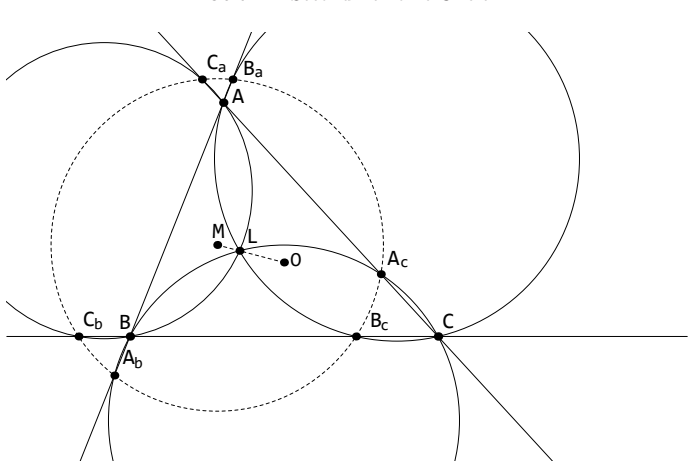
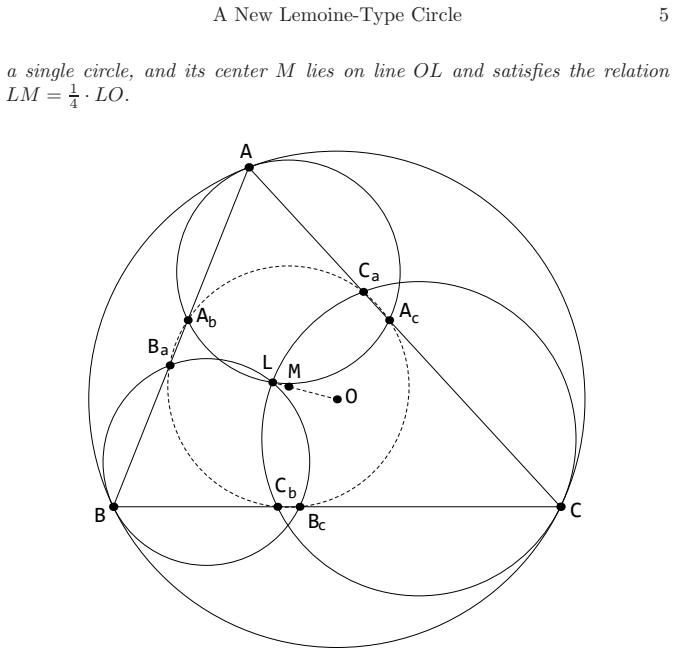
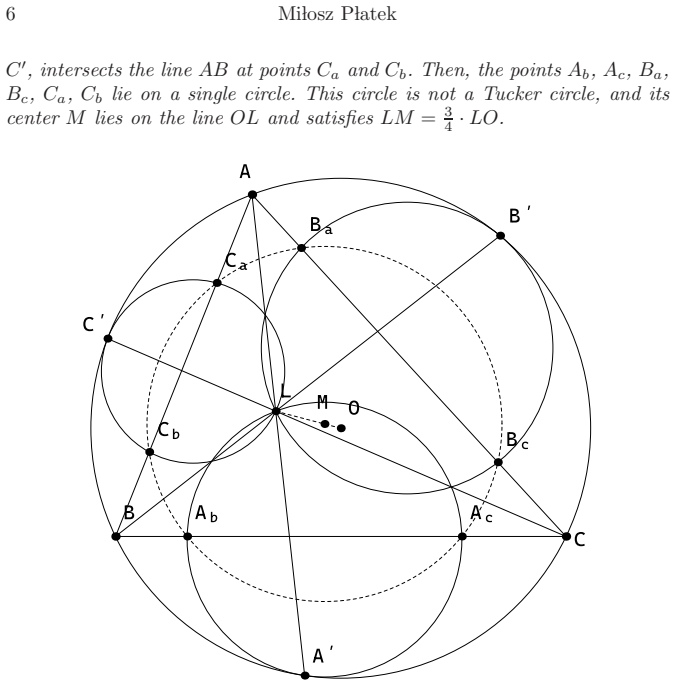
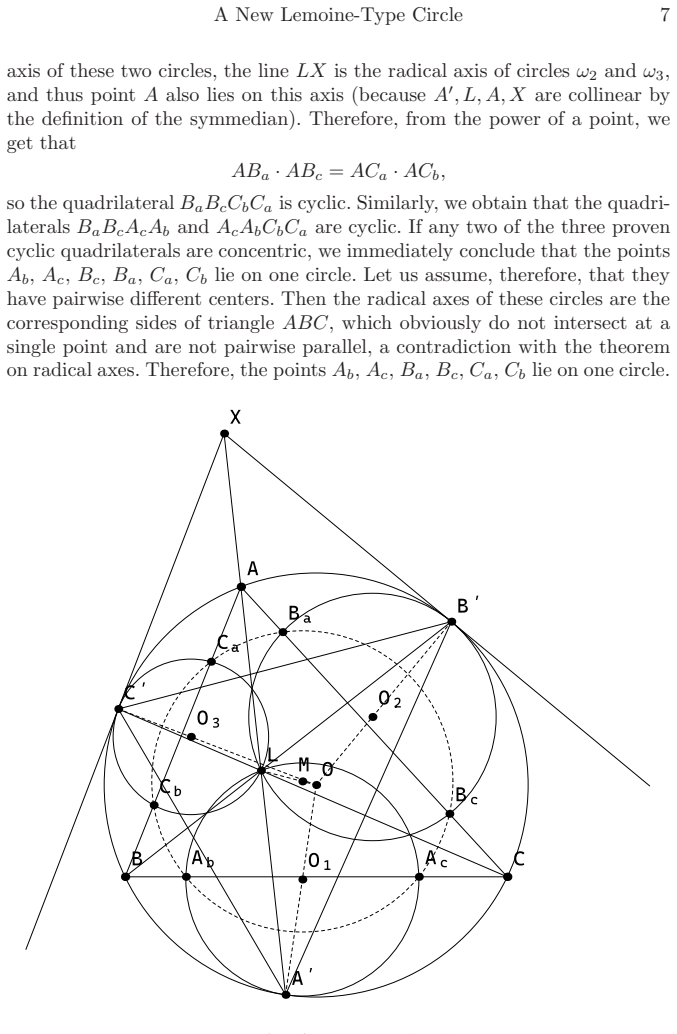
The central claim is that a six-point configuration on the sides of a triangle, when the points satisfy the given cocyclicity criterion, determines a new Lemoine-type circle. The paper proves existence, states and proves a converse theorem, positions the circle relative to known examples such as Bui's Lemoine circle, and shows that the new circle does not belong to the Tucker family.
What carries the argument
The six-point configuration on the triangle sides together with its cocyclicity criterion, which together locate the new Lemoine-type circle.
If this is right
- The cocyclicity criterion forces the six points to determine a single circle of Lemoine type.
- The new circle is distinct from every member of the Tucker family.
- A converse statement recovers the configuration from the circle.
- The new circle shares some but not all properties with Bui's earlier Lemoine circle.
Where Pith is reading between the lines
- Multiple independent Lemoine-type circles may exist, suggesting a larger parametric family of such circles.
- The six-point construction could be tested numerically on specific triangles to locate additional intersection properties.
- Similar cocyclicity conditions might produce further circles attached to other classical triangle points.
Load-bearing premise
The six points satisfy the stated cocyclicity criterion that is used to define the new circle.
What would settle it
A concrete triangle together with an explicit choice of six points that obey all stated side conditions yet fail to lie on a common circle would falsify the general existence result.
Figures


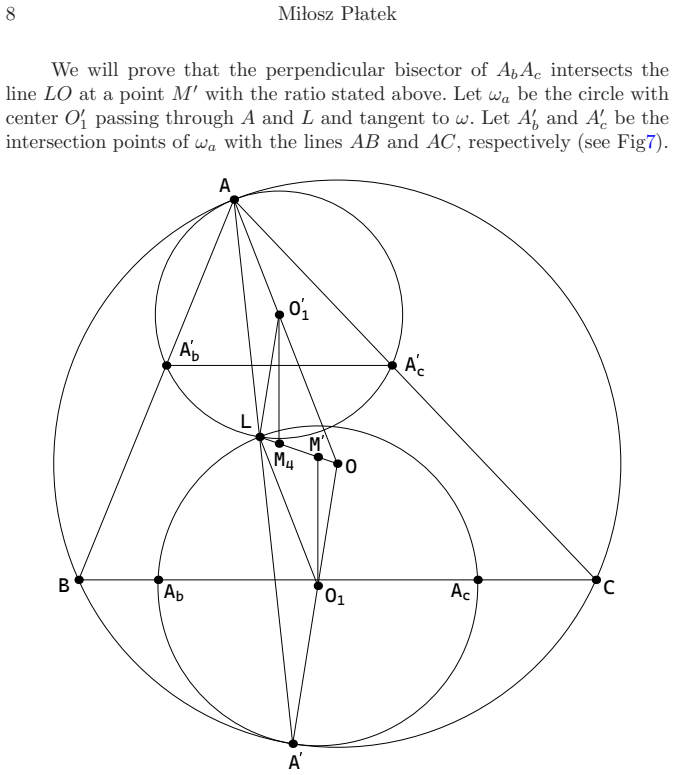
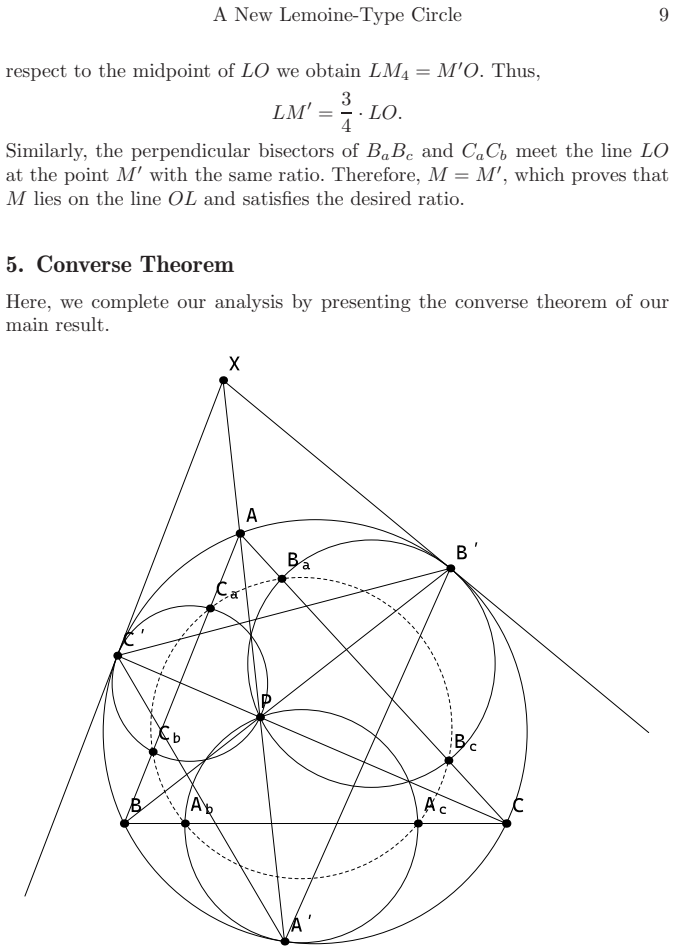
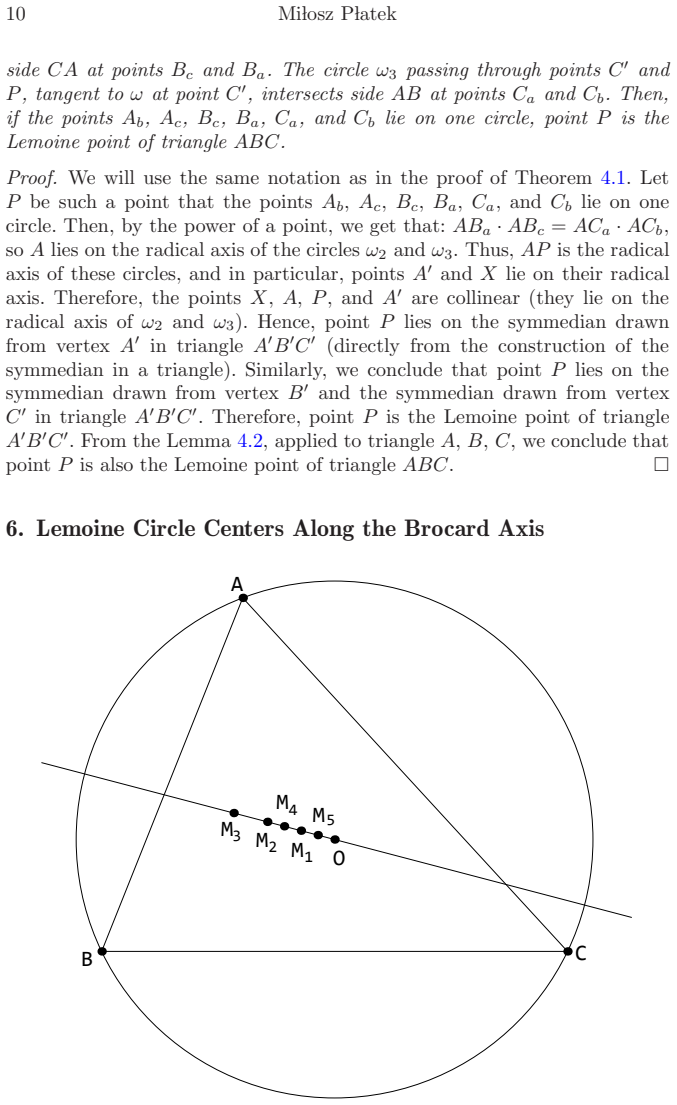
read the original abstract
This paper presents a new Lemoine-type circle defined by a six-point configuration satisfying a cocyclicity criterion. We prove the result, establish a converse theorem, and relate the new circle to previously known Lemoine circles, in particular the one introduced by Q.T. Bui. We show that the new circle does not belong to the family of Tucker circles.
Editorial analysis
A structured set of objections, weighed in public.
Referee Report
Summary. The paper introduces a new Lemoine-type circle defined via a six-point configuration in a triangle that satisfies a stated cocyclicity criterion. It claims to prove that the points are concyclic, establishes a converse theorem, relates the circle to Bui's Lemoine circle, and proves that the new circle lies outside the Tucker family.
Significance. If the central cocyclicity proof and separation from the Tucker family hold, the work adds a concrete new configuration to the literature on Lemoine circles, with the converse providing a useful characterization. Explicit comparison to Bui's circle and the Tucker family helps delineate the landscape of such circles in triangle geometry.
minor comments (1)
- [Abstract] The abstract states that a cocyclicity criterion is satisfied and proved, but does not name the criterion or the six points explicitly; adding one sentence identifying the points (e.g., by their standard triangle-geometry labels) would improve readability without altering the technical content.
Simulated Author's Rebuttal
We thank the referee for their positive assessment of our manuscript and for recommending minor revision. The referee's summary accurately captures the paper's main results: the introduction and proof of a new Lemoine-type circle via a six-point cocyclic configuration, the converse theorem, the explicit relation to Bui's Lemoine circle, and the separation from the Tucker family.
Circularity Check
No significant circularity in the derivation chain
full rationale
The paper presents a geometric proof establishing a new Lemoine-type circle from a six-point configuration satisfying a stated cocyclicity criterion, together with a converse theorem and explicit relations to prior circles (including Bui's). No equations, fitted parameters, self-definitional reductions, or load-bearing self-citations appear in the abstract or description. The central claims rest on standard Euclidean geometric relations and direct proofs rather than reducing to their own inputs by construction, rendering the derivation self-contained.
Axiom & Free-Parameter Ledger
axioms (1)
- standard math Standard axioms of Euclidean plane geometry including properties of circles and concyclic points
Reference graph
Works this paper leans on
-
[1]
Lemoine, Sur quelques propri´ et´ es d’un point remarquable du triangle
E. Lemoine, Sur quelques propri´ et´ es d’un point remarquable du triangle. Nou- velles Annales de Math´ ematiques (1873), 364–366
-
[2]
Bui Q.T., Hyacinthos message 13617. 2006
work page 2006
-
[3]
Kimberling, Encyclopedia of Triangle Centers
C. Kimberling, Encyclopedia of Triangle Centers. Homepage on the Internet, updated July 15, 2025. https://faculty.evansville.edu/ck6/encyclopedia/etc.html
work page 2025
-
[4]
Grinberg, Ehrmann ’s Third Lemoine Circle
D. Grinberg, Ehrmann ’s Third Lemoine Circle. J. Classical Geometry (2012), 40–52
work page 2012
-
[5]
G. Berkhan and W. F. Meyer, Neuere Dreiecksgeometrie. In W. Fr. Meyer and H. Mohrmann (eds.), Geometrie. Encyklop¨ adie der mathematischen Wis- senschaften mit Einschluß ihrer Anwendungen , vol. 3.1.2, B. G. Teubner, Leipzig (1914), 1177–1276
work page 1914
-
[6]
E. W. Weisstein, Brocard Axis. MathWorld - A Wolfram Web Resource, 2025. https://mathworld.wolfram.com/BrocardAxis.html. Accessed July 15, 2025
work page 2025
-
[7]
E. W. Weisstein, Tucker Circles. MathWorld - A Wolfram Web Resource,
-
[8]
https://mathworld.wolfram.com/TuckerCircles.html. Accessed July 15, 2025
work page 2025
- [9]
-
[10]
Honsberger, Episodes in Nineteenth and Twentieth Century Euclidean Ge- ometry
R. Honsberger, Episodes in Nineteenth and Twentieth Century Euclidean Ge- ometry. Mathematical Association of America, 1995
work page 1995
-
[11]
S. N. Kiss and P. Yiu, On the Tucker Circles. Forum Geometricorum 17 (2017), 157–175. Mi/suppress losz P/suppress latek Independent researcher Krak´ ow, Poland e-mail: milosz@platek.org
work page 2017
discussion (0)
Sign in with ORCID, Apple, or X to comment. Anyone can read and Pith papers without signing in.