Nonlinear interface effects in multilayered structures: vibro-acoustic modeling and experimental analysis
Pith reviewed 2026-05-13 18:28 UTC · model grok-4.3
The pith
The equivalent bending stiffness of multilayer beams with imperfect interfaces depends on excitation level due to nonlinear interface behavior.
A machine-rendered reading of the paper's core claim, the machinery that carries it, and where it could break.
Core claim
The paper establishes that the dynamic response of a three-layer beam with imperfect interfaces depends on the excitation level, with observed variations in the equivalent bending stiffness revealing the nonlinear nature of the interfacial behavior. The Zig-Zag formulation with coupling conditions reduces kinematic unknowns without losing accuracy, and the derived equivalent plate model is validated experimentally on a glass-epoxy-glass beam under various excitation levels.
What carries the argument
Zig-Zag formulation with interfacial coupling conditions of stress continuity and displacement discontinuity, from which an equivalent frequency-dependent bending stiffness is derived in a Kirchhoff-Love plate model.
If this is right
- Nonlinear interface effects must be included when predicting the vibro-acoustic response of multilayer beams at varying load levels.
- The frequency-dependent equivalent stiffness offers a reduced-order way to characterize global behavior without full layer-by-layer kinematics.
- The approach applies directly to glass-epoxy-glass beams and indicates similar nonlinear signatures in other imperfectly bonded composites.
- Experimental extraction via the Corrected Force Analysis Technique provides a practical method to quantify interface nonlinearity in situ.
Where Pith is reading between the lines
- Amplitude dependence could shift resonance frequencies or alter damping in composite panels used in vehicles or aircraft.
- Extending the model from beams to plates would allow prediction of two-dimensional wave propagation and sound radiation influenced by the same nonlinearity.
- Design of interfaces with controlled nonlinearity might enable structures whose acoustic properties change with operating intensity.
Load-bearing premise
The Zig-Zag formulation with interfacial coupling conditions accurately captures the nonlinear interfacial behavior while the equivalent Kirchhoff-Love plate formulation represents the global structural response.
What would settle it
If the equivalent bending stiffness extracted from vibrometry measurements remained constant across increasing excitation levels, or if model predictions failed to match the measured stiffness changes.
Figures
read the original abstract
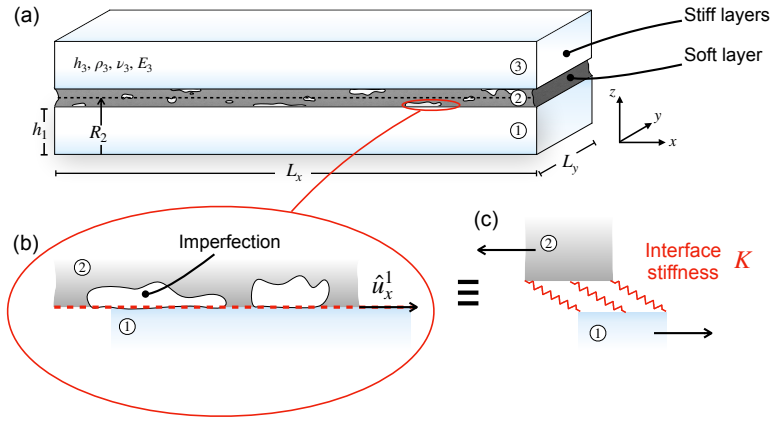
This paper presents an experimental and theoretical study of the nonlinear behavior of imperfect interfaces in multilayer structures using an equivalent vibro-acoustic approach. The multilayer system is modeled through a Zig-Zag formulation, in which interfacial coupling conditions, stress continuity and displacement discontinuity, relate the kinematics of adjacent layers while preserving an independent description of each layer. This framework significantly reduces the number of kinematic unknowns without compromising the model accuracy. An equivalent Kirchhoff-Love plate formulation is then introduced to derive a frequency-dependent bending stiffness representative of the global structural response. Experimental measurements of the transverse displacement field are performed using laser vibrometry and processed via the Corrected Force Analysis Technique (CFAT).The results demonstrate that the dynamic response of a three-layer beam with imperfect interfaces depends on the excitation level. In particular, variations in the equivalent bending stiffness are observed, revealing the nonlinear nature of the interfacial behavior. The proposed methodology is applied to a glass-epoxy-glass multilayer beam under various excitation levels.
Editorial analysis
A structured set of objections, weighed in public.
Referee Report
Summary. The paper develops a Zig-Zag kinematic model for multilayer beams incorporating interfacial stress continuity and displacement discontinuity, which is reduced to an equivalent frequency-dependent bending stiffness via a Kirchhoff-Love plate formulation. Laser-vibrometry measurements on a glass-epoxy-glass beam are inverted with the Corrected Force Analysis Technique (CFAT) to show that the recovered equivalent bending stiffness varies with excitation amplitude, which is interpreted as evidence of nonlinear interfacial behavior.
Significance. If the experimental inversion is shown to be free of linear-operator artifacts, the work supplies a reduced-order modeling route and an experimental diagnostic for amplitude-dependent interface effects in layered structures, with relevance to composite design and vibro-acoustic prediction.
major comments (2)
- [Experimental analysis and CFAT processing] The CFAT inversion (described in the experimental section) applies the linear Kirchhoff-Love operator to reconstruct equivalent forces and stiffness from measured displacement fields. When the true interface response is nonlinear, the displacement field does not satisfy the linear PDE pointwise; the linear inverse can therefore return an amplitude-dependent “equivalent” stiffness even in the absence of interfacial nonlinearity. No section provides a forward nonlinear simulation, bias quantification, or exclusion of alternative linear sources (material damping, boundary compliance) to demonstrate that CFAT remains unbiased at the observed excitation levels.
- [Equivalent plate derivation] The reduction from the Zig-Zag model to a single equivalent Kirchhoff-Love plate (Section on equivalent formulation) assumes that a linear, frequency-dependent bending stiffness fully captures the global response across excitation amplitudes. For genuinely nonlinear interfaces this equivalence is not guaranteed to be unique or amplitude-independent; the manuscript does not derive or test the conditions under which the effective stiffness remains a valid descriptor.
minor comments (2)
- [Abstract] The abstract states that “variations in the equivalent bending stiffness are observed” but supplies neither the magnitude of the variation, the number of excitation levels tested, nor uncertainty estimates, which weakens the reader’s ability to judge the strength of the central claim.
- [Modeling section] Notation for the interfacial coupling conditions and the definition of the frequency-dependent bending stiffness should be collected in a single table or appendix for clarity.
Simulated Author's Rebuttal
We thank the referee for the detailed and constructive comments on our manuscript. We address each major point below and have revised the manuscript to incorporate clarifications and additional discussion where feasible.
read point-by-point responses
-
Referee: [Experimental analysis and CFAT processing] The CFAT inversion (described in the experimental section) applies the linear Kirchhoff-Love operator to reconstruct equivalent forces and stiffness from measured displacement fields. When the true interface response is nonlinear, the displacement field does not satisfy the linear PDE pointwise; the linear inverse can therefore return an amplitude-dependent “equivalent” stiffness even in the absence of interfacial nonlinearity. No section provides a forward nonlinear simulation, bias quantification, or exclusion of alternative linear sources (material damping, boundary compliance) to demonstrate that CFAT remains unbiased at the observed excitation levels.
Authors: We acknowledge that CFAT relies on the linear Kirchhoff-Love assumptions, so nonlinear interface behavior can in principle introduce reconstruction artifacts. However, the amplitude dependence we recover is systematic, repeatable across multiple modes and frequencies, and vanishes at the lowest excitation levels where the structure behaves linearly. To address the concern, we have added a dedicated paragraph in the experimental section that (i) establishes the linear baseline from low-amplitude data, (ii) shows that conventional linear mechanisms (viscoelastic damping, boundary compliance) cannot reproduce the observed magnitude of stiffness variation, and (iii) discusses the expected bias order for the displacement amplitudes used. A complete forward nonlinear simulation to quantify residual bias lies outside the present scope and is noted as future work. revision: yes
-
Referee: [Equivalent plate derivation] The reduction from the Zig-Zag model to a single equivalent Kirchhoff-Love plate (Section on equivalent formulation) assumes that a linear, frequency-dependent bending stiffness fully captures the global response across excitation amplitudes. For genuinely nonlinear interfaces this equivalence is not guaranteed to be unique or amplitude-independent; the manuscript does not derive or test the conditions under which the effective stiffness remains a valid descriptor.
Authors: The equivalent-plate reduction is presented as an approximate reduced-order model valid when interfacial nonlinearity remains moderate and the response can still be represented by a single frequency-dependent stiffness parameter. We have revised the derivation section to state these assumptions explicitly, to sketch the steps by which the Zig-Zag kinematics collapse to an effective bending stiffness, and to note that the mapping is not claimed to be unique for strong nonlinearity. Within the experimental range reported, the effective stiffness provides a compact descriptor that matches the measured global response; we have added a short numerical check confirming consistency in the linear limit. revision: yes
- A full forward nonlinear time-domain simulation to quantify CFAT bias exactly, which would require a separate modeling framework beyond the scope of the current study.
Circularity Check
No significant circularity; standard formulations and independent experimental processing
full rationale
The paper's modeling chain starts from the established Zig-Zag kinematic description with interfacial stress continuity and displacement discontinuity, then reduces to an equivalent Kirchhoff-Love plate to obtain a frequency-dependent bending stiffness. This reduction follows directly from the layer-wise equilibrium and continuity conditions without redefining any output as an input. The experimental claim relies on laser vibrometry data inverted via the standard CFAT procedure (linear operator applied to measured fields). No parameter is fitted to a data subset and then relabeled as a prediction, no self-citation supplies a load-bearing uniqueness theorem, and the observed amplitude dependence of stiffness is reported as a direct experimental outcome rather than a constructed result. The derivation remains self-contained against external benchmarks.
Axiom & Free-Parameter Ledger
Reference graph
Works this paper leans on
-
[1]
V. Birman and G. A. Kardomateas. Review of current trends in research and applications of sandwich structures.Compos. B: Eng., 142:221–240, 2018
work page 2018
-
[2]
M. D. Rao. Recent applications of viscoelastic damping for noise control in automobiles and commercial airplanes.J. Sound Vib., 262(3):457–474, 2003
work page 2003
-
[3]
M. Caniato, F. Bettarello, A. Ferluga, L. Marsich, C. Schmid, and P. Fausti. Acoustic of lightweight timber buildings: A review.Renew. Sust. Energ. Rev., 80:585–596, 2017
work page 2017
- [4]
-
[5]
Saeed Manteghi, Zia Mahboob, Zouheir Fawaz, and Habiba Bougherara. Investigation of the mechanical properties and failure modes of hybrid natural fiber composites for potential bone fracture fixation plates.J. Mech. Behav. Biomed. Mater., 65:306–316, January 2017
work page 2017
- [6]
-
[7]
R. Da S. Raqueti, N. Atalla, M. Ouisse, and E. Sadoulet-Reboul. An equivalent plate model for assessing the dynamic behavior of highly damped sandwich plates.J. Sound Vib., 616:119209, 2025
work page 2025
-
[8]
S. Zeng, A. T. Smith, K. Shen, and L. Sun. Smart Soft Materials with Multiscale Architecture and Dynamic Surface Topographies.Acc. Mater. Res., 3(11):1115–1126, 2022
work page 2022
-
[9]
E. Carrera. An assessment of mixed and classical theories on global and local response of multilayered orthotropic plates.Compos. Struct., 50(2):183–198, 2000
work page 2000
-
[10]
J.-L. Guyader and C. Lesueur. Acoustic transmission through orthotropic multilayered plates, part I: Plate vibration modes.J. Sound Vib., 58(1):51–68, 1978
work page 1978
-
[11]
J.-L. Guyader and C. Cacciolati. Viscoelastic properties of single layer plate material equiv- alent to multi-layer composites plates. InProceedings of Inter-Noise 2007, pages 1558–1567, Istanbul, Turkey, 2007
work page 2007
-
[12]
F. Marchetti, K. Ege, Q. Lecl` ere, and N.B. Roozen. On the structural dynamics of laminated composite plates and sandwich structures; a new perspective on damping identification.J. Sound Vib., 474:115256, 2020. 25
work page 2020
-
[13]
A.O. Adekola. Partial interaction between elastically connected elements of a composite beam. Int. J. Solids Struct., 4(11):1125–1135, 1968
work page 1968
- [14]
- [15]
-
[16]
L. A. Perez Ramirez, F. Erel-Demore, G. Rizzi, J. Voss, and A. Madeo. Effective surface forces and non-coherent interfaces within the reduced relaxed micromorphic modeling of finite-size mechanical metamaterials.J. Mech. Phys. Solids, 186:105558, 2024
work page 2024
-
[17]
S. Hermann, K. Billon, A. M. Parlak, J. Orlowsky, M. Collet, and A. Madeo. Design and experimental validation of a finite-size labyrinthine metamaterial for vibro-acoustics: enabling upscaling towards large-scale structures.Philos. Trans. R. Soc. A, 382(2278):20230367, 2024
work page 2024
-
[18]
S. Hermann, K. Billon, M. Collet, and A. Madeo. Unveiling the key role of interfaces in the design of finite-sized metamaterial structures.EUR J MECH A-SOLID, 118:106102, 2026
work page 2026
-
[19]
N. Auquier, K. Ege, and E. Gourdon. Imperfect interfaces characterization in a multilayered structure by means of an equivalent dynamic model.Acta Acust., 8:78, 2024
work page 2024
-
[20]
R. Massab` o and F. Campi. An efficient approach for multilayered beams and wide plates with imperfect interfaces and delaminations.Compos. Struct., 116:311–324, 2014
work page 2014
-
[21]
J. Wang, Z. Chang, T. Liu, and L. Chen. A review of linear and nonlinear vibration analysis of composite laminated structures by computational approaches: 2015–2024.Nonlinear Dyn., 113(10):10839–10859, 2025
work page 2015
-
[22]
R. Massab` o and F. Campi. Assessment and correction of theories for multilayered plates with imperfect interfaces.Meccanica, 50(4):1045–1071, 2015
work page 2015
-
[23]
N. Auquier, K. Ege, and E. Gourdon. Equivalent dynamic model of multilayered structures with imperfect interfaces: Application to a sandwich structured plate with sliding interfaces. J. Sound Vib., 535:117052, 2022
work page 2022
- [24]
-
[25]
S.G. Lekhnitskii. Strength calculation of composite beams.Vestnik inzhen i tekhnikov, 9:137– 148, 1935. 26
work page 1935
-
[26]
J.G. Ren. A new theory of laminated plate.Compos. Sci. Technol., 26:225–239, 1986
work page 1986
-
[27]
C. T. Sun and J. M. Whitney. Theories for the Dynamic Response of Laminated Plates.AIAA Journal, 11(2):178–183, 1973
work page 1973
-
[28]
A. E. H. Love. The small free vibrations and deformation of a thin elastic shell.Philos. Trans. R. Soc. A, 179(0):491–546, 1888
- [29]
-
[30]
R. D. Mindlin. Influence of rotatory inertia and shear on flexural motions of isotropic, elastic plates.J. Appl. Mech., 18:31–38, 1951
work page 1951
- [31]
-
[32]
T. O. Williams and F. L. Addessio. A general theory for laminated plates with delaminations. Int. J. Solids Struct., 34(16):2003–2024, 1997
work page 2003
-
[33]
P. Margerit.Caract´ erisation large bande du comportement dynamique lin´ eaire des structures h´ et´ erog` enes visco´ elastiques anisotropes : application ` a la table d’harmonie du piano. Th` ese de doctorat, Universit´ e Paris-Est, 2018. NNT : 2018PESC1151
work page 2018
-
[34]
N. Madinier, Q. Lecl` ere, K. Ege, and A. Berry. Spatial and frequency identification of the dynamic properties of thin plates with the Frequency-Adapted Virtual Fields Method.J. Sound Vib., 596:118760, 2025
work page 2025
-
[35]
Q. Lecl` ere and C. P´ ezerat. Vibration source identification using corrected finite difference schemes.J. Sound Vib., 331(6):1366–1377, 2012
work page 2012
-
[36]
Q. Lecl` ere, F. Ablitzer, and C. P´ ezerat. Practical implementation of the corrected force analysis technique to identify the structural parameter and load distributions.J. Sound Vib., 351:106–118, 2015
work page 2015
-
[37]
T. D. Ngo, A. Kashani, G. Imbalzano, K. T.Q. Nguyen, and D. Hui. Additive manufacturing (3D printing): A review of materials, methods, applications and challenges.Compos. Part B Eng., 143:172–196, 2018. 27
work page 2018
discussion (0)
Sign in with ORCID, Apple, or X to comment. Anyone can read and Pith papers without signing in.