Recognition: 2 theorem links
· Lean TheoremMI-Pruner: Crossmodal Mutual Information-guided Token Pruner for Efficient MLLMs
Pith reviewed 2026-05-13 19:53 UTC · model grok-4.3
The pith
Mutual information between visual and textual features allows more effective pruning of visual tokens in multimodal large language models than attention-based methods.
A machine-rendered reading of the paper's core claim, the machinery that carries it, and where it could break.
Core claim
By directly computing Mutual Information (MI) between visual and textual features prior to their interaction, the MI-Pruner identifies visual tokens with high crossmodal dependency for retention and prunes the rest, outperforming attention-based pruning methods while adding minimal latency and requiring no internal access or modifications.
What carries the argument
Crossmodal Mutual Information computed between visual and textual features before interaction, used to measure dependency and guide token selection.
Load-bearing premise
That mutual information between visual and textual features computed prior to their interaction accurately identifies which visual tokens can be pruned without harming model performance.
What would settle it
A benchmark experiment where MI-based pruning results in lower accuracy or higher latency than attention-based pruning on standard MLLM tasks.
Figures



read the original abstract
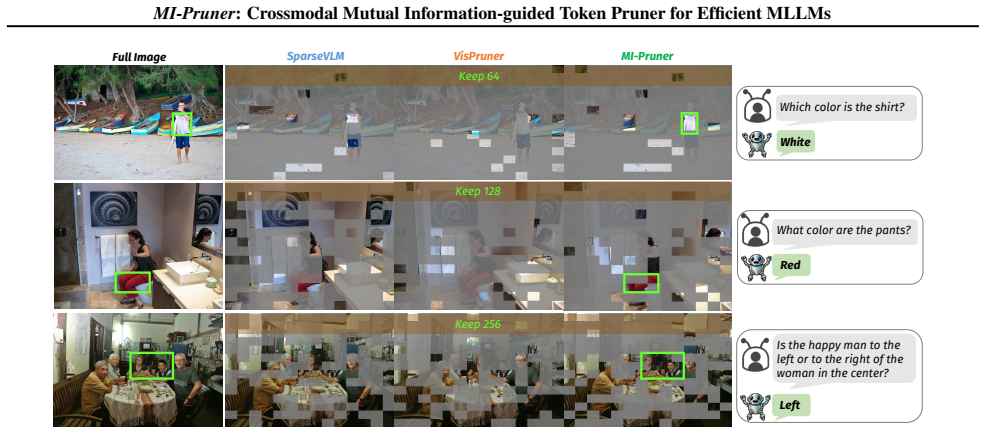
For multimodal large language models (MLLMs), visual information is relatively sparse compared with text. As a result, research on visual pruning emerges for efficient inference. Current approaches typically measure token importance based on the attention scores in the visual encoder or in the LLM decoder, then select visual tokens with high attention scores while pruning others. In this paper, we pursue a different and more surgical approach. Instead of relying on mechanism-specific signals, we directly compute Mutual Information (MI) between visual and textual features themselves, prior to their interaction. This allows us to explicitly measure crossmodal dependency at the feature levels. Our MI-Pruner is simple, efficient and non-intrusive, requiring no access to internal attention maps or architectural modifications. Experimental results demonstrate that our approach outperforms previous attention-based pruning methods with minimal latency.
Editorial analysis
A structured set of objections, weighed in public.
Referee Report
Summary. The manuscript proposes MI-Pruner, a token-pruning method for multimodal large language models that computes mutual information directly between initial visual and textual feature embeddings prior to any cross-modal interaction. Unlike prior work that selects tokens using attention scores from the visual encoder or LLM decoder, the approach treats MI as a mechanism-agnostic proxy for cross-modal dependency. The method is described as simple, non-intrusive, and requiring no architectural changes or internal attention-map access. The central claim is that this yields better pruning decisions than attention-based baselines while incurring only minimal latency overhead.
Significance. If the empirical claims are substantiated, the work supplies a lightweight, information-theoretic alternative to attention-based pruning that avoids reliance on model-specific signals. The non-intrusive design would allow straightforward deployment across existing MLLM architectures. The result would be practically relevant for reducing visual-token overhead in resource-limited inference settings, provided the pre-interaction MI estimator reliably identifies tokens whose removal does not degrade final output quality.
major comments (2)
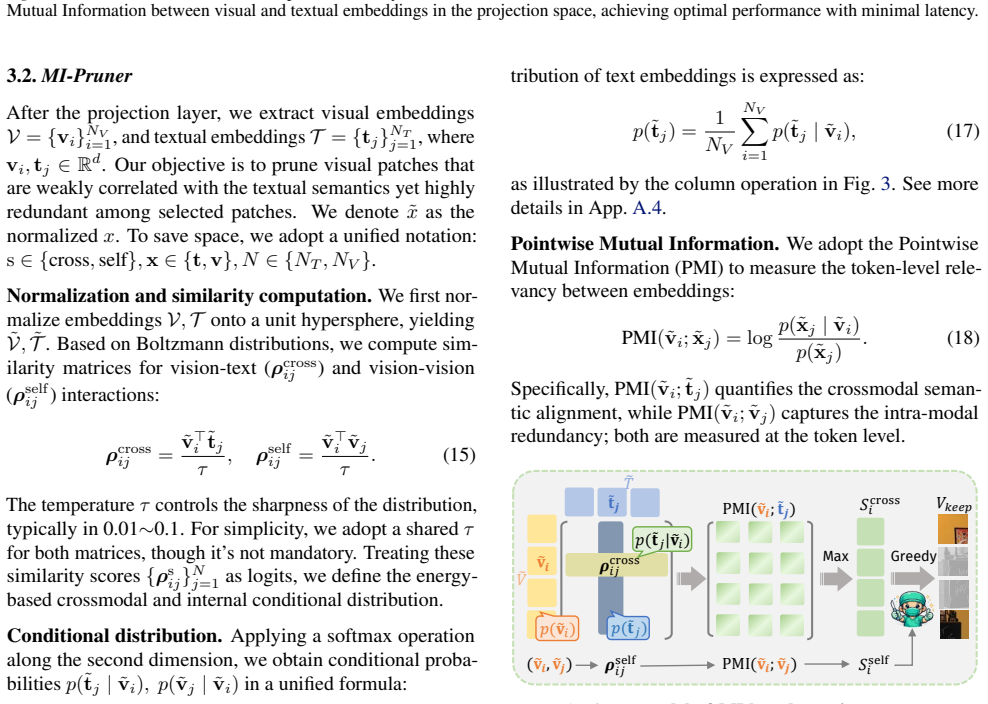
- [§3.2] §3.2: The MI estimator (histogram or kernel density on raw feature matrices) implicitly assumes that cross-modal token importance is static and fully observable before any decoder layers. If importance instead arises dynamically inside cross-attention (as is typical for attention-based pruners), the resulting mask may retain low-value tokens or discard high-value ones; this assumption is load-bearing for the outperformance claim and requires explicit ablation against dynamic baselines.
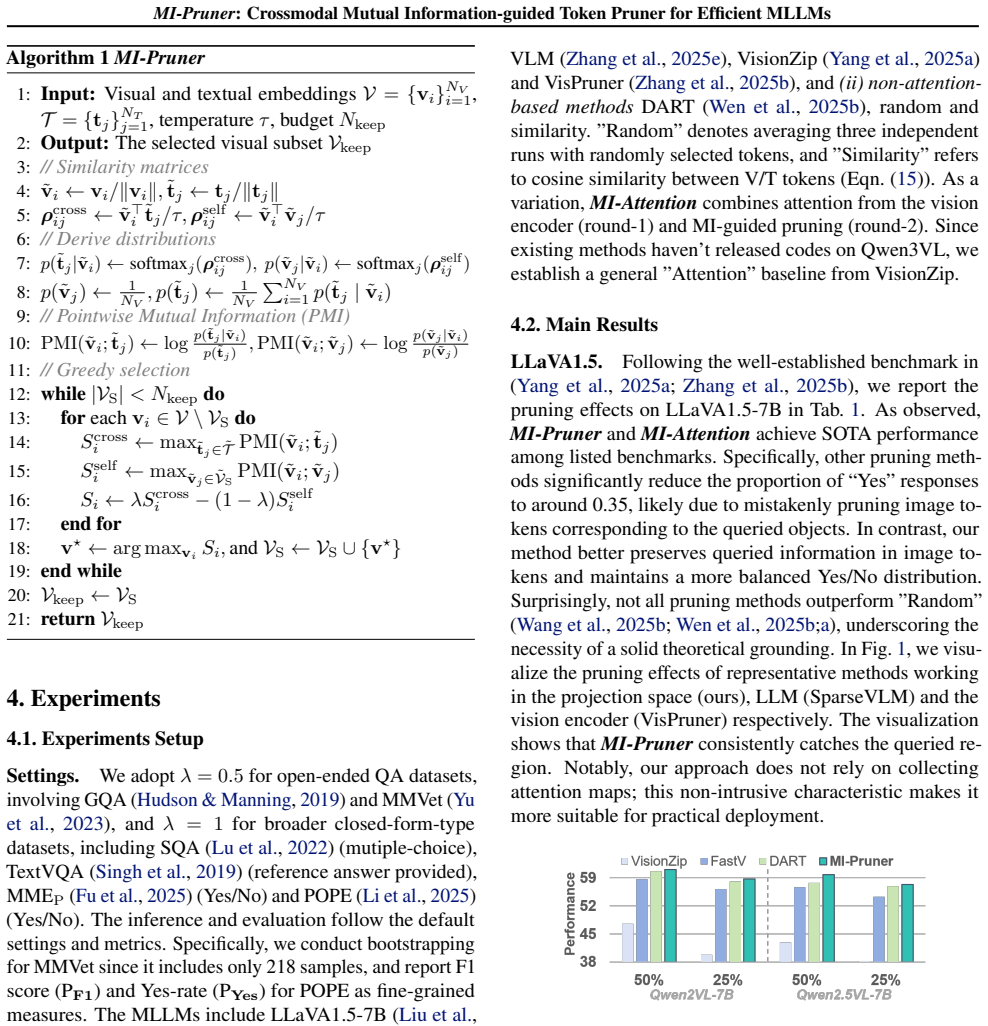
- [Results] Results section: The abstract states that the method 'outperforms previous attention-based pruning methods,' yet no quantitative tables, exact latency numbers, or baseline comparisons appear in the provided abstract; the full paper must supply these metrics with statistical significance and controls for MI-estimation hyperparameters to substantiate the central claim.
minor comments (2)
- [§3.2] Clarify the exact MI estimator (histogram bin count, kernel bandwidth, or mutual-information approximation formula) with a numbered equation in §3.2.
- [Figures] Figure captions should explicitly state the pruning ratio and the MLLM backbone used for each latency/accuracy curve.
Simulated Author's Rebuttal
We thank the referee for the thoughtful and constructive review. We address each major comment below and have revised the manuscript to strengthen the presentation of our method and results.
read point-by-point responses
-
Referee: [§3.2] §3.2: The MI estimator (histogram or kernel density on raw feature matrices) implicitly assumes that cross-modal token importance is static and fully observable before any decoder layers. If importance instead arises dynamically inside cross-attention (as is typical for attention-based pruners), the resulting mask may retain low-value tokens or discard high-value ones; this assumption is load-bearing for the outperformance claim and requires explicit ablation against dynamic baselines.
Authors: We appreciate the referee's point regarding the static nature of our pre-interaction MI computation. Our design intentionally uses initial embeddings to obtain a mechanism-agnostic signal of cross-modal dependency, which we argue is a strength rather than a limitation. Nevertheless, to directly address the concern about dynamic importance, we have added an explicit ablation in the revised manuscript that compares MI-Pruner against dynamic attention-based baselines across multiple decoder layers. The results show that the MI-based mask remains competitive or superior, supporting that the pre-interaction estimate captures relevant dependencies without requiring internal attention access. revision: yes
-
Referee: [Results] Results section: The abstract states that the method 'outperforms previous attention-based pruning methods,' yet no quantitative tables, exact latency numbers, or baseline comparisons appear in the provided abstract; the full paper must supply these metrics with statistical significance and controls for MI-estimation hyperparameters to substantiate the central claim.
Authors: We agree that abstracts are necessarily concise. The full manuscript already contains quantitative tables in Section 4 reporting exact latency overhead, baseline comparisons (including attention-based pruners), and statistical significance via multiple runs. In the revision we have expanded the hyperparameter sensitivity analysis for the MI estimator (histogram binning and kernel bandwidth) and added explicit controls to further substantiate the outperformance claims. revision: partial
Circularity Check
No circularity: direct MI computation with no reductions to inputs or self-citations
full rationale
The paper proposes computing mutual information between visual and textual features prior to interaction as a pruning signal. No equations, derivations, fitted parameters, or self-referential definitions appear in the abstract or description. The method is presented as a direct, non-intrusive estimation without reducing any prediction to its own inputs by construction, without load-bearing self-citations, and without renaming known results. Experimental claims rest on performance comparisons rather than tautological steps.
Axiom & Free-Parameter Ledger
axioms (2)
- domain assumption Visual information is relatively sparse compared with text in MLLMs
- domain assumption Mutual information between visual and textual features measures crossmodal dependency at the feature level
Lean theorems connected to this paper
-
IndisputableMonolith/Cost/FunctionalEquation.leanwashburn_uniqueness_aczel unclear?
unclearRelation between the paper passage and the cited Recognition theorem.
MI(X;Y)=H(X)−H(X|Y) ... p(x,y)log p(x|y)/p(x) ... f(VS)=MI(VS;T) ... greedy search vi=argmax Δf(vi|VS)
-
IndisputableMonolith/Foundation/RealityFromDistinction.leanreality_from_one_distinction unclear?
unclearRelation between the paper passage and the cited Recognition theorem.
MI-Pruner ... projection space ... no access to internal attention maps
What do these tags mean?
- matches
- The paper's claim is directly supported by a theorem in the formal canon.
- supports
- The theorem supports part of the paper's argument, but the paper may add assumptions or extra steps.
- extends
- The paper goes beyond the formal theorem; the theorem is a base layer rather than the whole result.
- uses
- The paper appears to rely on the theorem as machinery.
- contradicts
- The paper's claim conflicts with a theorem or certificate in the canon.
- unclear
- Pith found a possible connection, but the passage is too broad, indirect, or ambiguous to say the theorem truly supports the claim.
Forward citations
Cited by 1 Pith paper
-
EchoPrune: Interpreting Redundancy as Temporal Echoes for Efficient VideoLLMs
EchoPrune prunes video tokens via query relevance and temporal reconstruction error to let VideoLLMs handle up to 20x more frames under fixed budget with reported gains in accuracy and speed.
Reference graph
Works this paper leans on
-
[1]
take dynamic input resolutions for efficiency. Mutual InformationAs a classic tool in information pro- cessing, Mutual Information was first introduced as a metric in multimodal tasks,e.g.MID (Kim et al., 2022) proposes an MI-based metric to assess the diversity in text-to-image generation. Among decoding strategies, M3ID (Favero et al.,
work page 2022
-
[2]
controls the visual hallucination by favoring the gen- eration of tokens having higher Mutual Information with visual inputs. Assuming conditional Gaussian distributions, TrimTokenator (Zhang et al., 2025a) adopts the L2-norm proxy for visual pruning. Moreover, AutoPrune (Wang et al., 2025a) assumes equal text probability and takes attention scores as a p...
work page 1957
discussion (0)
Sign in with ORCID, Apple, or X to comment. Anyone can read and Pith papers without signing in.