Recognition: 2 theorem links
· Lean TheoremEntropy correction artificial viscosity for high order DG methods using multiple artificial viscosities
Pith reviewed 2026-05-13 18:41 UTC · model grok-4.3
The pith
Multiple artificial viscosities with analytical parameters enable precise targeting of physical phenomena in entropy-stable DG methods.
A machine-rendered reading of the paper's core claim, the machinery that carries it, and where it could break.
Core claim
Extending the entropy correction artificial viscosity to multiple types such as viscosity and thermal diffusivity, together with analytically derived optimal parameter values, allows more precise targeting of specific physical phenomena than a single viscosity parameter while retaining robustness across general problem settings, as shown by comparisons on one- and two-dimensional test problems.
What carries the argument
The entropy correction artificial viscosity formulation extended to multiple viscosity types, with closed-form analytical expressions for the optimal parameters of each type.
If this is right
- Users can apply dissipation selectively to thermal effects separately from momentum diffusion.
- Robustness for shocks, turbulence, and under-resolved features is preserved without retuning.
- Entropy stability is achieved without evaluating computationally expensive entropy-conservative fluxes.
- Simple analytical formulas replace ad-hoc parameter choices for the viscosity terms.
Where Pith is reading between the lines
- The same multi-parameter construction could be applied to three-dimensional problems or to additional diffusion mechanisms such as species transport.
- Targeted lower dissipation in some regions may improve resolution of fine-scale turbulence features compared with monolithic viscosity.
- The analytical parameter expressions could be adapted to other high-order discretizations that use artificial viscosity for stabilization.
Load-bearing premise
That the derived analytical expressions for optimal viscosity parameters remain effective and generalizable beyond the specific 1D and 2D test problems shown, without requiring problem-specific retuning.
What would settle it
A three-dimensional shock-turbulence interaction test in which the multi-viscosity parameters fail to enforce the entropy inequality or produce non-robust solutions without retuning.
Figures


read the original abstract
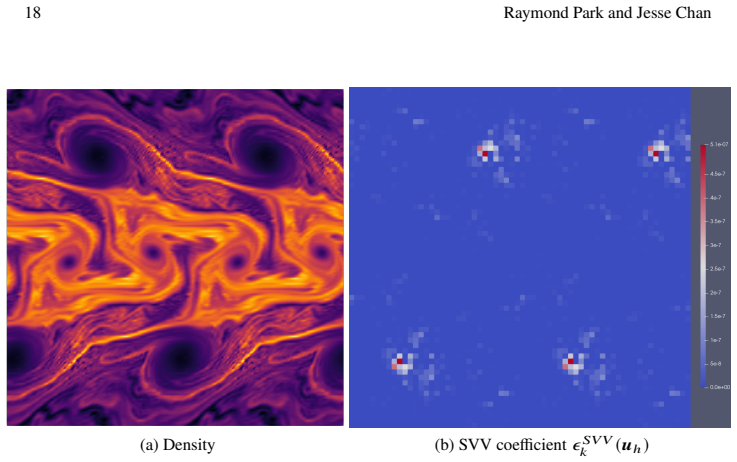
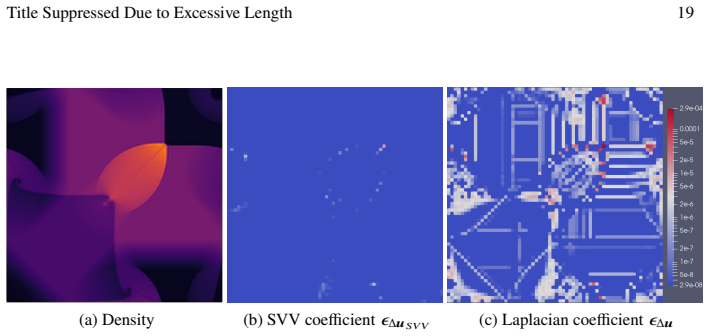
Entropy stable discontinuous Galerkin (DG) methods display improved robustness for problems with shocks, turbulence, and under-resolved features by enforcing an entropy inequality. Such methods have traditionally relied on entropy conservative (EC) fluxes that are computationally expensive to evaluate. An alternative approach for enforcing an entropy inequality is through a minimally dissipative ``entropy correction" artificial viscosity. We review how to construct such an artificial viscosity formulation and extend this approach to multiple types of viscosity (e.g., viscosity and thermal diffusivity). We determine simple analytical expressions for optimal viscosity parameters. We compare this to the case of a single monolithic viscosity parameter for different 1D and 2D problems, and show that the proposed method allows users to more precisely target specific physical phenomena while retaining robustness for general problem settings.
Editorial analysis
A structured set of objections, weighed in public.
Referee Report
Summary. The manuscript proposes an extension of entropy-correction artificial viscosity for high-order discontinuous Galerkin methods by introducing multiple distinct viscosity terms (e.g., separate viscosity and thermal diffusivity). It derives simple analytical expressions for the optimal parameters of these terms, compares the multi-viscosity formulation against a single monolithic parameter on selected 1D and 2D test problems, and claims that the new approach permits more precise targeting of physical phenomena while preserving robustness for general settings.
Significance. If the analytical expressions remain near-optimal without retuning across a broader range of regimes, the method supplies a low-cost route to entropy stability that avoids the expense of entropy-conservative fluxes, thereby increasing flexibility for DG simulations of shocks, turbulence, and under-resolved flows.
major comments (2)
- [Derivation of optimal multi-viscosity parameters] The derivation of the closed-form optimal parameters (obtained by minimizing a local dissipation functional or solving an algebraic system tied to the entropy correction) is not accompanied by an explicit statement of the underlying assumptions, such as local smoothness for Taylor expansion of entropy variables or a particular numerical-flux structure. If these assumptions are violated by strong shocks or under-resolved turbulence, the claimed optimality may not hold, undermining the central claim of parameter-free generality.
- [Numerical experiments section] The numerical comparisons on 1D and 2D problems demonstrate improvement over a single viscosity parameter, yet no sensitivity study is reported that perturbs polynomial degree, mesh aspect ratio, or Mach number while retaining the same analytical expressions. This omission leaves the robustness claim load-bearing on the specific test suite rather than on a general proof of near-optimality.
minor comments (2)
- [Abstract] The abstract states that comparisons were performed on 1D and 2D problems but does not list the specific test cases or quantitative metrics (e.g., error norms or entropy-production rates) used to support the improvement claim.
- [Notation and formulation] Notation for the separate viscosity coefficients should be introduced once and used consistently; occasional reuse of symbols for the single-viscosity case creates minor ambiguity.
Simulated Author's Rebuttal
We thank the referee for the constructive feedback on our manuscript. We address each major comment point by point below, indicating the changes we will make in the revised version.
read point-by-point responses
-
Referee: The derivation of the closed-form optimal parameters (obtained by minimizing a local dissipation functional or solving an algebraic system tied to the entropy correction) is not accompanied by an explicit statement of the underlying assumptions, such as local smoothness for Taylor expansion of entropy variables or a particular numerical-flux structure. If these assumptions are violated by strong shocks or under-resolved turbulence, the claimed optimality may not hold, undermining the central claim of parameter-free generality.
Authors: We appreciate this observation. In the revised manuscript, we will add an explicit subsection detailing the assumptions, including the local smoothness requirement for the Taylor expansion of entropy variables and the specific numerical-flux structure employed. We acknowledge that strong shocks or highly under-resolved turbulence may locally violate the smoothness assumption. Nevertheless, the entropy correction is formulated to enforce the inequality in a global sense, and our numerical results on problems containing shocks demonstrate that the method retains robustness even when the local optimality is approximate. The analytical expressions are intended to provide effective, untuned parameters rather than exact optimality in every regime. revision: yes
-
Referee: The numerical comparisons on 1D and 2D problems demonstrate improvement over a single viscosity parameter, yet no sensitivity study is reported that perturbs polynomial degree, mesh aspect ratio, or Mach number while retaining the same analytical expressions. This omission leaves the robustness claim load-bearing on the specific test suite rather than on a general proof of near-optimality.
Authors: We agree that additional sensitivity information would strengthen the robustness claim. In the revised manuscript we will augment the numerical experiments section with a short sensitivity study that perturbs polynomial degree (P=1 to P=3) and mesh aspect ratio on the existing 1D and 2D test cases while keeping the analytical parameters fixed. Regarding Mach number, the derivation is independent of Mach number because it follows directly from the entropy correction; we will add a brief discussion of this independence together with one supplementary high-Mach test to illustrate retention of performance. A general proof of near-optimality across all regimes lies outside the present scope, but the combination of the analytical derivation and the expanded numerical evidence supports the practical utility of the expressions. revision: partial
Circularity Check
No significant circularity; analytical expressions derived independently from entropy inequality
full rationale
The paper reviews the construction of entropy-correction artificial viscosity from prior entropy-stable DG literature, then extends the formulation to separate viscosity and thermal diffusivity parameters. It states that simple analytical expressions for the optimal parameters are determined by minimizing a local dissipation functional tied directly to the entropy correction term. No step reduces by construction to a fitted input renamed as prediction, nor does any load-bearing claim rest solely on a self-citation chain whose own justification is unverified. The 1D/2D comparisons serve as validation rather than the source of the closed-form expressions. The derivation chain remains self-contained against the stated entropy inequality and dissipation minimization, with no evidence of self-definitional loops or ansatz smuggling.
Axiom & Free-Parameter Ledger
axioms (1)
- domain assumption Entropy inequality can be enforced through artificial viscosity in DG methods
Lean theorems connected to this paper
-
IndisputableMonolith/Cost/FunctionalEquationwashburn_uniqueness_aczel echoes?
echoesECHOES: this paper passage has the same mathematical shape or conceptual pattern as the Recognition theorem, but is not a direct formal dependency.
min ½ εᵀ W ε s.t. rᵀ ε = σ_k(u_h) … ε_i = σ r_i / Σ r_j²
-
IndisputableMonolith/Foundation/AbsoluteFloorClosurereality_from_one_distinction unclear?
unclearRelation between the paper passage and the cited Recognition theorem.
entropy correction artificial viscosity … provably dissipative BR1 discretization
What do these tags mean?
- matches
- The paper's claim is directly supported by a theorem in the formal canon.
- supports
- The theorem supports part of the paper's argument, but the paper may add assumptions or extra steps.
- extends
- The paper goes beyond the formal theorem; the theorem is a base layer rather than the whole result.
- uses
- The paper appears to rely on the theorem as machinery.
- contradicts
- The paper's claim conflicts with a theorem or certificate in the canon.
- unclear
- Pith found a possible connection, but the passage is too broad, indirect, or ambiguous to say the theorem truly supports the claim.
Reference graph
Works this paper leans on
-
[1]
Barth, T.J.: Numerical methods for gasdynamic systems on unstructured meshes. In: An Intro- duction to Recent Developments in Theory and Numerics for Conservation Laws: Proceedings of the International School on Theory and Numerics for Conservation Laws, Freiburg/Littenweiler, October 20–24, 1997, pp. 195–285. Springer (1999)
work page 1997
-
[2]
Journal of Computational Physics131(2), 267–279 (1997)
Bassi, F., Rebay, S.: A high-order accurate discontinuous finite element method for the numerical solution of the compressible Navier–Stokes equations. Journal of Computational Physics131(2), 267–279 (1997)
work page 1997
-
[3]
SIAM Journal on Scientific Computing36(5), B835–B867 (2014)
Carpenter, M.H., Fisher, T.C., Nielsen, E.J., Frankel, S.H.: Entropy stable spectral collocation schemes for the Navier-Stokes equations: Discontinuous interfaces. SIAM Journal on Scientific Computing36(5), B835–B867 (2014)
work page 2014
-
[4]
Journal of Computational Physics362, 346–374 (2018)
Chan, J.: On discretely entropy conservative and entropy stable discontinuous Galerkin methods. Journal of Computational Physics362, 346–374 (2018)
work page 2018
-
[5]
Chan, J.: An artificial viscosity approach to high order entropy stable discontinuous Galerkin methods. Journal of Computational Physics543, 114380 (2025). DOI https://doi.org/10.1016/j. jcp.2025.114380
work page doi:10.1016/j 2025
-
[6]
Journal of Computational Physics448, 110723 (2022)
Chan, J., Lin, Y., Warburton, T.: Entropy stable modal discontinuous Galerkin schemes and wall boundary conditions for the compressible Navier-Stokes equations. Journal of Computational Physics448, 110723 (2022)
work page 2022
-
[7]
Frontiers in Physics10, 898028 (2022)
Chan, J., Ranocha, H., Rueda-Ram ´ırez, A.M., Gassner, G., Warburton, T.: On the entropy projec- tion and the robustness of high order entropy stable discontinuous Galerkin schemes for under- resolved flows. Frontiers in Physics10, 898028 (2022)
work page 2022
-
[8]
Journal of Computational Physics345, 427– 461 (2017)
Chen, T., Shu, C.W.: Entropy stable high order discontinuous Galerkin methods with suitable quadrature rules for hyperbolic conservation laws. Journal of Computational Physics345, 427– 461 (2017)
work page 2017
-
[9]
arXiv preprint arXiv:2508.21226 (2025)
Christner, B., Chan, J.: Entropy stable finite difference methods via entropy correction artificial viscosity and knapsack limiting. arXiv preprint arXiv:2508.21226 (2025)
-
[10]
arXiv preprint arXiv:2507.14488 (2025)
Christner, B., Chan, J.: Entropy stable nodal discontinuous Galerkin methods via quadratic knap- sack limiting. arXiv preprint arXiv:2507.14488 (2025)
-
[11]
Journal of Computational Physics348, 754–775 (2017)
Ferrer, E.: An interior penalty stabilised incompressible discontinuous Galerkin–Fourier solver for implicit large eddy simulations. Journal of Computational Physics348, 754–775 (2017)
work page 2017
-
[12]
Foundations of Com- putational Mathematics17(3), 763–827 (2017)
Fjordholm, U.S., K ¨appeli, R., Mishra, S., Tadmor, E.: Construction of approximate entropy measure-valued solutions for hyperbolic systems of conservation laws. Foundations of Com- putational Mathematics17(3), 763–827 (2017)
work page 2017
-
[13]
SIAM Journal on Scientific Computing33(5), 2560–2579 (2011)
Gassner, G., Kopriva, D.A.: A comparison of the dispersion and dissipation errors of Gauss and Gauss–Lobatto discontinuous Galerkin spectral element methods. SIAM Journal on Scientific Computing33(5), 2560–2579 (2011)
work page 2011
-
[14]
SIAM Journal on Scientific Computing35(3), A1233–A1253 (2013)
Gassner, G.J.: A skew-symmetric discontinuous Galerkin spectral element discretization and its relation to SBP-SAT finite difference methods. SIAM Journal on Scientific Computing35(3), A1233–A1253 (2013)
work page 2013
-
[15]
Journal of Computational Physics327, 39–66 (2016)
Gassner, G.J., Winters, A.R., Kopriva, D.A.: Split form nodal discontinuous Galerkin schemes with summation-by-parts property for the compressible Euler equations. Journal of Computational Physics327, 39–66 (2016)
work page 2016
-
[16]
Godlewski, E., Raviart, P.A.: Numerical approximation of hyperbolic systems of conservation laws, vol. 118. Springer Science & Business Media (2013)
work page 2013
-
[17]
Journal of Computational Physics49(1983)
Harten, A.: On the symmetric form of systems of conservation laws with entropy. Journal of Computational Physics49(1983)
work page 1983
-
[18]
Journal of Computational Physics163(1), 22–50 (2000)
Karamanos, G., Karniadakis, G.: A Spectral Vanishing Viscosity Method for Large-eddy simula- tions. Journal of Computational Physics163(1), 22–50 (2000)
work page 2000
-
[19]
Numerical Methods for Partial Differential Equations: An International Journal18(5), 584–608 (2002)
Kurganov, A., Tadmor, E.: Solution of two-dimensional Riemann problems for gas dynamics without Riemann problem solvers. Numerical Methods for Partial Differential Equations: An International Journal18(5), 584–608 (2002)
work page 2002
-
[20]
In: 21st AIAA Compu- tational Fluid Dynamics Conference, p
Liou, M.S.: Why is the overheating problem difficult: The role of entropy. In: 21st AIAA Compu- tational Fluid Dynamics Conference, p. 2697 (2013) Title Suppressed Due to Excessive Length 21
work page 2013
-
[21]
In: 23rd AIAA Computational Fluid Dynamics Conference, p
Liou, M.S.: The root cause of the overheating problem. In: 23rd AIAA Computational Fluid Dynamics Conference, p. 4107 (2017)
work page 2017
-
[22]
SIAM Journal on Numerical Analysis30(2), 321–342 (1993)
Maday, Y., Kaber, S.M.O., Tadmor, E.: Legendre Pseudospectral Viscosity Method for Nonlinear Conservation Laws. SIAM Journal on Numerical Analysis30(2), 321–342 (1993)
work page 1993
-
[23]
Computers & Fluids200, 104440 (2020)
Manzanero, J., Ferrer, E., Rubio, G., Valero, E.: Design of a Smagorinsky spectral vanishing viscosity turbulence model for discontinuous Galerkin methods. Computers & Fluids200, 104440 (2020)
work page 2020
-
[24]
Journal of Computational Physics471, 111618 (2022)
Mateo-Gab ´ın, A., Manzanero, J., Valero, E.: An entropy stable spectral vanishing viscosity for discontinuous Galerkin schemes: Application to shock capturing and LES models. Journal of Computational Physics471, 111618 (2022)
work page 2022
-
[25]
Journal of Computational Physics307, 401–422 (2016)
Moura, R.C., Sherwin, S.J., Peir ´o, J.: Eigensolution analysis of spectral/hp continuous Galerkin approximations to advection–diffusion problems: Insights into spectral vanishing viscosity. Journal of Computational Physics307, 401–422 (2016)
work page 2016
-
[26]
jl–a performant and feature-rich ecosystem for solving differential equations in Julia
Rackauckas, C., Nie, Q.: Differentialequations. jl–a performant and feature-rich ecosystem for solving differential equations in Julia. Journal of open research software5(1), 15–15 (2017)
work page 2017
-
[27]
Ranocha, H., Schlottke-Lakemper, M., Winters, A.R., Faulhaber, E., Chan, J., Gassner, G.J.: Adaptive numerical simulations with trixi. jl: A case study of julia for scientific computing. arXiv preprint arXiv:2108.06476 (2021)
-
[28]
Journal of Computational Physics518, 113323 (2024)
Sv ¨ard, M.: A convergent finite-volume scheme for the diffusive compressible Euler model—resolved and under-resolved flows. Journal of Computational Physics518, 113323 (2024)
work page 2024
-
[29]
SIAM Journal on Numerical Analysis26(1), 30–44 (1989)
Tadmor, E.: Convergence of spectral methods for nonlinear conservation laws. SIAM Journal on Numerical Analysis26(1), 30–44 (1989)
work page 1989
-
[30]
arXiv preprint arXiv:2602.23210 (2026)
Van Fleet, S., Chan, J.: On the choice of viscous discontinuous Galerkin discretization for entropy correction artificial viscosity methods. arXiv preprint arXiv:2602.23210 (2026)
-
[31]
International Journal for Numerical Methods in Fluids72(8), 811–845 (2013)
Wang, Z.J., Fidkowski, K., Abgrall, R., Bassi, F., Caraeni, D., Cary, A., Deconinck, H., Hartmann, R., Hillewaert, K., Huynh, H.T., et al.: High-order CFD methods: current status and perspective. International Journal for Numerical Methods in Fluids72(8), 811–845 (2013)
work page 2013
discussion (0)
Sign in with ORCID, Apple, or X to comment. Anyone can read and Pith papers without signing in.