pith. machine review for the scientific record. sign in

arxiv: 2604.03161 · v1 · submitted 2026-04-03 · 🧮 math.SG

Recognition: 2 theorem links

· Lean Theorem

Tropical disk potential for almost toric manifolds

C. T. Woodward, S. Venugopalan

Authors on Pith no claims yet

Pith reviewed 2026-05-13 18:11 UTC · model grok-4.3

classification 🧮 math.SG
keywords tropical disk potentialalmost toric manifoldsLagrangian toridisk potentialsdel Pezzo surfacestropical geometrysymplectic geometry
0
0 comments X

The pith

A tropical formula computes the disk potentials of Lagrangian tori in almost toric four-manifolds from their fibration data.

A machine-rendered reading of the paper's core claim, the machinery that carries it, and where it could break.

The paper establishes a tropical formula for the disk potentials of Lagrangian tori inside almost toric four-manifolds. These manifolds are symplectic fibrations by tori whose only singularities are of toric or focus-focus type. The formula generalizes Mikhalkin's earlier tropical count of holomorphic spheres in the projective plane. It produces explicit potentials for all monotone del Pezzo surfaces, reproducing earlier results obtained by Floer-theoretic and Gross-Siebert methods.

Core claim

Using our previous work we give a tropical formula for disk potentials for Lagrangian tori in almost toric four-manifolds, that is, fibrations by Lagrangian tori with only toric and focus-focus singularities, generalizing results of Mikhalkin for holomorphic spheres in the projective plane. As examples, we directly compute potentials for Lagrangian tori in del Pezzo surfaces equipped with monotone symplectic forms.

What carries the argument

The tropical disk potential constructed directly from the almost toric fibration by recording the contributions of Maslov index two disks as tropical curves in the base.

If this is right

  • Disk potentials for any Lagrangian torus in an almost toric four-manifold become computable from the combinatorial data of its base diagram.
  • The same tropical counts recover the superpotentials previously obtained for monotone del Pezzo surfaces by other techniques.
  • The method supplies a uniform way to pass from the geometry of the fibration to the algebraic structure of the Lagrangian Floer theory.

Where Pith is reading between the lines

These are editorial extensions of the paper, not claims the author makes directly.

  • The formula may extend to almost toric manifolds with more complicated singularities once appropriate tropical corrections are identified.
  • These potentials could give new information about the quantum cohomology ring or the Fukaya category of the ambient manifold.
  • The approach offers a route to verify predictions from the Gross-Siebert program by direct comparison of tropical and symplectic counts.

Load-bearing premise

The fibration consists solely of toric and focus-focus singularities so that the tropical formula derived in the authors' prior work applies without additional correction terms.

What would settle it

An explicit Floer-theoretic computation of the disk potential for a monotone Lagrangian torus in a del Pezzo surface that produces a term absent from or differing in coefficient from the tropical prediction.

Figures
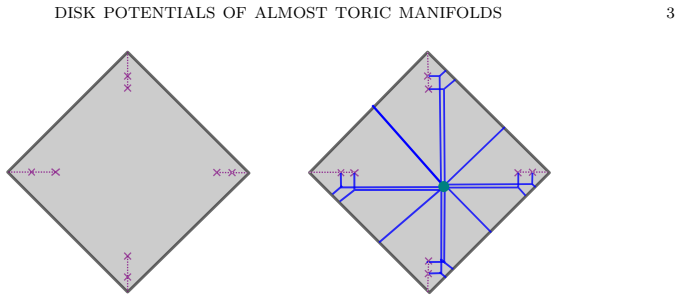
Figures reproduced from arXiv: 2604.03161 by C. T. Woodward, S. Venugopalan.

Figure 1
Figure 1. Figure 1: An almost toric diagram for the del Pezzo of degree four and the twelve tropical disks contributing to the potential of the monotone torus [5], The tropical computations reproduce the maximally mutable Laurent polyno￾mials found in mirror symmetry; see, for example, Akhtar et al. [1] on the basis of maximal mutability. The results in Bardwell-Evans et al. [2] take a detour through algebraic geometry. In th… view at source ↗
Figure 2
Figure 2. Figure 2: An almost toric diagram for the Chekanov torus and the four tropical disks contributing to the potential Example 1.6. (Potential for the Chekanov torus) An almost toric diagram for P 2 is shown in [PITH_FULL_IMAGE:figures/full_fig_p008_2.png] view at source ↗
Figure 3
Figure 3. Figure 3: Cartoon diagrams for the 252 degree one curves in Bl8 P 2 e ′ e 1 ′ 3 e ′ 2 ℓ3 ℓ2 ℓ1 Γ pert v e1 e2 e3 e4 e5 v Γv [PITH_FULL_IMAGE:figures/full_fig_p010_3.png] view at source ↗
Figure 4
Figure 4. Figure 4: Perturbing incoming edges of v with parameters ℓ1 > ℓ2 > ℓ3. The pairs e1, e5 and e2, e3 are coincident in Γ. multiplicity of v is defined by is m(v) := X Γ pert v   Y v1∈Vert(Γpert v ) m(v1)   , where the sum ranges over all perturbed graphs of Γv that respect a fixed ordering (5) of incoming edges. (We will see later that different orderings (5) of the incoming edges produce the same multiplicity. ) … view at source ↗
Figure 5
Figure 5. Figure 5: Perturbing Γ in [PITH_FULL_IMAGE:figures/full_fig_p011_5.png] view at source ↗
Figure 6
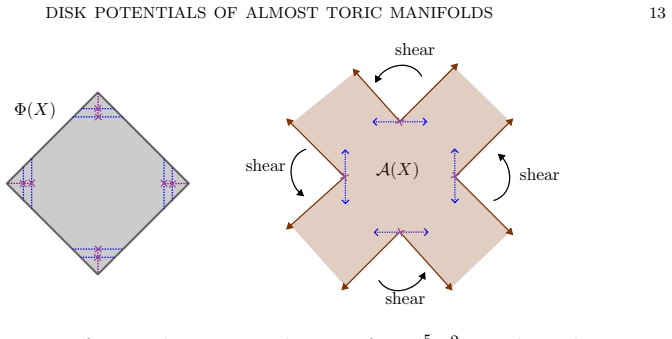
Figure 6. Figure 6: Left: an almost toric diagram for Bl5 P 2 . Right: The dual affine manifold, and the blue dotted lines indicate the direction µb in which a tropical curve emanates from a singular point b. Section 5, and shown in [PITH_FULL_IMAGE:figures/full_fig_p013_6.png] view at source ↗
Figure 7
Figure 7. Figure 7: A focus-focus singularity where π : T ∗S 2 → S 2 is the projection, ξ ∈ R 3 is the direction of gravity and ∥v∥ is the norm defined using the standard invariant metric. The angular momentum is defined by ψ : X → R, v 7→ ⟨ι(v), ξ⟩ where ι : T ∗S 2 → R 3 is the moment map for the SO(3)-action. Combining the two functions gives rise to a map Ψ := (ϕ, ψ) : X → R 2 . Its moment image has boundary given by the s… view at source ↗
Figure 8
Figure 8. Figure 8: Almost toric diagrams for the del Pezzo surfaces We are particularly interested in almost toric diagrams for del Pezzo surfaces where the focus-focus values are close to the vertices. Definition 2.11. A base diagram (B, ∆, C, Bfoc) of a monotone almost toric man￾ifold X is of Vianna type if the cut loci Ci in C do not intersect, and the image of the monotone fiber λ = Φ(L) does not lie on any branch cut. L… view at source ↗
Figure 9
Figure 9. Figure 9: Operations on almost toric diagrams Definition 2.13. Suppose an almost toric structure on a compact symplectic four￾manifold X with base diagram ∆ is given. (a) Transferring the cut is an operation which produces a new almost toric struc￾ture on X with the same number |Bfoc| of focus-focus values as follows. Sup￾pose the base diagram ∆′ has cuts (C1, . . . , ck). The new cuts are (C ′ 1 , . . . , C′ k ) = … view at source ↗
Figure 10
Figure 10. Figure 10: Transferring a cut The Hamiltonian isotopy class of a Lagrangian fiber of an almost toric structure is invariant under modifications of almost toric structures except for a nodal slide that crosses a focus-focus fiber: Let Φt : X → R 2 , t ∈ [0, 1] [PITH_FULL_IMAGE:figures/full_fig_p020_10.png] view at source ↗
Figure 11
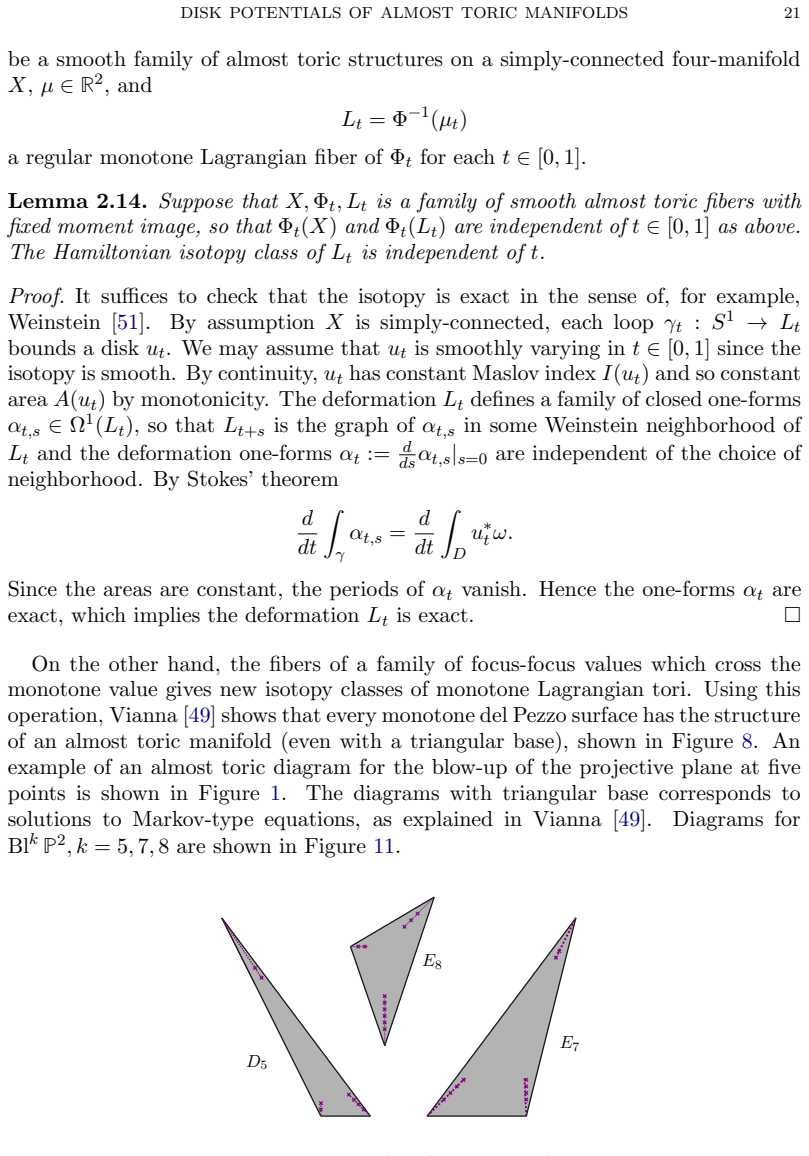
Figure 11. Figure 11: Triangular almost toric diagrams [PITH_FULL_IMAGE:figures/full_fig_p021_11.png] view at source ↗
Figure 12
Figure 12. Figure 12: A polyhedral decomposition of an almost toric diagram and three Maslov-two broken disks The disk potential in a broken manifold is defined similarly to the unbroken case, the only difference being that one counts broken disks. Assuming that L ⊂ X is a monotone Lagrangian brane contained in a top-dimensional component XP ⊂ X , the disk potential is (16) WX,L = X u∈MΓ(X,L,Y )0 HolL([∂u])ϵ(u) d (Γ)! , where … view at source ↗
Figure 13
Figure 13. Figure 13: The moduli space as a product of moduli spaces for its pieces The distribution of constraints give orientations on the edges of the tropical graph. In the statement of Theorem 3.17, for an edge e = (v+, v−), if an end-point v+ has a point constraint and the end-point v− has an trivial constraint, we orient the edge e from v− to v+. This system of orientations on the tropical graph is called the constraint… view at source ↗
Figure 14
Figure 14. Figure 14: The combination P of the polyhedral decompositions P0, P1 has a family of dual complexes {B∨ ρ }ρ. The tropical graph Γ is not realizable in B∨ ρ if ρ is large enough. If the parameter ρ is large enough, we may view the combined multiple cut P as performing the cut P0 followed by P1. This is equivalent to saying that any tropical graph Γ in B∨ ρ can be transformed to a tropical graph in B∨ 0 by collapsing… view at source ↗
Figure 15
Figure 15. Figure 15: Holomorphic curves in the toric local models Proposition 4.9. Suppose that X is a compact symplectic manifold of arbitrary dimension, L is contained in a piece XP0 of X which is a toric variety, that is, P0 ∈ P is a polytope of maximal dimension and Φ(L) is contained in P0, and L is a toric moment fiber. Then the disk potential WL has no constant term, that is, the coefficient of y 0 in W vanishes. Proof.… view at source ↗
Figure 16
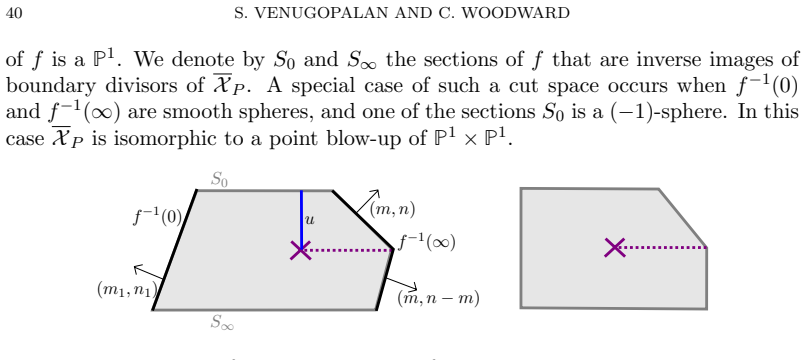
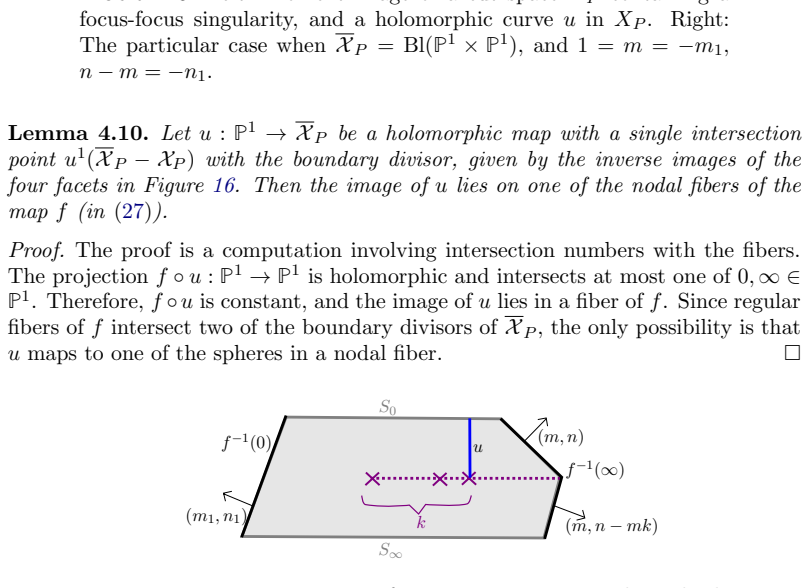
Figure 16. Figure 16: Left: Moment image of a cut space XP containing a focus-focus singularity, and a holomorphic curve u in XP . Right: The particular case when X P = Bl(P 1 × P 1 ), and 1 = m = −m1, n − m = −n1. Lemma 4.10. Let u : P 1 → X P be a holomorphic map with a single intersection point u 1 (X P − XP ) with the boundary divisor, given by the inverse images of the four facets in [PITH_FULL_IMAGE:figures/full_fig_p04… view at source ↗
Figure 17
Figure 17. Figure 17: Moment image of a cut space XP with multiple focus-focus singularities whose shear matrices have the same eigen￾direction, and a holomorphic curve u in XP . In the rest of the section, we count the number of holomorphic spheres in a focus￾focus piece that have a single relative marking, or in other words, the sphere has a single intersection with boundary divisors. For simplicity of notation, we assume th… view at source ↗
Figure 18
Figure 18. Figure 18: Perturbations of Γv. In each case, the figure shows the space and the multiple cut, the dual complex, and the tropical graph. Proposition 4.15. In the above setting, m(v) = mpert(v). Proof. To prove the Proposition, we recall the notion of splitting the matching condi￾tion from our earlier work [47]. The splitting process produces a version of a broken map, called a split map in which there is no matching… view at source ↗
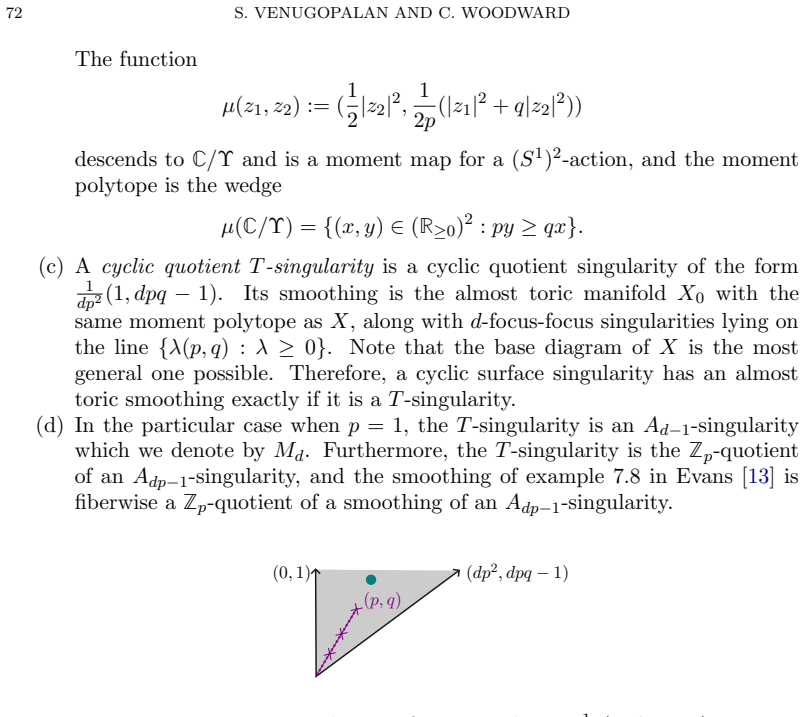
Figure 19
Figure 19. Figure 19: The vertex v in the tropical graph Γ has two incoming edges in the direction (0, 1). Splitting e2 produces the split graph Γ. ˜ The corresponding perturbed graph at v is Γpert v . Definition 4.16. (a) (Coincident edges) Given a map type Γ, a collection of edges ei = (vi , w) is coincident if they share an end-point w, the other end￾points of each of the edges lie on the same focus-focus singularity in X, … view at source ↗
Figure 20
Figure 20. Figure 20: Bunchings of one-sided perturbations of a vertex at a singular point b. Remark 4.19. Proposition 4.15 on the equality of counts of (+) and (−)-perturbations can alternately be proved by explicitly counting both sides via bunching. 5. Tropical graphs of rigid disks In this Section we study special polyhedral decompositions for the almost toric manifolds of the type considered in Vianna [49], which we call … view at source ↗
Figure 21
Figure 21. Figure 21: A standard polyhedral decomposition P on Bl8 P 2 de￾fined as the intersection of Pann and Pin. Lemma 5.6. (A family of dual complexes) Let P0, P1 be polyhedral decompositions of R n with dual complexes B∨ 0 and B∨ 1 respectively, and both P0 and P1 have a cutting datum. Then, the intersection P0 ∩ P1 has a family of dual complexes and cutting data parametrized by ρ > 0, where for any polytope P01 ∈ P0 ∩ P… view at source ↗
Figure 22
Figure 22. Figure 22: Left: A polyhedral decomposition P for X := Bl8 P 2 . The polytope P0 is top-dimensional, Pi , Qi , i = 1, . . . , 6 are zero￾dimensional. Right: Dual complex B∨(ρ). Notation 5.9. Let P be a standard polyhedral decomposition of an almost toric manifold X, with dual complex B∨ [PITH_FULL_IMAGE:figures/full_fig_p051_22.png] view at source ↗
Figure 23
Figure 23. Figure 23: Dual affine manifold corresponding to the polyhedral decomposition P of Bl8 P 2 in [PITH_FULL_IMAGE:figures/full_fig_p052_23.png] view at source ↗
Figure 24
Figure 24. Figure 24: Left: A multiple cut on an almost toric manifold with three elliptic singularities at vertices of the pentagon. Right: The dual complex. An outward pointing vector field µout is defined on Q∨ i , i = 1, . . . , 10. (a) (Annular part of the dual complex) The annular part of the dual complex is a subset of the dual complex B∨ defined as (36) B ∨ ann := [ (P ∨ = P ∨ in × P ∨ ann), dim(P ∨ ann) ≥ 1. In the ab… view at source ↗
Figure 25
Figure 25. Figure 25: Dual polytope R∨ x corresponding to an elliptic singular￾ity x, and the extensions of the outward normal vector µout to R∨ x . (b) (Normals to facets) In the absence of elliptic singularities, the affine manifold B∨ ann ⊂ B∨ has a parallel vector field (37) µout ∈ Vect(B ∨ ann) made up of primitive normals to facets. Such a vector field exists, since in the absence of elliptic singularities, the shear at … view at source ↗
Figure 26
Figure 26. Figure 26: Left: A broken map in Bl8 P 2 whose starting direction is a normal to a divisor. Right: Tropical curve in the dual complex. The polyhedral decomposition and dual complex are as in [PITH_FULL_IMAGE:figures/full_fig_p054_26.png] view at source ↗
Figure 27
Figure 27. Figure 27: Left: A broken map in Bl8 P 2 . Middle: The correspond￾ing cartoon tropical curve. Right: Actual tropical graph in the dual complex. 5.2. Collisions at generic points. In this section we describe the conditions on a standard polyhedral decomposition that ensures that for broken disks of Maslov index 2, collisions occur at generic points in the sense of Definition 1.2. The following is the precise statemen… view at source ↗
Figure 28
Figure 28. Figure 28: Left: A broken map in Bl8 P 2 whose starting direction is a normal to a divisor. Middle: The corresponding cartoon tropical curve. Right: Actual tropical graph in the dual complex. where cξ > 0 is such that for the plane Fξ := {⟨x, ξ⟩ = cξ} ⊂ t ∨, the intersection ∆ ∩ Fξ is non-empty and contained in ∂∆. Proof. The proof is identical to that of Theorem 8.1 in Cho-Oh [9] which computes the area of disks th… view at source ↗
Figure 29
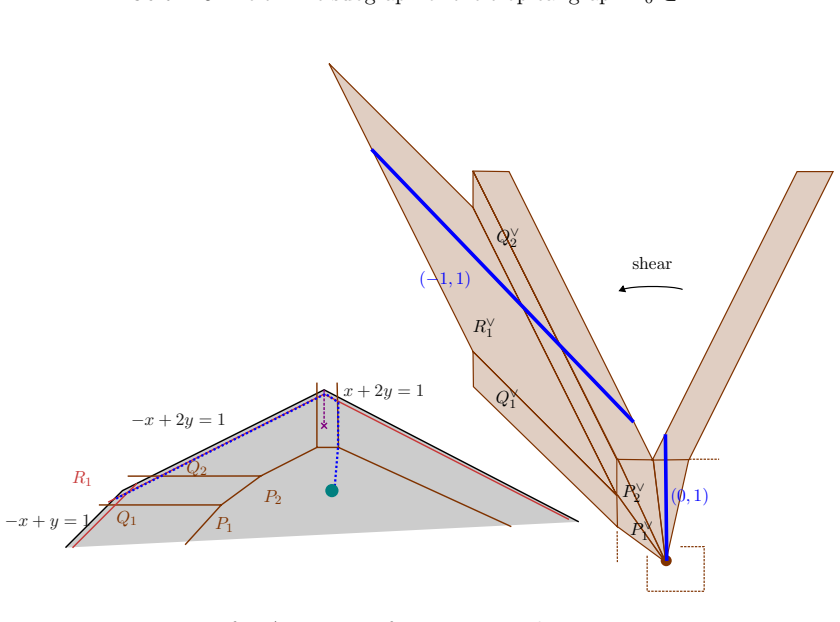
Figure 29. Figure 29: Left: The subgraph of the tropical graph Γ0 ⊂ Γ P1 P2 Q1 Q2 (−1, 1) R1 −x + 2y = 1 −x + y = 1 x + 2y = 1 R∨ 1 Q∨ 1 P ∨ 1 P ∨ 2 Q∨ 2 shear (0, 1) [PITH_FULL_IMAGE:figures/full_fig_p059_29.png] view at source ↗
Figure 30
Figure 30. Figure 30: Left: A portion of a moment polytope containing a A1/Z2-singularity and an elliptic singularity. Right : A tropical graph of a Maslov index two disk [PITH_FULL_IMAGE:figures/full_fig_p059_30.png] view at source ↗
Figure 31
Figure 31. Figure 31: Moving the singular point b1 inward (towards the La￾grangian point λ) removes a rectangle from the dual affine manifold, but does not change the equivalence class. For an almost toric manifold X and a monotone Lagrangian fiber, the dual affine manifold can be determined up to equivalence by the construction (43), which pro￾duces a dual manifold where all focus-focus singularities in a branch cut coincide.… view at source ↗
Figure 32
Figure 32. Figure 32: Types of end-points for a one-dimensional family of tropical graphs. Case 1A: First, consider the case that both v+, v− have valence at least 3 in Γ. Consider any tropical graph Γ± ∈ S±, and let Γ±,v ⊂ Γ± be the subgraph consisting of the vertices that get collapsed to v in Γ0. The positions of the incoming edges 5 of Γ±,v, collectively denoted by ℓ±(v), are fixed across all graphs Γ± ∈ S±, and these posi… view at source ↗
Figure 33
Figure 33. Figure 33: Sliding a node does not change the count of these trop￾ical graphs. The top left is a bunched tropical graph. To apply Theorem 6.8, we need to show that a path of dual affine manifolds does not contain a wall. For this purpose, it is helpful to have a notion of an annular part of a dual affine manifold, which is a slight variation of the corresponding notion (36) for dual complexes: For our purposes we co… view at source ↗
Figure 34
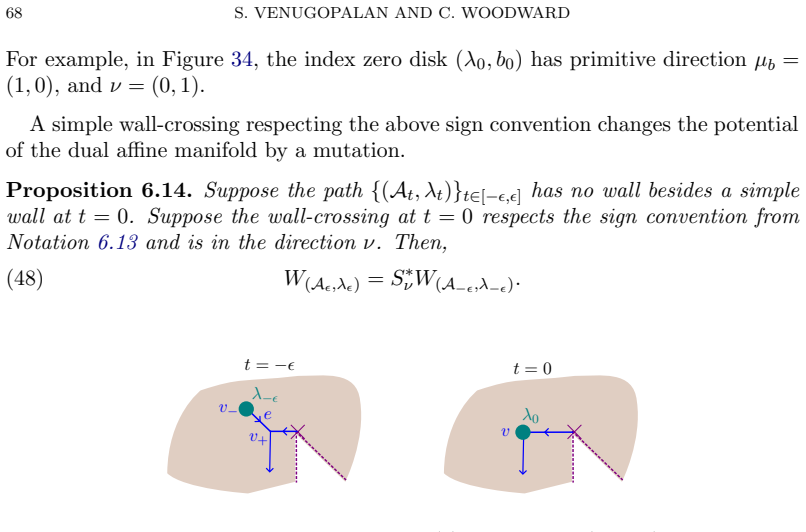
Figure 34. Figure 34: Crossing a wall in the direction ν = (0, 1). Proposition 6.12. Suppose X0, X1 are almost toric manifolds related by a mutation where a single focus-focus singularity b ∈ Xfoc is moved from one side of the polytope to another. Let ∆0, ∆1 be base diagrams of X0, X1 of Vianna type and let (A0, λ0), (A1, λ1) be dual affine manifolds obtained via standard decompositions applied to ∆0, ∆1, with singular points … view at source ↗
Figure 35
Figure 35. Figure 35: The edge length ℓ(e) goes to 0 in (A0, λ0). Proof of Proposition 6.14. By the proof of Theorem 6.8, the potential W(At,λt) is discontinuous at t = t0 only if At has a tropical disk of type 1C, which can occur only if At0 has a wall configuration, so t0 = 0. Furthermore, since A0 only has simple walls, the tropical disk of type 1C is of the form shown in [PITH_FULL_IMAGE:figures/full_fig_p068_35.png] view at source ↗
Figure 36
Figure 36. Figure 36: Corresponding to a disk with initial slope (k, l), l ≥ 0, in A−ϵ, there is a bunched disk in Aϵ for each k1. Here, the edge with direction (−k1, 0) is a bunched edge. We count all such contributions. By the GL(2,Z)-equivariance of the mutation formula (46) (see [39, Remark 4.2]), it is enough to consider the case when ν = (0, 1) and µb = ±(1, 0). Corresponding to any tropical disk with initial slope (k, l… view at source ↗
Figure 37
Figure 37. Figure 37: Nodal slide in the direction ν and transferring the cut respecting the sign convention of Notation 6.13. Proof. The potential in both cases is equal to the potential of the corresponding dual affine manifold A, A′ as defined in (42), and by Proposition 6.12, the dual affine manifolds A, A′ are connected by a path that crosses a simple wall. By Proposition 6.14, crossing a simple wall mutates the potential… view at source ↗
Figure 38
Figure 38. Figure 38: Moment polytope of a T-singularity 1 dp2 (1, dpq − 1) The sense in which X is a smoothing of X0 is explained in Evans [13, Chapter 7]. The following example is the important one for our purposes: Example 6.22. Cyclic quotient T-singularities are quotients of An-singularities by finite groups. For coprime positive integers q < p and an integer d ≥ 0 let X0 be a cyclic quotient of type 1 dp2 (1, dpq − 1) in… view at source ↗
Figure 39
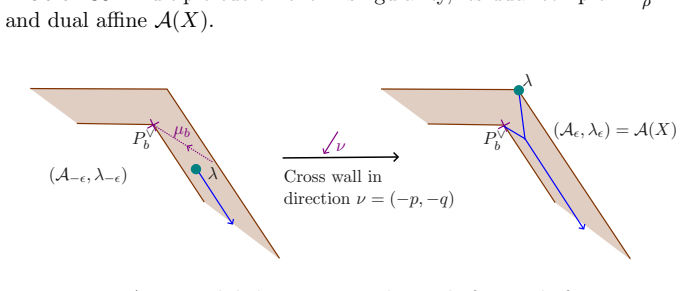
Figure 39. Figure 39: Multiple cut on the T-singularity, its dual complex B∨ ρ and dual affine A(X). λ P ∨ b µb λ P ∨ ν b Cross wall in direction ν = (−p, −q) (A−ϵ, λ−ϵ) (Aϵ, λϵ) = A(X) [PITH_FULL_IMAGE:figures/full_fig_p073_39.png] view at source ↗
Figure 40
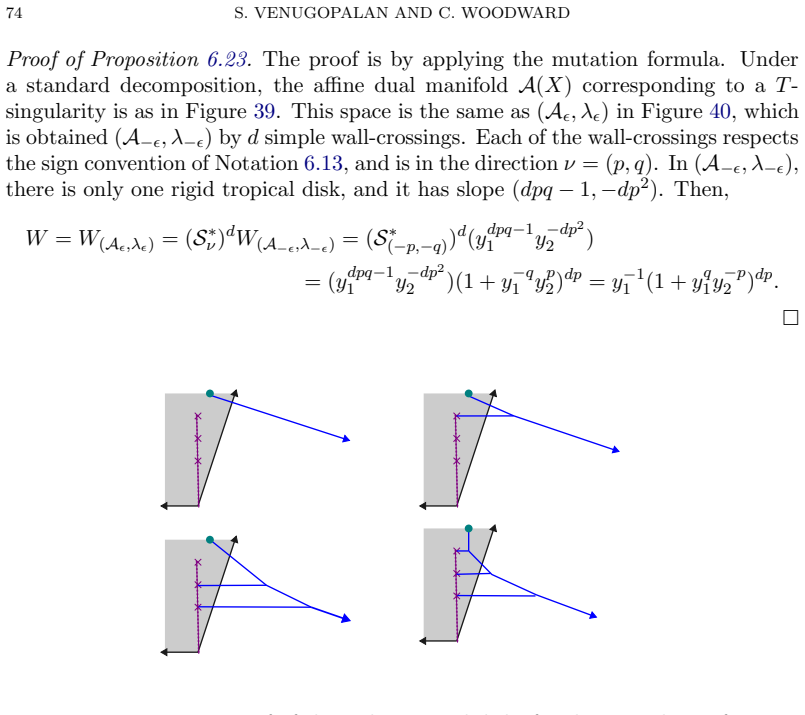
Figure 40. Figure 40: A tropical disk in a T-singularity, before and after cross￾ing the wall indicated by µb. The main result of this subsection is the computation of the potential of a smooth￾ing of a cyclic quotient T-singularity: Proposition 6.23. Let X be the smoothing of a cyclic quotient T-singularity X0 with normal vectors to facets µ1 = (−1, 0) and µ2 = (−1 + dpq, −dp2 ). Let L ⊂ X be a monotone Lagrangian torus fiber… view at source ↗
Figure 41
Figure 41. Figure 41: Four of of the eight tropical disks for the smoothing of an A3 singularity Example 6.24. We describe the computation for the disk potential of the spherical pendulum from Example 2.3. The potential of the toric fiber depicted in Theorem 42 on the left is WL(y1, y2) = (y1 + 2 + y −1 1 )/y2. The potential of the moment fiber on the right is WL′(y ′ 1 , y′ 2 ) = (y ′−1 1 + 1)(y ′ 2 ) −1 . The two potentials … view at source ↗
Figure 42
Figure 42. Figure 42: Computing the disk potential of the spherical pendulum 6.5. The classification of potentials. In this section we reprove the Pascaleff￾Tonkonog result [39] that the potentials are the mutable polynomials as expected, via a somewhat indirect argument involving their mutability. A similar argument was used in Pascaleff-Tonkonog [39], but the argument here is entirely combinatorial. We will need some definit… view at source ↗
Figure 43
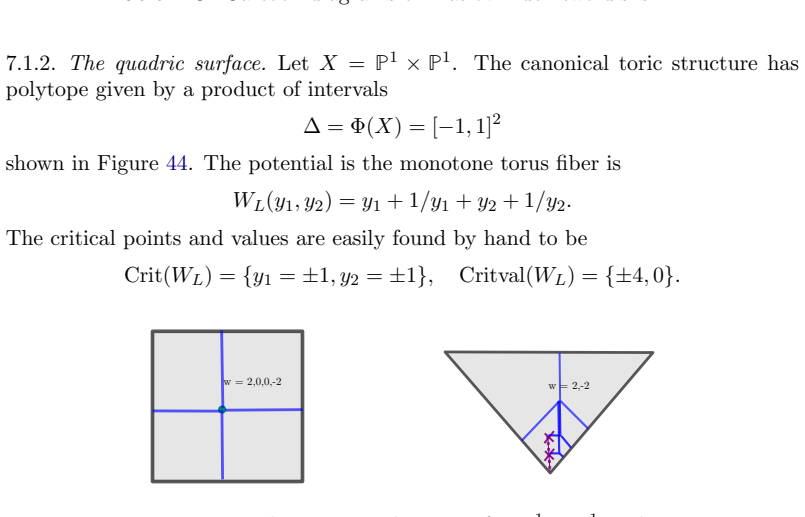
Figure 43. Figure 43: Cartoon diagrams of Maslov-index-two disks in P 2 7.1.2. The quadric surface. Let X = P 1 × P 1 . The canonical toric structure has polytope given by a product of intervals ∆ = Φ(X) = [−1, 1]2 shown in [PITH_FULL_IMAGE:figures/full_fig_p078_43.png] view at source ↗
Figure 44
Figure 44. Figure 44: Two almost toric diagrams for P 1 × P 1 and cartoon diagrams of Maslov-index-two disks A second almost toric diagram of the quadric surface is shown in [PITH_FULL_IMAGE:figures/full_fig_p078_44.png] view at source ↗
Figure 45
Figure 45. Figure 45: Cartoon diagrams for Maslov-index-two disks in Bl2 P 2 [PITH_FULL_IMAGE:figures/full_fig_p079_45.png] view at source ↗
Figure 46
Figure 46. Figure 46: Cartoon diagrams for Maslov-index-two disks in Bl3 P 2 7.2. Potentials of non-toric del Pezzo surfaces. 7.2.1. The del Pezzo of degree five. The four-times blow-up of the projective plane does not admit a toric monotone symplectic form. An almost toric diagram for the monotone symplectic form with two focus-focus singularities is shown in [PITH_FULL_IMAGE:figures/full_fig_p080_46.png] view at source ↗
Figure 47
Figure 47. Figure 47: Cartoon diagrams of disks contributing to the potentials for Bl4 P 2 [PITH_FULL_IMAGE:figures/full_fig_p080_47.png] view at source ↗
Figure 48
Figure 48. Figure 48: Cartoon diagrams for disks contributing to the poten￾tials for Bl6 P 2 7.2.4. The del Pezzo of degree two. The seven-times blow-up has an almost toric base diagram shown in [PITH_FULL_IMAGE:figures/full_fig_p081_48.png] view at source ↗
Figure 49
Figure 49. Figure 49: Cartoon diagrams for disks contributing to the potential for the torus for Bl7 P 2 Appendix A. Rigid spheres This appendix contains a digression on counting rigid holomorphic stable maps of genus zero in almost toric four-manifolds; these are closely related to the so￾called exceptional spheres in del Pezzo surfaces considered in the algebraic geometry literature, for example Testa [45]. Definition A.1. A… view at source ↗
Figure 50
Figure 50. Figure 50: Cartoon diagrams for Maslov-index-two disks in Bl8 P 2 By enumeration of graphs we obtain the following: Theorem A.4. (see Testa [45]) The number E(X) of rigid spheres u : P 1 → X is given in the following table. X Bl1 P 2 Bl2 P 2 Bl3 P 2 Bl4 P 2 Bl5 P 2 Bl6 P 2 Bl7 P 2 Bl8 P 2 E(X) 1 3 6 10 16 27 56 252. Remark A.5. In all but the case of the degree one del Pezzo, every stable map of non-zero lowest area… view at source ↗
Figure 51
Figure 51. Figure 51: Cartoon diagrams (left) and tropical graphs (right) for one of the 27 lines on the cubic surface Appendix B. Code for computing potentials and Jacobian rings In the course of writing the paper, we found it useful to have computer-assisted calculations of sets of critical values of potentials and subrings of the Jacobian ring. We include the code for these computations below. We begin with the computation … view at source ↗
read the original abstract

Using our previous work we give a tropical formula for disk potentials for Lagrangian tori in almost toric four-manifolds, that is, fibrations by Lagrangian tori with only toric and focus-focus singularities, generalizing results of Mikhalkin for holomorphic spheres in the projective plane. As examples, we directly compute potentials for Lagrangian tori in del Pezzo surfaces equipped with monotone symplectic forms. These formulas were established in the monotone case by different methods in Pascaleff-Tonkonog, and investigated from the point of view of the Gross-Siebert program in Carl-Pumperla-Siebert, Bardwell-Evans--Cheung--Hong--Lin and also Lau-Lee-Lin.

Editorial analysis

A structured set of objections, weighed in public.

Desk editor's note, referee report, simulated authors' rebuttal, and a circularity audit. Tearing a paper down is the easy half of reading it; the pith above is the substance, this is the friction.

Referee Report

2 major / 2 minor

Summary. The paper claims to give a tropical formula for disk potentials of Lagrangian tori in almost toric four-manifolds (Lagrangian torus fibrations with only toric and focus-focus singularities) by invoking the authors' previous work; this generalizes Mikhalkin's tropical counts for holomorphic spheres in CP^2. Explicit formulas are computed for monotone Lagrangian tori in del Pezzo surfaces, recovering results previously obtained by Pascaleff-Tonkonog and others via different methods.

Significance. If the extension holds, the result supplies a direct combinatorial tool for computing disk potentials in a strictly larger class of symplectic four-manifolds than the toric case, with concrete formulas for all monotone del Pezzo surfaces. This strengthens the link between tropical geometry and symplectic invariants and offers a uniform framework that could be checked against existing Gross-Siebert and Floer-theoretic computations.

major comments (2)
  1. [Main theorem / §2] The central claim rests on the assertion that the tropical correspondence from the authors' prior work continues to hold after the introduction of focus-focus singularities. No lemma, proposition, or subsection is supplied that verifies invariance of the tropical multiplicity under the monodromy around these nodes or that rules out additional wall-crossing contributions to the disk counts; this step is load-bearing for the generalization beyond the toric setting.
  2. [Examples / §4] In the examples for del Pezzo surfaces, the positions of the focus-focus points are not explicitly related to the tropical diagram or to the choice of almost-complex structure; without this, it is unclear whether the computed potentials are independent of the almost toric fibration or require additional correction terms.
minor comments (2)
  1. [Introduction] The introduction cites Mikhalkin, Pascaleff-Tonkonog, Carl-Pumperla-Siebert, Bardwell-Evans-Cheung-Hong-Lin and Lau-Lee-Lin but does not contain a short comparative table or sentence stating precisely which terms in the new tropical formula coincide with or differ from those earlier expressions.
  2. [Notation and setup] Notation for the tropical disk potential (e.g., the role of the base diagram and the almost toric base) should be fixed once at the beginning and used uniformly; occasional shifts between “tropical count” and “disk potential” obscure the precise statement of the formula.

Simulated Author's Rebuttal

2 responses · 0 unresolved

We thank the referee for the careful reading and constructive comments on our manuscript. We address each major comment below and will make the indicated revisions to strengthen the exposition.

read point-by-point responses
  1. Referee: [Main theorem / §2] The central claim rests on the assertion that the tropical correspondence from the authors' prior work continues to hold after the introduction of focus-focus singularities. No lemma, proposition, or subsection is supplied that verifies invariance of the tropical multiplicity under the monodromy around these nodes or that rules out additional wall-crossing contributions to the disk counts; this step is load-bearing for the generalization beyond the toric setting.

    Authors: We agree that an explicit verification is required. Our prior work establishes the correspondence only for toric fibrations. For almost toric manifolds the focus-focus singularities induce monodromy on the torus homology, but the Maslov index 2 disks counted by the potential can be chosen to lie away from the singular fibers. Consequently the tropical multiplicity is invariant and no extra wall-crossing terms appear. We will insert a new lemma in §2 that proves this invariance by continuity of the counts with respect to almost-complex structures compatible with the fibration. revision: yes

  2. Referee: [Examples / §4] In the examples for del Pezzo surfaces, the positions of the focus-focus points are not explicitly related to the tropical diagram or to the choice of almost-complex structure; without this, it is unclear whether the computed potentials are independent of the almost toric fibration or require additional correction terms.

    Authors: The tropical diagrams are drawn relative to the chosen almost toric fibration, with focus-focus points located at the nodes that determine the cuts and monodromy. The resulting potentials agree with the known symplectic invariants computed by Pascaleff-Tonkonog et al., which are independent of fibration choice. We will add a short paragraph in §4 that explicitly locates each focus-focus point on the diagram, states the corresponding almost-complex structure, and notes that the tropical count yields the same value for any almost toric fibration on the given manifold. revision: yes

Circularity Check

1 steps flagged

Tropical disk potential formula for almost toric manifolds obtained via direct self-citation to authors' prior work without explicit extension to focus-focus singularities

specific steps
  1. self citation load bearing [Abstract]
    "Using our previous work we give a tropical formula for disk potentials for Lagrangian tori in almost toric four-manifolds, that is, fibrations by Lagrangian tori with only toric and focus-focus singularities, generalizing results of Mikhalkin for holomorphic spheres in the projective plane."

    The derivation of the claimed tropical formula is reduced to an invocation of the authors' prior work; no independent check is supplied showing that the tropical count remains valid once focus-focus singularities introduce base monodromy, so the new result is obtained by construction from the self-cited foundation rather than a fresh derivation.

full rationale

The paper's central result is presented as an application of the authors' previous work to the almost toric setting. The abstract asserts the tropical formula holds for fibrations with toric and focus-focus singularities by invoking that prior construction, but provides no new lemmas verifying that monodromy or wall-crossing from nodal singularities preserves the tropical multiplicity or correspondence. This makes the load-bearing step reduce to the self-cited input. The generalization from Mikhalkin is noted but not re-derived here. No self-definitional equations, fitted predictions, or ansatz smuggling appear in the given text, so circularity is partial rather than total.

Axiom & Free-Parameter Ledger

0 free parameters · 1 axioms · 0 invented entities

The result rests on standard definitions of almost toric manifolds and prior results on tropical disks; no new free parameters or invented entities are introduced in the abstract.

axioms (1)
  • domain assumption Almost toric manifolds are fibrations by Lagrangian tori with only toric and focus-focus singularities.
    This is the explicit setting stated in the abstract for which the tropical formula is claimed to hold.

pith-pipeline@v0.9.0 · 5411 in / 1277 out tokens · 37860 ms · 2026-05-13T18:11:14.756047+00:00 · methodology

discussion (0)

Sign in with ORCID, Apple, or X to comment. Anyone can read and Pith papers without signing in.

Reference graph

Works this paper leans on

51 extracted references · 51 canonical work pages

  1. [1]

    Mirror symmetry and the classification of orbifold del Pezzo surfaces.Proc

    Mohammad Akhtar, Tom Coates, Alessio Corti, Liana Heuberger, Alexander Kasprzyk, Alessandro Oneto, Andrea Petracci, Thomas Prince, and Ketil Tveiten. Mirror symmetry and the classification of orbifold del Pezzo surfaces.Proc. Amer. Math. Soc., 144(2):513–527, 2016

  2. [2]

    Scattering diagrams from holomorphic discs in log Calabi-Yau surfaces.J

    Sam Bardwell-Evans, Man-Wai Mandy Cheung, Hansol Hong, and Yu-Shen Lin. Scattering diagrams from holomorphic discs in log Calabi-Yau surfaces.J. Differential Geom., 130(1):–, 2025

  3. [3]

    Explicit equations for mirror families to log Calabi-Yau surfaces.Bull

    Lawrence Jack Barrott. Explicit equations for mirror families to log Calabi-Yau surfaces.Bull. Korean Math. Soc., 57(1):139–165, 2020

  4. [4]

    The local Gromov-Witten theory of curves.J

    Jim Bryan and Rahul Pandharipande. The local Gromov-Witten theory of curves.J. Amer. Math. Soc., 21(1):101–136, 2008. With an appendix by Bryan, C. Faber, A. Okounkov and Pandharipande

  5. [5]

    A tropical view on Landau-Ginzburg models

    Michael Carl, Max Pumperla, and Bernd Siebert. A tropical view on Landau-Ginzburg models. Acta Math. Sin. (Engl. Ser.), 40(1):329–382, 2024

  6. [6]

    Floer trajectories and stabilizing divisors.J

    Fran¸ cois Charest and Chris Woodward. Floer trajectories and stabilizing divisors.J. Fixed Point Theory Appl., 19(2):1165–1236, 2017

  7. [7]

    Woodward

    Fran¸ cois Charest and Chris T. Woodward. Floer cohomology and flips.Mem. Amer. Math. Soc., 279(1372):v+166, 2022

  8. [8]

    Donaldson-Thomas invariants from tropical disks.Selecta Math

    Man-Wai Cheung and Travis Mandel. Donaldson-Thomas invariants from tropical disks.Selecta Math. (N.S.), 26(4):Paper No. 57, 46, 2020

  9. [9]

    Floer cohomology and disc instantons of Lagrangian torus fibers in Fano toric manifolds.Asian J

    Cheol-Hyun Cho and Yong-Geun Oh. Floer cohomology and disc instantons of Lagrangian torus fibers in Fano toric manifolds.Asian J. Math., 10(4):773–814, 2006. DISK POTENTIALS OF ALMOST TORIC MANIFOLDS 89

  10. [10]

    Symplectic hypersurfaces and transversality in Gromov- Witten theory.J

    Kai Cieliebak and Klaus Mohnke. Symplectic hypersurfaces and transversality in Gromov- Witten theory.J. Symplectic Geom., 5(3):281–356, 2007

  11. [11]

    Kasprzyk, Giuseppe Pitton, and Ketil Tveiten

    Tom Coates, Alexander M. Kasprzyk, Giuseppe Pitton, and Ketil Tveiten. Maximally mutable Laurent polynomials.Proc. A., 477(2254):Paper No. 20210584, 21, 2021

  12. [12]

    J. J. Duistermaat. On global action-angle coordinates.Comm. Pure Appl. Math., 33(6):687– 706, 1980

  13. [13]

    Cambridge University Press, Cambridge, 2023

    Jonny Evans.Lectures on Lagrangian torus fibrations, volume 105 ofLondon Mathematical Society Student Texts. Cambridge University Press, Cambridge, 2023

  14. [14]

    Lagrangian Floer theory and mirror symmetry on compact toric manifolds.Ast´ erisque, (376):vi+340, 2016

    Kenji Fukaya, Yong-Geun Oh, Hiroshi Ohta, and Kaoru Ono. Lagrangian Floer theory and mirror symmetry on compact toric manifolds.Ast´ erisque, (376):vi+340, 2016

  15. [15]

    Givental

    Alexander B. Givental. Homological geometry and mirror symmetry. InProceedings of the In- ternational Congress of Mathematicians, Vol. 1, 2 (Z¨ urich, 1994), pages 472–480. Birkh¨ auser, Basel, 1995

  16. [16]

    Givental

    Alexander B. Givental. Equivariant Gromov-Witten invariants.Internat. Math. Res. Notices, (13):613–663, 1996

  17. [17]

    Tropical correspondence for smooth del Pezzo log Calabi-Yau pairs.J

    Tim Graefnitz. Tropical correspondence for smooth del Pezzo log Calabi-Yau pairs.J. Algebraic Geom., 31(4):687–749, 2022

  18. [18]

    Theta functions, broken lines and 2-marked log Gromov-Witten invariants

    Tim Gr¨ afnitz. Theta functions, broken lines and 2-marked log Gromov-Witten invariants. Manuscripta Math., 176(4):Paper No. 41, 34, 2025

  19. [19]

    The proper Landau-Ginzburg potential is the open mirror map.Adv

    Tim Gr¨ afnitz, Helge Ruddat, and Eric Zaslow. The proper Landau-Ginzburg potential is the open mirror map.Adv. Math., 447:Paper No. 109639, 69, 2024

  20. [20]

    Published for the Conference Board of the Mathematical Sciences, Washington, DC; by the American Mathematical Society, Providence, RI, 2011

    Mark Gross.Tropical geometry and mirror symmetry, volume 114 ofCBMS Regional Confer- ence Series in Mathematics. Published for the Conference Board of the Mathematical Sciences, Washington, DC; by the American Mathematical Society, Providence, RI, 2011

  21. [21]

    Kaehler structures on toric varieties.J

    Victor Guillemin. Kaehler structures on toric varieties.J. Differential Geom., 40(2):285–309, 1994

  22. [22]

    Birkh¨ auser Boston, Inc., Boston, MA, 1994

    Victor Guillemin.Moment maps and combinatorial invariants of HamiltonianT n-spaces, vol- ume 122 ofProgress in Mathematics. Birkh¨ auser Boston, Inc., Boston, MA, 1994

  23. [23]

    Mirror symmetry, 2000

    Kentaro Hori and Cumrun Vafa. Mirror symmetry, 2000

  24. [24]

    Syz mirror symmetry for del pezzo surfaces and affine structures.arXiv: 2206.01681, 2024

    Siu-Cheong Lau, Tsung-Ju Lee, and Yu-Shen Lin. Syz mirror symmetry for del pezzo surfaces and affine structures.arXiv: 2206.01681, 2024

  25. [25]

    Orbifolds as stacks?Enseign

    Eugene Lerman. Orbifolds as stacks?Enseign. Math. (2), 56(3-4):315–363, 2010

  26. [26]

    Almost toric symplectic four-manifolds.J

    Naichung Conan Leung and Margaret Symington. Almost toric symplectic four-manifolds.J. Symplectic Geom., 8(2):143–187, 2010

  27. [27]

    Almost toric presentations of symplectic log calabi- yau pairs.arXiv: 2303.09964, 2023

    Tian-Jun Li, Jie Min, and Shengzhen Ning. Almost toric presentations of symplectic log calabi- yau pairs.arXiv: 2303.09964, 2023

  28. [28]

    Open Gromov-Witten invariants on elliptic K3 surfaces and wall-crossing.Comm

    Yu-Shen Lin. Open Gromov-Witten invariants on elliptic K3 surfaces and wall-crossing.Comm. Math. Phys., 349(1):109–164, 2017

  29. [29]

    On the tropical discs counting on elliptic k3 surfaces with general singular fibres

    Yu-Shen Lin. On the tropical discs counting on elliptic k3 surfaces with general singular fibres. arXiv: 1710.10625, 2019

  30. [30]

    Mirrors to del Pezzo surfaces and the classification ofT-polygons.SIGMA Symmetry Integrability Geom

    Wendelin Lutz. Mirrors to del Pezzo surfaces and the classification ofT-polygons.SIGMA Symmetry Integrability Geom. Methods Appl., 20:Paper No. 095, 20, 2024

  31. [31]

    Yu. I. Manin.Cubic forms, volume 4 ofNorth-Holland Mathematical Library. North-Holland Publishing Co., Amsterdam, second edition, 1986. Algebra, geometry, arithmetic, Translated from the Russian by M. Hazewinkel

  32. [32]

    From symplectic deformation to isotopy

    Dusa McDuff. From symplectic deformation to isotopy. InTopics in symplectic4-manifolds (Irvine, CA, 1996), First Int. Press Lect. Ser., I, pages 85–99. Int. Press, Cambridge, MA, 1998

  33. [33]

    American Mathematical Society, Providence, RI, second edition, 2012

    Dusa McDuff and Dietmar Salamon.J-holomorphic curves and symplectic topology, volume 52 ofAmerican Mathematical Society Colloquium Publications. American Mathematical Society, Providence, RI, second edition, 2012

  34. [34]

    Enumerative tropical algebraic geometry inR 2.J

    Grigory Mikhalkin. Enumerative tropical algebraic geometry inR 2.J. Amer. Math. Soc., 18(2):313–377, 2005. 90 S. VENUGOPALAN AND C. WOODWARD

  35. [35]

    Toric degenerations of toric varieties and tropical curves

    Takeo Nishinou and Bernd Siebert. Toric degenerations of toric varieties and tropical curves. Duke Math. J., 135(1):1–51, 2006

  36. [36]

    Floer cohomology of Lagrangian intersections and pseudo-holomorphic disks

    Yong-Geun Oh. Floer cohomology of Lagrangian intersections and pseudo-holomorphic disks. I.Comm. Pure Appl. Math., 46(7):949–993, 1993

  37. [37]

    Symplectic 4-manifolds withb + 2 = 1

    Hiroshi Ohta and Kaoru Ono. Symplectic 4-manifolds withb + 2 = 1. InGeometry and physics (Aarhus, 1995), volume 184 ofLecture Notes in Pure and Appl. Math., pages 237–244. Dekker, New York, 1997

  38. [38]

    Tropical enumeration of curves in blowups ofCP 2.J

    Brett Parker. Tropical enumeration of curves in blowups ofCP 2.J. Differential Geom., 129(1):165–223, 2025

  39. [40]

    The wall-crossing formula and Lagrangian mutations

    James Pascaleff and Dmitry Tonkonog. The wall-crossing formula and Lagrangian mutations. Adv. Math., 361:106850, 67, 2020

  40. [41]

    Ritter and Ivan Smith

    Alexander F. Ritter and Ivan Smith. The monotone wrapped Fukaya category and the open- closed string map.Selecta Math. (N.S.), 23(1):533–642, 2017

  41. [42]

    Serganova and Alexei N

    Vera V. Serganova and Alexei N. Skorobogatov. Adjoint representation of E 8 and del Pezzo surfaces of degree 1.Ann. Inst. Fourier (Grenoble), 61(6):2337–2360 (2012), 2011

  42. [43]

    On the Fukaya category of a Fano hypersurface in projective space.Publ

    Nick Sheridan. On the Fukaya category of a Fano hypersurface in projective space.Publ. Math. Inst. Hautes ´Etudes Sci., 124:165–317, 2016

  43. [44]

    Four dimensions from two in symplectic topology

    Margaret Symington. Four dimensions from two in symplectic topology. InTopology and geom- etry of manifolds (Athens, GA, 2001), volume 71 ofProc. Sympos. Pure Math., pages 153–208. Amer. Math. Soc., Providence, RI, 2003

  44. [45]

    The irreducibility of the spaces of rational curves on del Pezzo surfaces.arXiv: math/0609355, 2006

    Damiano Testa. The irreducibility of the spaces of rational curves on del Pezzo surfaces.arXiv: math/0609355, 2006

  45. [46]

    Tropical Fukaya algebras.arXiv: 2004.14314, 2020

    Sushmita Venugopalan and Chris Woodward. Tropical Fukaya algebras.arXiv: 2004.14314, 2020

  46. [47]

    Splitting the diagonal for broken maps.arXiv: 2504.15583, 2025

    Sushmita Venugopalan and Chris Woodward. Splitting the diagonal for broken maps.arXiv: 2504.15583, 2025

  47. [48]

    Woodward, and Guangbo Xu

    Sushmita Venugopalan, Chris T. Woodward, and Guangbo Xu. Fukaya categories of blowups. J. Inst. Math. Jussieu, 25(1):85–214, 2026

  48. [49]

    Infinitely many monotone Lagrangian tori in del Pezzo surfaces.arXiv: 1602.03356, 2016

    Renato Vianna. Infinitely many monotone Lagrangian tori in del Pezzo surfaces.arXiv: 1602.03356, 2016

  49. [50]

    Infinitely many exotic monotone Lagrangian tori inCP 2

    Renato Ferreira de Velloso Vianna. Infinitely many exotic monotone Lagrangian tori inCP 2. J. Topol., 9(2):535–551, 2016

  50. [51]

    Removing intersections of Lagrangian immersions.Illinois J

    Alan Weinstein. Removing intersections of Lagrangian immersions.Illinois J. Math., 27(3):484– 500, 1983

  51. [52]

    Disks bounding tropical lagrangians in almost toric manifolds

    Chris Woodward. Disks bounding tropical lagrangians in almost toric manifolds. In preparation