Recognition: 2 theorem links
· Lean TheoremRevisiting the Rhoades-Ruffini bound
Pith reviewed 2026-05-13 18:24 UTC · model grok-4.3
The pith
Relaxing the onset density of stiff matter raises the neutron star maximum mass limit to 4 solar masses or higher.
A machine-rendered reading of the paper's core claim, the machinery that carries it, and where it could break.
Core claim
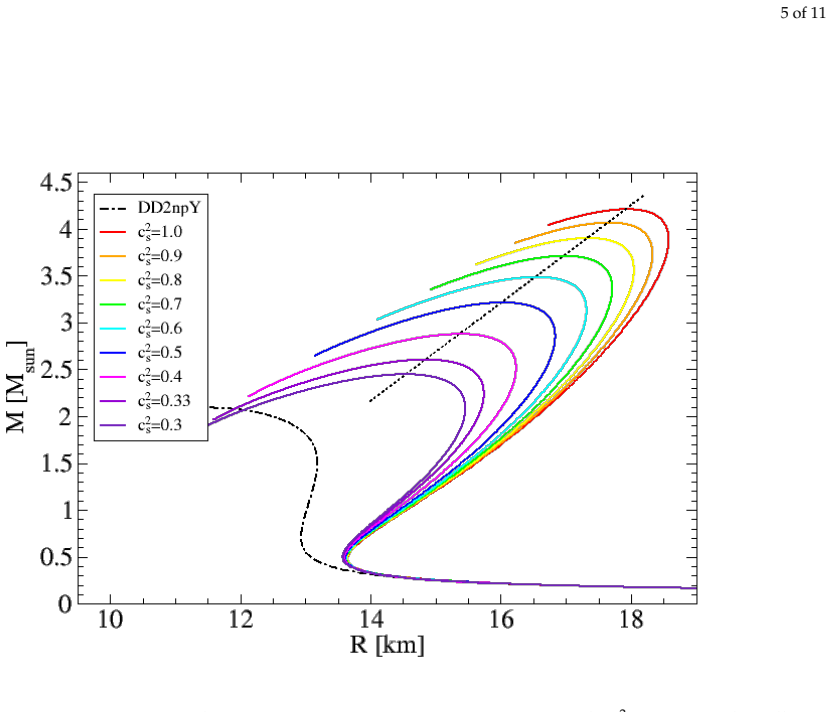
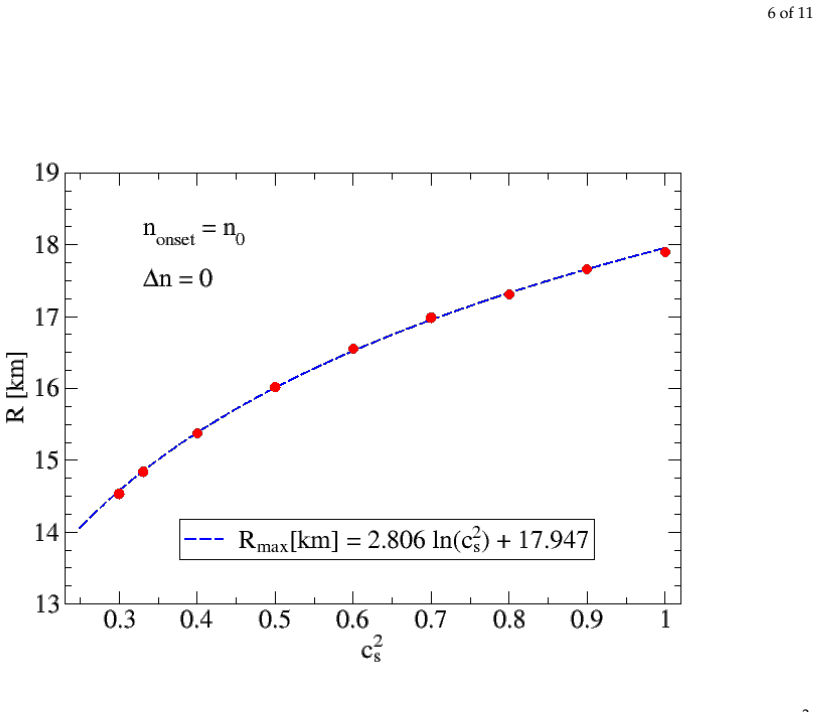
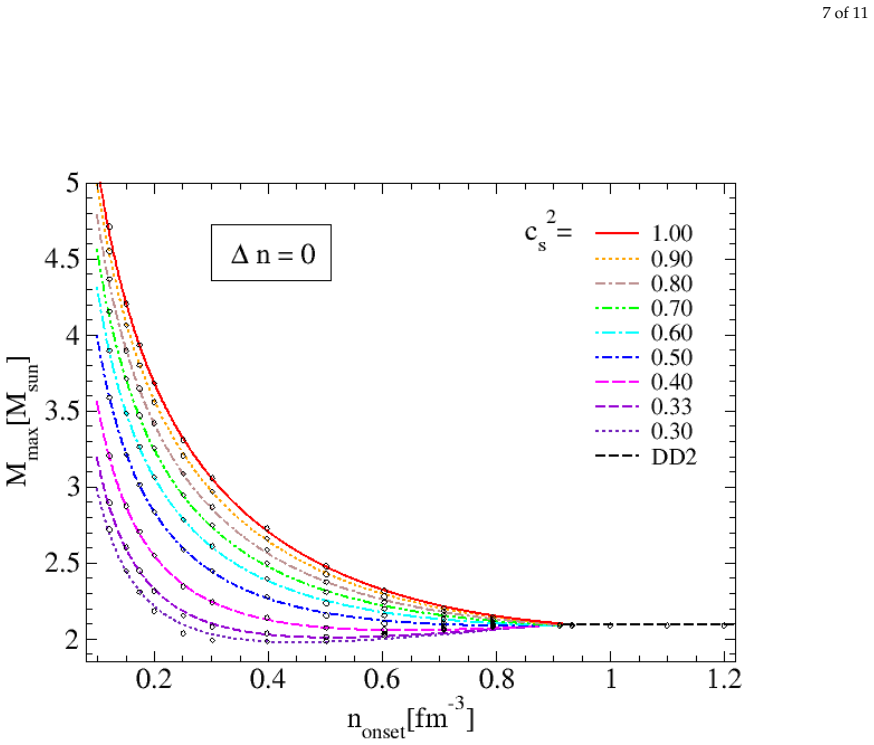
By relaxing the assumption for the onset of an ultimately stiff phase of high-density matter to the saturation density or below, the upper limit of the theoretically possible maximum mass of neutron stars is boosted to 4 M_odot or higher under neutron star constraints. A fit formula for the dependence of this upper limit on the speed of sound and the onset density of the deconfinement transition is provided.
What carries the argument
The assumption regarding the onset density of the stiff high-density phase in the derivation of the mass bound, which when relaxed allows for higher maximum masses consistent with constraints.
If this is right
- The upper mass limit for neutron stars increases to 4 solar masses or higher.
- Neutron stars could populate the mass-gap region with stellar-mass black holes.
- The upper limit depends on the speed of sound and onset density according to a provided fit formula.
- All current neutron star constraints on maximum mass, radius, and tidal deformability remain satisfied.
Where Pith is reading between the lines
- High-mass compact objects in the gap might sometimes be neutron stars with early phase transitions.
- Models of dense matter may need to incorporate stiff phases at lower densities than usually assumed.
- Future mass measurements of compact objects could directly test the revised bound.
- The sensitivity of the limit to onset density highlights the importance of the transition point in equation-of-state models.
Load-bearing premise
That a stiff phase of non-nucleonic matter can onset at nuclear saturation density or below while remaining consistent with causality and all current neutron-star observations.
What would settle it
The discovery of a neutron star whose mass exceeds the upper limit predicted by the fit formula for any plausible onset density and sound speed, or measurements ruling out stiff matter below a certain density.
Figures



read the original abstract
We revisit the derivation of the Rhoades-Ruffini bound on the upper limit for the maximum mass of neutron stars and find that the assumption made there for the onset of an ultimately stiff phase of high-density matter is not stringent. Relaxing this assumption and allowing for an onset of stiff non-nucleonic matter under neutron star constraints at the saturation density or below boost the upper limit of the theoretically possible maximum mass to $4~M_\odot$ or higher, in the mass-gap region between neutron stars and stellar-mass black holes. We provide a fit formula for the dependence of this upper limit on the speed of sound and the onset density of the deconfinement transition.
Editorial analysis
A structured set of objections, weighed in public.
Referee Report
Summary. The manuscript revisits the Rhoades-Ruffini construction of an upper bound on neutron-star maximum mass. It argues that the original assumption fixing the onset of the ultimately causal (stiff) phase at a density well above nuclear saturation is not required by causality or by current observational constraints. By allowing the stiff non-nucleonic phase to begin at or below saturation density, while still satisfying maximum-mass, radius, and tidal-deformability bounds, the theoretical ceiling on the maximum mass is raised to 4 M_⊙ or higher. An explicit fit formula is supplied that expresses this revised upper limit in terms of the sound speed in the stiff phase and the onset density of the transition.
Significance. If the numerical construction is robust, the result would place a non-negligible population of compact objects in the mass gap between the heaviest neutron stars and the lightest stellar-mass black holes, with direct implications for gravitational-wave and X-ray observations. The provision of a closed-form fit in terms of two physically motivated parameters is a clear strength for reproducibility and for guiding future EOS modeling.
major comments (2)
- [Fit formula and numerical procedure] The central numerical result (maximum mass reaching 4 M_⊙) is obtained from a fit whose inputs are the sound speed and onset density, both treated as free parameters. The manuscript must demonstrate, with explicit EOS tables or functional forms, that at least one family of models satisfying all current constraints (M_max ≥ 2 M_⊙, radius bounds, tidal deformability) actually exists for onset densities ≤ n_sat and c_s² approaching 1; without this explicit construction the fit remains circular.
- [Results and discussion] The original Rhoades-Ruffini bound is recovered only when the onset density is taken well above saturation. The manuscript should quantify how much the bound relaxes as a function of onset density (e.g., a plot or table of M_max versus onset density for fixed c_s) so that the reader can see the precise threshold at which the 4 M_⊙ limit is crossed.
minor comments (2)
- [Equation of state construction] Clarify the precise matching conditions (pressure and energy-density continuity) imposed at the transition density; any discontinuity would affect the TOV integration and the resulting mass limit.
- [Observational constraints] The abstract states that the models remain consistent with neutron-star constraints, but the main text should list the specific observational limits adopted (e.g., the 2.08 M_⊙ lower bound, NICER radius intervals, GW170817 tidal deformability) and show that the stiff-phase models satisfy them simultaneously.
Simulated Author's Rebuttal
We thank the referee for the careful reading, positive assessment of the significance, and constructive suggestions. We have revised the manuscript to strengthen the explicit demonstration of viable EOS models and to add quantitative visualization of the bound relaxation. Our point-by-point responses follow.
read point-by-point responses
-
Referee: [Fit formula and numerical procedure] The central numerical result (maximum mass reaching 4 M_⊙) is obtained from a fit whose inputs are the sound speed and onset density, both treated as free parameters. The manuscript must demonstrate, with explicit EOS tables or functional forms, that at least one family of models satisfying all current constraints (M_max ≥ 2 M_⊙, radius bounds, tidal deformability) actually exists for onset densities ≤ n_sat and c_s² approaching 1; without this explicit construction the fit remains circular.
Authors: We agree that an explicit construction is needed to remove any appearance of circularity. The original fit was obtained by solving the TOV equation over a dense grid of piecewise EOS models (nuclear crust + transition at variable n_onset to a constant-c_s phase). In the revised manuscript we now include an explicit functional form for a representative family: for n_onset = n_sat and c_s² = 0.95 the low-density segment follows the SLy4 EOS up to n_sat, after which P = P_sat + c_s² (ε - ε_sat) with a smooth matching. This specific model yields M_max = 4.05 M_⊙ while satisfying M_max > 2 M_⊙, R_1.4 = 12.8 km, and Λ_1.4 < 800, thereby confirming that the high-mass end of the fit is realized by at least one physically allowed EOS. The fit coefficients have been recomputed from this enlarged grid and are reported in the revised text. revision: yes
-
Referee: [Results and discussion] The original Rhoades-Ruffini bound is recovered only when the onset density is taken well above saturation. The manuscript should quantify how much the bound relaxes as a function of onset density (e.g., a plot or table of M_max versus onset density for fixed c_s) so that the reader can see the precise threshold at which the 4 M_⊙ limit is crossed.
Authors: We concur that a direct visualization clarifies the dependence. We have added a new figure (Fig. 3) that displays M_max versus n_onset / n_sat for three fixed values of c_s² (0.5, 0.75, 1.0). The curves show that the original Rhoades-Ruffini limit (~3.2 M_⊙) is recovered only for n_onset ≳ 3 n_sat; the bound rises above 4 M_⊙ once n_onset drops below ~1.2 n_sat for c_s² near unity. A supplementary table lists the numerical values at selected onset densities for easy reference. These additions make the relaxation threshold explicit without altering the central conclusions. revision: yes
Circularity Check
No significant circularity; derivation self-contained against original assumptions
full rationale
The paper relaxes the onset-density assumption of the Rhoades-Ruffini construction, inserts a causal (c_s = 1) segment at or below saturation density, and integrates the TOV equation to obtain a higher maximum mass. The quoted fit formula is an explicit post-processing parametrization of those numerical results as a function of the two free parameters (onset density and sound speed); it does not redefine the bound or substitute for the underlying integration. No self-definitional step, fitted-input-called-prediction, or load-bearing self-citation chain appears in the abstract or described procedure. The central claim therefore remains an independent consequence of the relaxed EOS construction and is not forced by construction from its own inputs.
Axiom & Free-Parameter Ledger
free parameters (2)
- speed of sound in stiff phase
- onset density of stiff phase
axioms (2)
- standard math General relativity governs the structure of neutron stars
- domain assumption Speed of sound cannot exceed the speed of light
Lean theorems connected to this paper
-
IndisputableMonolith/Foundation/RealityFromDistinction.leanreality_from_one_distinction unclearWe revisit the derivation of the Rhoades-Ruffini bound... fit formula for the dependence of this upper limit on the speed of sound and the onset density of the deconfinement transition.
-
IndisputableMonolith/Cost/FunctionalEquation.leanwashburn_uniqueness_aczel unclearP(μ) = A (μ/μ0)^{1+c_s^{-2}} - B ... TOV equations
Reference graph
Works this paper leans on
-
[1]
Maximum mass of a neutron star.Phys
Rhoades, Jr., C.E.; Ruffini, R. Maximum mass of a neutron star.Phys. Rev. Lett.1974,32, 324–327. https://doi.org/10.1103/PhysRevLett.32.324
-
[2]
Generic conditions for stable hybrid stars.Phys
Alford, M.G.; Han, S.; Prakash, M. Generic conditions for stable hybrid stars.Phys. Rev. D2013,88, 083013, [arXiv:astro-ph.SR/1302.4732]. https://doi.org/10.1103/PhysRevD.88.083013
-
[3]
Maximum mass of neutron stars and strange neutron-star cores.Astron
Zdunik, J.L.; Haensel, P . Maximum mass of neutron stars and strange neutron-star cores.Astron. Astrophys. 2013,551, A61, [arXiv:astro-ph.SR/1211.1231]. https://doi.org/10.1051/0004-6361/201220697
-
[4]
Quark-nuclear hybrid equation of state for neutron stars under modern observational constraints.Phys
Contrera, G.A.; Blaschke, D.; Carlomagno, J.P .; Grunfeld, A.G.; Liebing, S. Quark-nuclear hybrid equation of state for neutron stars under modern observational constraints.Phys. Rev. C2022,105, 045808, [arXiv:nucl- th/2201.00477]. https://doi.org/10.1103/PhysRevC.105.045808
-
[5]
The Mass distribution of stellar black holes.Astrophys
Bailyn, C.D.; Jain, R.K.; Coppi, P .; Orosz, J.A. The Mass distribution of stellar black holes.Astrophys. J.1998, 499, 367, [astro-ph/9708032]. https://doi.org/10.1086/305614
-
[6]
The evolution and explosion of massive stars.Rev
Woosley, S.E.; Heger, A.; Weaver, T.A. The evolution and explosion of massive stars.Rev. Mod. Phys.2002, 74, 1015–1071. https://doi.org/10.1103/RevModPhys.74.1015
-
[7]
Quantifying the Evidence Against a Mass Gap between Black Holes and Neutron Stars.Astrophys
de Sá, L.M.; Bernardo, A.; Bachega, R.R.A.; Horvath, J.E.; Rocha, L.S.; Moraes, P .H.R.S. Quantifying the Evidence Against a Mass Gap between Black Holes and Neutron Stars.Astrophys. J.2022,941, 130, [arXiv:astro-ph.HE/2211.01447]. https://doi.org/10.3847/1538-4357/aca076
-
[8]
Abbott, R.; et al. GW190814: Gravitational Waves from the Coalescence of a 23 Solar Mass Black Hole with a 2.6 Solar Mass Compact Object.Astrophys. J. Lett.2020,896, L44, [arXiv:astro-ph.HE/2006.12611]. https://doi.org/10.3847/2041-8213/ab960f
-
[9]
Abac, A.G.; et al. Observation of Gravitational Waves from the Coalescence of a 2.5–4.5 M ⊙ Compact Object and a Neutron Star.Astrophys. J. Lett.2024,970, L34, [arXiv:astro-ph.HE/2404.04248]. https: //doi.org/10.3847/2041-8213/ad5beb
-
[10]
GW170817: Observation of Gravitational Waves from a Binary Neutron Star Inspiral
Abbott, B.P .; et al. GW170817: Observation of Gravitational Waves from a Binary Neutron Star Inspiral.Phys. Rev. Lett.2017,119, 161101, [arXiv:gr-qc/1710.05832]. https://doi.org/10.1103/PhysRevLett.119.161101
work page internal anchor Pith review Pith/arXiv arXiv doi:10.1103/physrevlett.119.161101 2017
-
[11]
New class of hybrid EoS and Bayesian M-R data analysis.Eur
Alvarez-Castillo, D.; Ayriyan, A.; Benic, S.; Blaschke, D.; Grigorian, H.; Typel, S. New class of hybrid EoS and Bayesian M-R data analysis.Eur. Phys. J. A2016,52, 69, [arXiv:nucl-th/1603.03457]. https: //doi.org/10.1140/epja/i2016-16069-2
-
[12]
Bayesian analysis of multimessenger M-R data with interpolated hybrid EoS.Eur
Ayriyan, A.; Blaschke, D.; Grunfeld, A.G.; Alvarez-Castillo, D.; Grigorian, H.; Abgaryan, V . Bayesian analysis of multimessenger M-R data with interpolated hybrid EoS.Eur. Phys. J. A2021,57, 318, [arXiv:astro- ph.HE/2102.13485]
-
[13]
The maximum mass of a neutron star.Astrophys
Kalogera, V .; Baym, G. The maximum mass of a neutron star.Astrophys. J. Lett.1996,470, L61–L64, [astro-ph/9608059]. https://doi.org/10.1086/310296
-
[14]
Hybrid neutron stars in the mass-radius diagram.Astron
Cierniak, M.; Blaschke, D. Hybrid neutron stars in the mass-radius diagram.Astron. Nachr.2021,342, 819– 825, [arXiv:nucl-th/2106.06986]. https://doi.org/10.1002/asna.202114000
-
[15]
Upper bound on the speed of sound in nuclear matter from transport.Phys
Hippert, M.; Noronha, J.; Romatschke, P . Upper bound on the speed of sound in nuclear matter from transport.Phys. Lett. B2025,860, 139184, [arXiv:nucl-th/2402.14085]. https://doi.org/10.1016/j.physletb.20 24.139184
-
[16]
Sexaquark dilemma in neutron stars and its solution by quark deconfinement.Phys
Shahrbaf, M.; Blaschke, D.; Typel, S.; Farrar, G.R.; Alvarez-Castillo, D.E. Sexaquark dilemma in neutron stars and its solution by quark deconfinement.Phys. Rev. D2022,105, 103005, [arXiv:nucl-th/2202.00652]. https://doi.org/10.1103/PhysRevD.105.103005
-
[17]
private communication (2026)
work page 2026
-
[18]
Gravitational-wave constraints on the neutron-star- matter Equation of State.Phys
Annala, E.; Gorda, T.; Kurkela, A.; Vuorinen, A. Gravitational-wave constraints on the neutron-star- matter Equation of State.Phys. Rev. Lett.2018,120, 172703, [arXiv:astro-ph.HE/1711.02644]. https: //doi.org/10.1103/PhysRevLett.120.172703
-
[19]
Efficient Bayesian analysis of kilonovae and gamma ray burst afterglows with FIESTA.Astron
Koehn, H.; Wouters, T.; Pang, P .T.H.; Bulla, M.; Rose, H.; Wichern, H.; Dietrich, T. Efficient Bayesian analysis of kilonovae and gamma ray burst afterglows with FIESTA.Astron. Astrophys.2025,704, A55, [arXiv:astro-ph.HE/2507.13807]. https://doi.org/10.1051/0004-6361/202556626. 11 of 11 Disclaimer/Publisher’s Note:The statements, opinions and data contai...
discussion (0)
Sign in with ORCID, Apple, or X to comment. Anyone can read and Pith papers without signing in.