Recognition: 1 theorem link
· Lean TheoremA scalable infrastructure for strontium optical clocks with integrated photonics
Pith reviewed 2026-05-13 18:06 UTC · model grok-4.3
The pith
Integrated photonics and metasurfaces create magneto-optical traps for every stable strontium isotope.
A machine-rendered reading of the paper's core claim, the machinery that carries it, and where it could break.
Core claim
A co-designed atomic-beam slowing and MOT system, paired with a photonic integrated circuit and metasurface optics to produce complex three-dimensional free-space laser beams and with integrated nonlinear photonics for frequency-comb supercontinuum stabilization, realizes magneto-optical traps of all stable strontium isotopes with populations commensurate with natural abundances, demonstrating precise beam control and robustness toward a largely bulk-optics-free strontium optical clock.
What carries the argument
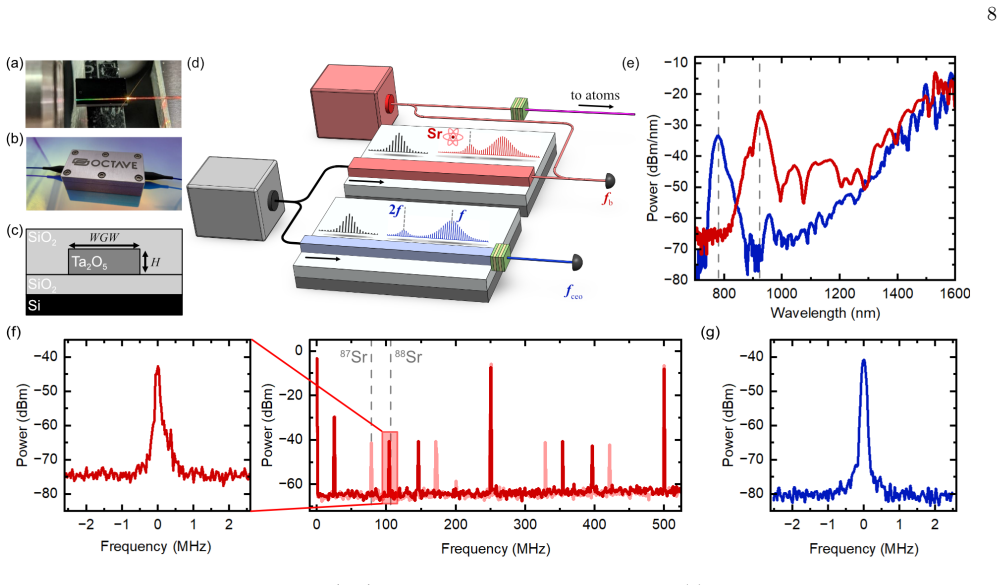
Photonic integrated circuit combined with metasurface optics that generate the three-dimensional laser beams required for slowing and trapping, integrated with nonlinear photonics for laser stabilization to a frequency-comb supercontinuum.
If this is right
- MOTs of 84Sr, 86Sr, 87Sr, and 88Sr are achieved with populations matching natural isotopic abundances.
- Precise three-dimensional beam control is maintained using only the photonic integrated circuit and metasurface optics.
- Laser stabilization to an integrated nonlinear photonics supercontinuum supports the required frequency references.
- The demonstrated elements form an extensible platform for strontium-based optical clocks, quantum sensors, and quantum information systems.
Where Pith is reading between the lines
- Miniaturized versions of these clocks could become deployable for field metrology or space-based applications where size and power matter.
- The same integration strategy may apply to other alkaline-earth atoms that need similar complex laser configurations.
- Lowered reliance on bulk optics could reduce system cost and complexity enough to support wider use in precision measurements outside specialized laboratories.
Load-bearing premise
The integrated photonics and metasurface components must deliver sufficient power, beam quality, and long-term stability without adding noise that would degrade clock performance.
What would settle it
Observation that the MOT atom numbers or loading rates fall substantially below natural-abundance expectations when the system runs exclusively on the photonic integrated circuit and metasurface beams, or that laser frequency noise increases when stabilization uses only the integrated supercontinuum.
Figures


read the original abstract
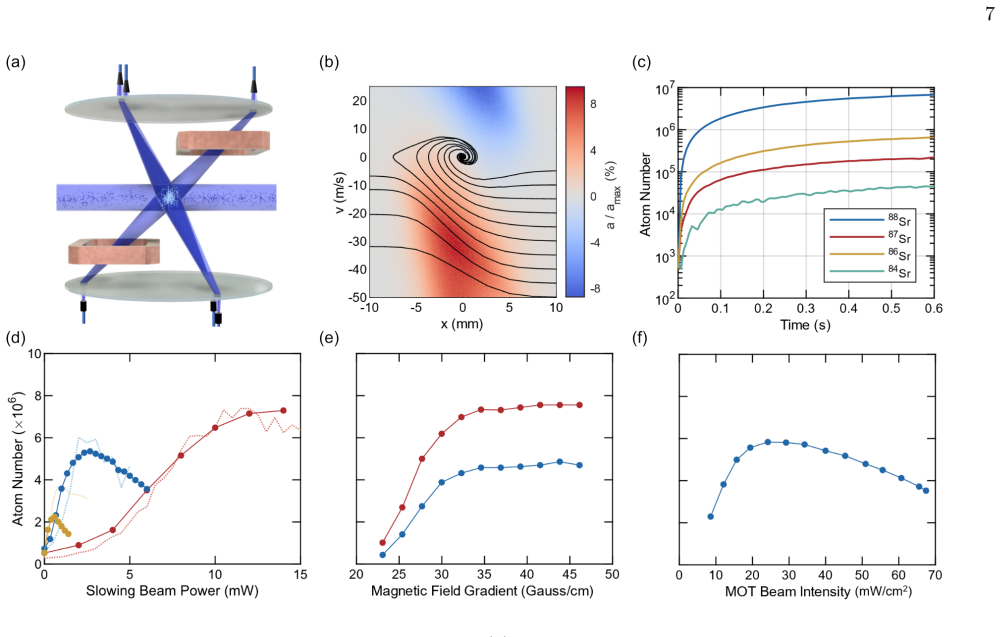
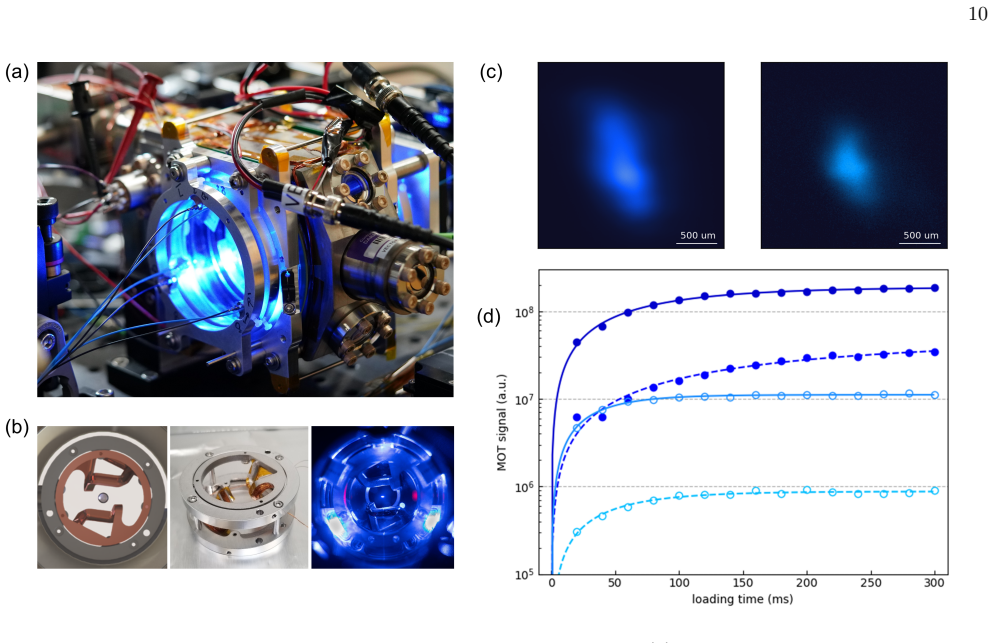
Optical atomic clocks provide exceptionally accurate and precise signals for timekeeping and precision measurements, but they require high-power, free-space laser configurations that limit scalability. We introduce and explore a scalable infrastructure for strontium (Sr) optical-lattice clocks that incorporates co-design of atomic-beam slowing and a magneto-optical trap (MOT) from an effusion source, generation of complex, three-dimensional free-space laser configurations with a photonic integrated circuit (PIC) and metasurface (MS) optics, and laser stabilization to a frequency-comb supercontinuum generated with integrated nonlinear photonics. With these elements, we realize MOTs of all stable strontium isotopes ($^{84}$Sr, $^{86}$Sr, $^{87}$Sr, $^{88}$Sr) with populations commensurate with natural abundances, demonstrating precise beam control and robustness. Access to laser-cooled alkaline-earth atoms with scalable integrated photonics enables system engineering for optical clocks, quantum sensing, and quantum information, and our experiments demonstrate extensible technologies that advance toward a Sr optical clock largely free of bulk optics.
Editorial analysis
A structured set of objections, weighed in public.
Referee Report
Summary. The manuscript presents a scalable infrastructure for strontium optical-lattice clocks that co-designs atomic-beam slowing and MOT operation from an effusion source, employs photonic integrated circuits (PICs) and metasurface optics to generate the required three-dimensional laser fields, and uses integrated nonlinear photonics for frequency-comb stabilization. The central experimental result is the realization of MOTs for all stable strontium isotopes (84Sr, 86Sr, 87Sr, 88Sr) with populations commensurate with natural abundances, offered as evidence of precise beam control and robustness.
Significance. If the experimental claims are substantiated, the work would represent a meaningful step toward compact, optics-reduced Sr clock systems. Demonstrating multi-isotope MOT loading with integrated photonics directly addresses scalability barriers in precision metrology and could facilitate applications in quantum sensing and information processing by reducing reliance on bulk optics.
major comments (1)
- [Abstract] Abstract and main results: The claim of MOT populations for all four stable isotopes being commensurate with natural abundances is load-bearing for the demonstration of precise beam control, yet the manuscript provides no quantitative population measurements, fluorescence imaging data, loading curves, or error bars to support this assertion.
minor comments (1)
- The description of the co-design between the PIC and metasurface components would benefit from an explicit diagram or table listing the beam parameters (power, waist, detuning) delivered to the MOT region.
Simulated Author's Rebuttal
We thank the referee for their thorough review and constructive feedback on our manuscript. We address the major comment below and will revise the manuscript accordingly to strengthen the quantitative support for our claims.
read point-by-point responses
-
Referee: [Abstract] Abstract and main results: The claim of MOT populations for all four stable isotopes being commensurate with natural abundances is load-bearing for the demonstration of precise beam control, yet the manuscript provides no quantitative population measurements, fluorescence imaging data, loading curves, or error bars to support this assertion.
Authors: We agree that the claim of realizing MOTs for all stable strontium isotopes with populations commensurate with natural abundances is central to the demonstration of precise beam control. The current manuscript states this result but does not include the requested quantitative details such as atom-number measurements, fluorescence images, loading curves, or error bars. We will revise the manuscript to incorporate these data, adding a new figure (or supplementary figure) that presents measured populations for ^{84}Sr, ^{86}Sr, ^{87}Sr, and ^{88}Sr alongside natural-abundance values, with uncertainties derived from repeated measurements and loading curves. This addition will directly substantiate the claim and improve the clarity of the experimental results. revision: yes
Circularity Check
No significant circularity in experimental demonstration
full rationale
The paper reports direct experimental realization of MOTs for all stable strontium isotopes using integrated photonics components, with central claims resting on fluorescence imaging and measured population data that match natural abundances. These results are independent measurements, not derivations, predictions, or fitted parameters that reduce by construction to inputs. No load-bearing steps invoke self-citations for uniqueness theorems, ansatzes, or renamings of known results; the work is self-contained against standard atomic physics benchmarks.
Axiom & Free-Parameter Ledger
axioms (1)
- standard math Standard atomic physics for MOT operation and strontium isotope abundances
Lean theorems connected to this paper
-
IndisputableMonolith/Foundation/RealityFromDistinction.leanreality_from_one_distinction unclear?
unclearRelation between the paper passage and the cited Recognition theorem.
We realize MOTs of all stable strontium isotopes (84Sr, 86Sr, 87Sr, 88Sr) with populations commensurate with natural abundances, demonstrating precise beam control and robustness.
What do these tags mean?
- matches
- The paper's claim is directly supported by a theorem in the formal canon.
- supports
- The theorem supports part of the paper's argument, but the paper may add assumptions or extra steps.
- extends
- The paper goes beyond the formal theorem; the theorem is a base layer rather than the whole result.
- uses
- The paper appears to rely on the theorem as machinery.
- contradicts
- The paper's claim conflicts with a theorem or certificate in the canon.
- unclear
- Pith found a possible connection, but the passage is too broad, indirect, or ambiguous to say the theorem truly supports the claim.
Reference graph
Works this paper leans on
-
[1]
K. Kikuchi, Fundamentals of Coherent Optical Fiber Communications, Journal of Lightwave Technology34, 157 (2016)
work page 2016
-
[2]
M. Xiao, S. Mumtaz, Y. Huang, L. Dai, Y. Li, M. Matthaiou, G. K. Karagiannidis, E. Bj¨ ornson, K. Yang, C.-L. I, and A. Ghosh, Millimeter Wave Com- munications for Future Mobile Networks, IEEE Journal on Selected Areas in Communications35, 1909 (2017)
work page 1909
-
[3]
C. Clivati, R. Aiello, G. Bianco, C. Bortolotti, P. D. Na- tale, V. D. Sarno, P. Maddaloni, G. Maccaferri, A. Mura, M. Negusini, F. Levi, F. Perini, R. Ricci, M. Roma, L. S. Amato, M. S. d. Cumis, M. Stagni, A. Tuozzi, and 11 D. Calonico, Common-clock very long baseline interfer- ometry using a coherent optical fiber link, Optica7, 1031 (2020)
work page 2020
-
[4]
P. Lu, N. Lalam, M. Badar, B. Liu, B. T. Chorpening, M. P. Buric, and P. R. Ohodnicki, Distributed optical fiber sensing: Review and perspective, Applied Physics Reviews6, 041302 (2019)
work page 2019
-
[5]
A. D. Ludlow, M. M. Boyd, J. Ye, E. Peik, and P. O. Schmidt, Optical atomic clocks, Reviews of Modern Physics87, 637 (2015)
work page 2015
-
[6]
Riehle, Towards a redefinition of the second based on optical atomic clocks, Comptes Rendus
F. Riehle, Towards a redefinition of the second based on optical atomic clocks, Comptes Rendus. Physique16, 506 (2015)
work page 2015
-
[7]
N. Dimarcq, M. Gertsvolf, G. Mileti, S. Bize, C. W. Oates, E. Peik, D. Calonico, T. Ido, P. Tavella, F. Mey- nadier, G. Petit, G. Panfilo, J. Bartholomew, P. De- fraigne, E. A. Donley, P. O. Hedekvist, I. Sesia, M. Wouters, P. Dub´ e, F. Fang, F. Levi, J. Lodewyck, H. S. Margolis, D. Newell, S. Slyusarev, S. Weyers, J.- P. Uzan, M. Yasuda, D.-H. Yu, C. Ri...
work page 2024
-
[8]
G. Spektor, D. Carlson, Z. Newman, J. L. Skarda, N. Sapra, L. Su, S. Jammi, A. R. Ferdinand, A. Agrawal, J. Vuˇ ckovi´ c, and S. B. Papp, Universal visible emitters in nanoscale integrated photonics, Optica10, 871 (2023)
work page 2023
- [9]
-
[10]
B. W. Reichardt, A. Paetznick, D. Aasen, I. Basov, J. M. Bello-Rivas, P. Bonderson, R. Chao, W. v. Dam, M. B. Hastings, R. V. Mishmash, A. Paz, M. P. d. Silva, A. Sun- daram, K. M. Svore, A. Vaschillo, Z. Wang, M. Zanner, W. B. Cairncross, C.-A. Chen, D. Crow, H. Kim, J. M. Kindem, J. King, M. McDonald, M. A. Norcia, A. Ryou, M. Stone, L. Wadleigh, K. Bar...
-
[11]
M. Takamoto, I. Ushijima, N. Ohmae, T. Yahagi, K. Kokado, H. Shinkai, and H. Katori, Test of general relativity by a pair of transportable optical lattice clocks, Nature photonics14, 411 (2020)
work page 2020
-
[12]
G. M. Brodnik, M. W. Harrington, J. H. Dallyn, D. Bose, W. Zhang, L. Stern, P. A. Morton, R. O. Behunin, S. B. Papp, and D. J. Blumenthal, Optically synchronized fi- bre links using spectrally pure chip-scale lasers, Nature Photonics15, 588 (2021)
work page 2021
-
[13]
A. Pirmoradi, J. Zang, K. Omirzakhov, Z. Yu, Y. Jin, S. B. Papp, and F. Aflatouni, Integrated multi-port multi-wavelength coherent optical source for beyond Tb/s optical links, Nature Communications16, 6387 (2025)
work page 2025
- [14]
-
[15]
Riehle, Optical clock networks, Nature Photonics11, 25 (2017)
F. Riehle, Optical clock networks, Nature Photonics11, 25 (2017)
work page 2017
-
[16]
R. Bondarescu, A. Sch¨ arer, A. Lundgren, G. Het´ enyi, N. Houli´ e, P. Jetzer, and M. Bondarescu, Ground- based optical atomic clocks as a tool to monitor ver- tical surface motion, Geophysical Journal International 202, 1770 (2015), https://academic.oup.com/gji/article- pdf/202/3/1770/33388648/ggv246.pdf
work page 2015
-
[17]
S. Origlia, M. S. Pramod, S. Schiller, Y. Singh, K. Bongs, R. Schwarz, A. Al-Masoudi, S. D¨ orscher, S. Herbers, S. H¨ afner, U. Sterr, and C. Lisdat, Towards an opti- cal clock for space: Compact, high-performance optical lattice clock based on bosonic atoms, Phys. Rev. A98, 053443 (2018)
work page 2018
- [18]
-
[19]
K. W. Martin, G. Phelps, N. D. Lemke, M. S. Bigelow, B. Stuhl, M. Wojcik, M. Holt, I. Coddington, M. W. Bishop, and J. H. Burke, Compact optical atomic clock based on a two-photon transition in rubidium, Phys. Rev. Appl.9, 014019 (2018)
work page 2018
-
[20]
N. D. Lemke, K. W. Martin, R. Beard, B. K. Stuhl, A. J. Metcalf, and J. D. Elgin, Measurement of Optical Rubid- ium Clock Frequency Spanning 65 Days, Sensors (Basel, Switzerland)22, 1 (2022)
work page 2022
-
[21]
K. D¨ oringshoff, F. B. Gutsch, V. Schkolnik, C. K¨ urbis, M. Oswald, B. Pr¨ obster, E. V. Kovalchuk, A. Bawamia, R. Smol, T. Schuldt, M. Lezius, R. Holzwarth, A. Wicht, C. Braxmaier, M. Krutzik, and A. Peters, Iodine Fre- quency Reference on a Sounding Rocket, Physical Review Applied11, 1 (2019)
work page 2019
-
[22]
J. Sanjuan, K. Abich, L. Bl¨ umel, M. Gohlke, V. Gualani, M. Oswald, T. Wegehaupt, T. Schuldt, and C. Brax- maier, Simultaneous laser frequency stabilization to an optical cavity and an iodine frequency reference, Optics Letters46, 360 (2021)
work page 2021
-
[23]
J. D. Roslund, A. Cing¨ oz, W. D. Lunden, G. B. Par- tridge, A. S. Kowligy, F. Roller, D. B. Sheredy, G. E. Skulason, J. P. Song, J. R. Abo-Shaeer, and M. M. Boyd, Optical clocks at sea, Nature628, 736 (2024)
work page 2024
-
[24]
A. L. Gaeta, M. Lipson, and T. J. Kippenberg, Photonic- chip-based frequency combs, Nature Photonics13, 158 (2019)
work page 2019
-
[25]
D. R. Carlson, D. D. Hickstein, A. Lind, J. B. Olson, R. W. Fox, R. C. Brown, A. D. Ludlow, Q. Li, D. Westly, H. Leopardi, T. M. Fortier, K. Srinivasan, S. A. Did- dams, and S. B. Papp, Photonic-Chip Supercontinuum with Tailored Spectra for Counting Optical Frequencies, Physical Review Applied8, 1 (2017)
work page 2017
-
[26]
D. R. Carlson, D. D. Hickstein, A. Lind, S. Droste, D. Westly, N. Nader, I. Coddington, N. R. Newbury, K. Srinivasan, S. A. Diddams, and S. B. Papp, Self- referenced frequency combs using high-efficiency silicon- nitride waveguides, Optics Letters42, 2314 (2017)
work page 2017
-
[27]
N. Ohmae, M. Takamoto, Y. Takahashi, M. Kokubun, K. Araki, A. Hinton, I. Ushijima, T. Muramatsu, T. Fu- 12 rumiya, Y. Sakai, N. Moriya, N. Kamiya, K. Fujii, R. Mu- ramatsu, T. Shiimado, and H. Katori, Transportable Strontium Optical Lattice Clocks Operated Outside Lab- oratory at the Level of 10-18 Uncertainty, Advanced Quantum Technologies4, 1 (2021)
work page 2021
-
[28]
S. Origlia, M. S. Pramod, S. Schiller, Y. Singh, K. Bongs, R. Schwarz, A. Al-Masoudi, S. D¨ orscher, S. Herbers, S. H¨ afner, U. Sterr, and C. Lisdat, Towards an optical clock for space: Compact, high-performance optical lat- tice clock based on bosonic atoms, Physical Review A 98, 1 (2018)
work page 2018
-
[29]
M. Barbiero, D. Calonico, F. Levi, and M. G. Tarallo, Optically Loaded Strontium Lattice Clock With a Single Multi-Wavelength Reference Cavity, IEEE Transactions on Instrumentation and Measurement71, 1 (2022)
work page 2022
-
[30]
J. Grotti, I. Nosske, S. B. Koller, S. Herbers, H. Denker, L. Timmen, G. Vishnyakova, G. Grosche, T. Waterholter, A. Kuhl, S. Koke, E. Benkler, M. Giunta, L. Maisen- bacher, A. Matveev, S. D¨ orscher, R. Schwarz, A. Al- Masoudi, T. W. H¨ ansch, T. Udem, R. Holzwarth, and C. Lisdat, Long-distance chronometric leveling with a portable optical clock, Physica...
work page 2024
- [31]
-
[32]
K. Liu, N. Chauhan, J. Wang, A. Isichenko, G. M. Brod- nik, P. A. Morton, R. O. Behunin, S. B. Papp, and D. J. Blumenthal, 36 Hz integral linewidth laser based on a photonic integrated 4.0 m coil resonator, Optica9, 770 (2022)
work page 2022
-
[33]
M. Tran, C. Zhang, T. Morin, L. Chang, S. Barik, Z. Yuan, W. Lee, G. Kim, A. Malik, Z. Zhang, J. Guo, H. Wang, B. Shen, L. Wu, K. Vahala, J. Bowers, T. Komljenovic, and H. Park, Extending the spectrum of fully integrated photonics, Nature610, 10.1038/s41586- 022-05119-9 (2022)
- [34]
- [35]
- [36]
-
[37]
G. Moody, V. J. Sorger, D. J. Blumenthal, P. W. Juodawlkis, W. Loh, C. Sorace-Agaskar, A. E. Jones, K. C. Balram, J. C. Matthews, A. Laing, M. Da- vanco, L. Chang, J. E. Bowers, N. Quack, C. Gal- land, I. Aharonovich, M. A. Wolff, C. Schuck, N. Sin- clair, M. Lonˇ car, T. Komljenovic, D. Weld, S. Mookher- jea, S. Buckley, M. Radulaski, S. Reitzenstein, B....
-
[38]
S. Fathpour, Heterogeneous nonlinear integrated photon- ics, IEEE Journal of Quantum Electronics54, 1 (2018)
work page 2018
-
[39]
M. Davanco, J. Liu, L. Sapienza, C. Z. Zhang, J. V. De Miranda Cardoso, V. Verma, R. Mirin, S. W. Nam, L. Liu, and K. Srinivasan, Heterogeneous integration for on-chip quantum photonic circuits with single quantum dot devices, Nature Communications8, 1 (2017)
work page 2017
-
[40]
P. Kaur, A. Boes, G. Ren, T. G. Nguyen, G. Roelkens, and A. Mitchell, Hybrid and heterogeneous photonic in- tegration, APL Photonics6, 10.1063/5.0052700 (2021)
-
[41]
A. Arbabi and A. Faraon, Advances in optical metal- enses, Nature Photonics17, 16 (2023)
work page 2023
-
[42]
M. A. Tran, C. Zhang, T. J. Morin, L. Chang, S. Barik, Z. Yuan, W. Lee, G. Kim, A. Malik, Z. Zhang, J. Guo, H. Wang, B. Shen, L. Wu, K. Vahala, J. E. Bowers, H. Park, and T. Komljenovic, Extending the spectrum of fully integrated photonics to submicrometre wavelengths, Nature610, 54 (2022)
work page 2022
-
[43]
K. K. Mehta, C. D. Bruzewicz, R. Mcconnell, R. J. Ram, J. M. Sage, and J. Chiaverini, Integrated optical address- ing of an ion qubit, Nature Nanotechnology11, 1066 (2016)
work page 2016
-
[44]
R. J. Niffenegger, J. Stuart, C. Sorace-Agaskar, D. Kha- ras, S. Bramhavar, C. D. Bruzewicz, W. Loh, R. T. Max- son, R. McConnell, D. Reens, G. N. West, J. M. Sage, and J. Chiaverini, Integrated multi-wavelength control of an ion qubit, Nature586, 538 (2020)
work page 2020
- [45]
-
[46]
A. Isichenko, N. Chauhan, D. Bose, J. Wang, P. D. Kunz, and D. J. Blumenthal, Photonic integrated beam delivery in a rubidium 3D magneto-optical trap, Nature Commu- nications14, 3080 (2023)
work page 2023
-
[47]
C. Ropp, A. Yulaev, D. Westly, G. Simelgor, and V. Aksyuk, Meta-grating outcouplers for optimized beam shaping in the visible, Optics Express29, 14789 (2021)
work page 2021
-
[48]
C. Ropp, W. Zhu, A. Yulaev, D. Westly, G. Simel- gor, A. Rakholia, W. Lunden, D. Sheredy, M. M. Boyd, S. Papp, A. Agrawal, and V. Aksyuk, Integrating planar photonics for multi-beam generation and atomic clock packaging on chip, Light: Science and Applications12, 83 (2023)
work page 2023
- [49]
-
[50]
T. J. Morin, L. Chang, W. Jin, C. Li, J. Guo, H. Park, M. A. Tran, T. Komljenovic, and J. E. Bowers, Cmos- foundry-based blue and violet photonics, Optica8, 755 (2021)
work page 2021
-
[51]
N. Chauhan, J. Wang, D. Bose, K. Liu, R. L. Compton, C. Fertig, C. W. Hoyt, and D. J. Blumenthal, Ultra-low loss visible light waveguides for integrated atomic, molec- ular, and quantum photonics, Opt. Express30, 6960 (2022)
work page 2022
-
[52]
T. W. Hsu, W. Zhu, T. Thiele, M. O. Brown, S. B. Papp, 13 A. Agrawal, and C. A. Regal, Single-Atom Trapping in a Metasurface-Lens Optical Tweezer, PRX Quantum3, 030316 (2022)
work page 2022
- [53]
-
[54]
B. A. C. O. N. B. Collaboration, Frequency ratio mea- surements at 18-digit accuracy using an optical clock net- work, Nature591, 564 (2021)
work page 2021
- [55]
-
[56]
X. Xu, T. H. Loftus, J. L. Hall, A. Gallagher, and J. Ye, Cooling and trapping of atomic strontium, Journal of the Optical Society of America B20, 968 (2003)
work page 2003
-
[57]
M. Barbiero, M. G. Tarallo, D. Calonico, F. Levi, G. Lamporesi, and G. Ferrari, Sideband-Enhanced Cold Atomic Source for Optical Clocks, Physical Review Ap- plied13, 014013 (2020)
work page 2020
-
[58]
S. Jammi, A. R. Ferdinand, Z. Luo, Z. L. Newman, G. Spektor, J. Song, O. Koksal, A. V. Rakholia, W. Lun- den, D. Sheredy, P. B. Patel, M. M. Boyd, W. Zhu, A. Agrawal, T. C. Briles, and S. B. Papp, Three- dimensional, multi-wavelength beam formation with in- tegrated metasurface optics for Sr laser cooling, Optics Letters49, 6013 (2024)
work page 2024
-
[59]
A. R. Ferdinand, Z. Luo, S. Jammi, Z. Newman, G. Spek- tor, O. Koksal, P. B. Patel, D. Sheredy, W. Lun- den, A. Rakholia, T. C. Briles, W. Zhu, M. M. Boyd, A. Agrawal, and S. B. Papp, Laser-cooling 88 Sr to mi- crokelvin temperature with an integrated-photonics sys- tem, Physical Review Applied23, L031002 (2025)
work page 2025
-
[60]
K. Lindquist, M. Stephens, and C. Wieman, Experimen- tal and theoretical study of the vapor-cell zeeman optical trap, Physical Review A46, 4082 (1992)
work page 1992
-
[61]
C. S. Nichols, L. M. Nofs, M. A. Viray, L. Ma, E. Paradis, and G. Raithel, Magneto-Optical Trap with Millimeter Ball Lenses, Physical Review Applied14, 044013 (2020)
work page 2020
- [62]
-
[63]
C. Ropp, A. Yulaev, D. Westly, G. Simelgor, and V. Aksyuk, Meta-grating outcouplers for optimized beam shaping in the visible, Opt. Express29, 14789 (2021)
work page 2021
-
[64]
A. R. Ferdinand, Z. Luo, S. Jammi, Z. Newman, G. Spek- tor, O. Koksal, P. B. Patel, D. Sheredy, W. Lun- den, A. Rakholia, T. C. Briles, W. Zhu, M. M. Boyd, A. Agrawal, and S. B. Papp, Laser-cooling 88sr to mi- crokelvin temperature with an integrated-photonics sys- tem, Phys. Rev. Appl.23, L031002 (2025)
work page 2025
-
[65]
K. F. Lamee, D. R. Carlson, Z. L. Newman, S.-P. Yu, and S. B. Papp, Nanophotonic tantala waveguides for supercontinuum generation pumped at 1560 nm, Optics Letters45, 4192 (2020)
work page 2020
-
[66]
H. Jung, S.-P. Yu, D. R. Carlson, T. E. Drake, T. C. Briles, and S. B. Papp, Tantala Kerr nonlinear integrated photonics, Optica8, 811 (2021)
work page 2021
-
[67]
J. A. Black, R. Streater, K. F. Lamee, D. R. Carlson, S.-P. Yu, and S. B. Papp, Group-velocity-dispersion en- gineering of tantala integrated photonics, Optics Letters 46, 817 (2021)
work page 2021
discussion (0)
Sign in with ORCID, Apple, or X to comment. Anyone can read and Pith papers without signing in.