Recognition: 2 theorem links
· Lean TheoremThe Kakeya conjecture, after Wang and Zahl
Pith reviewed 2026-05-13 18:00 UTC · model grok-4.3
The pith
Wang and Zahl proved that every Kakeya set in three dimensions has Hausdorff dimension three.
A machine-rendered reading of the paper's core claim, the machinery that carries it, and where it could break.
Core claim
Wang and Zahl show that any set in R^3 containing a unit line segment in every direction must have Hausdorff dimension exactly three. The survey traces how they achieve this by first reducing the problem to a discrete incidence question about tubes, then applying polynomial partitioning to control the number of incidences, and finally closing an induction on scales that bounds the size of the set at every level of resolution.
What carries the argument
Polynomial partitioning combined with induction on scales and incidence bounds for tubes and lines.
If this is right
- Kakeya sets in three dimensions must have positive Lebesgue measure.
- The same techniques yield new bounds on the dimension of Besicovitch sets in R^3.
- The proof structure separates the geometric incidence problem from the analytic side in a way that may apply to related questions about line configurations.
Where Pith is reading between the lines
- The approach may suggest a path toward the restriction conjecture by converting line incidences into Fourier decay estimates.
- Similar partitioning arguments could be tested on Kakeya-type problems in higher dimensions where the full conjecture remains open.
- The explicit diagrams in the survey make the scale-induction step easier to verify numerically on finite approximations of Kakeya sets.
Load-bearing premise
The survey takes the correctness of the original Wang-Zahl argument as given and does not re-derive every technical estimate.
What would settle it
A concrete Kakeya set in R^3 whose Hausdorff dimension is strictly less than three would disprove the claim.
Figures


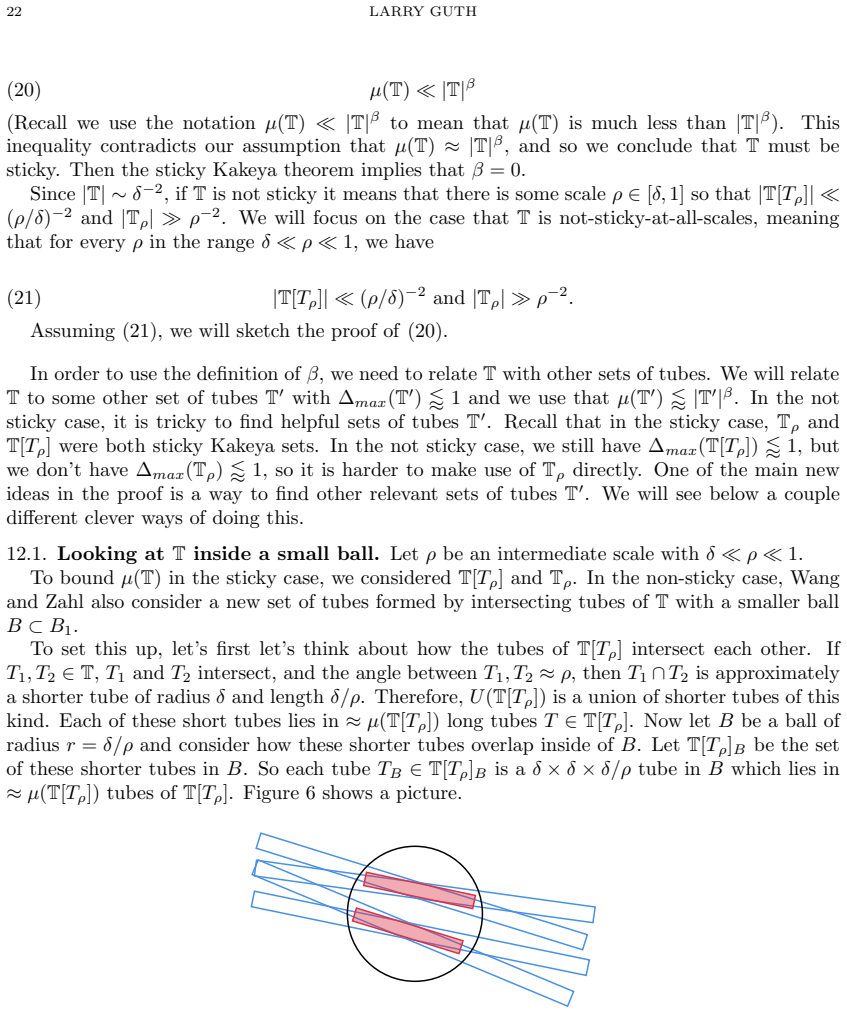

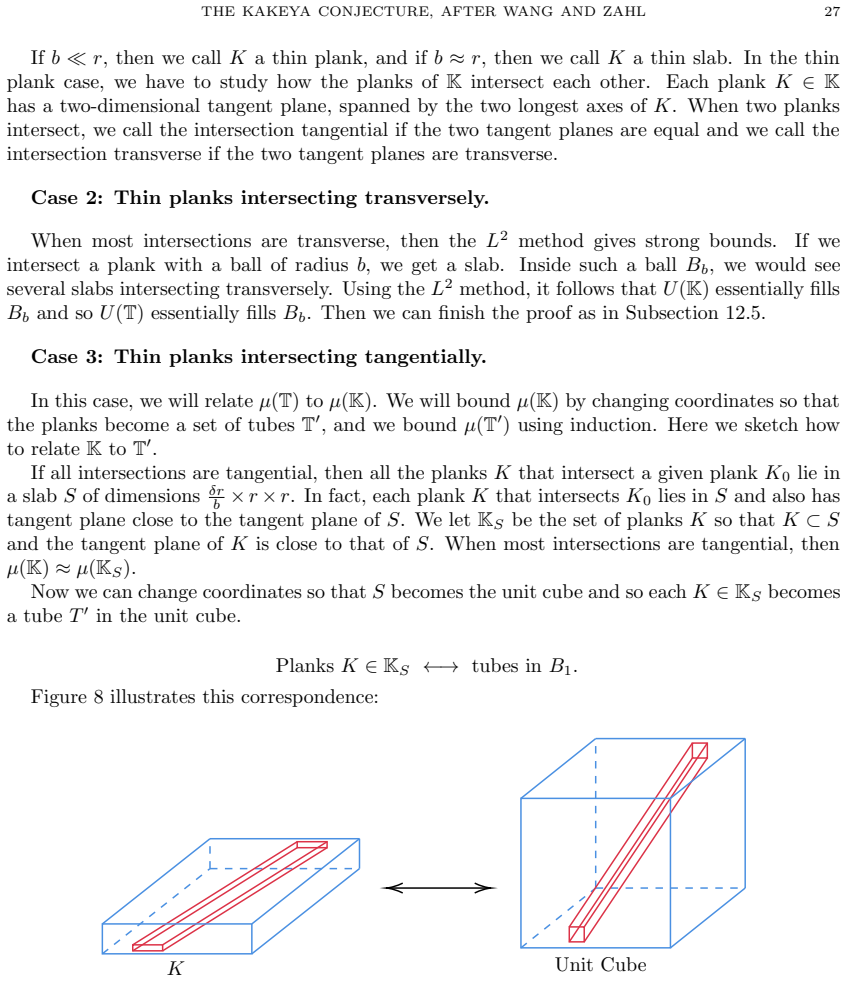

read the original abstract
This is a Seminaire Bourbaki survey of the proof of the Kakeya conjecture in three dimensions. The survey is written for a broad mathematical audience. We sketch all the ideas in the proof, with many pictures.
Editorial analysis
A structured set of objections, weighed in public.
Referee Report
Summary. This paper is a Seminaire Bourbaki survey of the proof of the Kakeya conjecture in three dimensions by Wang and Zahl. Written for a broad mathematical audience, it sketches all the main ideas in the proof and includes many pictures to illustrate the concepts.
Significance. As an expository account, the survey is significant for making a landmark recent result in harmonic analysis and geometric measure theory accessible to a wider audience. The emphasis on sketches and pictures strengthens its value as a dissemination tool, potentially aiding researchers and students in engaging with the Wang-Zahl proof without requiring full immersion in the original technical details.
minor comments (1)
- The abstract could explicitly note that the survey contains no new derivations or theorems, to further clarify its purely expository nature for readers.
Simulated Author's Rebuttal
We thank the referee for their positive report, which recognizes the survey's value as an accessible exposition of the Wang-Zahl proof for a broad audience. We are pleased that the emphasis on sketches and illustrations was noted as strengthening the manuscript's utility.
Circularity Check
Expository survey with no independent derivations or circular steps
full rationale
This is a Bourbaki seminar survey paper whose sole claim is to sketch the ideas from the external Wang-Zahl proof of the 3D Kakeya conjecture, with pictures, for a broad audience. No new theorems, derivations, parameters, or predictions are asserted. The text therefore contains no load-bearing steps that could reduce by construction to self-defined inputs, fitted quantities, or self-citation chains. The central claim reduces only to descriptive fidelity to the cited external work, which is independent of any internal fitting or re-derivation performed here.
Axiom & Free-Parameter Ledger
Lean theorems connected to this paper
-
IndisputableMonolith/Foundation/AlexanderDuality.leanalexander_duality_circle_linking echoes?
echoesECHOES: this paper passage has the same mathematical shape or conceptual pattern as the Recognition theorem, but is not a direct formal dependency.
Wang and Zahl proved the Kakeya conjecture in dimension 3... the only way a set of tubes in R^3 can overlap a lot is by clustering into convex sets
-
IndisputableMonolith/Cost/FunctionalEquation.leanwashburn_uniqueness_aczel unclear?
unclearRelation between the paper passage and the cited Recognition theorem.
multiscale analysis... T_ρ... grain structure... complex conjugation structure... sum-product theorem
What do these tags mean?
- matches
- The paper's claim is directly supported by a theorem in the formal canon.
- supports
- The theorem supports part of the paper's argument, but the paper may add assumptions or extra steps.
- extends
- The paper goes beyond the formal theorem; the theorem is a base layer rather than the whole result.
- uses
- The paper appears to rely on the theorem as machinery.
- contradicts
- The paper's claim conflicts with a theorem or certificate in the canon.
- unclear
- Pith found a possible connection, but the passage is too broad, indirect, or ambiguous to say the theorem truly supports the claim.
Reference graph
Works this paper leans on
-
[1]
On the Erd˝ os-Volkmann and Katz-Tao ring conjectures
Jean Bourgain, “On the Erd˝ os-Volkmann and Katz-Tao ring conjectures.” GAFA 13 (2003): 334-365
work page 2003
-
[2]
L p estimates for oscillatory integrals in several variables
Bourgain, J. “L p estimates for oscillatory integrals in several variables.” Geometric & Functional Analysis GAFA 1 (1991): 321-374
work page 1991
-
[3]
Bourgain, Jean. ”The discretized sum-product and projection theorems.” Journal d’Analyse Math´ ematique 112.1 (2010): 193-236
work page 2010
-
[4]
The proof of the l 2 decoupling conjecture
Bourgain, Jean, and Ciprian Demeter. “The proof of the l 2 decoupling conjecture.” Annals of mathematics (2015): 351-389
work page 2015
-
[5]
On the multilinear restriction and Kakeya conjec- tures
Bennett, Jonathan, Anthony Carbery, and Terence Tao. “On the multilinear restriction and Kakeya conjec- tures.” (2006): 261-302
work page 2006
-
[6]
Bourgain, Jean, Nets Katz, and Terence Tao. ”A sum-product estimate in finite fields, and applications.” Geometric and Functional Analysis GAFA 14.1 (2004): 27-57
work page 2004
-
[7]
”Szemer´ edi-Trotter bounds for tubes and applications.” arXiv preprint arXiv:2406.06884 (2024)
Demeter, Ciprian, and Hong Wang. ”Szemer´ edi-Trotter bounds for tubes and applications.” arXiv preprint arXiv:2406.06884 (2024)
-
[8]
Edgar, G., and Chris Miller. ”Borel subrings of the reals.” Proceedings of the American Mathematical Society 131.4 (2003): 1121-1129
work page 2003
-
[9]
”On sums and products of integers.” Studies in pure mathematics (1983): 213-218
Erdos, Paul, and Endre Szemer´ edi. ”On sums and products of integers.” Studies in pure mathematics (1983): 213-218
work page 1983
-
[10]
Garaev, Moubariz Z. ”An explicit sum-product estimate inF p.” International Mathematics Research Notices 2007 (2007): rnm035
work page 2007
-
[11]
A short proof of the multilinear Kakeya inequality
Guth, Larry. “A short proof of the multilinear Kakeya inequality.” Mathematical Proceedings of the Cam- bridge Philosophical Society. Vol. 158. No. 1. Cambridge University Press, 2015
work page 2015
-
[12]
Guth, Larry. ”Outline of the Wang-Zahl proof of the Kakeya conjecture inR 3.” arXiv preprint arXiv:2508.05475 (2025)
-
[13]
Guth Katz Zahl sum product
-
[14]
Incidence estimates for well spaced tubes
Guth, Larry, Noam Solomon, and Hong Wang. “Incidence estimates for well spaced tubes.” Geometric and Functional Analysis 29.6 (2019): 1844-1863
work page 2019
-
[15]
”A streamlined proof of the Kakeya set conjecture inR 3.” arXiv preprint arXiv:2601.14411 (2026)
Guth, Larry, Hong Wang, and Joshua Zahl. ”A streamlined proof of the Kakeya set conjecture inR 3.” arXiv preprint arXiv:2601.14411 (2026)
-
[16]
An improved bound on the Minkowski dimension of Besicovitch sets in R 3
Netx Katz, Izabella Laba, and Terence Tao. “An improved bound on the Minkowski dimension of Besicovitch sets in R 3.” Annals of Mathematics (2000): 383-446
work page 2000
-
[17]
An improved bound on the Hausdorff dimension of Besicovitch sets inR 3
Katz, Nets, and Joshua Zahl. “An improved bound on the Hausdorff dimension of Besicovitch sets inR 3.” Journal of the American Mathematical Society 32.1 (2019): 195-259
work page 2019
-
[18]
Keleti, Tam´ as, and Pablo Shmerkin. ”New bounds on the dimensions of planar distance sets.” Geometric and Functional Analysis 29.6 (2019): 1886-1948
work page 2019
-
[19]
https://arxiv.org/abs/2511.21656
O’Regan, Shmerkin, Wang. https://arxiv.org/abs/2511.21656
-
[20]
On the distance sets of Ahlfors–David regular sets
Orponen, Tuomas. “On the distance sets of Ahlfors–David regular sets.” Advances in Mathematics 307 (2017): 1029-1045
work page 2017
-
[21]
”On arithmetic sums of Ahlfors-regular sets.” Geometric and Functional Analysis 32.1 (2022): 81-134
, Orponen, Tuomas. ”On arithmetic sums of Ahlfors-regular sets.” Geometric and Functional Analysis 32.1 (2022): 81-134
work page 2022
-
[22]
On the Hausdorff dimension of Furstenberg sets and orthogonal projections in the plane
Orponen, Tuomas, and Pablo Shmerkin. “On the Hausdorff dimension of Furstenberg sets and orthogonal projections in the plane.” Duke Mathematical Journal 172.18 (2023): 3559-3632
work page 2023
-
[23]
Projections, Furstenberg sets, and theABCsum-product problem
Orponen, Tuomas, and Pablo Shmerkin. “Projections, Furstenberg sets, and theABCsum-product problem.” arXiv preprint arXiv:2301.10199 (2023)
-
[24]
Kaufman and Falconer estimates for radial projections and a continuum version of Beck’s theorem
Orponen, Tuomas, Pablo Shmerkin, and Hong Wang. “Kaufman and Falconer estimates for radial projections and a continuum version of Beck’s theorem.” Geometric and Functional Analysis 34.1 (2024): 164-201
work page 2024
-
[25]
Furstenberg sets estimate in the plane
Ren, Kevin, and Hong Wang. “Furstenberg sets estimate in the plane.” arXiv preprint arXiv:2308.08819 (2023). THE KAKEYA CONJECTURE, AFTER W ANG AND ZAHL 35
-
[26]
Shmerkin, Pablo, and Hong Wang. ”On the Distance Sets Spanned by Sets of Dimension d/2 in.” Geometric and Functional Analysis 35.1 (2025): 283-358
work page 2025
-
[27]
Stickiness, graininess, planiness, and a sum-product approach to the Kakeya problem
Terence Tao, Blog post “Stickiness, graininess, planiness, and a sum-product approach to the Kakeya problem” , https://terrytao.wordpress.com/2014/05/07/stickiness-graininess-planiness-and-a-sum-product- approach-to-the-kakeya-problem/
work page 2014
-
[28]
Tao, Terence. ”From Rotating Needles to Stability of Waves: Emerging Connections between.” Notices of the AMS 48.3 (2001)
work page 2001
-
[29]
Wang, Hong, and Shukun Wu. ”Restriction estimates using decoupling theorems and two-ends Furstenberg inequalities.” arXiv preprint arXiv:2411.08871 (2024)
-
[30]
Wang, Hong, and Joshua Zahl. ”Sticky Kakeya sets and the sticky Kakeya conjecture.” Journal of the American Mathematical Society 39.2 (2026): 515-585
work page 2026
-
[31]
Volume estimates for unions of convex sets, and the Kakeya set conjecture in three dimensions,
Hong Wang and Josh Zahl, “Volume estimates for unions of convex sets, and the Kakeya set conjecture in three dimensions,” arXiv:2502.17655
-
[32]
Wolff, Thomas. ”An improved bound for Kakeya type maximal functions.” Revista Matem´ atica Iberoameri- cana 11.3 (1995): 651-674
work page 1995
-
[33]
Wolff, Thomas. ”Recent work connected with the Kakeya problem.” Prospects in mathematics (Princeton, NJ, 1996) 2 (1999): 129-162
work page 1996
discussion (0)
Sign in with ORCID, Apple, or X to comment. Anyone can read and Pith papers without signing in.