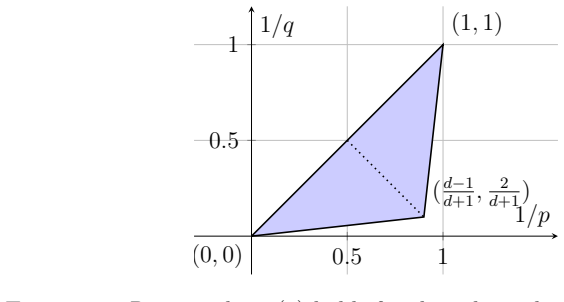
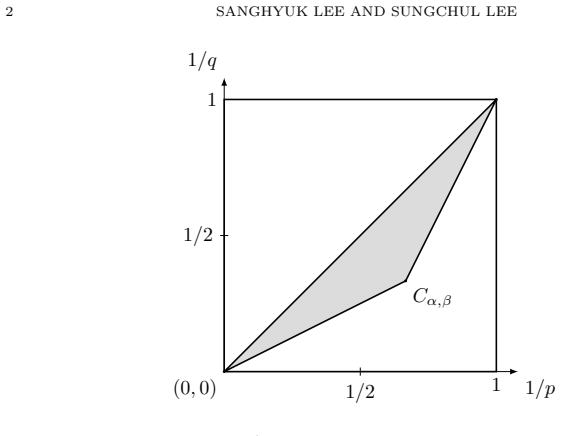
We undertake a systematic study of the mapping properties of forms based on distance graphs in $\mathbb{Z}^{d}$ to see how the structure of a graph, $G$, affects the $\ell^{p}$ improving estimates of the form, $\Lambda_{G}$, based on $G$. This extends previous work on $\ell^{p}$ improving properties for the spherical averaging operator, which corresponds to a distance graph of a single distance. We obtain $\ell^{p}$ improving estimates for the collection of forms based on all graphs with 2, 3, and 4 vertices, as well as chains and simplexes of any size in $\mathbb{Z}^{d}$. Surprisingly, certain mapping properties only seem to depend on the number of vertices in the graph, not its structure, and forms based on subgraphs of a graph, $G$, do not necessarily inherit all mapping properties from $G$.
Newton-Puiseux polygon at infinity supplies explicit bounds: at most (n2-1)+2(n3-1) over C and 12 over R.
abstractclick to expand
We study nonconstant rational solutions of \[ x'=A_3(t)x^{n_3}+A_2(t)x^{n_2}+A_1(t)x^{n_1}, \qquad 1<n_1<n_2<n_3, \] with $A_i\in\Bbbk[t]$, $\Bbbk\in\{\mathbb R,\mathbb C\}$. We prove that every such solution is of the form $x=1/p(t)$, and use the Newton--Puiseux polygon at infinity to restrict the possible degrees of $p$. Under a nondegeneracy hypothesis, the associated edge polynomials yield explicit bounds for the total number $\mathcal S$ of rational solutions. In particular, $\mathcal S\le (n_2-1)+2(n_3-1)$ over $\mathbb C$, while over $\mathbb R$ one has $\mathcal S\le 12$, with sharper parity-dependent estimates in the real case.
In d dimensions the L^p supremum is attained for p < 2d/(d-2) but unbounded above it, with complete resolution in the 2D critical case.
abstractclick to expand
We study the $L^p$ concentration problem for the Born--Jordan distribution in dimension $d>1$, thus extending the one-dimensional analysis in [Stra-Svela-Trapasso, J. Math. Pures Appl. (2026)]. We show that the existence of concentration optimizers depends on the exponent $p$ with a critical threshold at $p_*(d)= \frac{2d}{d-2}$ for $d\geq2$ (with the understanding that $p_*(2)=\infty$). In particular, for subcritical exponents $1\leq p<p_*(d)$ we prove that the supremum is finite and is attained, whereas for supercritical exponents $p>p_*(d)$ we show that the functional is unbounded. We also provide the complete solution in the (significantly more) challenging critical regime in dimension $d=2$.
The new multiplier theorems cover cases outside prior results and support weak definitions for these nonlinear quantities.
abstractclick to expand
We establish several variants of the multilinear multiplier theorem of Coifman and Meyer. We also present examples that are not covered by existing theories. Our motivation comes from applications to the definition of the Jacobian and Hessian determinant in the distributional sense.
In this paper, we determine the sharp \((p,q)\) range for \(L^p\)--\(L^q\) bounds of convolution operators \(f\mapsto \mu*f\) associated with fractal measures \(\mu\in \mathcal P_{\alpha,\beta}(\mathbb R^d)\), namely, compactly supported Borel probability measures satisfying the \(\alpha\)-Frostman condition \[ \mu(B(x,\rho)) \lesssim \rho^\alpha, \qquad \forall (x,\rho)\in \mathbb R^d\times (0,1), \] and the \(\beta/2\)-Fourier decay condition \[ |\widehat{\mu}(\xi)| \lesssim |\xi|^{-\beta/2}, \qquad \forall \xi\in\mathbb R^d. \] Sharpness is established by constructing measures satisfying these conditions together with a suitable lower regularity condition. Modifications of the same constructions also refine previous sharpness results for the \(L^2\) restriction estimate of Mockenhaupt--Mitsis--Bak--Seeger by producing, in every dimension and in both the geometric \((\alpha\ge\beta)\) and non-geometric \((\beta>\alpha)\) regimes, a single measure in \(\mathcal P_{\alpha,\beta}(\mathbb R^d)\) for which the corresponding threshold exponent is sharp.
Bounds for wave, Klein-Gordon and fractional Schrödinger equations on compact manifolds are obtained by combining sharp line results with an
abstractclick to expand
We establish new Strichartz estimates for orthonormal systems on compact Riemannian manifolds in the non-sharp admissible region of exponents, covering wave, Klein-Gordon, and fractional Schr\"odinger equations. Our approach combines the result of Wang-Zhang-Zhang \cite{wang2025strichartz} on the sharp admissible line with a Lieb-Sobolev inequality derived from a recent Cwikel estimate due to Sukochev-Yang-Zanin \cite{sukochev2025singular}, along with an alternative globalization method based on localized weak Lorentz estimates. Our results extend the Euclidean results of Bez-Hong-Lee-Nakamura-Sawano \cite{bez2019strichartz} and Bez-Lee-Nakamura \cite{bez2021strichartz}, as well as the classical single-function estimates on manifolds due to Kapitanski \cite{kapitanski1989some}, Burq-G\'erard-Tzvetkov \cite{MR2058384}, and Dinh \cite{dinh2016strichartz}.
Smooth domains satisfy |Ω|^{(Q-1)/Q} ≤ C P(Ω) where Q = n + m(β+1-α)/(1-α) encodes the degeneracy
abstractclick to expand
Let $n,m\ge 1$, $\alpha\in(0,1)$, and $\beta\ge 0$. For the Grushin-type operator \[ L=-\nabla_x\!\cdot\!\bigl(|x|^{2\alpha}\nabla_x\bigr)+|x|^{2\beta}\Delta_y \qquad \text{on } \mathbb R^n\times \mathbb R^m, \] we prove the isoperimetric inequality on the associated Grushin space. Equivalently, if \[ Q=\frac{n+m(\beta+1-\alpha)}{1-\alpha}, \] then \[ |\Omega|^{\frac{Q-1}{Q}}\le C\,P(\Omega) \] for every smooth bounded domain $\Omega\subset \mathbb R^{n+m}$.
Orthogonal polynomials from q-positive measures obey the classical theorems via new matrix-valued Schur recurrences and moment formulas.
abstractclick to expand
We introduce a theory of orthogonal polynomials on the unit sphere of the quaternions based on the notion of a $q$-positive measure (which originated in a work of Alpay, Colombo, the second author and Sabadini). The results we extend to this setting include the Szeg\H{o} recurrences, the Zeros Theorem for orthogonal polynomials, the Szeg\H{o}--Verblunsky theorem, and Baxter's theorem; to obtain these results, we utilise the Verblunsky coefficients (or Schur parameters) of Alpay, Colombo and Sabadini and a number of established results in the matricial setting. Our approach also requires matrix-valued analogues of Schur's recurrences for the coefficients of a Schur function and of Verblunsky's formula for the moments of a measure, which appear to be new.
The rates imply time decay for the harmonic-oscillator Schrödinger equation and sharpen the subcritical uncertainty principle.
abstractclick to expand
In this paper, we analyze a function space consisting of functions for which both the function and its Fourier transform exhibit Gaussian decay together with exponential growth governed by suitable weight functions.
First, we examine logarithmic-type weights, in which case these function spaces are equivalent to Pilipovi\'c spaces. In this setting, we establish a decay estimate for the Hermite coefficients of functions. Furthermore, by combining these estimates with the asymptotic behavior of Hermite functions, we prove a decay rate for solutions to the harmonic oscillator Schr\"odinger equation.
Second, we consider a class of weights and prove the exponential decay of the Hermite projection operators on these spaces by analyzing Laguerre expansions and the short-time Fourier transform.
Additionally, we revisit the subcritical Hardy uncertainty principle and obtain a partial improvement toward a conjecture posed by Vemuri.
Weights with controlled oscillation across dyadic scales and bounded at the top level make subsequence maximal operators weak type (1,1), in
abstractclick to expand
We study weighted Walsh--Carleson maximal operators arising from dyadic martingale transforms associated with Walsh--Fourier partial sums. For weights satisfying a uniform dyadic variation condition and a uniform bound at the top dyadic scale, we prove weak type~$(1,1)$ estimates for the corresponding maximal operators along subsequences. We also give divergence criteria in terms of the behavior of the weights near the top dyadic scale and, under suitable admissibility assumptions, relate these criteria to explicit ratio conditions. As applications, we obtain results on matrix transforms of Walsh--Fourier partial sums, including de la Vall\'ee Poussin means, Ces\`aro means with varying parameters, N\"orlund logarithmic means, and general N\"orlund means. In particular, we prove a Walsh--Paley analogue of the Leindler--Tandori theorem and establish everywhere divergence results for several summability methods.
Motivated by the average partition function of c free bosons $($Afhkami-Jeddi et al. \cite{Afhk2021}$)$ and the average of the genus 1 partition function over the Narain moduli space $($Maloney-Witten \cite{Witten2020}$)$, we investigate ratios of theta functions. In this paper, we completely classify the minimizers (or maximizers) for ratios of theta and Epstein zeta functions. We find that the hexagonal lattice plays a pivotal role there. These results have direct applications in conformal and Liouville field theory via partition functions. Additionally, they yield the minima of differences of theta and Epstein zeta functions, which have implications for the mathematics of crystallization and interacting particle theory (\cite{Bet2016,Bet2019AMP}).
When growth function inverses are log-convex, admissible (α, β) pairs form a convex region that supports systematic interpolation.
abstractclick to expand
In this note, we study the geometric structure of the parameter sets governing continuous embeddings between weighted Bergman-Orlicz spaces. First, for a fixed pair of growth functions, we show that the set of admissible weight exponents $(\alpha, \beta)$ is convex, provided the growth functions satisfy specific log-convexity and log-concavity conditions of the inverses. Second, we consider the dual problem where the weight exponents are fixed. We prove that the collection of growth function pairs that yield such an embedding is log-convex under a natural interpolation of their inverses. We then obtain interpolated embeddings between Bergman-Orlicz spaces.
The condition links interval sizes r_k to weights w_k so that continuous functions on the circle can carry arbitrary square-summable values
abstractclick to expand
Let $(r_k)$ be an increasing sequence and $(w_k)$ a positive sequence. We study the following question: is it true that for every sequence $(a_k)$ satisfying $\sum_{k=0}^\infty |a_k|^2 w_k^2 < \infty$ there exists a function $f\in C(\mathbb{T})$ such that $\hat{f}(2^k) = a_k$ and $\hat{f}(n) = 0$ for $n\notin \cup_k [2^k-r_k,2^k+r_k]$? We show that this is possible if and only if $\sup_{k\in\mathbb{N}}\sum_{n=[\log_2 r_k]}^k w_k^{-2} < \infty$.
The bound depends only on the number of linear regions and the trigonometric degree, giving a solved case of Hilbert's sixteenth problem.
abstractclick to expand
Let $x'=S(t,x)$ be a differential equation in the cylinder, linear piecewise in $x$ and with trigonometric coefficients in $t$. In this paper, we provide an upper bound on the number of limit cycles in terms of the number of regions of the piecewise equation and the degree of the coefficients, that is, an analogue of Hilbert's 16th problem in this context.
Counterexample rules out c=2; at the critical exponent the bound holds for integers p>=2 and three functions get a sharper optimal c(p)
abstractclick to expand
Carbery proposed the following sharpened form of triangle inequality for many functions: for any $p\ge 2$ and any finite sequence $(f_j)_j\subset L^p$ we have \[ \Big\|\sum_j f_j\Big\|_p \ \le\ \left(\sup_{j} \sum_{k} \alpha_{jk}^{\,c}\right)^{1/p'} \Big(\sum_j \|f_j\|_p^p\Big)^{1/p}, \] where $c=2$, $1/p+1/p'=1$, and $\alpha_{jk}=\sqrt{\frac{\|f_{j}f_{k}\|_{p/2}}{\|f_{j}\|_{p}\|f_{k}\|_{p}}}$. In the first part of this paper we construct a counterexample showing that this inequality fails for every $p>2$. We then prove that if an estimate of the above form holds, the exponent must satisfy $c\le p'$. Finally, at the critical exponent $c=p'$, we establish the inequality for all integer values $p\ge 2$.
In the second part of the paper we obtain a sharp three-function bound \[ \Big\|\sum_{j=1}^{3} f_j\Big\|_p \ \le\ \left(1+2\Gamma^{c(p)}\right)^{1/p'} \Big(\sum_{j=1}^{3} \|f_j\|_p^p\Big)^{1/p}, \] where $p \geq 3$, $c(p) = \frac{2\ln(2)}{(p-2)\ln(3)+2\ln(2)}$ and $\Gamma=\Gamma(f_1,f_2,f_3)\in[0,1]$ quantifies the degree of orthogonality among $f_1,f_2,f_3$. The exponent $c(p)$ is optimal, and improves upon the power $r(p) = \frac{6}{5p-4}$ obtained previously by Carlen, Frank, and Lieb. Some intermediate lemmas and inequalities appearing in this work were explored with the assistance of the large language model Grok.
The criteria complement Gasper's result on Jacobi polynomials and produce nonnegative expressions for the determinants.
abstractclick to expand
Originally, Tur\'{a}n's inequality states that if $(P_n(x))_{n\in\mathbb{N}_0}$ is the sequence of Legendre polynomials, then $\Delta_n(x):=P_n^2(x)-P_{n+1}(x)P_{n-1}(x)\geq0$ for all $n\in\mathbb{N}$ and $x\in[-1,1]$. Gasper specified the parameters $\alpha,\beta>-1$ for which the Jacobi polynomials $(R_n^{(\alpha,\beta)}(x))_{n\in\mathbb{N}_0}$ satisfy Tur\'{a}n's inequality. Frequently, such results rely on the specific structure of the concrete orthogonal polynomials under consideration. Therefore, special focus has been put on general criteria (whose importance was particularly emphasized by Nevai). We provide two general criteria for Tur\'{a}n's inequality in terms of the three-term recurrence relation and also deal with sharper estimations of the Tur\'{a}n determinants $\Delta_n(x)$. They extend earlier results of Szwarc and Berg--Szwarc. Applying our criteria to the class of generalized Chebyshev polynomials $(T_n^{(\alpha,\beta)}(x))_{n\in\mathbb{N}_0}$, which are the quadratic transformations of the Jacobi polynomials, we find the companion to Gasper's above-mentioned result. At this stage, we also obtain nonnegative representations of $\Delta_n(x)$. Finally, we study $2$-sieved polynomials and discuss further examples.
The equivalence holds in Hilbert spaces and extends to almost strict convexity through envelopes and proximal mappings.
abstractclick to expand
In this paper, we unify and improve existing results on characterizing strict and almost stricty convex functions via subdifferential mapping, Moreau envelope, and proximal mappings. In particular, it is shown that if a convex function is subdifferentiable on its domain, then it is strictly convex if and only if its subdifferential is strictly monotone, equivalently, almost strictly monotone. Rockafellar-Wets' characterizations of almost strictly convex functions via almost differentiability of Fenchel conjugates and strict monotonicity of subdifferentials are extended from a finite-dimensional space to a Hilbert space. We also establish similar results for paramonotone operators.
The 2019 result on subsequence averages is extended from δ<1/2 to the full range 0<δ<1 for every integrable function.
abstractclick to expand
Let $S_m f$ denote the $m$-th partial sum of the Walsh-Fourier series of $f \in L^1$. For an increasing sequence $a=(a(n))_{n \geq 1}$ of positive integers, consider the arithmetic means
$$ \sigma_N f:=\frac{1}{N} \sum_{n=1}^N S_{a(n)} f . $$
G\'at proved in 2019 that $\sigma_N f \rightarrow f$ almost everywhere for every $f \in L^1$ under the growth condition
$$ a(n+1) \geq\left(1+\frac{1}{n^\delta}\right) a(n), \quad 0<\delta<\frac{1}{2} . $$
We show that the same conclusion remains valid throughout the full range $0<\delta<1$.
Integrable functions converge almost everywhere when the condition holds, but functions in weak Orlicz classes diverge everywhere otherwise.
abstractclick to expand
We study de la Vall\'ee Poussin means of Walsh--Fourier series associated with a nondecreasing window sequence. We establish a sharp criterion for almost everywhere convergence for integrable functions. We further show that, when this criterion fails, every Orlicz class below the logarithmic square-root scale contains a function whose de la Vall\'ee Poussin means diverge everywhere.
This reveals a basic limit on what energy techniques can show about Favard length.
abstractclick to expand
Energy techniques can be used to study the structure of fractal sets; the existence of a measure with finite Riesz energy supported on a set gives information about its dimension, distribution, and density. In this paper, we study energy-minimizing measures supported near fractal $1$-sets. Using physical analogy and a variant of the fast multipole method, we show a strong equidistribution result for these measures. We impose only mild geometric constraints on our sets, assuming only a generational structure of the approximations. This allows us to consider sets which do not exhibit self-similarity or other algebraic constraints. As a corollary, we demonstrate a fundamental limitation in the use of energy techniques for studying Favard length.
Refining the argument extends the class of vector fields for which the operator remains controlled, strengthening an earlier implicit result
abstractclick to expand
By refining Bourgain's argument for maximal functions associated with planar vector fields, we identify a condition ensuring boundedness that is weaker than previously known. As a consequence, this strengthens a result implicit in the work of Lacey and Li. The proof is elementary and follows Bourgain's original method. In addition, we compare boundedness criteria in both finite-type and non-finite-type settings for related operators.
The volume of the unit ball in continuous dimension x follows directly as the mass of the unit interval under the unique invariant measure.
abstractclick to expand
We classify positive linear functionals on $C_c(\mathbb{R}_{>0})$ satisfying scaling covariance of degree $x/2$ and Gaussian normalization to $\pi^{x/2}$. We prove that the unique such functionals are represented by the Mellin--Gamma measures \[ d\mu_x(u) = \frac{\pi^{x/2}}{\Gamma(x/2)}\, u^{x/2 - 1}\, du, \quad x > 0. \] The result is a rigidity statement: the Mellin--Gamma structure is forced by the axioms, without assuming analytic continuation, special functions, or a priori formulas. The proof reduces the scaling condition, via a logarithmic change of variables, to translation invariance on $\mathbb{R}$, where Haar measure uniqueness determines the measure up to normalization, which is fixed by the Gaussian integral.
As a consequence, the Euclidean ball volume formula \[ V(x) = \frac{\pi^{x/2}}{\Gamma(x/2 + 1)} \] is recovered as the mass of the unit interval. We further analyze the induced dimension-shift structure, identifying two multiplicative cocycles whose ratio is a coboundary given by the dimension function $x$, and give an independent characterization via a shifted Bohr--Mollerup theorem.
We study scalar dyadic refinement operators on R^2 of the form (Vf)(x,y) = sum_{(j,k) in Z^2} c_{j,k} f(2x-j, 2y-k), where only finitely many mask coefficients c_{j,k} are nonzero. Under a fixed support-window hypothesis, we prove that for every compactly supported continuous piecewise linear seed g:R^2->R, the iterates V^n g admit exact ReLU realizations of fixed width and depth O(n).
This gives a first genuinely two-dimensional extension of the exact realization theory for refinement cascades. Using the one-dimensional exact loop-controller framework, the proof transports the tensor-product residual dynamics exactly on the product of two polygonal loops and reduces the remaining seam ambiguity to a final readout and selector step. The matrix cascade is then handled by a fixed-depth recursive block, and general compactly supported continuous piecewise linear seeds are reduced to a finite decomposition together with exact clamped gluing on the support window. This identifies the tensor-product dyadic case as a natural first multivariate instance of the loop-controller method for refinement iterates.
For supercritical pairs, bounds on f and its Fourier transform at sample points imply full exponential decay bounds and identify Gaussians.
abstractclick to expand
We show that knowing the decay of a function $f$ on a discrete set $\Lambda\subset\mathbb{R}$ and the decay of its Fourier transform $\hat{f}$ on a discrete set $M\subset\mathbb{R}$ is enough to determine the global decay of $f$ and $\hat{f}$, provided that $(\Lambda,M)$ is a supercritical pair in the sense of Kulikov, Nazarov, and Sodin. This decay transfer result leads to a discrete generalization of Morgan's uncertainty principle: it is enough to require $|f(\lambda)|\lesssim e^{-\frac{2}{p}A\pi|\lambda|^p}$ for all $\lambda\in\Lambda$ and $|\hat{f}(\mu)|\lesssim e^{-\frac{2}{q}A\pi|\mu|^q}$ for all $\mu\in M$, where $(p,q)$ are H\"{o}lder conjugates, $A>|\cos(\frac{r\pi}{2})|^\frac{1}{r}$, and $r:=\min\{p,q\}$. For $A=1$ and $p,q=2$, we also show that any such function must be a scaled Gaussian. This yields a discrete version of Hardy's uncertainty principle and resolves two questions posed by Ramos and Sousa.
The match supplies the leading large-t behavior for zeta identities and gamma integrals by using the known Bleistein expression.
abstractclick to expand
Several important functions, including the gamma function, as well as several infinite sums, admit integral representations involving the Hankel contour. In addition, the large $t$ asymptotic analysis of several recently derived identities satisfied by the Riemann zeta function requires computing the asymptotic form of certain integrals which also involve the Hankel contour; these integrals depend on a real parameter, $\alpha$. A rigorous asymptotic technique is presented here for computing such integrals to all orders. For certain values of $\alpha$, the relevant formula, in addition to an asymptotic series of explicit terms, also contains a specific integral. It is shown that, remarkably, the leading order of this integral can be written in the form of the leading order of the Bleistein integral. The latter integral arises in the implementation of the classical steepest descent method in the case that the stationary point coincides with one of the boundary points of the integral under consideration.
It is known that every point on L\'evy's Dragon Curve admits a natural representation as a complex power series. We introduce a directed graph $\mathcal{G}_1$ which characterizes this representation. In this paper, we study the translation of the curve by $s=-1/2+i/2$. We identify another directed graph $\mathcal{G}_2$, that characterizes the translated curve and exhibits a revolving structure analogous to that of $\mathcal{G}_1$.
The bounds recover fractal L2 restriction estimates with sharper weight dependence and improve Falconer distance results under weaker weight
abstractclick to expand
We prove weighted $L^2$ and refined $L^p$ decoupling estimates for functions whose Fourier transforms are supported in a small neighborhood of the unit sphere or the truncated paraboloid with an additional lower-dimensional frequency localization property. As a special case, we recover the fractal $L^2$ restriction estimate of Du and Zhang, with a sharper dependence on the density of the weight. We also derive weighted refined decoupling estimates related to the Falconer distance set problem, improving earlier results under the stronger assumption that the underlying weight is $\alpha$-dimensional at every scale.
The minimum ratio equals 2 to the power 1/p minus 1/2 for p at most 1 and the smaller of two expressions for 1 less than p less than 2.
abstractclick to expand
Let $d\ge 3$ and $p>0$. Let $\|x\|_p$ denote the $\ell_p$ (quasi-)norm of a $d$-dimensional vector $x$. Holevo and Utkin \cite{HU26} conjectured that for $0<p\le 1$, \[ \min \left\{\frac{\|x\|_p}{\|x\|_2}:\vec{0}\neq x\in\mathbb R^d,\ \sum_{i=1}^d x_i=0\right\} =2^{1/p-1/2}; \] for $1<p<2$, \[ \min \left\{\frac{\|x\|_p}{\|x\|_2}:\vec{0}\neq x\in\mathbb R^d,\ \sum_{i=1}^d x_i=0\right\} = \min\left\{2^{1/p-1/2},\left(\frac{(d-1)^{p/2}+(d-1)^{1-p/2}}{d^{p/2}}\right)^{1/p}\right\}; \] and for $2<q<\infty$ \[ \max\left\{\frac{\|x\|_q}{\|x\|_2}:\vec{0}\neq x\in\mathbb R^d,\ \sum_{i=1}^d x_i=0\right\} = \max\left\{2^{1/q-1/2},\left(\frac{(d-1)^{q/2}+(d-1)^{1-q/2}}{d^{q/2}}\right)^{1/q}\right\}. \] They proved the $d=3$ case in \cite{HU26}. In this paper, we confirm the conjecture of the remaining cases $d\ge 4$.
They give the maximum number of isolated zeros for piecewise polynomial perturbations when the separation line inclination is treated as a自由
abstractclick to expand
In this paper, we explicitly obtain inhomogeneous Picard-Fuchs equations for Abelian integrals $I_{i,j}^+(h)$, where $I_{i,j}^+(h)$ is an integral along orbital arcs defined by polynomials $\frac{1}{2}y^2 + F(x)=h$. Moreover, we discuss the method of using Picard-Fuchs equations to recursively compute the asymptotic expansions of genearating functions of Abelian integrals near a homoclinic loop. As an application, we derive the maximum number of isolated zeros of Melnikov functions near a nilpotent saddle homoclinic loop for piecewise polynomials perturbations with the inclination $\theta$ of the separation line as a free parameter.
In the context of the Dirac equation with square-summable potential, we study the Jost solutions and prove that the maximal function associated with the argument of the transmission coefficient is unbounded. We also show that the strong version of the nonlinear Carleson conjecture fails for Dirac equations and Krein systems.
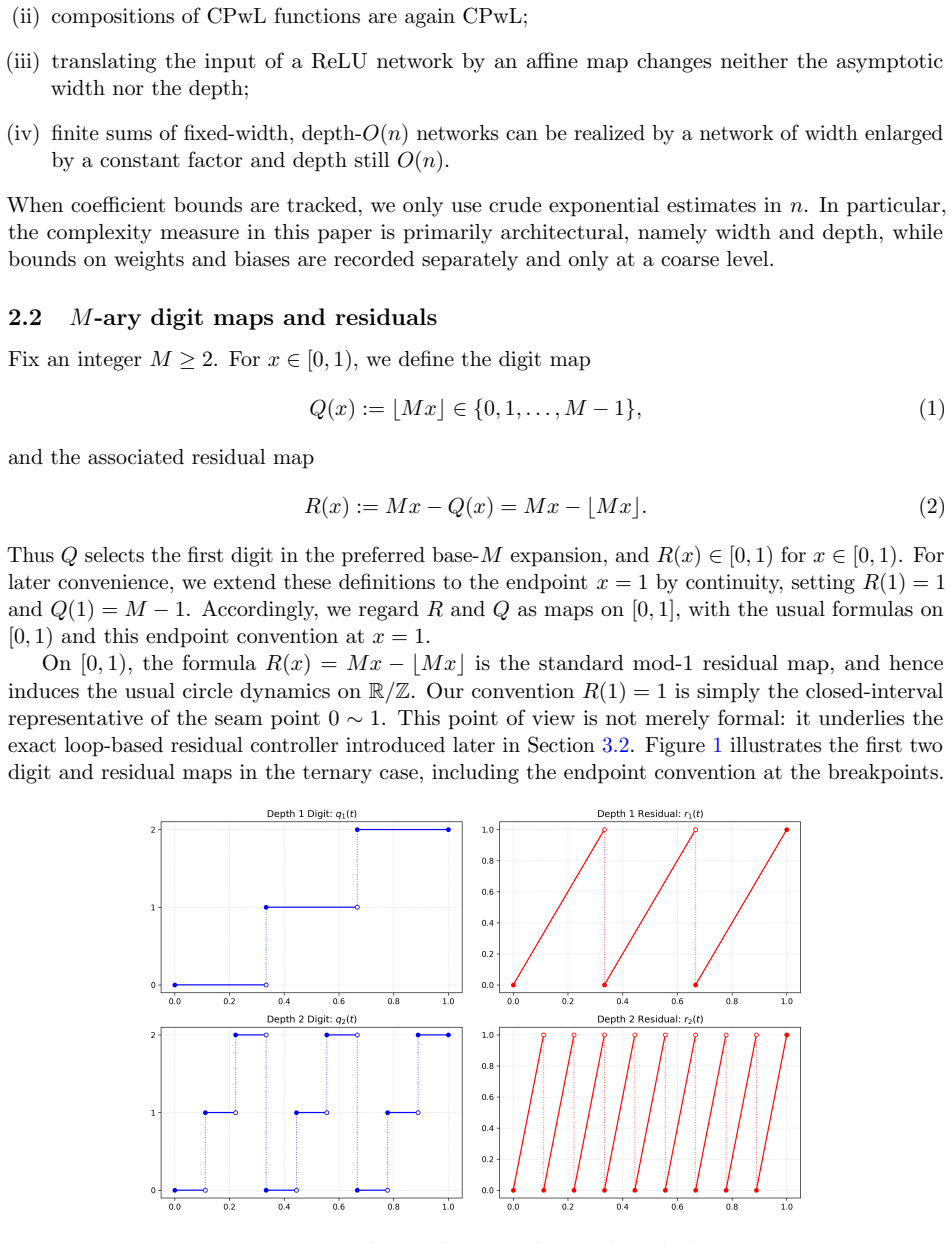
We study homogeneous refinement operators \((V\gamma)(t)=\sum_{j\in\mathbb Z}A_j\gamma(Mt-j)\), acting on compactly supported continuous piecewise linear curves \(\gamma:\mathbb R\to\mathbb R^p\), where \(M\ge2\) and only finitely many matrices \(A_j\in\mathbb R^{p\times p}\) are nonzero. We prove that the iterates \(V^n\gamma\) admit exact ReLU realizations of fixed width and depth \(O(n)\).
The main new ingredient is an exact loop controller for the residual dynamics. Instead of propagating scalar residual surrogates, the construction transports the residual orbit by a forward-exact state on a polygonal loop. Scalar factors and digit selectors are then recovered from this loop state by complementary CPwL readouts. The loop seam is not removed, but its remaining ambiguity is confined to the final readout/selector stage, where it is harmless because the scalar atom is supported away from the seam. This gives a homogeneous \(M\)-ary vector-valued extension of the scalar binary refinable-function construction with a more geometric controller architecture.
We also record crude exponential bounds on the network weights and biases. Affine forcing terms are handled by expanding affine iterates into finite sums of homogeneous iterates, giving exact fixed-width realizations with depth \(O(n^2)\), and anchored open curves reduce to compactly supported defects with affine anchor mismatch. We also describe homogeneous polygonal generators, including dragon-type examples and a self-intersecting Hilbert-type prototype in arbitrary dimension. The extended version includes stage-dependent forcing, finite-state stacking reductions, and further geometric constructions such as Koch-, Gosper-, Morton-, and connector-based Hilbert-type variants.
Special solutions of the q-Heun equation are obtained as finite summations of q-hypergeometric functions via q-integral transformations…
abstractclick to expand
We obtain special solutions of the $q$-Heun equation which are expressed as finite summations of $q$-hypergeometric functions. These solutions are obtained by considering the $q$-integral transformations of the polynomial-type solutions.
We consider series expansions in bases of classical orthogonal polynomials. When such a series solves a linear differential equation with polynomial coefficients, its coefficients satisfy a linear recurrence equation. We interpret this equation as the numerator of a fraction of linear recurrence operators. This interpretation lets us give a simple and unified view of previous algorithms computing these recurrences, with a noncommutative Euclidean algorithm as the algorithmic engine. Finally, we demonstrate the effectiveness of our approach on various examples.
Continuous strictly monotone generators on non-positive reals receive an explicit closed-form extension satisfying the equation on the whole
abstractclick to expand
Here, we investigate the solutions to equation \[f(f(-x)+x)=f(-f(x))+f(x),\qquad x\in\mathbb{R}\] that are prescribed on the non-positive half-line. We will refer to this prescribed function as the generator of the corresponding solution.
We show that any function taking negative values on the negative half-line and being strictly greater than the identity can be extended to a solution. Nevertheless, the solutions generated by continuous, strictly monotone functions can be well characterized. As our main result, we establish a closed-form expression for these functions.
Negativity on negatives plus exceeding the identity suffices for existence; continuous monotone generators get closed forms.
abstractclick to expand
Here, we investigate the solutions to equation \[f(f(-x)+x)=f(-f(x))+f(x),\qquad x\in\mathbb{R}\] that are prescribed on the non-positive half-line. We will refer to this prescribed function as the generator of the corresponding solution.
We show that any function taking negative values on the negative half-line and being strictly greater than the identity can be extended to a solution. Nevertheless, the solutions generated by continuous, strictly monotone functions can be well characterized. As our main result, we establish a closed-form expression for these functions.
Functions obeying the weighted average only for x ≤ y must obey it for all pairs once the domain is any subinterval of R.
abstractclick to expand
In 2014, Michal Lewicki and Andrzej Olbry\'s proved that if a real valued function $f$ defined on the real line satisfies the conditional functional equation \[ f(tx + (1-t)y) = t f(x) + (1-t) f(y),\qquad x\leq y, \] called non-symmetrically $t$-affine, then it is $t$-affine. That is, they concluded that $f$ must fulfill the above equality without any restriction on $x$ and $y$.
In the current study, first we show that the above conditional equation implies that the function in question is locally $t$-affine. Then we derive $t$-affinity on open intervals. Finally, we formulate our main result, which generalizes the theorem of Lewicki and Olbry\'s for any subinterval of $\mathbb{R}$.
Blend-to-zero operators match arbitrary derivatives at endpoints; trigonometric steps solve related boundary-value problems
abstractclick to expand
Motivated by existing blend-to-zero techniques, a formal framework is developed for defining and constructing blend-to-zero operators on closed intervals for the generation of sufficiently smooth transitions between functions. Such transitions are first formulated as a two-point Hermite-type interpolation that is not necessarily polynomial. It is shown that, in the polynomial case, the corresponding interpolant can be explicitly represented in terms of the regularized incomplete Beta-function. This representation is then used to generate linear blend-to-zero operators. Following this, additional blend-to-zero operators are constructed by considering the algebraic and geometric properties of functions with sufficiently flat ends (e.g., smooth staircase functions and smooth step functions). Finally, explicit formulas for a family of trigonometric smooth step functions are provided, and these functions are shown to be related to certain higher-order two-point boundary value problems.
The critical exponent matches the best known for the bilinear T1 theorem via a new weak compactness condition.
abstractclick to expand
This paper extends the characterization of compactness established in \cite{cao2024} to bilinear singular integral operators with mild kernel regularity. The exponent we obtain coincides with the best known sufficient condition for the classical bilinear $T1$ theorem. A novel weak compactness property condition is also introduced.
A version of the Uncertainty Principle says: There does not exist a non zero function in $L_p(\mathbb{R}^d)$ if its Fourier transform is supported by a set of finite $\alpha$-Hausdorff measure with $\alpha<2d/p$. This UP does not hold at the endpoint $\alpha=2d/p$. We find the sharp form of the UP in the limit case. We prove that there exists a non-zero function in the Lorentz space $L_{p,q}(\mathbb{R}^d)$ such that its Fourier transform is supported by a set of zero $(\frac{2d}{p},\beta)$-Netrusov--Hausdorff capacity if and only if $\beta>\frac{q}{2(q-1)}$.
Quantitative results for A_∞ weights with small Fujii-Wilson constant give Poincaré-Sobolev inequalities recovering the classical Sobolev p*
abstractclick to expand
We provide new quantitative results on the embedding of the Muckenhoupt class $A_\infty$ into $A_p$ with the correct asymptotic behavior when the Fujii--Wilson constant $[w]_{A_\infty}$ is close to 1, namely that the parameter $p$ goes to 1 when the weight is nearly constant. As intermediate steps towards the result, we obtain quantitative estimates on the weighted and unweighted BMO norms of $\log w$ for an $A_\infty$ weight $w$. As a consequence, we show that a precise quantitative weighted Poincar\'e-Sobolev inequality can be proved for weights with small $[w]_{A_\infty}$ that recovers the classical Sobolev exponent $p^*=\frac{np}{n-p}$ when $[w]_{A_\infty}\to 1^+$.
A mixed recurrence locates the exact extra points needed when two zeros are missing, with explicit results for Jacobi, Meixner-Pollaczek and
abstractclick to expand
We investigate completed interlacing of zeros for pairs of polynomial sequences that fail to interlace by exactly two points. Using a general mixed recurrence relation, we identify a quadratic polynomial whose zeros serve as the two extra points required to achieve complete interlacing. We determine the precise positions of these two extra points relative to the zeros of the higher-degree polynomial, thereby establishing full interlacing results. The theory is applied to several classical families of orthogonal polynomials. In the Jacobi case, we improve earlier results by giving explicit extra points that complete the interlacing of $P_n^{(\alpha,\beta)}$ and $P_{n+1}^{(\alpha+1,\beta+1)}$. Second, we address an open question regarding the interlacing of zeros for Meixner-Pollaczek polynomials of consecutive degree with parameter increased by one. Finally, we establish new interlacing results for Pseudo-Jacobi polynomials.
Compact subsets of [0,1] with large Hausdorff dimension contain three-point configurations defined by polynomials and logarithmic terms.
abstractclick to expand
We study the occurrence of curved three-point configurations in fractal subsets of the real line. We prove that if \(E \subset [0,1]\) is a compact set with sufficiently large Hausdorff dimension, then \(E\) contains a curved three-point progression associated with a broad class of nonlinear functions.
Our approach can also show the existence of the curved three-point pattern under the assumption that the Hausdorff content of \(E\) is bounded away from zero. The class of functions includes, in addition to polynomials with vanishing constant term, nonlinear functions such as \[ t^k \log(1+t), \quad \forall k \geq 1. \]
This condition is necessary and sufficient for almost everywhere unconditional convergence in arbitrary wavelet-type dyadic systems, with a
abstractclick to expand
We establish new quantitative estimates for general systems of functions with wavelet-type dyadic structure. These estimates are applied to obtain the optimal growth of various types of Weyl multipliers for certain wavelet-type systems. Some of our results are sufficiently general to allow the orthogonality assumption to be removed. In particular, as a consequence of these estimates we show that the condition
\begin{equation*}
\sum_{n=1}^\infty\frac{1}{nw(n)}<\infty
\end{equation*}
is necessary and sufficient for an increasing sequence $w(n)$ to be an almost everywhere unconditional convergence Weyl multiplier for an arbitrary wavelet-type system. We also prove that $\log n$ is an almost everywhere convergence Weyl multiplier for any rearranged wavelet-type system, and that this bound is optimal.
We study the problem of finding the "smoothest'' local average of a function $f \in \ell^2(\mathbb{Z})$ when we consider its convolution with suitable kernels $u$. The measurement of smoothness is as follows: Given a positive integer $k$, we aim to minimize the constant \begin{equation*} \sup_{0 \neq f \in \ell^2(\mathbb{Z})} \frac{\|\nabla^{k}(u\ast f)\|_{\ell^2(\mathbb{Z})}}{\|f\|_{\ell^2(\mathbb{Z})}} \end{equation*} among all symmetric kernels $u : \{-n,\dots,n\} \to \mathbb{R}$ with normalization $\sum_{j=-n}^{n}u(j) = 1$. We are also interested in finding the kernel for which the least constant is attained. For $k=1$ and $k=2$, the sharp constants and optimal kernels were obtained by Kravitz-Steinerberger, and Richardson. In this paper, we provide alternative proofs for $k\in \{1,2\}$ by using complex analysis tools. Moreover, we establish the case $k=3$, and also the cases $k\in \{4,6\}$ when the kernels are restricted to have non-negative Fourier transform. These are the first results in the literature for $k>2$. Finally, we deduce a general relation between the sharp constants and optimal kernels corresponding to $\nabla^k$ and $\nabla^{2k}$.
Lecture notes survey the Paley-Wiener, Beurling-Malliavin, and Ivashev-Musatov theorems as illustrations of spectral gaps and integrability.
abstractclick to expand
These lecture notes are devoted to selected topics related to the uncertainty principle in harmonic analysis. Rather than attempting a systematic treatment, we emphasize only a number of both classical and deep manifestations of this principle, mainly from the perspective of Fourier analysis on the unit circle and on the real line.
We consider problems of uniqueness and reconstruction for Fourier series and Fourier transforms, the influence of spectral gaps, and the role of logarithmic integrability in questions of approximation and quasi-analyticity. Central results discussed include the Paley--Wiener theorem, the Beurling--Malliavin multiplier theorem, and the Ivashev--Musatov theorem. These notes are intended as an entry point toward the research literature, with several sections pointing in the direction of more recent developments.
Identity rewrites det(A+B) for matrices built from contours 0 and Γ as det(I+K) on Γ, extending prior results.
abstractclick to expand
We derive an identity for the determinant of the sum of two $n\times n$ matrices, $A$ and $B$, whose entries are defined via contour integrals. Specifically, we consider $A(i,j)=\frac{1}{2\pi\mathrm{i}}\oint_0 z^{i-j-1}p_i(z)f_j(z)\mathrm{d} z$ and $B(i,j)= \frac{1}{2\pi\mathrm{i}}\int_{\Gamma} q_i(z)g_j(z) \mathrm{d} z$. Under suitable assumptions on the functions $p,q,f,g$, we show that $\det(A+B)$ can be expressed as a Fredholm determinant $\det(\mathrm{I} +K)$, where $K$ is an integral kernel acting on the contour $\Gamma$. This result generalizes a recent identity obtained in \cite{Baik-Liao-Liu26}.
A sextic-to-cubic integral ratio equals a rational constant and generates new 3- and 6-term equations that prove several dilogarithm results
abstractclick to expand
Building on results by Abouzahra and Lewin, McIntosh, and Kirilov we derive new functional dilogarithm equations and consequent diologarithim ladders. By showing that the ratio of a pair of sextic and cubic integrals equals a rational constant, we construct new 3- and 6-term functional equations, from which we derive an analytic proof of an identity by Loxton-Lewin, as well as a pair of quartic-base dilogarithm ladders, also believed to be new, building on Loxton's result. Finally, we prove conjectured 2-term dilogarithm identities of Bytsko, and extend his result for the Bloch-Wigner function using the above methods.
For weights (1-cos θ)^m the integral condition on log w implies the m-th differences of α are square-summable and α lies in ℓ to the 2m+2.
abstractclick to expand
We give a direct algebraic proof of the necessity direction in the single-point higher-order Szeg\H{o} sum rules on the unit circle for $m=1,2,3$. More precisely, for $H_m(e^{i\theta})=(1-\cos\theta)^m$, we show that $\int_0^{2\pi}H_m(e^{i\theta})\log w(\theta)\frac{d\theta}{2\pi}>-\infty$ implies $(S-1)^m\alpha\in\ell^2,\qquad \alpha\in\ell^{2m+2}.$ The proof is carried out within Yan's algebraic model for higher-order sum rules. The main point is to obtain coercive lower bounds for the nonlogarithmic part of the truncated sum rule: the quadratic component yields the principal finite-difference energy, while the higher-order correction terms are controlled by telescoping cancellations and relative bounds. The logarithmic remainder then gives the required $\ell^{2m+2}$-summability. The purpose is to isolate explicit low-order necessity arguments within the algebraic framework.
A rotation-growth condition finds T-periodic orbits for superquadratic systems that may blow up in finite time.
abstractclick to expand
We prove a sufficient condition for the existence of a $T$-periodic solution for the planar system $\dot z=F(t,z)$, characterized by the growth to infinity of the rotations made in one period by solutions starting at increasingly large initial values.
Our result applies in particular to superquadratic Hamiltonian systems satisfying the Ambrosetti--Rabinowitz condition. The key novelty of the paper is that we do not require any growth condition on the flow to ensure global existence of solutions, allowing finite-time blow-up. Our method is based on a fixed-point theorem which exploits the rotational properties of the dynamics. To conclude, we discuss a family of examples of Hamiltonian systems showing finite-time blow-up.
Generalizing Miyachi's result gives an alternative proof of weighted L^p estimates via extrapolation
abstractclick to expand
In this work, we establish continuity properties of strongly singular integral operators for extreme values of $p$. Particularly, weighted $L^\infty$-$BMO$ boundedness is obtained, generalizing Miyachi's result to the context of Muckenhoupt weights. As an application, we get an alternative proof of Chanillo's weighted $L^p$ estimates via extrapolation techniques.
This work is a thorough investigation of skew-orthogonal polynomials with respect to a quartic Freud weight. We provide an explicit method to evaluate skew-orthogonal polynomials of any degree as linear combinations of orthogonal polynomials. The coefficients of these combinations can be evaluated via novel recursive relations. Moreover, we observe that skew-orthogonal polynomials with even and odd degree constitute two families of quasi-orthogonal polynomials with respect to two different semi-classical Laguerre weights, and we provide the first instance of closed recursive relations involving skew-orthogonal polynomials only.
New bound forces either AA or A+A to have box dimension at least 29s/23 when Hausdorff dimension of A is at most 1/2.
abstractclick to expand
Utilising recent advances in incidence geometry for balls and tubes, and advances in sum-product theory in the discrete setting, we show that for $0 < s \leq 1/2$ and for any $A \subset \mathbb{R}$ with Hausdorff dimension $s$, either the upper-box dimension of $AA$, or the lower-box dimension of $A+A$ must be at least $29s/23$. We obtain the slightly better bound of $33 s / 26$ when we replace the sum-set with the smoother difference-set.
We introduce a natural bilinear fractional integral type operator induced by a third order hypermetric on Ahlfors regular quasi-metric spaces. Given a quasi-metric space $(X,d)$ the function $\rho(x,y,z)$, defined as the distance, in $X^3$, of $(x,y,z)$ to the diagonal $\bigtriangleup_3=\{(x,x,x)\in X^3:x\in X\}$ is said to be a third order hypermetric in $X$. When $(X,d)$ is a Euclidean space or, more generally, when $(X,d,\mu)$ is $\eta$-Ahlfors regular for some $\eta$ positive, the function $\rho(x,y,z)$ generates kernels for bilinear operators of the type $T^{\gamma}(f,g)(x)=\iint_{X\times X}\rho(x,y,z)^{-\gamma}f(y)g(z)d\mu(y)d\mu(z)$, for a given positive $\gamma$. In the setting of $\eta$-Ahlfors regular space, the power $-\gamma=-2\eta$ of $\rho(x,\cdot,\cdot)$ provides the natural singularity for this family of kernels. In this paper we consider the fractional integral rank $0<\gamma<2\eta$. We prove boundedness properties of the type $\|T^{\gamma}(f,g)\|_{p_3}\leq C\|f\|_{p_1}\|g\|_{p_2}$ for adequate values of the exponents $p_1,p_2$ and $p_3$. The proof is based on three upper bounds for $T^{\gamma}(f,g)$ in terms of the classical linear fractional Riesz operators $I_{\eta-\frac{\gamma}{2}}$, using the linear Hardy-Littlewood-Sobolev inequality.
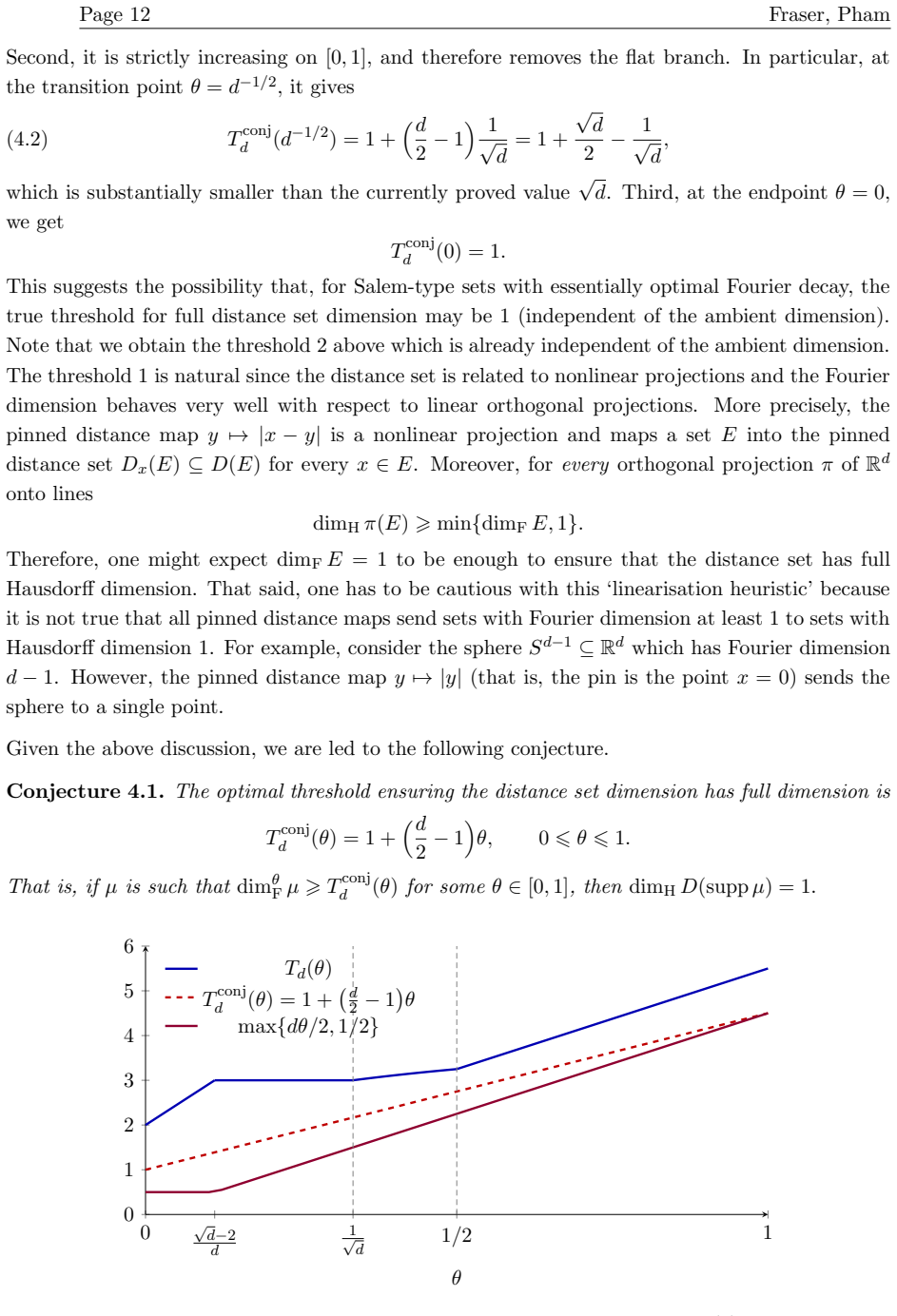
We study the Falconer distance set problem in Euclidean space and obtain improved dimensional estimates under natural Fourier analytic assumptions cast in terms of the Fourier dimension and spectrum. Interestingly, under reasonably mild assumptions, we are able to beat the $d/2$ dimension threshold in dimensions $d \geq 5$. For example, we show that (in any ambient spatial dimension $d$) a Borel set with Fourier dimension at least $2$ has a distance set of full Hausdorff dimension. We also show that (in any ambient spatial dimension $d$) a Borel set with Fourier spectrum at least $d/4+1$ at $\theta=1/2$ has a distance set of full Hausdorff dimension. In particular, this can hold for sets with Fourier dimension zero (provided $d \geq 4$). We also consider pinned variants of these problems and construct examples that demonstrate the sharpness (or near sharpness) of our results.
We consider scaled Volterra equations of the form $f_n + n k*f_n = g$ for $n \in \mathbb{N}$, where $g$ is given and $f_n$ is sought. We show that global two-sided Abel-type bounds on a positive kernel $k$ do not force the solutions $f_n$ to converge to zero as $n \to +\infty$. More precisely, we construct a continuous strictly positive kernel globally comparable with the Abel kernel $x^{-1/2}$, and a continuous strictly positive $g$, for which a subsequence of $(f_n)_{n \in \mathbb{N}}$ diverges to $+\infty$ at some point $x_0 > 0$. Consequently, the resolvents associated with the scaled kernels $nk$ need not form a generalized approximate identity, in contrast to a couple of classical results.
For Ahlfors regular domains, this equivalence characterizes Lyapunov domains via a higher-dimensional Plemelj-Privalov theorem.
abstractclick to expand
We prove several characterizations of $\mathscr{C}^{1,\omega}$-domains (aka Lyapunov domains), where $\omega$ is a growth function satisfying natural assumptions. For example, given an Ahlfors regular domain $\Omega\subseteq{\mathbb{R}}^n$, we show that the modulus of continuity of the geometric measure theoretic outward unit normal $\nu$ to $\Omega$ is dominated by (a multiple of) $\omega$ if and only if the action of each Riesz transform $R_j$ associated with $\partial\Omega$ on the constant function $1$ has a modulus of continuity dominated by (a multiple of) $\omega$. The proof of this result requires that we establish a higher-dimensional generalization of the classical Plemelj-Privalov theorem, identifying a large class of singular integral operators that are bounded on generalized H\"older spaces. This class includes the Cauchy-Clifford operator and the harmonic double layer operator, among others.
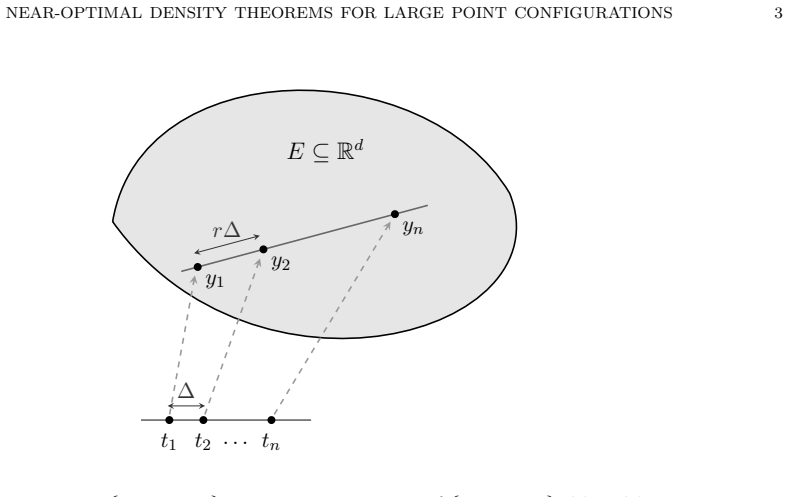
We study density thresholds that force a measurable set $E\subseteq\mathbb{R}^d$ to contain all sufficiently large similar copies of every $n$-point configuration. We prove a lower bound of the form $1-O((\log n)/n)$, which matches the known upper bound up to the logarithmic factor, thus essentially resolving a problem posed by Falconer, Yavicoli, and the first author of the present paper. We also study the same problem for embeddings of $n$-point configurations into $\mathbb{R}^d$ equipped with the $\ell^p$ norm, obtaining an asymptotically sharp bound $1-1/n+o(1/n)$, as soon as $p\in(1,\infty)\setminus\{2\}$. In the proof of the former estimate we use equidistribution of polynomial sequences modulo $1$ combined with probabilistic thinning. The proof of the latter estimate relies on the geometry of the $\ell^p$ spaces for $p\neq2$.
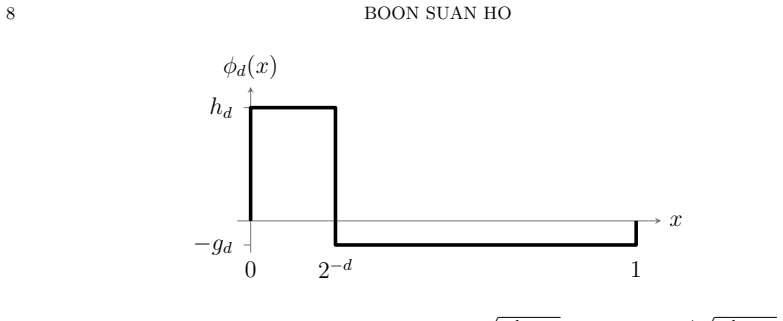
We construct dyadic lacunary counterexamples for two problems of Erd\H{o}s on pointwise behavior of dilates on the circle. The main device is a dyadic spike block: rare positive spikes create long positive runs in the lacunary averages, while a deterministic lower floor prevents cancellation from the remaining stages.
The endpoint construction gives a mean-zero $f\in\bigcap_{1\le q<\infty}L^q(\mathbb T)$ and a sequence $n_j=2^{m_j}$, $n_{j+1}/n_j\ge2$, such that $$ \|f-S_Nf\|_2\ll (\log\log N)^{-1/2}, \qquad \limsup_{N\to\infty} \frac1N\sum_{j\le N}f(n_jx)=+\infty $$ for almost every $x$. Thus Matsuyama's positive theorem at exponent $c>1/2$ cannot be extended to the endpoint $c=1/2$, and Erd\H{o}s Problem #996 has a negative answer.
A second choice of parameters gives, for every $2\le p<\infty$, functions $f\in L^p(\mathbb T)$ with $$ \limsup_{N\to\infty} \frac{\sum_{j\le N}f(n_jx)} {N(\log N)^{1/p-\varepsilon}} =+\infty \qquad(\varepsilon>0) $$ almost everywhere; the case $p=2$ answers Erd\H{o}s Problem #995. We also include a bounded small-set companion construction.
Necessary and sufficient test for typical projections of Borel measures, with explicit lower bounds otherwise
abstractclick to expand
We study the packing dimension of Borel measures under orthogonal projections. We give a necessary and sufficient condition such that typical projections of Borel probability measures have full packing dimension and derive general lower bounds in the complementary case. Our approach shows that the Assouad dimension of the support influences the behavior of projected measures. The same method yields corresponding results for images under fractional Brownian motion.
The inequality recovers the classical bound when spectra are homogeneous and quantifies the loss from inhomogeneity, shown sharp in general.
abstractclick to expand
We establish uncertainty principles on compact Riemannian manifolds without boundary in the setting of Laplace-Beltrami operators, including the case of real-valued singular potentials. We replace the classical homogeneity assumption by a quantitative spectral condition and obtain corresponding stability versions of uncertainty inequalities. In particular, we prove that \[ (1-\epsilon-\epsilon')^2 \leq \frac{|E|}{|M|}\cdot \# X_S \cdot \sup_{x\in E} \frac{A_S(x)}{\frac{\# X_S}{|M|}}, \] which recovers the classical bound in the homogeneous case, quantifies its deterioration in the presence of spectral inhomogeneity, and is shown to be sharp in general. In {\it dimension one}, we show that the homogeneity condition holds automatically, and we complement this rigidity by incorporating Fourier-ratio complexity bounds, yielding a quantitative relationship between spectral complexity and spatial support. In higher dimensions, we derive analogous results using pointwise Weyl laws and the eigenfunction restriction estimates on submanifolds.
Uniform volume estimates and O(C^m n) weak (1,1) maximal function bounds hold for Carnot-Carathéodory balls on generalized Heisenberg-type…
abstractclick to expand
On generalized Heisenberg-type groups $\mathbb{G}(2n,m,\mathbb{U},\mathbb{W})$, we give uniform volume estimates for the ball defined by a large class of Carnot-Carath\'{e}odory distances, and establish weak (1, 1) $O(C^m \, n)$-estimates for associated centered Hardy-Littlewood maximal functions, extending the results in \cite{BLZ25}. As a by-product, we establish uniformly volume doubling property on Heisenberg groups for a class of left-invariant Riemannian metrics.
For analytic Z in R^n with dim Z ≤ n-2 and curved Σ with positive sectional or geodesic curvature, the projection π to T_x S^{n-1}…
abstractclick to expand
We study dimensions of sets projected to an $(n-2)$-dimensional family of hyperplanes in $\mathbb{R}^n$ under curvature conditions. Let $n\ge 3$ and $\Sigma \subset S^{n-1}$ be an $(n-2)$-dimensional $C^2$ manifold such that $\Sigma$ has non-vanishing geodesic curvature ($n=3$)/sectional curvature $>1$ ($n \ge 4)$. Let $Z \subset \mathbb{R}^{n}$ be analytic with $\dim Z \le n-2$ and $0 < s < \dim Z$. Then \begin{equation*}
\dim \{x \in \Sigma : \dim \pi_{T_xS^{n-1}}(Z) < s\} \le s \end{equation*} where $\pi_{T_xS^{n-1}}$ is the orthogonal projection from $\mathbb{R}^n$ to the tangent space $T_xS^{n-1}$. In particular, for $\mathcal{H}^{n-2}$-a.e. $x \in \Sigma$, $\dim \pi_{T_xS^{n-1}}(Z) = \dim Z$. When $n=3$ and $\dim Z < 1$, the quantitative estimate improves the one obtained by Gan-Guo-Guth-Harris-Maldague-Wang.
For the case $\dim Z > n-2$, if in addition $\pi_{T_yS^{n-1}}(Z) \le n-2$ for some $y \in S^{n-1}$, we show that $\dim \pi_{T_xS^{n-1}}(Z) = \min\{\dim Z, n-1\}$ for $\mathcal{H}^{n-2}$-a.e. $x \in \Sigma$.
A new weighted Hardy-type inequality for functions from the Sobolev space $W_{p}^{1}$ is proved. It is assumed that functions vanish on small alternating pieces of the boundary. The proved inequality generalizes the classical known weighted Hardy-type inequalities.
Under symmetry or normalization conditions on a banded complex matrix, polynomial solutions become orthogonal with respect to a positive two
abstractclick to expand
In this paper we study higher-order difference equations which can be written as follows: $$ \mathbf{J} (y_0,y_1,...)^T = \lambda^N (y_0,y_1,...)^T, $$ where $\mathbf{J}$ is a $(2N+1)$-diagonal bounded banded matrix ($\mathbf{J}=(g_{m,n})_{m,n=0}^\infty$, $| g_{m,n} |< C$, $C>0$; and $g_{k,l}=0$ if $|k-l|>N$), $y_j$s are unknowns, $\lambda$ is a complex parameter, $N\in\mathbb{N}$. It is assumed that all $g_{k,k+N}$ and $g_{l-N,l}$ are nonzero. Two special cases are considered:
\noindent \textit{Case A}: The matrix $\mathbf{J}$ is complex symmetric, i.e. $\mathbf{J} = \mathbf{J}^T$.
\noindent \textit{Case B}: The matrix $\mathbf{J}$ is such that $g_{k,k+N}=1$, $k=0,1,2,...$. Notice that this condition can be attained by changing $y_j$s by their multiples.
In both cases there exists a \textit{positive} matrix measure $M$ on a circle in the complex plane such that polynomial solutions satisfy some orthogonality relations. Namely, in case~A this is related to a $J$-orthogonality in the Hilbert space $L^2(M)$ ($J$ is a complex conjugation). In case~B we have a left $J$-orthogonality in $L^2(M)$. As a tool, a related matrix moment problem is studied. A complex rank-one perturbation of a free Jacobi matrix is discussed.
On the sphere they match the best known growth rate for s with d-2 ≤ s < d via separation and polarization control.
abstractclick to expand
We investigate the asymptotic behavior of greedy $s$-Riesz and Green energy sequences $\{x_{n}\}_{n=1}^{\infty}$ on the unit sphere $\mathbb{S}^{d} \subset \mathbb{R}^{d+1}$, where each point $x_n$ is defined as the minimizer of the discrete potential generated by the preceding points $x_1, x_2, ..., x_{n-1}$. We show that the greedy sequence attains optimal growth behavior for the second-order term of the Green and Riesz $s$-energies when $d-2 \leq s < d$. The main idea is to establish the bounds on polarization using well-separation properties of the greedy configurations.
Let $\Theta=\{\theta_n\}, \Lambda=\{\lambda_n\}$ be two sequences of independent and identically distributed uniform random variables on $[0,1]$. The random vector-valued Weierstrass function is given by \[ f_{\Theta,\Lambda}(t)=
\left(
\sum_{n=0}^{\infty} b^{-\beta n}\cos\bigl(2\pi (b^n t+\theta_n)\bigr),\
\sum_{n=0}^{\infty} b^{-\beta n}\sin\bigl(2\pi (b^n t+\lambda_n)\bigr)
\right),\quad t\in[0,1],
\] where $b>1, \beta\in (0,1/2)$. We prove that, with probability one, the Hausdorff dimension of the graph of this function is
\[
\dim_H G(f_{\Theta,\Lambda})=3-2\beta,
\] extending a result of Hunt in 1998.
Motivated by the Cauchy--Szeg\H{o} projections on a broad class of Siegel domains and the geometric quotient structures of nilpotent Lie groups observed by Nagel, Ricci, and Stein, we develop a martingale and Haar wavelet framework for twisted multi-parameter geometries. We introduce twisted dyadic filtrations and construct adapted Haar bases on Euclidean spaces $\mathbb{R}^{2m}$. Each of the resulting dyadic systems forms a complete orthonormal basis of $L^2(\mathbb R^{2m})$, and their union yields a tight frame with frame bound $3$. We establish $L^p$-equivalences for the associated discrete twisted Littlewood--Paley square functions.
Furthermore, we extend this discrete real-variable theory to the non-abelian setting of a nilpotent Lie group of step two, $\mathscr{N}$, which serves as the Shilov boundary of certain fundamental Siegel domains. By projecting product fractal tiles from a lifting group of Heisenberg products, we define twisted dyadic shards and construct twisted nilpotent Haar frames. More precisely, we first introduce raw projected shards that reflect the quotient geometry, and then pass to analytic dyadic shards which are exactly rectifiable and remain uniformly comparable to the raw quotient structure in the relevant scale regimes. This yields a discrete framework adapted to twisted quotient geometries in both the Euclidean and nilpotent settings, providing a basic dyadic infrastructure for further developments in twisted real-variable theory.
Sufficient conditions on two discrete sets in R^d make any function zero on one and with fractional Laplacian zero on the other vanish all.
abstractclick to expand
We establish sufficient conditions on discrete subsets of $\mathbb{R}^d$ for them to form a uniqueness or a non-uniqueness pair for the fractional Laplacian. Specifically, assuming that $f=0$ on $\Lambda$ and that $(-\Delta)^sf=0$ on $M$, where $\Lambda, M \subset \mathbb{R}^d$ are discrete, we find sufficient conditions on these sets that force $f$ to vanish identically, and we provide examples in which non-uniqueness occurs. Some of the ideas used in the proofs also extend to a broader class of multiplier operators.
For γ(t)=(t^α1,…,t^αn) with min exponent α<1/2 the threshold is max{(1-2α)/2, n/(2(n+1))}.
abstractclick to expand
We investigate the Sobolev regularity required for almost everywhere convergence to the initial datum of solutions to the linear Schr\"odinger equation along certain tangential curves. In the regime $\alpha<\tfrac12$, we analyze maximal estimates for expressions of the form $e^{it\Delta}f(x+\gamma(t))$ over specific $\alpha$-H\"older curves $\gamma$ and initial data $f\in H^s(\mathbb{R}^n)$. For the model family $\gamma(t)=(t^{\alpha_1},\ldots,t^{\alpha_n})$, where $\alpha=\min_j \alpha_j$, we show that the critical regularity is $s=\max\left\{\frac{1-2\alpha}{2},\frac{n}{2(n+1)}\right\}.$
A stopping time argument proves the equivalence, linking geometric porosity directly to the analytic A1 condition in parabolic spaces.
abstractclick to expand
We develop the parabolic weak porosity to characterize the parabolic Muckenhoupt $A_1$ weights with time-lag. Our main result shows that a nonempty closed set is parabolic weakly porous if and only if the parabolic distance function of the set to a negative power is in the parabolic Muckenhoupt $A_1$ class. We apply a novel stopping time argument in combination with the translation and doubling results for the parabolic weakly porous sets.
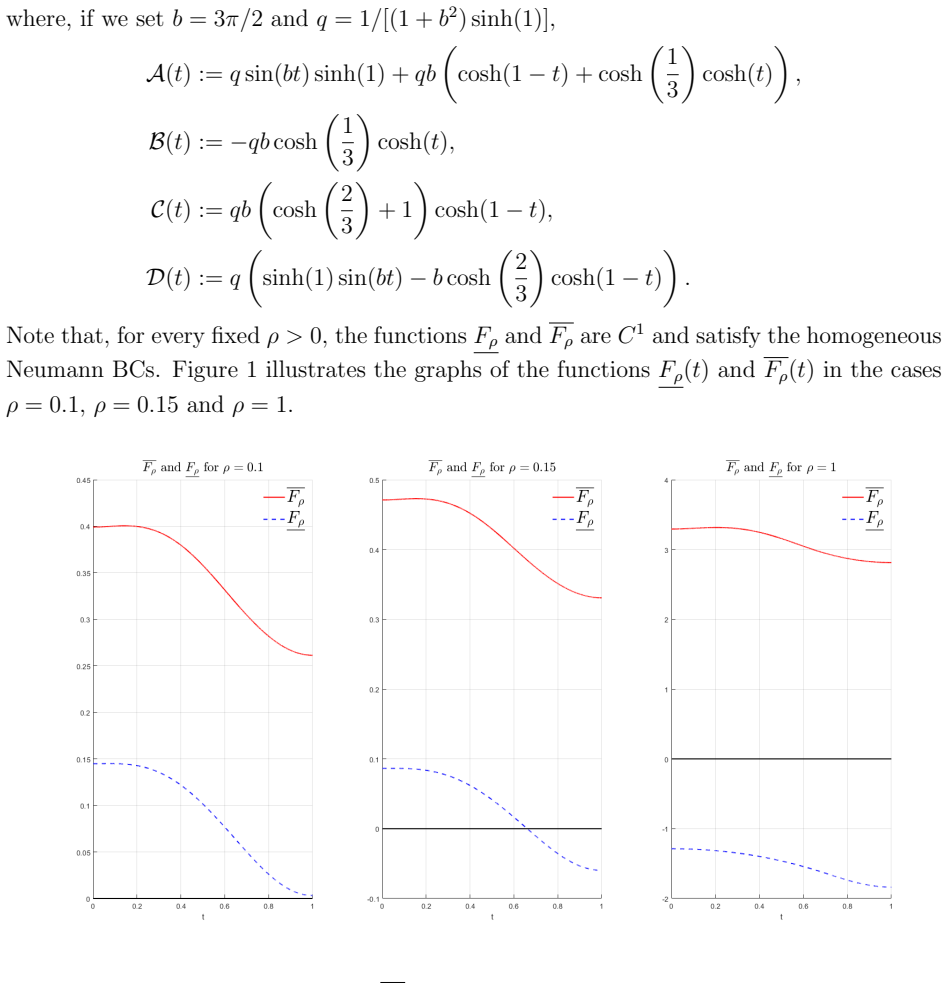
We study the existence and localization of eigenvalue-eigenfunction pairs for parameter-dependent Neumann BVPs with a functional term. By reformulating the problems as a Hammerstein integral equation, we apply an existence and localization result and propose a convergent fixed-point iteration scheme. Finally, two pseudocodes and a MATLAB implementation are provided to numerically approximate the eigenvalues and validate the theoretical localization bounds. We also illustrate an approximation of the eigenfunctions for a fixed norm.
For the Riesz and logarithmic energies, we consider a greedy sequence $(a_n)_{n=0}^\infty$ of points on the unit circle $S^1$ constructed in such a way that for every integer $N\geq 2$, the energy of the configuration $(a_0,\ldots,a_{N-2},x)$ attains its optimal value (say $E_N$) at $x=a_{N-1}$. We derive an asymptotic expansion for $E_N$ in terms of certain bounded, oscillatory sequences $H_{N}$, $K_{N}$, and $R_{N}$ with a doubling periodicity property. In particular, we recover the results of \cite{LopMc1,LopWag} showing that after a proper translation and scaling of $E_N$, one is left with a sequence $T_N$ that is bounded and divergent. We show that the limit points of the sequence $T_N$ fill a closed interval. This follows from our asymptotic formulae and an analogous density result for the limit points of the sequences $H_{N}$, $K_{N}$, and $R_{N}$. We also give a new, simpler proof of density results obtained in \cite{LopMin} for the optimal values of the potential generated by a greedy sequence.
Quantitative closeness at every scale and point forces local equivalence to a cone over a simplicial complex.
abstractclick to expand
In this paper we prove that if a closed set in R^N is close to a cone over a simplicial complex at each point and at each scale, then it is locally bi-H\"older equivalent to such a cone. This generalizes Reifenberg's Topological Disk Theorem in 1960 and G. David, T. De Pauw and T. Toro's result in 2008.
A new technique establishes the bidirectional link for odd dimensions and proves positive definiteness for a family of functions on the two-
abstractclick to expand
In this paper, we investigate the relationship between positive definite functions on the unit sphere $\sph$ and on the Euclidean space $\RR^d$. For the dimension $d$ to be odd, a new technique is developed to establish the inheritance of positive (semi-)definite property from $\RR^d$ to $\sph$ and the converse. For $d=2$, it is proved that a function defined by $$f_{\t,\delta}(t)=(\t-t)_+^\delta, \quad \delta\geq \f{d+1}2 $$ is positive definite on the unit sphere $\mathbb{S}^2$ by restricting $\t$ in an absolute range. Our results can verify a conjecture proposed by R.K. Beatson, W. zu Castell, Y. Xu and a sharp P\'{o}lya type criterion for positive definite functions on spheres.
New approach studies the singular perturbation equation using only advanced calculus and ODE theory without restrictions on turning points.
abstractclick to expand
A singular perturbation problem called WKB equation (Eq) $h^2u(x,h)-Q(x)u(x,h)=0$ is studied. $h>0$ is a small parameter. Investigation of (Eq) has long history. Recently it has developed by a new method named "Exact WKB Analysis" based on Borel resummation method and new analytic results. Here we study (Eq) by another elementary method. We only apply advanced calculus and the theory of differential equations to (Eq). We neither assume turning points are simple nor there is no Stokes curve that connects two turning points.
Equivalence to an evaluation-plus-derivative inner product at an external point supplies explicit recurrences and connections for the new Qn
abstractclick to expand
Iterated Geronimus transformations generate Sobolev-type orthogonal polynomials from classical families. We establish a direct equivalence between a Sobolev inner product involving point evaluation and the first derivative at a point a outside the support of the original measure and two successive Geronimus transformations. Explicit three-term and five-term recurrence relations are derived for the resulting polynomials, revealing their algebraic structure. Connection formulas linking the Sobolev-type polynomials Q_n^{M,N}(x) with both the original and the transformed Geronimus polynomials are obtained via Christoffel-Darboux kernels and determinantal representations. In the Jacobi case, asymptotic analysis shows that ratios of derivatives and norms converge to explicit constants independent of the parameters M and N. These results provide a unified framework connecting spectral transformations with Sobolev orthogonality.
We discuss the non-uniqueness of continuous solutions to differential equations with a {\it discrete } state-dependent delay and continuous initial functions. We are interested not only in the fact (conditions) of non-uniqueness, but in additional information on the number of non-unique solutions and discuss an approach to classify them. We provide a few explicit (easy to verify) examples of the non-uniqueness of continuous solutions and propose an approach to their classification. This partial classification may be illustrated by using just three collors and their simple and intuitive combination. We recognize that this initial classification is not exhaustive, and further study is necessary to build a complete picture.