Recognition: 2 theorem links
· Lean TheoremA Wirtinger Power Flow Jacobian Singularity Condition for Voltage Stability in Converter-Rich Power Systems
Pith reviewed 2026-05-13 18:41 UTC · model grok-4.3
The pith
A Wirtinger-derived index C_W greater than one at every bus certifies nonsingularity of the power flow Jacobian in converter-rich systems.
A machine-rendered reading of the paper's core claim, the machinery that carries it, and where it could break.
Core claim
The central claim is that the Wirtinger-based power flow Jacobian has the same singularity points as the conventional Jacobian, and that the condition min_i C_{W,i} > 1, where each C_{W,i} is obtained from diagonal dominance applied to the Wirtinger formulation, is sufficient to certify nonsingularity and thereby voltage stability when converters replace stiff voltage sources.
What carries the argument
Wirtinger derivative formulation of the power flow Jacobian whose singularity is certified by the minimum bus-wise diagonal dominance ratio C_W.
If this is right
- The singularity condition extends explicitly to all bus types rather than only slack and PQ buses.
- The min C_W > 1 test supplies a non-iterative voltage stability margin.
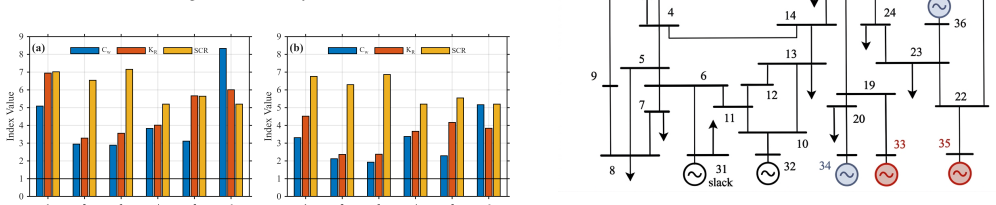
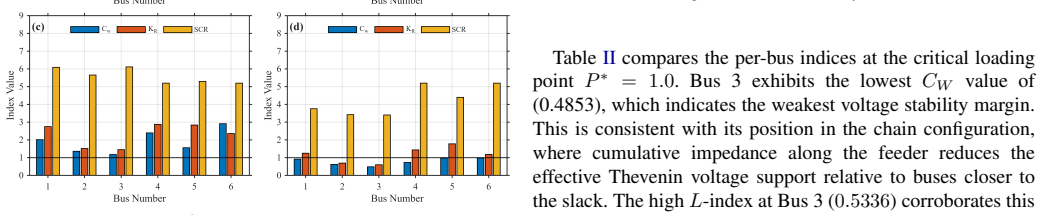
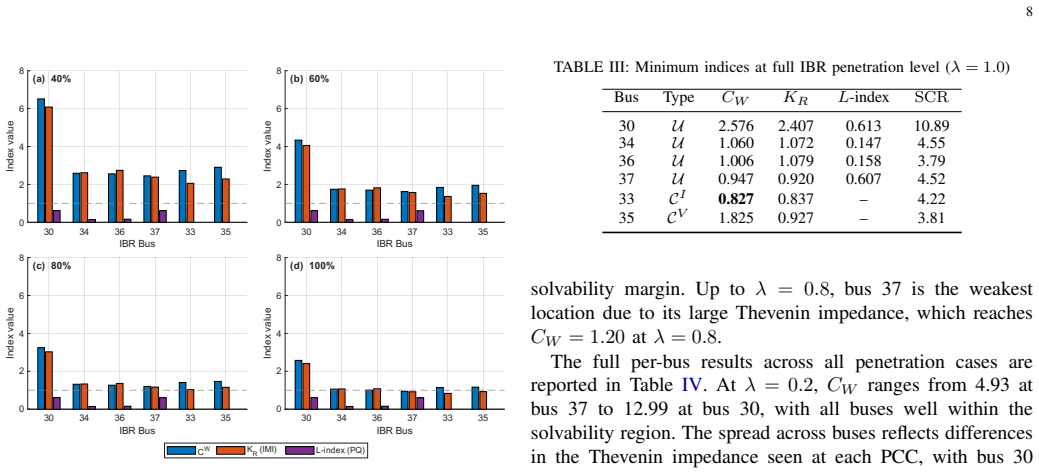
- The index produces less conservative and more localized stability assessments than the L-index, K_R index, and SCR index on standard test systems.
- Singularity of the Wirtinger Jacobian coincides exactly with singularity of the conventional Jacobian under the maintained power flow model structure.
Where Pith is reading between the lines
- The index could support real-time monitoring in large grids by avoiding iterative Jacobian factorization.
- Placement of converters might be optimized to raise the global min C_W and thereby enlarge the certified stability region.
- The same diagonal dominance approach may extend to other Jacobian-dependent analyses such as sensitivity calculations or small-signal stability.
Load-bearing premise
The Wirtinger Jacobian formulation and the diagonal dominance conditions remain valid once voltage- and current-limited converter behavior is incorporated at every bus type.
What would settle it
A power flow solution in which the Jacobian matrix is singular yet min_i C_{W,i} remains strictly greater than one, or the reverse, when converter limits are active.
Figures


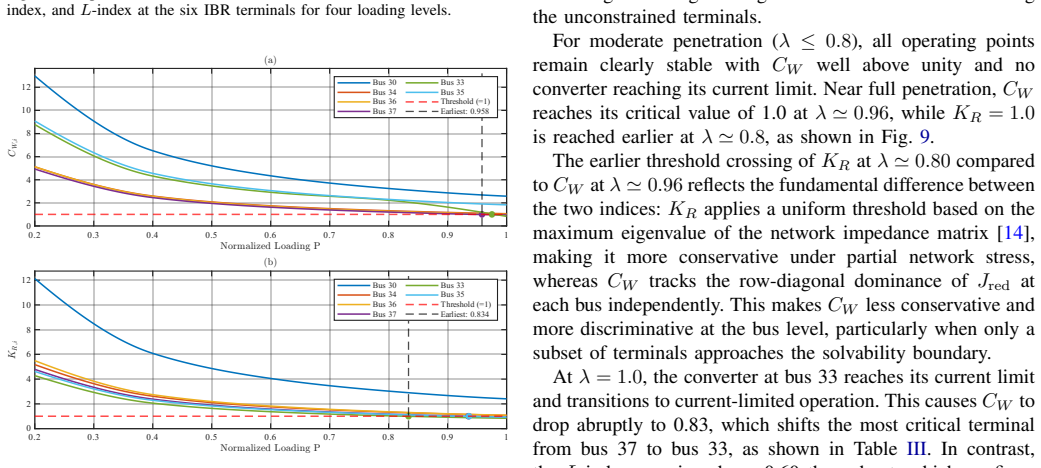
read the original abstract
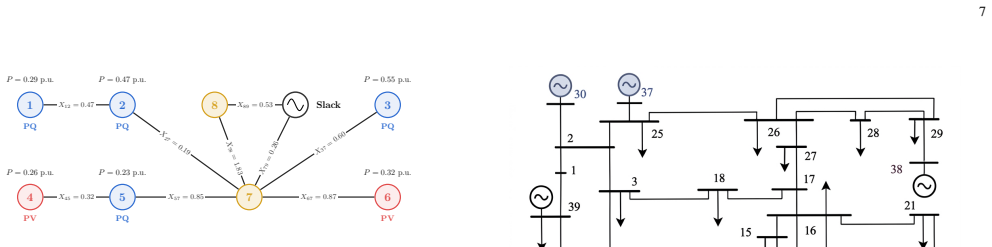
The progression of modern power systems towards converter-rich operations calls for new models and analytics in steady-state voltage stability assessment. The classic modeling assumption of the generators as stiff voltage sources no longer holds. Instead, the voltage- and current-limited behaviors of converters need to be considered. In this paper, we develop a Wirtinger derivative-based formulation for the power flow Jacobian and derive an explicit sufficient condition for its singularity. Compared to existing works, we extend the explicit sufficient singularity condition to incorporate all bus types instead of only slack and PQ types. We prove that the singularity of the alternative Jacobian coincides with that of the conventional one. A bus-wise voltage stability index, denoted $C_{\mathrm{W}}$, is derived from diagonal dominance conditions. The condition $\min_i C_{W,i}$ being greater than one certifies the nonsingularity of the Jacobian and provides a fast, non-iterative stability margin. Case studies in standard IEEE test systems show that the proposed index yields less conservative and more localized assessments than classical indices such as the L-index, the $K_{\mathrm{R}}$ index, and the SCR index.
Editorial analysis
A structured set of objections, weighed in public.
Referee Report
Summary. The paper develops a Wirtinger derivative-based formulation for the power flow Jacobian in converter-rich systems, derives an explicit sufficient singularity condition applicable to all bus types (extending prior work limited to slack/PQ), proves that this alternative Jacobian shares singularity points with the conventional Jacobian, introduces a bus-wise index C_W obtained from diagonal dominance such that min_i C_{W,i} > 1 certifies nonsingularity and supplies a fast non-iterative margin, and reports case-study comparisons on IEEE test systems showing less conservative and more localized results than the L-index, K_R index, and SCR index.
Significance. If the derivation and coincidence proof hold under the stated assumptions, the work supplies a computationally lightweight voltage-stability margin that directly incorporates converter behaviors and avoids iterative eigenvalue or continuation methods, which would be useful for real-time assessment in grids with high converter penetration.
major comments (3)
- [Case Studies] Case Studies section: the numerical validation uses only standard IEEE test systems in which generators remain stiff voltage sources without voltage or current limits. This leaves untested the central extension to converter-limited operation, where mode switches produce discontinuous Jacobian entries that can invalidate the diagonal-dominance argument even when min C_W,i > 1.
- [Proof of singularity coincidence] Proof that alternative and conventional Jacobians share singularity points (likely §3–4): the argument relies on the power-flow equations retaining their standard structure; once converter limits are active the Jacobian changes discontinuously, so the claimed coincidence and the sufficiency of the C_W > 1 condition require explicit verification or counter-example analysis under saturation.
- [Derivation of C_W] Derivation of C_W (from diagonal dominance applied to the Wirtinger Jacobian): the index is obtained by applying dominance conditions to the derived Jacobian, but the manuscript does not demonstrate that the resulting C_W remains a valid nonsingularity certificate once limit-induced mode switches alter the Jacobian entries.
minor comments (2)
- [Abstract] The abstract states that the index 'yields less conservative' assessments, but the case-study tables do not report quantitative margins or error bars that would allow direct comparison of conservatism.
- [Notation] Notation: the Wirtinger Jacobian blocks and the precise definition of the diagonal-dominance ratio used for C_W should be restated explicitly in the main text rather than left to supplementary material.
Simulated Author's Rebuttal
We thank the referee for the constructive and detailed comments. We address each major point below, clarifying the scope of the current derivation and indicating the revisions that will be made to the manuscript.
read point-by-point responses
-
Referee: [Case Studies] Case Studies section: the numerical validation uses only standard IEEE test systems in which generators remain stiff voltage sources without voltage or current limits. This leaves untested the central extension to converter-limited operation, where mode switches produce discontinuous Jacobian entries that can invalidate the diagonal-dominance argument even when min C_W,i > 1.
Authors: We acknowledge that the numerical validation is performed exclusively on standard IEEE test systems without enforcing voltage or current limits. The Wirtinger Jacobian and C_W index are derived under the continuous power-flow model. In the revised manuscript we will add an explicit limitations paragraph in the Case Studies section stating this scope and include a small illustrative example with artificial limit enforcement to show the effect on the index. Comprehensive validation under saturation is noted as future work. revision: partial
-
Referee: [Proof of singularity coincidence] Proof that alternative and conventional Jacobians share singularity points (likely §3–4): the argument relies on the power-flow equations retaining their standard structure; once converter limits are active the Jacobian changes discontinuously, so the claimed coincidence and the sufficiency of the C_W > 1 condition require explicit verification or counter-example analysis under saturation.
Authors: The algebraic proof in Sections 3–4 shows singularity coincidence by establishing equivalence of the two Jacobians for the standard (continuous) power-flow equations. When limits activate, the Jacobian becomes discontinuous and the equivalence no longer holds. We will revise the proof section to state the no-saturation assumption explicitly and note that the C_W > 1 sufficiency applies only in the unsaturated regime. revision: yes
-
Referee: [Derivation of C_W] Derivation of C_W (from diagonal dominance applied to the Wirtinger Jacobian): the index is obtained by applying dominance conditions to the derived Jacobian, but the manuscript does not demonstrate that the resulting C_W remains a valid nonsingularity certificate once limit-induced mode switches alter the Jacobian entries.
Authors: The C_W index follows directly from applying the diagonal-dominance criterion to the Wirtinger Jacobian matrix derived in the paper. This supplies a sufficient nonsingularity certificate only under the modeled continuous equations. We will add a clarifying remark in the derivation section that the specific dominance bounds used cease to be guaranteed once limit-induced mode switches alter the matrix entries. revision: yes
- Explicit verification or counter-example analysis of the C_W condition and singularity coincidence when converter voltage/current limits are active and induce discontinuous Jacobian changes
Circularity Check
No circularity detected in derivation chain
full rationale
The paper derives a Wirtinger-based power flow Jacobian from first-principles complex derivatives, applies the standard diagonal dominance theorem to obtain the bus-wise index C_W as a sufficient (not necessary) nonsingularity certificate, and separately proves that the alternative and conventional Jacobians share singularity loci under the maintained power-flow equation structure. None of these steps reduce to a fitted parameter renamed as prediction, a self-referential definition, or a load-bearing self-citation; the diagonal-dominance construction is a direct application of Gershgorin-type bounds and does not presuppose the target stability margin. Case-study validation on IEEE systems is external to the derivation itself.
Axiom & Free-Parameter Ledger
axioms (2)
- domain assumption Power flow equations admit a Wirtinger derivative formulation that preserves the singularity properties of the conventional Jacobian.
- domain assumption Diagonal dominance conditions on the Wirtinger Jacobian yield a sufficient certificate of nonsingularity.
invented entities (1)
-
C_W bus-wise voltage stability index
no independent evidence
Lean theorems connected to this paper
-
IndisputableMonolith/Cost/FunctionalEquation.leanwashburn_uniqueness_aczel unclear?
unclearRelation between the paper passage and the cited Recognition theorem.
A bus-wise voltage stability index, denoted C_W, is derived from diagonal dominance conditions. The condition min_i C_{W,i} > 1 certifies the nonsingularity of the Jacobian
-
IndisputableMonolith/Foundation/AlexanderDuality.leanalexander_duality_circle_linking unclear?
unclearRelation between the paper passage and the cited Recognition theorem.
We prove that the singularity of the alternative Jacobian coincides with that of the conventional one
What do these tags mean?
- matches
- The paper's claim is directly supported by a theorem in the formal canon.
- supports
- The theorem supports part of the paper's argument, but the paper may add assumptions or extra steps.
- extends
- The paper goes beyond the formal theorem; the theorem is a base layer rather than the whole result.
- uses
- The paper appears to rely on the theorem as machinery.
- contradicts
- The paper's claim conflicts with a theorem or certificate in the canon.
- unclear
- Pith found a possible connection, but the passage is too broad, indirect, or ambiguous to say the theorem truly supports the claim.
Reference graph
Works this paper leans on
-
[1]
Definition and classification of power system stability – revisited & extended,
N. Hatziargyriou, J. Milanovic, C. Rahmann, V . Ajjarapu, C. A. Canizares, I. Erlich, D. J. Hill, I. A. Hiskens, I. Kamwa, and B. C. Pal, “Definition and classification of power system stability – revisited & extended,”IEEE Trans. Power Syst., vol. 36, no. 4, pp. 3271–3281, Jul. 2021
work page 2021
-
[2]
Grid-forming inverters: A critical asset for the power grid,
R. H. Lasseter, Z. Chen, and D. Pattabiraman, “Grid-forming inverters: A critical asset for the power grid,”IEEE J. Emerg. Sel. Topics Power Electron., vol. 8, no. 2, pp. 925–935, Jun. 2020. [3]IEEE Standard for Interconnection and Interoperability of Inverter- Based Resources (IBRs) Interconnecting with Associated Transmission Electric Power Systems, IEE...
work page 2020
-
[3]
P. Kundur, J. Paserba, V . Ajjarapu, G. Andersson, A. Bose, C. Canizares, N. Hatziargyriou, D. Hill, A. Stankovic, C. Taylor, T. Van Cutsem, and V . Vittal, “Definition and classification of power system stability: Ieee/cigre joint task force on stability terms and definitions,”IEEE Trans. Power Syst., vol. 19, no. 3, pp. 1387–1401, Aug. 2004
work page 2004
-
[4]
P. Ge, F. Xiao, C. Tu, Q. Guo, J. Gao, and Y . Song, “Transient stability enhancement control for vsg considering power angle stability and fault current limitation,”CSEE J. Power Energy Syst., vol. 11, no. 1, pp. 173–183, Jan. 2025
work page 2025
-
[5]
System frequency response model considering the influence of power system stabilizers,
D. A. Leiva Roca, P. E. Mercado, and G. E. Suvire, “System frequency response model considering the influence of power system stabilizers,” IEEE Latin Am. Trans., vol. 20, no. 6, pp. 912–920, Jun. 2022
work page 2022
-
[6]
Maiden voltage control analysis of hybrid power system with dynamic voltage restorer,
S. Ranjan, D. C. Das, A. Latif, N. Sinha, S. M. S. Hussain, and T. S. Ustun, “Maiden voltage control analysis of hybrid power system with dynamic voltage restorer,”IEEE Access, vol. 9, pp. 60 531–60 542, May 2021
work page 2021
-
[7]
T. Van Cutsem and C. V ournas,Voltage Stability of Electric Power Systems. Boston, MA, USA: Springer, 1998
work page 1998
-
[8]
The continuation power flow: a tool for steady state voltage stability analysis,
V . Ajjarapu and C. Christy, “The continuation power flow: a tool for steady state voltage stability analysis,”IEEE Trans. Power Syst., vol. 7, no. 1, pp. 416–423, Feb. 1992
work page 1992
-
[9]
Kundur,Power System Stability and Control
P. Kundur,Power System Stability and Control. New York, NY , USA: McGraw-Hill, Inc., 1994
work page 1994
-
[10]
Impedance modeling and analysis of grid- connected voltage-source converters,
M. Cespedes and J. Sun, “Impedance modeling and analysis of grid- connected voltage-source converters,”IEEE Trans. Power Electron., vol. 29, no. 3, pp. 1254–1261, Mar. 2015
work page 2015
-
[11]
Q.-C. Zhong and T. Hornik,Control of Power Inverters in Renewable Energy and Smart Grid Integration, ser. IEEE Press Series on Power Engineering. Hoboken, NJ, USA: John Wiley & Sons, Inc., 2012, vol. 97
work page 2012
-
[12]
Estimating the voltage stability of a power system,
P. Kessel and H. Glavitsch, “Estimating the voltage stability of a power system,”IEEE Trans. Power Deliv., vol. 1, no. 3, pp. 346–354, Jul. 1986
work page 1986
-
[13]
Y . Wang, Y . Cai, W. Li, Z. Tan, Z. Song, Y . Li, H. Bai, and T. Liu, “Static-voltage-stability analysis of renewable energy-integrated distribu- tion power system based on impedance model index,”Energies, vol. 17, no. 5, p. 1028, Mar. 2024
work page 2024
-
[14]
D. Wu, G. Li, M. Javadi, A. M. Malyscheff, M. Hong, and J. N. Jiang, “Assessing impact of renewable energy integration on system strength using site-dependent short circuit ratio,”IEEE Trans. Sustain. Energy, vol. 9, no. 3, pp. 1072–1080, Jul. 2018
work page 2018
-
[15]
Load-preserving short-circuit ratio for voltage stability assessment,
H. Lan, Y . Zhang, and W. Liu, “Load-preserving short-circuit ratio for voltage stability assessment,”IEEE Trans. Power Syst., 2025, early Access, to be published
work page 2025
-
[16]
Z. Wang, B. Cui, and J. Wang, “A necessary condition for power flow insolvability in power distribution systems with distributed generators,” IEEE Trans. Power Syst., vol. 32, no. 2, pp. 1440–1450, Mar. 2017
work page 2017
-
[17]
High performance distribution network power flow using wirtinger calculus,
I. D ˇzafi´c, R. A. Jabr, and T. Hrnji ´c, “High performance distribution network power flow using wirtinger calculus,”IEEE Trans. Smart Grid, vol. 10, no. 3, pp. 3311–3319, May 2019
work page 2019
-
[18]
A. Rasool, F. Ahmad, M. S. Fakhar, S. A. R. Kashif, and E. Matlotse, “Utilizing full degrees of freedom of control in voltage source inverters to support micro-grid with symmetric and asymmetric voltage require- ments,”Symmetry, vol. 15, no. 4, p. 865, Apr. 2023
work page 2023
-
[19]
A novel approach for grid-connected inverter operation based on selective harmonic elimination,
C. Poongothai and K. Vasudevan, “A novel approach for grid-connected inverter operation based on selective harmonic elimination,”Int. Trans. Electr. Energy Syst., vol. 31, no. 10, p. e12679, Oct. 2021
work page 2021
-
[20]
Z. Chu and F. Teng, “Stability constrained optimization in high ibr- penetrated power systems—part i: Constraint development and unifica- tion,”arXiv preprint, 2023, arXiv:2307.12151
-
[21]
Power system steady-state stability and the load-flow jacobian,
P. W. Sauer and M. A. Pai, “Power system steady-state stability and the load-flow jacobian,”IEEE Trans. Power Syst., vol. 5, no. 4, pp. 1374– 1383, Nov. 1990
work page 1990
-
[22]
V oltage stability evaluation using modal analysis,
B. Gao, G. K. Morison, and P. Kundur, “V oltage stability evaluation using modal analysis,”IEEE Trans. Power Syst., vol. 7, no. 4, pp. 1529– 1542, Nov. 1992
work page 1992
-
[23]
R. A. Horn and C. R. Johnson,Matrix Analysis, 2nd ed. Cambridge, U.K.: Cambridge Univ. Press, 2013
work page 2013
-
[24]
R. D. Zimmerman, C. E. Murillo-S ´anchez, and R. J. Thomas, “Mat- power: Steady-state operations, planning, and analysis tools for power systems research and education,”IEEE Trans. Power Syst., vol. 26, no. 1, pp. 12–19, Feb. 2011
work page 2011
- [25]
-
[26]
W. Liu, X. Xie, H. Liu, C. Zhang, and Y . Wang, “Mechanism and characteristic analyses of subsynchronous oscillations caused by the interactions between direct-drive wind turbines and weak ac power systems,”J. Eng., vol. 2017, no. 13, pp. 1651–1656, 2017
work page 2017
-
[27]
A practical method for the direct analysis of transient stability,
T. Athay, R. Podmore, and S. Virmani, “A practical method for the direct analysis of transient stability,”IEEE Trans. Power App. Syst., vol. PAS-98, no. 2, pp. 573–584, Mar. 1979
work page 1979
-
[28]
Control of power converters in AC microgrids,
J. Rocabert, A. Luna, F. Blaabjerg, and P. Rodr ´ıguez, “Control of power converters in AC microgrids,”IEEE Trans. Power Electron., vol. 27, no. 11, pp. 4734–4749, Nov. 2012
work page 2012
-
[29]
Frequency stability of synchronous machines and grid-forming power converters,
A. Tayyebi, D. Gross, A. Anta, F. Kupzog, and F. D ¨orfler, “Frequency stability of synchronous machines and grid-forming power converters,” IEEE J. Emerg. Sel. Topics Power Electron., vol. 8, no. 2, pp. 1004– 1018, Jun. 2020
work page 2020
-
[30]
Grid forming technology: Bulk power system reliability considerations,
NERC, “Grid forming technology: Bulk power system reliability considerations,” North American Electric Reliability Corporation, Tech. Rep., 2021. [Online]. Available: https://www.nerc.com
work page 2021
-
[31]
Wirtinger’s cal- culus for the load flow in power distribution grids,
A. Garc ´es, W. Gil-Gonz ´alez, and O. D. Montoya, “Wirtinger’s cal- culus for the load flow in power distribution grids,” inProc. IEEE ANDESCON, Aug. 2018, pp. 1–5
work page 2018
-
[32]
A complex gradient operator and its application in adaptive array theory,
D. H. Brandwood, “A complex gradient operator and its application in adaptive array theory,” inIEE Proc. F—Commun., Radar Signal Process., vol. 130, no. 1, Feb. 1983, pp. 11–16
work page 1983
-
[33]
The complex gradient operator and the CR- calculus,
K. Kreutz-Delgado, “The complex gradient operator and the CR- calculus,” arXiv preprint arXiv:0906.4835, 2009. [Online]. Available: https://arxiv.org/abs/0906.4835
-
[34]
A. Hjørungnes,Complex-Valued Matrix Derivatives: With Applications in Signal Processing and Communications. Cambridge, U.K.: Cam- bridge University Press, 2011
work page 2011
discussion (0)
Sign in with ORCID, Apple, or X to comment. Anyone can read and Pith papers without signing in.