Recognition: 2 theorem links
· Lean TheoremThe morphologies of present-day galaxies in the COLIBRE simulations
Pith reviewed 2026-05-13 17:47 UTC · model grok-4.3
The pith
COLIBRE simulations find that galaxy rotational support peaks at stellar masses of 1-2 times 10^10 solar masses and links more strongly to internal properties than to host halos.
A machine-rendered reading of the paper's core claim, the machinery that carries it, and where it could break.
Core claim
COLIBRE predicts that kinematic morphology correlates strongly with stellar mass and colour, and that galaxies with stellar masses of ≈(1-2)×10^{10} M_⊙ tend to be the most rotationally-dominated. At fixed stellar mass, the morphology of central galaxies correlates weakly with the properties of their host halo. Morphology correlates more strongly with internal galaxy properties, with more disky galaxies being more gas-rich, having higher star formation rates and exhibiting younger and more extended stellar populations. Other properties, like the mass of the most massive black hole, the fraction of stars that are accreted and stellar metallicity, also correlate with morphology, but with the 0
What carries the argument
Four strongly correlated morphology metrics—three kinematic measures of rotational support versus random motions and one spatial shape indicator—applied to galaxies in the COLIBRE runs that resolve interstellar medium pressure and reduce spurious stellar-dark matter scattering.
If this is right
- Galaxies near 1-2×10^{10} solar masses reach the highest fraction of ordered rotation.
- Disk-dominated systems are systematically gas-richer, form stars faster, and host younger stellar populations.
- Central galaxies show only weak morphology links to halo mass or concentration once stellar mass is fixed.
- Black-hole mass, accreted-star fraction, and metallicity track morphology, but the strength of those links varies with galaxy mass and central versus satellite status.
Where Pith is reading between the lines
- Internal feedback and gas processes appear to set galaxy shape more than the external merger or accretion history encoded in the halo.
- Rotation-curve surveys targeting the 10^{10} solar-mass range could directly test the predicted peak in disk dominance.
- The resolution convergence reported here suggests that similar morphology trends should appear in future higher-resolution runs or in semi-analytic models tuned to the same internal physics.
- Extending the same metrics to earlier cosmic times could show when the mass-dependent morphology trends first appear.
Load-bearing premise
The new interstellar medium and stellar-dark matter interaction treatments in COLIBRE are assumed to remove the main prior biases so that the reported mass and internal-property correlations reflect actual galaxy formation.
What would settle it
Large observational samples showing no peak in rotational support near 1-2×10^{10} solar masses or a strong morphology-halo correlation at fixed stellar mass would falsify the central predictions.
Figures





read the original abstract
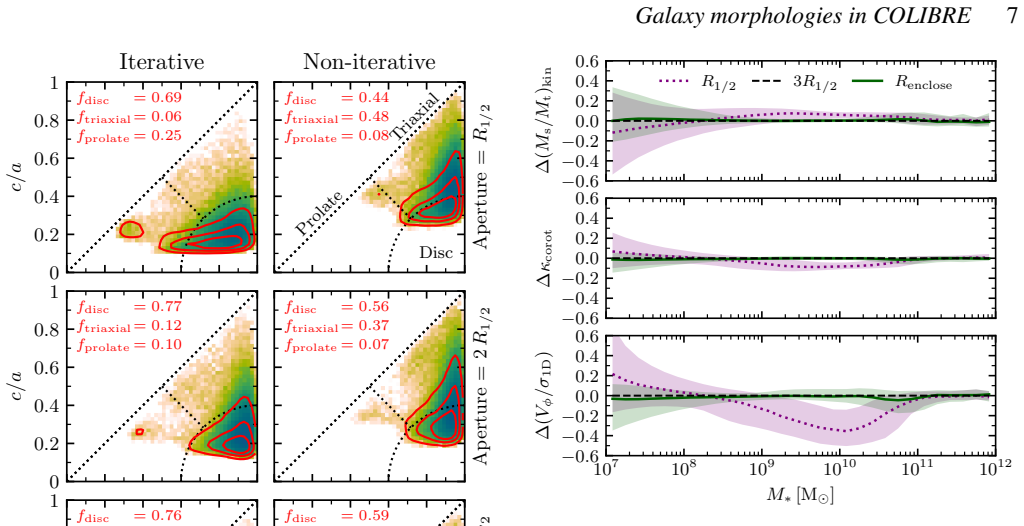
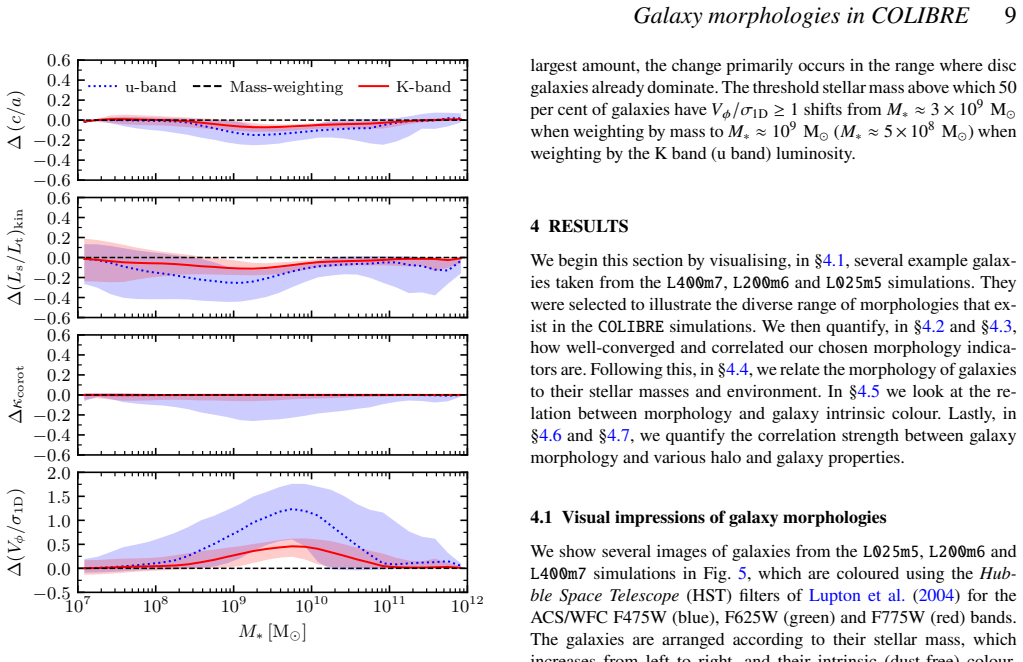
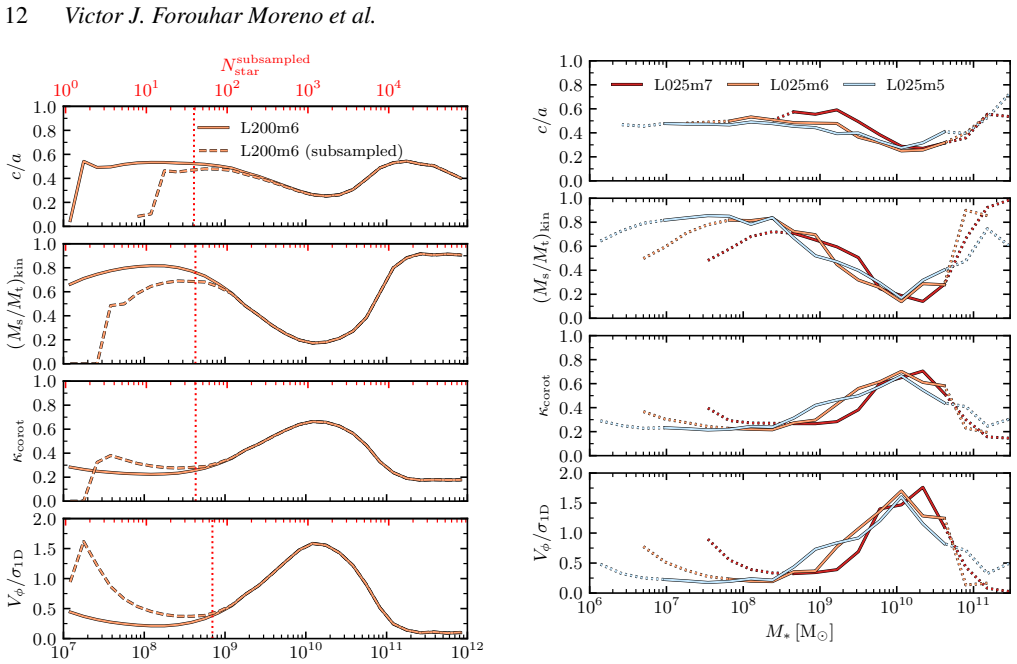
The diversity of galaxy morphologies and their relations with galaxy and halo properties is fundamental to understanding galaxy formation. Cosmological simulations of representative volumes can help disentangle the origin of observed correlations, but most suffer from two main limitations that affect morphologies: an over-pressurised interstellar medium and spurious interactions between stellar and dark matter particles. We present an overview of galaxy morphologies in the COLIBRE simulations, which address these limitations and reproduce many observed galaxy scaling relations. To quantify galaxy morphology, we use four (strongly-correlated) theory-space metrics, three kinematic and one spatial. We explore how different choices and limitations affect these indicators, including luminosity- versus mass-weighting, aperture size and shot noise. Overall, we find good convergence in present-day morphologies across two orders of magnitude in mass resolution. COLIBRE predicts that kinematic morphology correlates strongly with stellar mass and colour, and that galaxies with stellar masses of $\approx(1-2)\times 10^{10}\,\mathrm{M}_{\odot}$ tend to be the most rotationally-dominated. At fixed stellar mass, the morphology of central galaxies correlates weakly with the properties of their host halo. Morphology correlates more strongly with internal galaxy properties, with more disky galaxies being more gas-rich, having higher star formation rates and exhibiting younger and more extended stellar populations. Other properties, like the mass of the most massive black hole, the fraction of stars that are accreted and stellar metallicity, also correlate with morphology, but with correlation strengths sensitive to the stellar mass of the galaxy and whether it is a central or satellite.
Editorial analysis
A structured set of objections, weighed in public.
Axiom & Free-Parameter Ledger
Lean theorems connected to this paper
-
IndisputableMonolith/Foundation/ArithmeticFromLogic.leanreality_from_one_distinction unclear?
unclearRelation between the paper passage and the cited Recognition theorem.
COLIBRE predicts that kinematic morphology correlates strongly with stellar mass and colour, and that galaxies with stellar masses of ≈(1-2)×10^{10} M_⊙ tend to be the most rotationally-dominated. At fixed stellar mass, the morphology of central galaxies correlates weakly with the properties of their host halo.
-
IndisputableMonolith/Cost/FunctionalEquation.leanwashburn_uniqueness_aczel unclear?
unclearRelation between the paper passage and the cited Recognition theorem.
We find good convergence in present-day morphologies across two orders of magnitude in mass resolution.
What do these tags mean?
- matches
- The paper's claim is directly supported by a theorem in the formal canon.
- supports
- The theorem supports part of the paper's argument, but the paper may add assumptions or extra steps.
- extends
- The paper goes beyond the formal theorem; the theorem is a base layer rather than the whole result.
- uses
- The paper appears to rely on the theorem as machinery.
- contradicts
- The paper's claim conflicts with a theorem or certificate in the canon.
- unclear
- Pith found a possible connection, but the passage is too broad, indirect, or ambiguous to say the theorem truly supports the claim.
Reference graph
Works this paper leans on
-
[1]
" write newline "" before.all 'output.state := FUNCTION fin.entry write newline FUNCTION new.block output.state before.all = 'skip after.block 'output.state := if FUNCTION new.sentence output.state after.block = 'skip output.state before.all = 'skip after.sentence 'output.state := if if FUNCTION not #0 #1 if FUNCTION and 'skip pop #0 if FUNCTION or pop #1...
-
[2]
Abadi M. G., Navarro J. F., Steinmetz M., Eke V. R., 2003, @doi [ ] 10.1086/378316 , https://ui.adsabs.harvard.edu/abs/2003ApJ...597...21A 597, 21
-
[3]
Abbott T. M. C., et al., 2022, @doi [ ] 10.1103/PhysRevD.105.023520 , https://ui.adsabs.harvard.edu/abs/2022PhRvD.105b3520A 105, 023520
-
[4]
Algorry D. G., Navarro J. F., Abadi M. G., Sales L. V., Steinmetz M., Piontek F., 2014, @doi [ ] 10.1093/mnras/stt2154 , https://ui.adsabs.harvard.edu/abs/2014MNRAS.437.3596A 437, 3596
-
[5]
K., Glazebrook K., Brinkmann J., Ivezi \'c Z ., Lupton R
Baldry I. K., Glazebrook K., Brinkmann J., Ivezi \'c Z ., Lupton R. H., Nichol R. C., Szalay A. S., 2004, @doi [ ] 10.1086/380092 , https://ui.adsabs.harvard.edu/abs/2004ApJ...600..681B 600, 681
-
[6]
Bell E. F., et al., 2012, @doi [ ] 10.1088/0004-637X/753/2/167 , https://ui.adsabs.harvard.edu/abs/2012ApJ...753..167B 753, 167
-
[7]
The abundance of thin dwarf galaxies: a challenge for cosmological simulations
Benavides J. A., Sales L. V., Navarro J. F., White S. D. M., Frenk C. S., Oman K. A., Cole S., 2025a, @doi [arXiv e-prints] 10.48550/arXiv.2512.11035 , https://ui.adsabs.harvard.edu/abs/2025arXiv251211035B p. arXiv:2512.11035
work page internal anchor Pith review Pith/arXiv arXiv doi:10.48550/arxiv.2512.11035
-
[8]
Benavides J. A., et al., 2025b, @doi [ ] 10.1093/mnras/staf1847 , https://ui.adsabs.harvard.edu/abs/2025MNRAS.544.4651B 544, 4651
-
[9]
Ben \' tez-Llambay A., Navarro J. F., Frenk C. S., Ludlow A. D., 2018, @doi [ ] 10.1093/mnras/stx2420 , https://ui.adsabs.harvard.edu/abs/2018MNRAS.473.1019B 473, 1019
-
[10]
Ben \' tez-Llambay A., et al., 2026, @doi [ ] 10.1093/mnras/stag268 , https://ui.adsabs.harvard.edu/abs/2026MNRAS.546ag268B 546, stag268
-
[11]
Bevacqua D., Cappellari M., Pellegrini S., 2022, @doi [ ] 10.1093/mnras/stab3732 , https://ui.adsabs.harvard.edu/abs/2022MNRAS.511..139B 511, 139
-
[12]
Bignone L. A., Pedrosa S. E., Trayford J. W., Tissera P. B., Pellizza L. J., 2020, @doi [ ] 10.1093/mnras/stz3014 , https://ui.adsabs.harvard.edu/abs/2020MNRAS.491.3624B 491, 3624
-
[13]
Binney J., 1978, @doi [ ] 10.1093/mnras/183.3.501 , https://ui.adsabs.harvard.edu/abs/1978MNRAS.183..501B 183, 501
-
[14]
Binney J., Tremaine S., 2008, Galactic Dynamics: Second Edition
work page 2008
-
[15]
Bizyaev D., Mitronova S., 2009, @doi [ ] 10.1088/0004-637X/702/2/1567 , https://ui.adsabs.harvard.edu/abs/2009ApJ...702.1567B 702, 1567
-
[16]
Blanton M. R., et al., 2003, @doi [ ] 10.1086/375528 , https://ui.adsabs.harvard.edu/abs/2003ApJ...594..186B 594, 186
-
[17]
Bonamigo M., Despali G., Limousin M., Angulo R., Giocoli C., Soucail G., 2015, @doi [ ] 10.1093/mnras/stv417 , https://ui.adsabs.harvard.edu/abs/2015MNRAS.449.3171B 449, 3171
-
[18]
F., Capozziello, S., & Dainotti, M
Booth C. M., Schaye J., 2009, @doi [ ] 10.1111/j.1365-2966.2009.15043.x , https://ui.adsabs.harvard.edu/abs/2009MNRAS.398...53B 398, 53
-
[19]
doi:10.1093/mnras/stab3166 , archiveprefix =
Borrow J., Schaller M., Bower R. G., Schaye J., 2022, @doi [ ] 10.1093/mnras/stab3166 , https://ui.adsabs.harvard.edu/abs/2022MNRAS.511.2367B 511, 2367
-
[20]
Bottrell C., Torrey P., Simard L., Ellison S. L., 2017, @doi [ ] 10.1093/mnras/stx276 , https://ui.adsabs.harvard.edu/abs/2017MNRAS.467.2879B 467, 2879
-
[21]
Bruzual G., Charlot S., 2003, @doi [ ] 10.1046/j.1365-8711.2003.06897.x , https://ui.adsabs.harvard.edu/abs/2003MNRAS.344.1000B 344, 1000
-
[22]
Bryan S. E., Kay S. T., Duffy A. R., Schaye J., Dalla Vecchia C., Booth C. M., 2013, @doi [ ] 10.1093/mnras/sts587 , https://ui.adsabs.harvard.edu/abs/2013MNRAS.429.3316B 429, 3316
-
[23]
Bullock J. S., Dekel A., Kolatt T. S., Kravtsov A. V., Klypin A. A., Porciani C., Primack J. R., 2001, @doi [ ] 10.1086/321477 , https://ui.adsabs.harvard.edu/abs/2001ApJ...555..240B 555, 240
-
[24]
Bundy K., et al., 2010, @doi [ ] 10.1088/0004-637X/719/2/1969 , https://ui.adsabs.harvard.edu/abs/2010ApJ...719.1969B 719, 1969
-
[25]
Cappellari M., 2008, @doi [ ] 10.1111/j.1365-2966.2008.13754.x , https://ui.adsabs.harvard.edu/abs/2008MNRAS.390...71C 390, 71
-
[26]
Celiz B. M., Navarro J. F., Abadi M. G., Springel V., 2025, @doi [ ] 10.1051/0004-6361/202554847 , https://ui.adsabs.harvard.edu/abs/2025A&A...699A..12C 699, A12
-
[27]
Chaikin E., Schaye J., Schaller M., Ben \' tez-Llambay A., Nobels F. S. J., Ploeckinger S., 2023, @doi [ ] 10.1093/mnras/stad1626 , https://ui.adsabs.harvard.edu/abs/2023MNRAS.523.3709C 523, 3709
-
[28]
COLIBRE: calibrating subgrid feedback in cosmological simulations that include a cold gas phase
Chaikin E., et al., 2025a, @doi [arXiv e-prints] 10.48550/arXiv.2509.04067 , https://ui.adsabs.harvard.edu/abs/2025arXiv250904067C p. arXiv:2509.04067
work page internal anchor Pith review Pith/arXiv arXiv doi:10.48550/arxiv.2509.04067
-
[29]
Chaikin E., et al., 2025b, @doi [arXiv e-prints] 10.48550/arXiv.2509.07960 , https://ui.adsabs.harvard.edu/abs/2025arXiv250907960C p. arXiv:2509.07960
work page internal anchor Pith review Pith/arXiv arXiv doi:10.48550/arxiv.2509.07960
-
[30]
Chandro-G \'o mez \'A ., et al., 2025, @doi [ ] 10.1093/mnras/staf519 , https://ui.adsabs.harvard.edu/abs/2025MNRAS.539..776C 539, 776
-
[31]
Chua K. T. E., Pillepich A., Rodriguez-Gomez V., Vogelsberger M., Bird S., Hernquist L., 2017, @doi [ ] 10.1093/mnras/stx2238 , https://ui.adsabs.harvard.edu/abs/2017MNRAS.472.4343C 472, 4343
-
[32]
Chua K. T. E., Pillepich A., Vogelsberger M., Hernquist L., 2019, @doi [ ] 10.1093/mnras/sty3531 , https://ui.adsabs.harvard.edu/abs/2019MNRAS.484..476C 484, 476
-
[33]
Clauwens B., Schaye J., Franx M., Bower R. G., 2018, @doi [ ] 10.1093/mnras/sty1229 , https://ui.adsabs.harvard.edu/abs/2018MNRAS.478.3994C 478, 3994
-
[34]
A., Schaye J., Clauwens B., Bower R
Correa C. A., Schaye J., Clauwens B., Bower R. G., Crain R. A., Schaller M., Theuns T., Thob A. C. R., 2017, @doi [ ] 10.1093/mnrasl/slx133 , https://ui.adsabs.harvard.edu/abs/2017MNRAS.472L..45C 472, L45
-
[35]
Correa C. A., Schaye J., Trayford J. W., 2019, @doi [ ] 10.1093/mnras/stz295 , https://ui.adsabs.harvard.edu/abs/2019MNRAS.484.4401C 484, 4401
-
[36]
A., et al., 2026, arXiv e-prints, https://ui.adsabs.harvard.edu/abs/2026arXiv260400980C p
Correa C. A., et al., 2026, arXiv e-prints, https://ui.adsabs.harvard.edu/abs/2026arXiv260400980C p. arXiv:2604.00980
-
[37]
Crain R. A., van de Voort F., 2023, @doi [ ] 10.1146/annurev-astro-041923-043618 , https://ui.adsabs.harvard.edu/abs/2023ARA&A..61..473C 61, 473
-
[38]
Crain R. A., et al., 2015, @doi [ ] 10.1093/mnras/stv725 , https://ui.adsabs.harvard.edu/abs/2015MNRAS.450.1937C 450, 1937
-
[39]
Cui J., Gu Q., Shi Y., 2024, @doi [ ] 10.1093/mnras/stae156 , https://ui.adsabs.harvard.edu/abs/2024MNRAS.528.2391C 528, 2391
-
[40]
Dekel A., Ginzburg O., Jiang F., Freundlich J., Lapiner S., Ceverino D., Primack J., 2020, @doi [ ] 10.1093/mnras/staa470 , https://ui.adsabs.harvard.edu/abs/2020MNRAS.493.4126D 493, 4126
-
[41]
Dickinson H., et al., 2018, @doi [ ] 10.3847/1538-4357/aaa250 , https://ui.adsabs.harvard.edu/abs/2018ApJ...853..194D 853, 194
-
[42]
G., 1970, Astrofizika, https://ui.adsabs.harvard.edu/abs/1970Afz.....6..581D 6, 581
Doroshkevich A. G., 1970, Astrofizika, https://ui.adsabs.harvard.edu/abs/1970Afz.....6..581D 6, 581
work page 1970
-
[43]
Dressler A., 1980, @doi [ ] 10.1086/157753 , https://ui.adsabs.harvard.edu/abs/1980ApJ...236..351D 236, 351
-
[44]
Ram Pressure Stripping of Disc Galaxies: The Role of the Inclination Angle , shorttitle =
Driver S. P., et al., 2006, @doi [ ] 10.1111/j.1365-2966.2006.10126.x , https://ui.adsabs.harvard.edu/abs/2006MNRAS.368..414D 368, 414
-
[45]
Driver S. P., et al., 2009, @doi [Astronomy and Geophysics] 10.1111/j.1468-4004.2009.50512.x , https://ui.adsabs.harvard.edu/abs/2009A&G....50e..12D 50, 5.12
-
[46]
Driver S. P., et al., 2022, @doi [ ] 10.1093/mnras/stac472 , https://ui.adsabs.harvard.edu/abs/2022MNRAS.513..439D 513, 439
-
[47]
G., 1991, @doi [ ] 10.1086/170451 , https://ui.adsabs.harvard.edu/abs/1991ApJ...378..496D 378, 496
Dubinski J., Carlberg R. G., 1991, @doi [ ] 10.1086/170451 , https://ui.adsabs.harvard.edu/abs/1991ApJ...378..496D 378, 496
-
[48]
Dubois Y., Gavazzi R., Peirani S., Silk J., 2013, @doi [ ] 10.1093/mnras/stt997 , https://ui.adsabs.harvard.edu/abs/2013MNRAS.433.3297D 433, 3297
-
[49]
Dubois Y., et al., 2021, @doi [ ] 10.1051/0004-6361/202039429 , https://ui.adsabs.harvard.edu/abs/2021A&A...651A.109D 651, A109
-
[50]
Ebrov \'a I., okas E. L., Eli \'a s ek J., 2021, @doi [ ] 10.1051/0004-6361/202039562 , https://ui.adsabs.harvard.edu/abs/2021A&A...647A.103E 647, A103
-
[51]
El-Badry K., Wetzel A., Geha M., Hopkins P. F., Kere s D., Chan T. K., Faucher-Gigu \`e re C.-A., 2016, @doi [ ] 10.3847/0004-637X/820/2/131 , https://ui.adsabs.harvard.edu/abs/2016ApJ...820..131E 820, 131
-
[52]
El-Badry K., et al., 2018, @doi [ ] 10.1093/mnras/stx2482 , https://ui.adsabs.harvard.edu/abs/2018MNRAS.473.1930E 473, 1930
-
[53]
Euclid Collaboration et al., 2025, @doi [arXiv e-prints] 10.48550/arXiv.2511.02964 , https://ui.adsabs.harvard.edu/abs/2025arXiv251102964E p. arXiv:2511.02964
-
[54]
Fakhouri O., Ma C.-P., 2009, @doi [ ] 10.1111/j.1365-2966.2009.14480.x , https://ui.adsabs.harvard.edu/abs/2009MNRAS.394.1825F 394, 1825
-
[55]
Faltenbacher A., White S. D. M., 2010, @doi [ ] 10.1088/0004-637X/708/1/469 , https://ui.adsabs.harvard.edu/abs/2010ApJ...708..469F 708, 469
-
[56]
Feldmann R., et al., 2023, @doi [ ] 10.1093/mnras/stad1205 , https://ui.adsabs.harvard.edu/abs/2023MNRAS.522.3831F 522, 3831
-
[57]
Forouhar Moreno V. J., Ben \' tez-Llambay A., Cole S., Frenk C., 2022, @doi [ ] 10.1093/mnras/stac3062 , https://ui.adsabs.harvard.edu/abs/2022MNRAS.517.5627F 517, 5627
-
[58]
J., Helly J., McGibbon R., Schaye J., Schaller M., Han J., Kugel R., Bah \'e Y
Forouhar Moreno V. J., Helly J., McGibbon R., Schaye J., Schaller M., Han J., Kugel R., Bah \'e Y. M., 2025, @doi [ ] 10.1093/mnras/staf1478 , https://ui.adsabs.harvard.edu/abs/2025MNRAS.543.1339F 543, 1339
-
[59]
Frontiere N., Emberson J. D., Buehlmann M., Habib S., Heitmann K., Ramachandra N., Faucher-Gigu \`e re C.-A., 2025, @doi [arXiv e-prints] 10.48550/arXiv.2511.21921 , https://ui.adsabs.harvard.edu/abs/2025arXiv251121921F p. arXiv:2511.21921
-
[60]
Genel S., et al., 2014, @doi [ ] 10.1093/mnras/stu1654 , https://ui.adsabs.harvard.edu/abs/2014MNRAS.445..175G 445, 175
-
[61]
Graham A. W., Sahu N., 2023, @doi [ ] 10.1093/mnras/stac2019 , https://ui.adsabs.harvard.edu/abs/2023MNRAS.518.2177G 518, 2177
-
[62]
Hahn O., Rampf C., Uhlemann C., 2021, @doi [ ] 10.1093/mnras/staa3773 , https://ui.adsabs.harvard.edu/abs/2021MNRAS.503..426H 503, 426
-
[63]
Han J., Cole S., Frenk C. S., Benitez-Llambay A., Helly J., 2018, @doi [ ] 10.1093/mnras/stx2792 , https://ui.adsabs.harvard.edu/abs/2018MNRAS.474..604H 474, 604
-
[64]
A., Cortese L., Obreschkow D., Catinella B., Cook R
Hardwick J. A., Cortese L., Obreschkow D., Catinella B., Cook R. H. W., 2022, @doi [ ] 10.1093/mnras/stab3261 , https://ui.adsabs.harvard.edu/abs/2022MNRAS.509.3751H 509, 3751
-
[65]
Herle A., Chisari N. E., Hoekstra H., McGibbon R. J., Schaye J., Schaller M., Kugel R., 2025, @doi [ ] 10.1051/0004-6361/202554244 , https://ui.adsabs.harvard.edu/abs/2025A&A...699A.192H 699, A192
-
[66]
Hetznecker H., Burkert A., 2006, @doi [ ] 10.1111/j.1365-2966.2006.10616.x , https://ui.adsabs.harvard.edu/abs/2006MNRAS.370.1905H 370, 1905
-
[67]
P., 1926, @doi [ ] 10.1086/143018 , https://ui.adsabs.harvard.edu/abs/1926ApJ....64..321H 64, 321
Hubble E. P., 1926, @doi [ ] 10.1086/143018 , https://ui.adsabs.harvard.edu/abs/1926ApJ....64..321H 64, 321
-
[68]
Huertas-Company M., et al., 2019, @doi [ ] 10.1093/mnras/stz2191 , https://ui.adsabs.harvard.edu/abs/2019MNRAS.489.1859H 489, 1859
-
[69]
Hu s ko F., et al., 2026, @doi [ ] 10.1093/mnras/stag324 , https://ui.adsabs.harvard.edu/abs/2026MNRAS.547ag324H 547, stag324
-
[70]
Jeeson-Daniel A., Dalla Vecchia C., Haas M. R., Schaye J., 2011, @doi [ ] 10.1111/j.1745-3933.2011.01081.x , https://ui.adsabs.harvard.edu/abs/2011MNRAS.415L..69J 415, L69
-
[71]
Jung S. L., et al., 2022, @doi [ ] 10.1093/mnras/stac1622 , https://ui.adsabs.harvard.edu/abs/2022MNRAS.515...22J 515, 22
-
[72]
Kaiser N., 1984, @doi [ ] 10.1086/184341 , https://ui.adsabs.harvard.edu/abs/1984ApJ...284L...9K 284, L9
-
[73]
Klein C., et al., 2026, @doi [ ] 10.3847/1538-4357/ae31f4 , https://ui.adsabs.harvard.edu/abs/2026ApJ...998..125K 998, 125
-
[74]
Kugel R., et al., 2023, @doi [ ] 10.1093/mnras/stad2540 , https://ui.adsabs.harvard.edu/abs/2023MNRAS.526.6103K 526, 6103
-
[75]
Lagos C. d. P., Schaye J., Bah \'e Y., van de Sande J., Kay S. T., Barnes D., Davis T. A., Dalla Vecchia C., 2018, @doi [ ] 10.1093/mnras/sty489 , https://ui.adsabs.harvard.edu/abs/2018MNRAS.476.4327L 476, 4327
- [76]
-
[77]
Lang P., et al., 2014, @doi [ ] 10.1088/0004-637X/788/1/11 , https://ui.adsabs.harvard.edu/abs/2014ApJ...788...11L 788, 11
-
[78]
Ram Pressure Stripping of Disc Galaxies: The Role of the Inclination Angle , shorttitle =
Li C., Kauffmann G., Jing Y. P., White S. D. M., B \"o rner G., Cheng F. Z., 2006, @doi [ ] 10.1111/j.1365-2966.2006.10066.x , https://ui.adsabs.harvard.edu/abs/2006MNRAS.368...21L 368, 21
-
[79]
Ludlow A. D., Schaye J., Schaller M., Richings J., 2019, @doi [ ] 10.1093/mnrasl/slz110 , https://ui.adsabs.harvard.edu/abs/2019MNRAS.488L.123L 488, L123
-
[80]
Ludlow A. D., Schaye J., Schaller M., Bower R., 2020, @doi [ ] 10.1093/mnras/staa316 , https://ui.adsabs.harvard.edu/abs/2020MNRAS.493.2926L 493, 2926
discussion (0)
Sign in with ORCID, Apple, or X to comment. Anyone can read and Pith papers without signing in.