Recognition: no theorem link
Prediction of Magnetic Flux Evolution During Solar Active Region Emergence using Long Short-Term Memory Networks
Pith reviewed 2026-05-13 17:45 UTC · model grok-4.3
The pith
Standard LSTM networks predict solar active region magnetic flux evolution 3-10 hours ahead from intensity and oscillation maps, outperforming encoder-decoder variants on held-out test regions.
A machine-rendered reading of the paper's core claim, the machinery that carries it, and where it could break.
Core claim
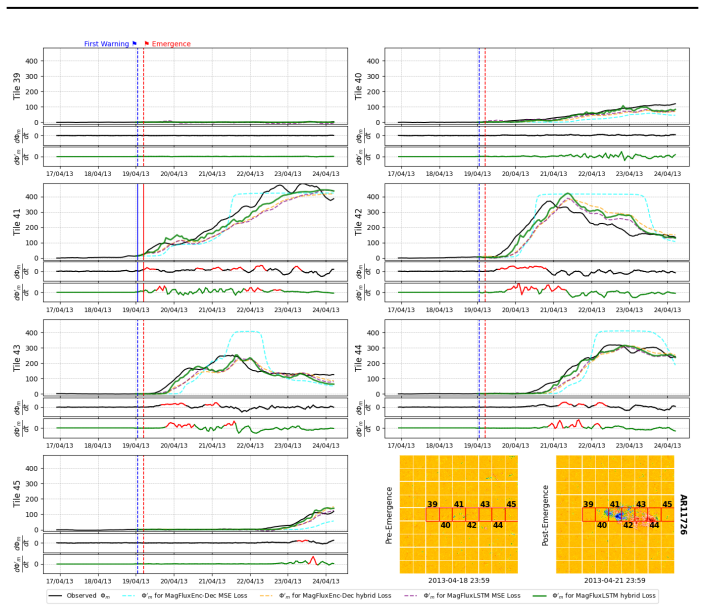
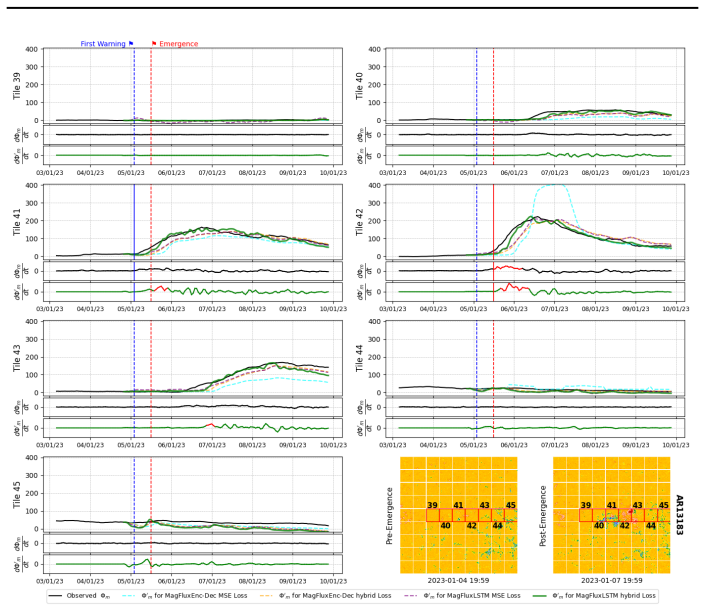
the simpler MagFluxLSTM, which can predict magnetic flux emergence 3-10 hours in advance within a 12-hour prediction window in both experimental and operational-type settings for the 5 testing active regions.
Load-bearing premise
That patterns learned from the 53 training active regions and their specific 30.66° field-of-view time series will generalize to new, unseen active regions without significant distribution shift or overfitting to the chosen frequency bands and preprocessing.
Figures



read the original abstract
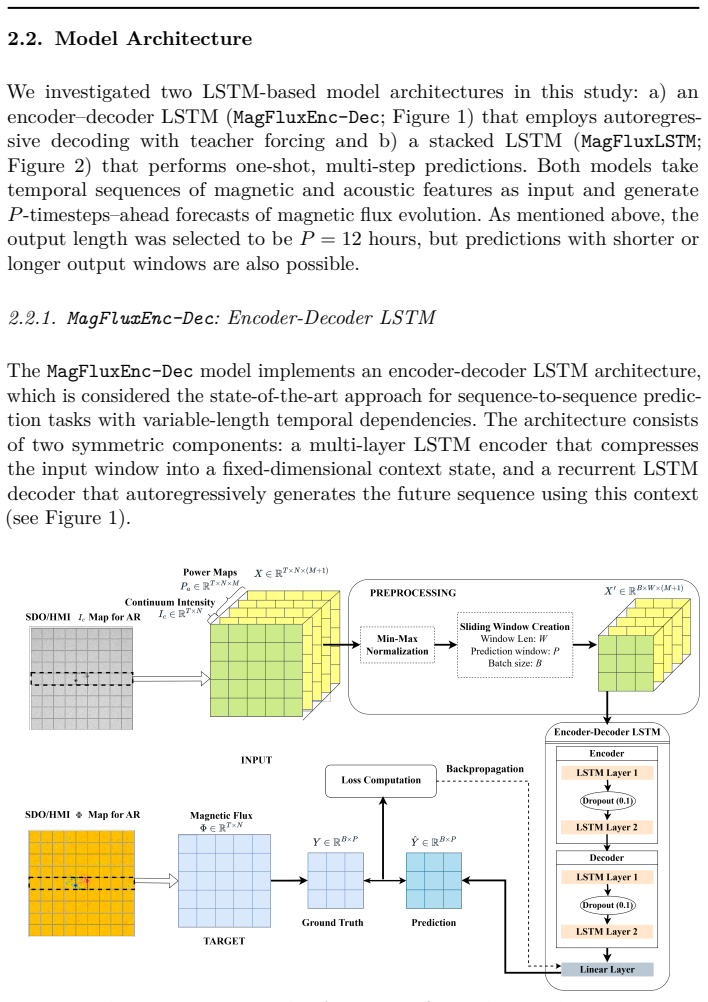
Solar active regions (ARs) are the primary drivers of space weather events, making their early prediction crucial for operational forecasting systems. We develop machine learning models capable of predicting the evolution of magnetic flux during AR emergence using 1D time series of the continuum intensity and solar oscillation power maps for 53 active regions and their surrounding quiet-Sun areas. Each observable is sampled over a fixed 30.66{\deg}x30.66{\deg} field of view. These observations capture the temporal evolution of each active region and serve as inputs for training and validation of our MagFluxLSTM and MagFluxEnc-Dec models. The MagFluxLSTM architecture implements a single-stage standard Long-Short Term Memory (LSTM) network. MagFluxEnc-Dec represents an LSTM encoder-decoder with teacher forcing. To test and evaluate the models' performance, we use the continuum intensity and oscillation power maps (calculated for several frequency bands from Doppler velocity) as input to predict the magnetic flux. Among the top 100 hyperparameter configurations ranked by validation derivative RMSE, 98% correspond to MagFluxLSTM, compared to only 2% for MagFluxEnc-Dec. Thus, although the MagFluxEnc-Dec architecture has higher model complexity, it leads to poorer generalization to ARs outside the training set and less stable training than the simpler MagFluxLSTM, which can predict magnetic flux emergence 3-10 hours in advance within a 12-hour prediction window in both experimental and operational-type settings for the 5 testing active regions.
Editorial analysis
A structured set of objections, weighed in public.
Circularity Check
No significant circularity in the LSTM time-series forecasting pipeline
full rationale
The paper trains standard LSTM architectures (MagFluxLSTM and MagFluxEnc-Dec) on 1D time series of continuum intensity and oscillation power maps drawn from 53 active regions, then evaluates forecasts on a held-out set of 5 regions. No algebraic derivation, parameter fitting, or self-referential definition reduces the claimed 3-10 hour predictions to the training inputs by construction. Hyperparameter ranking on validation RMSE introduces ordinary selection bias but does not create a tautology; the network weights are learned from data rather than presupposing the target flux values. No load-bearing self-citations or uniqueness theorems appear in the provided text. The workflow is therefore a conventional supervised learning setup whose outputs are not forced by the inputs.
Axiom & Free-Parameter Ledger
free parameters (2)
- LSTM hyperparameters (hidden size, layers, learning rate, etc.)
- Frequency bands for oscillation power maps
axioms (2)
- domain assumption LSTM networks can learn temporal dependencies in solar time series that correlate with future magnetic flux changes
- domain assumption The 30.66° field-of-view sampling and 1D time series representation preserve sufficient information for flux prediction
Reference graph
Works this paper leans on
-
[1]
Barnes, G., Birch, A., Leka, K., Braun, D.: 2014, Helioseismology of pre-emerging active regions. III. Statistical analysis.The Astrophysical Journal786,
work page 2014
-
[2]
Bergstra, J., Yamins, D., Cox, D.D., et al.: 2013, Hyperopt: A Python Library for Optimizing the Hyperparameters of Machine Learning Algorithms.SciPy13,
work page 2013
-
[3]
Birch, A., Braun, D., Leka, K., Barnes, G., Javornik, B.: 2012, Helioseismology of pre-emerging active regions. II. Average emergence properties.The Astrophysical Journal762,
work page 2012
-
[4]
Bobra, M.G., Ilonidis, S.: 2016, Predicting coronal mass ejections using machine learning methods.The Astrophysical Journal821,
work page 2016
-
[5]
Camporeale, E.: 2020, ML-Helio: An Emerging Community at the Intersection Between Heliophysics and Machine Learning.Journal of Geophysical Research (Space Physics) 125, e27502. DOI. ADS. Georgoulis, M.K., Bloomfield, D.S., Piana, M., Massone, A.M., Soldati, M., Gallagher, P.T., Pariat, E., Vilmer, N., Buchlin, E., Baudin, F., et al.: 2021, The flare likel...
work page 2020
-
[6]
Grigor’ev, V., Ermakova, L., Khlystova, A.: 2011, The dynamics of photospheric line-of-sight velocities in emerging active regions.Astronomy reports55,
work page 2011
-
[7]
Hartlep, T., Kosovichev, A.G., Zhao, J., Mansour, N.N.: 2011, Signatures of emerging subsurface structures in acoustic power maps of the Sun.Solar Physics268,
work page 2011
-
[8]
Astrophysics and Space Science370,
Hegde, M.: 2025, Predicting CME speed at 20 R ⊙using machine learning approaches. Astrophysics and Space Science370,
work page 2025
-
[9]
Hochreiter, S., Schmidhuber, J.: 1997, Long short-term memory.Neural computation9,
work page 1997
-
[10]
Hoeksema, J.T., Liu, Y., Hayashi, K., Sun, X., Schou, J., Couvidat, S., Norton, A., Bobra, M., Centeno, R., Leka, K.D., Barnes, G., Turmon, M.: 2014, The Helioseismic and Magnetic Imager (HMI) Vector Magnetic Field Pipeline: Overview and Performance.Solar Physics 289,
work page 2014
-
[11]
DOI.URL. Hua, Y., Zhao, Z., Li, R., Chen, X., Liu, Z., Zhang, H.: 2019, Deep learning with long short-term memory for time series prediction.IEEE Communications Magazine57,
work page 2019
-
[12]
Hutchins, T., Kasapis, S., Farooki, H., Cuesta, M.E., Khoo, L., Pak, S., Czarnota, R., Rankin, J., Szalay, J., Xu, Z., Livadiotis, G., Sarlis, N., McComas, D.: 2026, Solar Energetic Particle Prediction in the Inner Heliosphere Using Deep Learning and PSP/IS ⊙IS Data.JGR: Machine Learning and Computation. Manuscript under review. Ilonidis, S., Zhao, J., Ha...
work page 2026
-
[13]
Ilonidis, S., Zhao, J., Kosovichev, A.: 2011, Detection of emerging sunspot regions in the solar interior.Science333,
work page 2011
-
[14]
Jiao, Z., Sun, H., Wang, X., Manchester, W., Gombosi, T., Hero, A., Chen, Y.: 2020, Solar flare intensity prediction with machine learning models.Space weather18, e2020SW002440. Kasapis, S., Kitiashvili, I.N., Kosovichev, A.G., Stefan, J.T., Apte, B.: 2023, Predicting the Emergence of Solar Active Regions Using Machine Learning.Proceedings of the Internat...
work page 2020
-
[15]
Kasapis, S., Kitiashvili, I.N., Kosovichev, A.G., Stefan, J.T.: 2025, Prediction of Intensity Variations Associated with Emerging Active Regions using Helioseismic Power Maps and Machine Learning.The Astrophysical Journal Supplement Series280,
work page 2025
-
[16]
Kasapis, S., Hosseinzadeh, P., Whitman, K., Egeland, R., Georgoulis, M., Vourlidas, A., Papaioannou, A., Lavasa, E., Anastasiadis, A., Giannopoulos, G., Mu˜ noz-Jaramillo, A., Poduval, B., Kitiashvili, I.N., Kosovichev, A.G., Sadykov, V., Filali Boubrahimi, S., Hutchins, T.T., Farooki, H.A., Cuesta, M.E., Khoo, L.Y., Pak, S., Czarnota, R., Rankin, J.S., S...
-
[17]
DOI. ADS. Kosovichev, A.G., Duvall, T.L., Scherrer, P.H.: 1999, Time-distance helioseismology.Advances in Space Research24,
work page 1999
-
[18]
DOI. ADS. Leka, K.D., Barnes, G., Birch, A.C., Gonzalez-Hernandez, I., Dunn, T., Javornik, B., Braun, D.C.: 2013, Helioseismology of Pre-emerging Active Regions. I. Overview, Data, and Target Selection Criteria.ApJ762,
work page 2013
-
[19]
DOI. ADS. Li, L., Jamieson, K., Rostamizadeh, A., Gonina, E., Ben-Tzur, J., Hardt, M., Recht, B., Talwalkar, A.: 2020, A system for massively parallel hyperparameter tuning.Proceedings of machine learning and systems2,
work page 2020
-
[20]
Liaw, R., Liang, E., Nishihara, R., Moritz, P., Gonzalez, J.E., Stoica, I.: 1807, Tune: a research platform for distributed model selection and training (2018).ArXiv:1807.05118. Liaw, R., Liang, E., Nishihara, R., Moritz, P., Gonzalez, J.E., Stoica, I.: 2018, Tune: A Research Platform for Distributed Model Selection and Training.arXiv preprint arXiv:1807....
work page Pith review arXiv 2018
-
[21]
Pesnell, W.D., Thompson, B.J., Chamberlin, P.: 2012,The solar dynamics observatory (SDO), Springer. Roy, S., Schmude, J., Lal, R., Gaur, V., Freitag, M., Kuehnert, J., van Kessel, T., Hegde, D.V., Mu˜ noz-Jaramillo, A., Jakubik, J., et al.: 2025a, Surya: Foundation model for heliophysics. arXiv preprint arXiv:2508.14112. Roy, S., Hegde, D.V., Schmude, J.,...
-
[22]
DOI.URL. Schrijver, C.J.: 2009, Driving major solar flares and eruptions: A review.Advances in Space Research43,
work page 2009
-
[23]
Monthly Notices of the Royal Astronomical Society533,
Schunker, H., Roland-Batty, W., Birch, A.C., Braun, D.C., Cameron, R.H., Gizon, L.: 2024, A flux-independent increase in outflows prior to the emergence of active regions on the Sun. Monthly Notices of the Royal Astronomical Society533,
work page 2024
-
[24]
Sherstinsky, A.: 2020, Fundamentals of recurrent neural network (RNN) and long short-term memory (LSTM) network.Physica D: Nonlinear Phenomena404, 132306. Singh, N.K., Raichur, H., Brandenburg, A.: 2016, High-wavenumber solar f-mode strengthening prior to active region formation.The Astrophysical Journal832,
work page 2020
-
[25]
Stefan, J.T., Kosovichev, A.G.: 2023, Exploring the Connection between Helioseismic Travel Time Anomalies and the Emergence of Large Active Regions during Solar Cycle 24.The Astrophysical Journal948,
work page 2023
-
[26]
Tirona, J., Patil, S., Kasapis, S., Dogan, E., Stefan, J., Kitiashvili, I.N., Kosovichev, A.G., Xu, M.: 2026, Forecasting Continuum Intensity for Solar Active Region Emergence Prediction using Transformers.arXiv preprint arXiv:2601.13144. Waidele, M., Roth, M., Singh, N., K¨ apyl¨ a, P.: 2023, On Strengthening of the Solar f-Mode Prior to Active Region Em...
-
[27]
SOLA: solarphysicsjournal.tex; 7 April 2026; 0:16; p. 17 Appendix A. Hyperparameter Optimization Hyperparameter optimization was performed using Ray Tune using the Hyperopt search algorithm and the Asynchronous Successive Halving Algorithm (ASHA) for early-stopping of underperforming trials. The optimization objective was set to minimize the validation ro...
work page 2026
-
[28]
Listing 1: Ray Tune + Hyperopt search configuration for LSTM hyperparameter optimization. s e a r c h _ s p a c e = { " l e a r n i n g _ r a t e " : hp . l o g u n i f o r m ( " l e a r n i n g _ r a t e " , log (1 e -5) , log (1 e -2) ) , " h i d d e n _ s i z e " : hp . choice ( " h i d d e n _ s i z e " , [2 , 4 , 8 , 16 , 32 , 64 , 128]) , " n u m _ ...
work page 2026
discussion (0)
Sign in with ORCID, Apple, or X to comment. Anyone can read and Pith papers without signing in.