Recognition: no theorem link
Seeking Socially Responsible Consumers: Exploring the Intention-"Search"-Behaviour Gap
Pith reviewed 2026-05-13 17:28 UTC · model grok-4.3
The pith
The intention-behavior gap in socially responsible buying can be partly framed as an information seeking problem.
A machine-rendered reading of the paper's core claim, the machinery that carries it, and where it could break.
Core claim
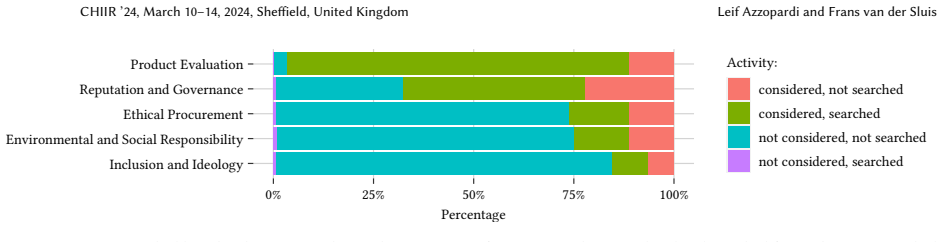
Contrary to expectations of a clear intention-behavior gap, a considerable number of participants exhibited indifference or lack of information regarding responsible aspects, with difficulties related to searching for and acquiring information contributing to the gap, including limited accessibility and reliability of information. This suggests that part of the intention-behaviour gap can be framed as an information seeking problem, which warrants and motivates search systems that help support consumers in making more informed and responsible purchasing decisions.
What carries the argument
An online survey of 286 participants asking about search behaviors and whether they considered price, features, environmental, social, and governance issues for a recent purchase. It identifies lack of information and search difficulties as contributors to the gap.
If this is right
- Search systems can be designed to surface environmental, social, and governance information more prominently to support responsible decisions.
- The gap arises partly from limited accessibility and reliability of responsible product information rather than solely from conflicting intentions.
- Many consumers appear indifferent or uninformed on responsible dimensions instead of exhibiting a straightforward intention-behavior mismatch.
Where Pith is reading between the lines
- Search interfaces could integrate ESG filters or summaries directly into product results to lower the effort needed for responsible choices.
- The information-seeking framing might extend to other domains like health or ethical investing where similar intention gaps occur.
- Testing prototype search tools that prioritize reliable responsible information could measure reductions in the observed gap.
Load-bearing premise
Self-reported survey responses about search behaviors and purchase considerations accurately capture real decision processes without significant recall bias or social desirability effects.
What would settle it
A field study that logs actual consumer searches and purchases in real time and finds no link between reported search difficulties and deviations from intended responsible choices.
Figures



read the original abstract
The increasing prominence of Socially Responsible Consumers has brought about a heightened focus on the ethical, environmental, social, and ideological dimensions influencing product purchasing decisions. Despite this emphasis, studies have consistently revealed a significant gap between individuals' intentions to be socially responsible and their actual purchasing behaviors: they often choose products that do not align with their values. This paper aims to investigate how search in influences this gap. Our investigation involves an online survey of 286 participants, where we inquire about their search behaviors and whether they considered various dimensions, ranging from price and features to environmental, social, and governance issues in relation to a recent purchase. Contrary to expectations of a clear intention-behavior gap, our findings suggest that a considerable number of participants exhibited indifference or lack of information regarding these responsible aspects. While, difficulties related to searching for and acquiring information contributed to the gap, including the limited accessibility and reliability of information. This suggests that part of the intention-behaviour gap can be framed as an information seeking problem. Moreover our findings warrant and motivate search systems that help support consumers make more informed and responsible purchasing decisions.
Editorial analysis
A structured set of objections, weighed in public.
Referee Report
Summary. The paper investigates the intention-behavior gap in socially responsible consumption, arguing that part of this gap can be reframed as an information-seeking problem. It reports results from an online survey of 286 participants who retrospectively described their search behaviors and consideration of price, features, and ESG dimensions during a recent purchase. Key findings include widespread participant indifference or lack of information on responsible aspects, plus difficulties in searching for and acquiring reliable information, which the authors link to the gap and use to motivate improved search systems for informed purchasing.
Significance. If the survey evidence holds after addressing methodological gaps, the reframing could usefully shift consumer-behavior research toward informational barriers rather than solely motivational ones, with direct implications for the design of search engines, recommendation systems, and interfaces that surface ESG data. The fresh empirical data (no circularity with prior fitted parameters) provides a concrete basis for such system-oriented follow-up work.
major comments (2)
- [Abstract and §3] Abstract and §3 (Methods): The survey of 286 participants is presented as offering directional support for information difficulties contributing to the gap, yet the abstract (and apparently the methods description) provides no details on statistical methods, response rates, exclusion criteria, or controls for confounding factors such as product category. These omissions are load-bearing because the central claim rests on the survey's ability to distinguish indifference/lack of information from other explanations.
- [§4 and §5] §4 (Results) and §5 (Discussion): The claim that search difficulties contribute to the gap depends on retrospective self-reports of search behaviors and purchase considerations. No validation against objective data (logs, eye-tracking, or longitudinal tracking) is described, leaving the findings vulnerable to recall bias and social-desirability effects. This is the weakest link for the information-seeking reframing.
minor comments (2)
- [Abstract] Abstract: Typo in 'how search in influences this gap' (likely 'how search influences this gap').
- [Title] Title: Inconsistent hyphenation and quotation marks around 'Search' make the title harder to parse; consider standardizing to 'Intention-Search-Behaviour Gap'.
Simulated Author's Rebuttal
We thank the referee for the constructive comments, which help clarify the presentation of our survey-based study. We address each major comment below and will revise the manuscript to improve transparency while preserving the core contribution.
read point-by-point responses
-
Referee: [Abstract and §3] Abstract and §3 (Methods): The survey of 286 participants is presented as offering directional support for information difficulties contributing to the gap, yet the abstract (and apparently the methods description) provides no details on statistical methods, response rates, exclusion criteria, or controls for confounding factors such as product category. These omissions are load-bearing because the central claim rests on the survey's ability to distinguish indifference/lack of information from other explanations.
Authors: We agree that the abstract and methods section require greater detail to support the claims. In the revised manuscript we will expand the abstract to note the primary analytical approach and revise §3 to report the platform response rate, explicit exclusion criteria applied to the 286 responses, the statistical methods (descriptive statistics and frequency distributions), and any post-hoc checks or stratification by product category. These additions will make the survey design more transparent and directly address the concern about distinguishing indifference from information barriers. revision: yes
-
Referee: [§4 and §5] §4 (Results) and §5 (Discussion): The claim that search difficulties contribute to the gap depends on retrospective self-reports of search behaviors and purchase considerations. No validation against objective data (logs, eye-tracking, or longitudinal tracking) is described, leaving the findings vulnerable to recall bias and social-desirability effects. This is the weakest link for the information-seeking reframing.
Authors: We acknowledge that the study relies exclusively on retrospective self-reports, which are susceptible to recall bias and social-desirability effects. No objective behavioral logs or eye-tracking data were collected in this online survey design. In the revision we will expand §5 to discuss these limitations explicitly, reference methodological literature on consumer surveys, and outline how future work could triangulate with logged search data or controlled experiments. We maintain that the self-report data still supplies useful directional evidence for reframing part of the gap as an information-seeking problem, but we agree it is not conclusive without complementary objective measures. revision: partial
Circularity Check
No significant circularity: empirical survey findings derive from fresh data collection
full rationale
The paper's derivation consists of administering an online survey to 286 participants and interpreting their self-reported search behaviors and consideration of ESG factors for a recent purchase. The central claim—that part of the intention-behavior gap can be framed as an information-seeking problem—follows directly from the observed patterns of indifference, lack of information, and reported search difficulties in this new dataset. No equations, parameter fitting, self-citations, or prior-work ansatzes are invoked to reduce the conclusion to the inputs by construction. The analysis remains self-contained against external benchmarks because it reports raw survey responses and draws an interpretive reframing without renaming known results or smuggling assumptions via self-reference.
Axiom & Free-Parameter Ledger
axioms (1)
- domain assumption Self-reported survey responses accurately reflect participants' true search behaviors and purchase considerations.
Reference graph
Works this paper leans on
-
[1]
Icek Ajzen. 1985. From Intentions to Actions: A Theory of Planned Behavior. InAction Control: From Cognition to Behavior, Julius Kuhl and Jürgen Beckmann (Eds.). Springer Berlin Heidelberg, Berlin, Heidelberg, 11–39. https://doi.org/10.1007/978-3-642-69746-3{_}2
-
[2]
1970.The Market for "Lemons": Quality Uncertainty and the Market Mechanism
George A Akerlof. 1970.The Market for "Lemons": Quality Uncertainty and the Market Mechanism. Technical Report 3. 488–500 pages. https: //about.jstor.org/terms
work page 1970
-
[3]
Joseph W Alba and J Wesley Hutchinson. 2000. Knowledge calibration: what consumers know and what they think they know.The Journal of Consumer Research27, 2 (2000), 123–156
work page 2000
-
[4]
Azzurra Annunziata, Sara Ianuario, and Paola Pascale. 2011. Consumers’ attitudes toward labelling of ethical products: The case of organic and fair trade products.Journal of Food Products Marketing17, 5 (10 2011), 518–535. https://doi.org/10.1080/10454446.2011.618790
- [5]
-
[6]
Amit Bhatnagar and Sanjoy Ghose. 2004. Online information search termination patterns across product categories and consumer demographics. Journal of Retailing80, 3 (2004), 221–228. https://doi.org/10.1016/j.jretai.2003.10.001
-
[7]
1986.Consumer Search: An Extended Framework
Peter H Bloch, Daniel L Sherrell, and Nancy M Ridgway. 1986.Consumer Search: An Extended Framework. Technical Report
work page 1986
-
[8]
Andrei Broder. 2002. A Taxonomy of Web Search.SIGIR Forum36, 2 (9 2002), 3–10. https://doi.org/10.1145/792550.792552
-
[9]
Glenn Browne, M G Pitts, and James Wetherbe. 2007. Cognitive rules for terminating information search in online tasks.MIS Quarterly: Management Information Systems31 (3 2007), 89–104
work page 2007
-
[10]
Erik Brynjolfsson, Michael Smith, Glorimar Ripoli, Julie Shin, Kristin Smith, and Lou Smith. 1999. Frictionless Commerce? - A Comparison of Internet and Conventional Retailers.Management Science45 (10 1999)
work page 1999
- [11]
-
[12]
[n.d.].Lost in Translation: Exploring the Ethical Consumer Intention-Behavior Gap
Michal J Carrington and Gregory J Whitwell. [n.d.].Lost in Translation: Exploring the Ethical Consumer Intention-Behavior Gap. Technical Report
-
[13]
Beatriz Casais and Joana Faria. 2022. The Intention-Behavior gap in Ethical Consumption: Mediators, Moderators and Consumer Profiles Based on Ethical Priorities.Journal of Macromarketing42, 1 (3 2022), 100–113. https://doi.org/10.1177/02761467211054836 17 CHIIR ’24, March 10–14, 2024, Sheffield, United Kingdom Leif Azzopardi and Frans van der Sluis
-
[14]
Bogeum Choi, Jaime Arguello, Robert Capra, and Austin R. Ward. 2021. OrgBox: A Knowledge Representation Tool to Support Complex Search Tasks. InCHIIR 2021 - Proceedings of the 2021 Conference on Human Information Interaction and Retrieval. Association for Computing Machinery, Inc, 219–228. https://doi.org/10.1145/3406522.3446029
-
[15]
Bogeum Choi, Robert Capra, and Jaime Arguello. 2019. The effects of working memory during search tasks of varying complexity. InCHIIR 2019 - Proceedings of the 2019 Conference on Human Information Interaction and Retrieval. Association for Computing Machinery, Inc, 261–265. https://doi.org/10.1145/3295750.3298948
-
[16]
2021.Bryman’s social research methods
Tom Clark, Liam Foster, Alan Bryman, and Luke Sloan. 2021.Bryman’s social research methods. Oxford university press
work page 2021
-
[17]
Anita Crescenzi, Austin R. Ward, Yuan Li, and Rob Capra. 2021. Supporting Metacognition during Exploratory Search with the OrgBox. InSIGIR 2021 - Proceedings of the 44th International ACM SIGIR Conference on Research and Development in Information Retrieval. Association for Computing Machinery, Inc, 1197–1207. https://doi.org/10.1145/3404835.3462955
-
[18]
Iain Andrew Davies and Sabrina Gutsche. 2016. Consumer motivations for mainstream “ethical” consumption.European Journal of Marketing50, 7/8 (1 2016), 1326–1347. https://doi.org/10.1108/EJM-11-2015-0795
-
[19]
Sebastião Vieira de Freitas Netto, Marcos Felipe Falcão Sobral, Ana Regina Bezerra Ribeiro, and Gleibson Robert da Luz Soares. 2020. Concepts and forms of greenwashing: A systematic review.Environmental Sciences Europe32, 1 (2020), 1–12
work page 2020
-
[20]
Elmira Djafarova and Sophie Foots. 2022. Exploring ethical consumption of generation Z: theory of planned behaviour.Young Consumers23, 3 (7 2022), 413–431. https://doi.org/10.1108/YC-10-2021-1405
-
[21]
Pam Ellen, Joshua Wiener, and Cathy Cobb-Walgren. 1991. The Role of Perceived Consumer Effectiveness in Motivating Environmentally Conscious Behaviors.Journal of Public Policy & Marketing10 (9 1991), 102–117. https://doi.org/10.1177/074391569101000206
-
[22]
James F Engel, Roger D Blackwell, and Paul W Miniard. 1990. Customer behavior.Hinsdale, IL: Dryden(1990)
work page 1990
-
[23]
John H Flavell. 1979. Metacognition and cognitive monitoring: A new area of cognitive–developmental inquiry.American Psychologist34, 10 (1979), 906–911. https://doi.org/10.1037/0003-066X.34.10.906
-
[24]
Carlos Flavián-Blanco, Raquel Gurrea-Sarasa, and Carlos Orús-Sanclemente. 2011. Analyzing the emotional outcomes of the online search behavior with search engines.Computers in Human Behavior27, 1 (1 2011), 540–551. https://doi.org/10.1016/j.chb.2010.10.002
-
[25]
Anindya Ghose, Panagiotis G Ipeirotis, and Beibei Li. 2014. Examining the Impact of Ranking on Consumer Behavior and Search Engine Revenue. Management Science60, 7 (2 2014), 1632–1654. https://doi.org/10.1287/mnsc.2013.1828
-
[26]
Vüsal Hasanzade, Victoria Sophie Osburg, and Waldemar Toporowski. 2018. Selecting decision-relevant ethical product attributes for grocery shopping.Management Decision56, 3 (3 2018), 591–609. https://doi.org/10.1108/MD-12-2016-0946
-
[27]
M A Hearst. 2006. Design recommendations for hierarchical faceted search interfaces. InProc. SIGIR 2006, Workshop on Faceted Search. 26–30
work page 2006
-
[28]
1974.Brand Choice Behavior as a Function of Information Load
Jacob Jacoby, Donald E Speller, and Carol A Kohn. 1974.Brand Choice Behavior as a Function of Information Load. Technical Report 1. 63–69 pages
work page 1974
-
[29]
Bernard J Jansen, Danielle L Booth, and Amanda Spink. 2008. Determining the informational, navigational, and transactional intent of Web queries. Information Processing & Management44, 3 (2008), 1251–1266
work page 2008
-
[30]
2022.The Better World Shopping Guide:: Every Dollar Makes a Difference
Ellis Jones. 2022.The Better World Shopping Guide:: Every Dollar Makes a Difference. New Society Publishers
work page 2022
-
[31]
Surya Kallumadi, Shervin Malmasi, Yubin Kim, Maarten de Rijke, Tracy Holloway King, and Jacopo Tagliabue. 2023. eCom’23: The SIGIR 2023 Workshop on eCommerce. InSIGIR 2023 - Proceedings of the 46th International ACM SIGIR Conference on Research and Development in Information Retrieval. Association for Computing Machinery, Inc, 3476–3478. https://doi.org/1...
-
[32]
Yvonne Kammerer and Saskia Brand-Gruwel. 2020. Trainings and Tools to Foster Source Credibility Evaluation During Web Search. 213–243. https://doi.org/10.1007/978-3-030-38825-6{_}11
-
[33]
Frank R Kardes, Steven S Posavac, David Silvera, Maria L Cronley, David M Sanbonmatsu, Susan Schertzer, Felicia Miller, Paul M Herr, and Murali Chandrashekaran. 2006. Debiasing omission neglect.Journal of Business Research59, 6 (2006), 786–792. https://doi.org/10.1016/j.jbusres.2006.01.016
-
[34]
Tony Ke, Zuo Jun Max Shen, and J
T. Tony Ke, Zuo Jun Max Shen, and J. Miguel Villas-Boas. 2016. Search for information on multiple products.Management Science62, 12 (12 2016), 3576–3603. https://doi.org/10.1287/mnsc.2015.2316
-
[35]
Kevin Lane Keller and Richard Staelin. 1987. Effects of Quality and Quantity of Information on Decision Effectiveness.Journal of Consumer Research 14, 2 (9 1987), 200–213. https://doi.org/10.1086/209106
-
[36]
Ivar Krumpal. 2013. Determinants of social desirability bias in sensitive surveys: A literature review. , 2025–2047 pages. https://doi.org/10.1007/s11135- 011-9640-9
-
[37]
Carol C Kuhlthau. 1991. Inside the search process: Information seeking from the user’s perspective.Journal of the American Society for Information Science42, 5 (6 1991), 361–371. https://doi.org/10.1002/(SICI)1097-4571(199106)42:5<361::AID-ASI6>3.0.CO;2-
-
[38]
Sang Yeal Lee and Yong-Suk Cho. 2010. Do Web Users Care About Banner Ads Anymore? The Effects of Frequency and Clutter in Web Advertising. Journal of Promotion Management16, 3 (July 2010), 288–302. https://doi.org/10.1080/10496490903582594
-
[39]
Jiqun Liu, Shawon Sarkar, and Chirag Shah. 2020. Identifying and predicting the states of complex search tasks. InCHIIR 2020 - Proceedings of the 2020 Conference on Human Information Interaction and Retrieval. Association for Computing Machinery, Inc, 193–202. https://doi.org/10.1145/ 3343413.3377976
-
[40]
Xiaoping Liu, Lijing Mao, and Wenxiang Deng. 2018. The influence of consumer mindset and corporate social responsility on purchase intention. Social Behavior and Personality: an international journal46, 10 (2018), 1647–1656
work page 2018
-
[41]
Byeong-Joon Moon. 2004. Consumer adoption of the internet as an information search and product purchase channel: some research hypotheses. International Journal of Internet Marketing and Advertising1, 1 (1 2004), 104–118. https://doi.org/10.1504/IJIMA.2004.003692 18 Seeking Socially Responsible Consumers: Exploring the Intention-“Search”-Behaviour Gap CHI...
-
[42]
Nil Ozcaglar-Toulouse, Edward Shiu, and Deirdre Shaw. 2006. In search of fair trade: Ethical consumer decision making in France.International Journal of Consumer Studies30, 5 (2006), 502–514. https://doi.org/10.1111/j.1470-6431.2006.00532.x
-
[43]
Eleni Papaoikonomou, Carmen Valor, and Matias Ginieis. 2018. Looking for info? Understanding ethical consumer information management using a diary approach.Management Decision56, 3 (3 2018), 645–662. https://doi.org/10.1108/MD-11-2016-0761
-
[44]
Bruce E Pfeiffer, Hélène Deval, Frank R Kardes, Douglas R Ewing, Xiaoqi Han, and Maria L Cronley. 2014. Effects of Construal Level on Omission Detection and Multiattribute Evaluation.Psychology & Marketing31, 11 (11 2014), 992–1007. https://doi.org/10.1002/mar.20748
-
[45]
Girish N Punj and David W Stewart. 1983. An Interaction Framework of Consumer Decision Making.Journal of Consumer Research10, 2 (9 1983), 181–196. https://doi.org/10.1086/208958
-
[46]
Rebecca Walker Reczek, Julie R. Irwin, Daniel M. Zane, and Kristine R. Ehrich. 2018. That’s Not How i Remember It: Willfully Ignorant Memory for Ethical Product Attribute Information.Journal of Consumer Research45, 1 (6 2018), 185–207. https://doi.org/10.1093/jcr/ucx120
-
[47]
[n.d.].Product search in e-shopping: a review and research propositions
Jennifer Rowley. [n.d.].Product search in e-shopping: a review and research propositions. Technical Report. http://www.emerald-library.com
-
[48]
S M Nazmuz Sakib. 2022. Ethical Consumerism: Attitude, Reality and the Behavioural Gap. (2022)
work page 2022
-
[49]
Rosa Schleenbecker and Ulrich Hamm. 2015. Information needs for a purchase of fairtrade coffee.Sustainability (Switzerland)7, 5 (2015), 5944–5962. https://doi.org/10.3390/su7055944
-
[50]
Jeffrey B. Schmidt and Richard A. Spreng. 1996. A proposed model of external consumer information search.Journal of the Academy of Marketing Science24, 3 (1996), 246–256. https://doi.org/10.1177/0092070396243005
-
[51]
Deirdre Shaw, Gillian Hogg, Elaine Wilson, Edward Shiu, and Louise Hassan. 2006. Fashion victim: The impact of fair trade concerns on clothing choice.Journal of Strategic Marketing14, 4 (2006), 427–440. https://doi.org/10.1080/09652540600956426
-
[52]
Deirdre Shaw and Edward Shiu. 2003. Ethics in consumer choice: a multivariate modelling approach.European Journal of Marketing37, 10 (1 2003), 1485–1498. https://doi.org/10.1108/03090560310487202
-
[53]
Jagdish N Sheth, Nirmal K Sethia, and Shanthi Srinivas. 2011. Mindful consumption: a customer-centric approach to sustainability.Journal of the Academy of Marketing Science39 (2011), 21–39. https://api.semanticscholar.org/CorpusID:53987253
work page 2011
-
[54]
Catherine L Smith and Soo Young Rieh. 2019. Knowledge-Context in Search Systems: Toward Information-Literate Actions. InCHIIR 2019 - Proceedings of the 2019 Conference on Human Information Interaction and Retrieval. 55–62. https://doi.org/10.1145/3295750.3298940
-
[55]
Laure Soulier, Lynda Tamine, and Wahiba Bahsoun. 2013. A Collaborative Document Ranking Model for a Multi-faceted Search. InInformation Retrieval Technology, Rafael E Banchs, Fabrizio Silvestri, Tie-Yan Liu, Min Zhang, Sheng Gao, and Jun Lang (Eds.). Springer Berlin Heidelberg, Berlin, Heidelberg, 109–120
work page 2013
-
[56]
Lynn Sudbury-Riley and Florian Kohlbacher. 2016. Ethically minded consumer behavior: Scale review, development, and validation.Journal of Business Research69, 8 (2016), 2697–2710. https://doi.org/10.1016/j.jbusres.2015.11.005
-
[57]
Ayumi Tanaka and Kou Murayama. 2014. Within-person analyses of situational interest and boredom: Interactions between task-specific perceptions and achievement goals.Journal of Educational Psychology106 (11 2014), 1122–1134. Issue 4. https://doi.org/10.1037/a0036659
-
[58]
Zakary L Tormala. 2016. The role of certainty (and uncertainty) in attitudes and persuasion.Current opinion in psychology10 (2016), 6–11
work page 2016
-
[59]
Manos Tsagkias, Tracy Holloway King, Surya Kallumadi, Vanessa Murdock, and Maarten de Rijke. 2021. Challenges and Research Opportunities in ECommerce Search and Recommendations.SIGIR Forum54, 1 (2 2021). https://doi.org/10.1145/3451964.3451966
-
[60]
Outi Uusitalo and Reetta Oksanen. 2004. Ethical consumerism: A view from Finland.International Journal of Consumer Studies28, 3 (2004), 214–221. https://doi.org/10.1111/j.1470-6431.2003.00339.x
- [61]
-
[62]
C-J. Wang and H-H. Chen. 2011. Learning User Behaviors for Advertisements Click Prediction.SIGIR Internet Advertising Workshop(2011)
work page 2011
-
[63]
[n.d.].Internet shopping, consumer search and product branding
Michael R Ward and Michael J Lee. [n.d.].Internet shopping, consumer search and product branding. Technical Report. http://www.emerald-library.com
-
[64]
Ryen W White and Eric Horvitz. 2015. Belief Dynamics and Biases in Web Search.ACM Trans. Inf. Syst.33, 4 (5 2015). https://doi.org/10.1145/2746229
-
[65]
Marie Wiederhold and Luis F. Martinez. 2018. Ethical consumer behaviour in Germany: The attitude-behaviour gap in the green apparel industry. International Journal of Consumer Studies42, 4 (7 2018), 419–429. https://doi.org/10.1111/ijcs.12435
-
[66]
Barbara Wildemuth, Luanne Freund, and Elaine G. Toms. 2014. Untangling search task complexity and difficulty in the context of interactive information retrieval studies.Journal of Documentation70, 6 (1 2014), 1118–1140. https://doi.org/10.1108/JD-03-2014-0056
-
[67]
William Young, Kumju Hwang, Seonaidh McDonald, and Caroline J. Oates. 2010. Sustainable consumption: Green consumer behaviour when purchasing products.Sustainable Development18, 1 (1 2010), 20–31. https://doi.org/10.1002/sd.394
-
[68]
Katrin Zander and Ulrich Hamm. 2012. Information search behaviour and its determinants: The case of ethical attributes of organic food.International Journal of Consumer Studies36, 3 (5 2012), 307–316. https://doi.org/10.1111/j.1470-6431.2011.00998.x 19 Seeking Socially Responsible Consumers: Exploring the Intention-“Search”-Behaviour Gap CHIIR ’24, March ...
discussion (0)
Sign in with ORCID, Apple, or X to comment. Anyone can read and Pith papers without signing in.