Recognition: no theorem link
A Unified and Economical Approach to Teaching Higher Secondary Electricity Experiments
Pith reviewed 2026-05-13 17:04 UTC · model grok-4.3
The pith
A homemade Indigenous Metre Bridge enables accurate electricity experiments using a mobile charger and nichrome wire.
A machine-rendered reading of the paper's core claim, the machinery that carries it, and where it could break.
Core claim
The Indigenous Metre Bridge (IMB) constructed from readily available components like a mobile charger and nichrome wire functions as an intuitive tool for conducting key electricity experiments at the higher secondary level, achieving educational outcomes comparable to standard metre bridges while being more accessible.
What carries the argument
The Indigenous Metre Bridge (IMB), a metre bridge assembly using a mobile charger for power, nichrome wire for the resistance element, a galvanometer for detection, and a digital multimeter for measurements, which enables verification of electrical laws through simple resistance balancing.
If this is right
- High school labs in under-resourced areas can now conduct electricity experiments without purchasing expensive commercial metre bridges.
- Multiple standard experiments can be unified under one simple apparatus design.
- Student engagement improves as the familiar components reduce fear of complex instruments.
- Teachers gain flexibility to adapt the setup for different curricula needs.
Where Pith is reading between the lines
- Similar frugal designs could be developed for other branches of physics to democratize lab access globally.
- Integration with smartphone apps for data recording might further enhance the educational value of such setups.
- Policy makers could consider subsidizing such low-cost kits to standardize practical education in public schools.
Load-bearing premise
The homemade metre bridge produces measurement results that are accurate enough for educational purposes and match the learning experience of using professional equipment.
What would settle it
If side-by-side tests show that resistance values measured by the IMB deviate by more than a few percent from those of a standard commercial metre bridge for identical samples, or if students fail to grasp the concepts as effectively, the claim would be challenged.
Figures



read the original abstract
In both rural and urban educational settings, science education is often hindered by limited access to lab resources and intimidating, complex instruments. This paper introduces a low-cost, homemade experimental apparatus built using a mobile charger, nichrome wire, galvanometer, and digital multimeter that enables educators to perform key higher secondary electricity experiments. The Indigenous Metre Bridge (IMB) has proven to be an intuitive, user-friendly tool that not only bridges theoretical and practical learning but also reduces student apprehension toward lab work. Its simplicity and accessibility exemplify how frugal innovation can transform physics education.
Editorial analysis
A structured set of objections, weighed in public.
Referee Report
Summary. The manuscript describes the construction and use of a low-cost homemade Indigenous Metre Bridge (IMB) assembled from a mobile charger, nichrome wire, galvanometer, and digital multimeter. It is presented as an accessible apparatus for performing standard higher-secondary electricity experiments, with the central claim that the IMB has proven effective and intuitive, bridging theory and practice while reducing student apprehension toward lab work.
Significance. If the effectiveness and accuracy claims were supported by calibration data and student-outcome measurements, the work could meaningfully advance equitable access to physics labs in resource-limited settings. The frugal-innovation framing is a strength, but the absence of any quantitative validation currently restricts the manuscript to a descriptive account rather than a demonstrated educational improvement.
major comments (1)
- [Abstract] Abstract: the assertion that the IMB 'has proven to be' an intuitive, user-friendly tool that reduces student apprehension is unsupported; the text supplies neither error-analysis tables, percentage deviations from commercial metre-bridge readings, nor pre/post-test or survey data on learning outcomes or anxiety reduction.
minor comments (2)
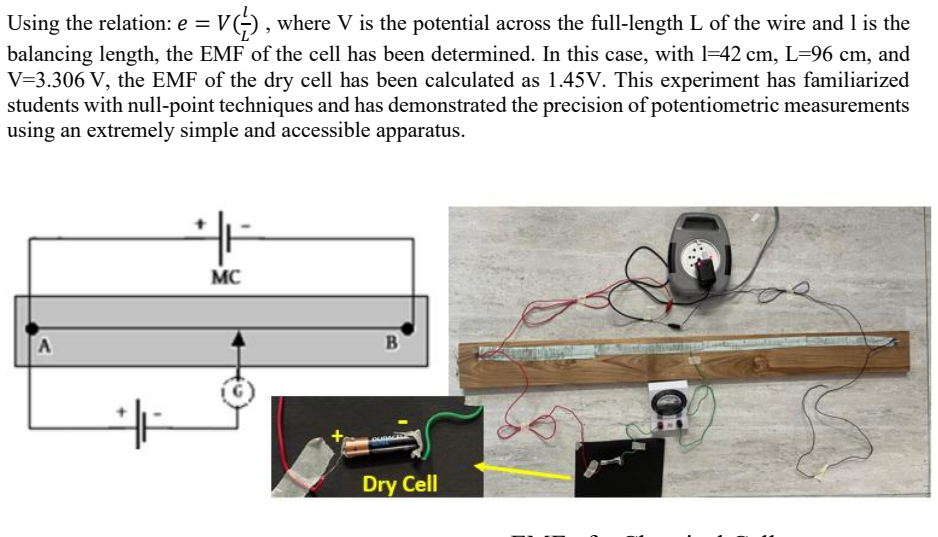
- The description of the assembly would be clearer if a labeled photograph or circuit diagram were included to facilitate replication by other educators.
- A brief comparison table of measured resistance values obtained with the IMB versus a standard commercial metre bridge would strengthen the accuracy claim.
Simulated Author's Rebuttal
We thank the referee for the constructive feedback. We agree that the manuscript is primarily descriptive and that the abstract overstates the educational impact without supporting quantitative evidence. We will revise the text to align claims with the available content.
read point-by-point responses
-
Referee: [Abstract] Abstract: the assertion that the IMB 'has proven to be' an intuitive, user-friendly tool that reduces student apprehension is unsupported; the text supplies neither error-analysis tables, percentage deviations from commercial metre-bridge readings, nor pre/post-test or survey data on learning outcomes or anxiety reduction.
Authors: We acknowledge that the manuscript provides no quantitative validation such as error-analysis tables, comparisons with commercial metre bridges, or pre/post student surveys. The description of the IMB's intuitiveness and effect on apprehension rests on the authors' qualitative observations during construction and informal classroom use. We will revise the abstract to remove the phrase 'has proven to be' and replace it with a statement that the apparatus offers a low-cost, accessible alternative for performing the experiments, based on initial development experience. A limitations paragraph will be added noting the absence of formal outcome measurements and calling for future empirical studies. revision: yes
Circularity Check
No circularity: purely descriptive account of teaching apparatus
full rationale
The paper contains no derivations, equations, fitted parameters, predictions, or self-referential claims. It is a descriptive presentation of a low-cost Indigenous Metre Bridge assembled from common components, with assertions about its educational value presented as direct observations rather than results derived from any chain that could reduce to its own inputs. No self-citations are used in a load-bearing way, and there are no mathematical structures or uniqueness theorems invoked. This matches the default expectation for non-circular descriptive work.
Axiom & Free-Parameter Ledger
axioms (1)
- domain assumption The chosen components can be combined to perform standard higher-secondary electricity experiments with sufficient accuracy for teaching purposes.
invented entities (1)
-
Indigenous Metre Bridge (IMB)
no independent evidence
Reference graph
Works this paper leans on
- [1]
-
[2]
N.D. Setyani, Suparmi, Sarwanto, J. Handhika, Students' conception and perception of simple electrical circuit, J. Phys.: Conf. Ser., V ol.909, 012051, 2017
work page 2017
-
[3]
Shipstone, Pupils' understanding of simple electrical circuits
D. Shipstone, Pupils' understanding of simple electrical circuits. Some implications for instruction, Phys. Educ., V ol.23, No.2, pp.92, 1988
work page 1988
-
[4]
L. Liégeois, E. Mullet, High school students' understanding of resistance in simple series electric circuits, Int. J. Sci. Educ., V ol.24, No.6, pp.551–564, 2002
work page 2002
discussion (0)
Sign in with ORCID, Apple, or X to comment. Anyone can read and Pith papers without signing in.