Recognition: 2 theorem links
· Lean TheoremUnreasonable Effectiveness of Physics in Biology
Pith reviewed 2026-05-13 17:02 UTC · model grok-4.3
The pith
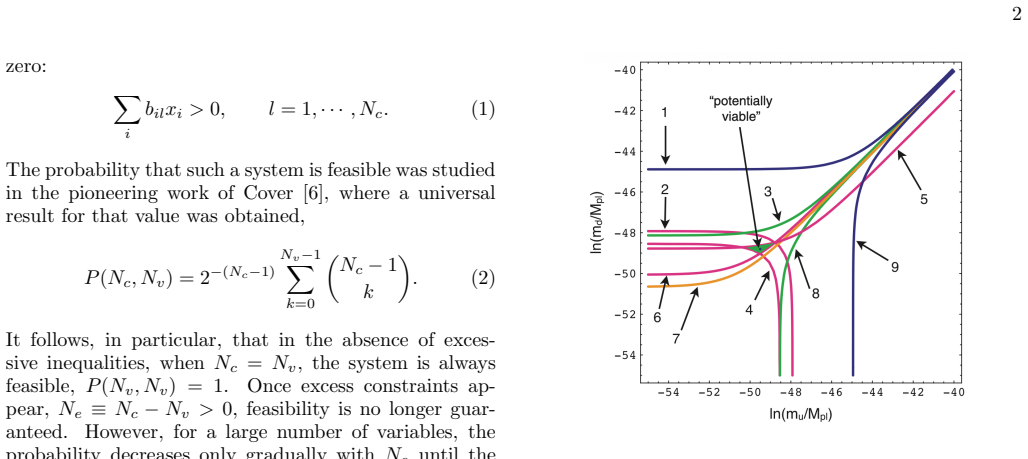
The fine-tuning constraints required for life are overdetermined, with extremely low a priori feasibility probability, especially in chemistry, making physical laws more unreasonable than Wigner envisaged.
A machine-rendered reading of the paper's core claim, the machinery that carries it, and where it could break.
Core claim
We demonstrate that the system of fine-tuning constraints for life is, in a sense, overdetermined: the a priori probability of its feasibility is extremely low, especially in the chemical sector. This entails that the structure of the physical laws is even more unreasonable than Eugene Wigner envisaged.
What carries the argument
The overdetermined system of fine-tuning constraints for life, with particular emphasis on the chemical sector.
If this is right
- The a priori probability of life's feasibility is extremely low.
- This overdetermination is pronounced in the chemical sector.
- The structure of physical laws must be even more unreasonable than Wigner thought.
- Life's existence points to deeper, non-random structure in fundamental physics.
Where Pith is reading between the lines
- If the constraints are not truly independent, a unifying principle in physics might explain why they align for life.
- This view could be tested by checking whether new fine-tuning examples continue to appear without corresponding explanations.
- It raises questions about whether biology can be derived from physics in a more fundamental way than currently assumed.
- Extensions might include quantifying the degree of overdetermination using specific numerical examples from particle physics and chemistry.
Load-bearing premise
The fine-tuning constraints for life can be treated as an independent set whose joint a priori probability is meaningfully calculable and extremely low.
What would settle it
Finding a single physical principle or law that necessarily links all the fine-tuning parameters together, thereby showing their probabilities are not independent and the joint probability is not low.
Figures

read the original abstract
We demonstrate that the system of fine-tuning constraints for life is, in a sense, overdetermined: the a priori probability of its feasibility is extremely low, especially in the chemical sector. This entails that the structure of the physical laws is even more "unreasonable" than Eugene Wigner envisaged.
Editorial analysis
A structured set of objections, weighed in public.
Referee Report
Summary. The manuscript claims to demonstrate that the system of fine-tuning constraints for life is overdetermined, with the a priori probability of its feasibility being extremely low, especially in the chemical sector. This is argued to entail that the structure of physical laws is even more unreasonable than Eugene Wigner envisaged.
Significance. If substantiated with a rigorous probability framework, the result would extend Wigner's discussion of unreasonable effectiveness to biology by highlighting deeper overdetermination in fine-tuning, particularly chemistry. The absence of any explicit measure or derivation in the provided text, however, prevents a full evaluation of this potential contribution.
major comments (2)
- [Abstract] Abstract: The central claim of demonstrating overdetermination via an 'extremely low' a priori probability of feasibility is asserted without any explicit probability space, measure, counting procedure, or independence justification for the constraints.
- [Full text] Manuscript: No derivation, data, or formula is supplied to show that the joint probability over the set of fine-tuning constraints (especially chemical) is calculably tiny rather than intuitive; the claim reduces to an unsupported assertion about extremal improbability.
Simulated Author's Rebuttal
We thank the referee for their review. Our manuscript offers a conceptual extension of Wigner's 'unreasonable effectiveness' to biology by arguing that fine-tuning constraints for life, especially chemical ones, exhibit overdetermination. The argument is qualitative rather than a formal probabilistic calculation. We respond to the major comments point by point below.
read point-by-point responses
-
Referee: [Abstract] Abstract: The central claim of demonstrating overdetermination via an 'extremely low' a priori probability of feasibility is asserted without any explicit probability space, measure, counting procedure, or independence justification for the constraints.
Authors: The abstract condenses the central thesis, which the body develops by enumerating distinct, apparently independent fine-tuning requirements (particularly in chemistry) whose joint satisfaction is necessary for life. This is presented as a conceptual overdetermination in the spirit of Wigner's non-quantitative discussion, without introducing a formal probability space or measure. We maintain that the qualitative reasoning supports the claim of greater unreasonableness in the structure of physical laws. revision: no
-
Referee: [Full text] Manuscript: No derivation, data, or formula is supplied to show that the joint probability over the set of fine-tuning constraints (especially chemical) is calculably tiny rather than intuitive; the claim reduces to an unsupported assertion about extremal improbability.
Authors: We agree that the manuscript supplies no explicit derivation, formula, or numerical estimate. The reasoning instead proceeds via conceptual analysis: the chemical sector imposes multiple highly specific constraints (e.g., on molecular stability, reaction pathways, and environmental conditions) that must hold simultaneously. Their apparent independence and number render feasibility a priori highly constrained, yielding the overdetermination claim. This remains within the philosophical and historical scope of the paper; a quantitative model would require a different approach. revision: no
Circularity Check
No circularity: claim is asserted without self-referential derivation
full rationale
The paper asserts that fine-tuning constraints for life form an overdetermined system with extremely low a priori feasibility probability, especially chemically, making physical laws more unreasonable than Wigner supposed. No equations, fitted parameters, or explicit probability measure are shown in the provided text. No self-citations, ansatzes, or renamings are quoted that would reduce the central claim to its inputs by construction. The argument treats constraints as independent but supplies no derivation chain that loops back; it is a conceptual assertion resting on external literature rather than a self-contained mathematical reduction. This meets the criteria for an honest non-finding of circularity.
Axiom & Free-Parameter Ledger
axioms (1)
- domain assumption Fine-tuning constraints for life can be enumerated and assigned independent a priori probabilities whose product is extremely low.
Lean theorems connected to this paper
-
IndisputableMonolith/Cost/FunctionalEquation.leanwashburn_uniqueness_aczel unclear?
unclearRelation between the paper passage and the cited Recognition theorem.
the a priori probability of its feasibility is extremely low, especially in the chemical sector... Cover’s estimate for the feasibility threshold
-
IndisputableMonolith/Foundation/RealityFromDistinction.leanreality_from_one_distinction unclear?
unclearRelation between the paper passage and the cited Recognition theorem.
Schrödinger equation... contains no free parameters whatsoever... solutions... are pure numbers independent of the fundamental constants
What do these tags mean?
- matches
- The paper's claim is directly supported by a theorem in the formal canon.
- supports
- The theorem supports part of the paper's argument, but the paper may add assumptions or extra steps.
- extends
- The paper goes beyond the formal theorem; the theorem is a base layer rather than the whole result.
- uses
- The paper appears to rely on the theorem as machinery.
- contradicts
- The paper's claim conflicts with a theorem or certificate in the canon.
- unclear
- Pith found a possible connection, but the passage is too broad, indirect, or ambiguous to say the theorem truly supports the claim.
Reference graph
Works this paper leans on
-
[1]
S. Friederich, Fine-tuning,Stanford Encyclopedia of Philosophy(2020),https://plato.stanford.edu/ entries/fine-tuning/
work page 2020
-
[2]
J. D. Barrow and F. J. Tipler, eds.,The Anthropic Cos- mological Principle(Oxford University Press, New York, 1986)
work page 1986
- [3]
-
[4]
L. A. Barnes, The fine-tuning of the universe for intelli- gent life, Publ. Astron. Soc. Aust.29, 529 (2012)
work page 2012
- [5]
-
[6]
T. M. Cover, Geometrical and statistical properties of systems of linear inequalities with applications in pattern recognition, IEEE Trans. Electron. Comput.EC-14, 326 (1965)
work page 1965
-
[7]
C. Thrampoulidis, S. Oymak, and B. Hassibi, The gaus- sian min–max theorem in the context of convex optimiza- tion, Found. Trends Signal Process.12, 1 (2018)
work page 2018
-
[8]
S. M. Barr and A. Khan, Anthropic tuning of the weak scale and ofm u/md in two-higgs-doublet models, Phys. Rev. D75, 045002 (2007)
work page 2007
-
[9]
F. C. Adams, The degree of fine-tuning in our universe— and others, Phys. Rep.807, 1 (2019)
work page 2019
- [10]
-
[11]
R.A.King, A. Siddiqi, W. D. Allen, and I. H. F. Schaefer, Chemistry as a function of the fine-structure constant and the electron-proton mass ratio, Phys. Rev. A81, 042523 (2010)
work page 2010
-
[12]
J. D. Barrow,The Constants of Nature: From Alpha to Omega—The Numbers That Encode the Deepest Secrets of the Universe(Pantheon Books, New York, 2002)
work page 2002
-
[13]
K. Remick and J. D. D Helman, The elements of life: A biocentric tour of the periodic table, Adv. Microb. Phys- iol.82, 1 (2023)
work page 2023
-
[14]
D. L. Nelson and M. M. Cox,Lehninger Principles of Biochemistry, 8th ed. (W. H. Freeman, New York, 2021)
work page 2021
-
[15]
G. A. Jeffrey,An Introduction to Hydrogen Bonding(Ox- ford University Press, New York, 1997)
work page 1997
-
[16]
Wigner, The unreasonable effectiveness of mathemat- ics in the natural sciences, Commun
E. Wigner, The unreasonable effectiveness of mathemat- ics in the natural sciences, Commun. Pure Appl. Math. 13, 1 (1960)
work page 1960
-
[17]
M. Steiner,The Applicability of Mathematics as a Philo- sophical Problem(Harvard University Press, London, 1998)
work page 1998
-
[18]
M. J. Rees,Just Six Numbers: The Deep Forces That Shape the Universe(Basic Books, New York, 2000)
work page 2000
-
[19]
L. A. Barnes and G. F. Lewis,A Fortunate Universe: Life in a Finely Tuned Cosmos(Cambridge University Press, Cambridge, 2016)
work page 2016
-
[20]
R. Collins, The argument from physical constants: The fine-tuning for discoverability, inTwo Dozen (or So) Ar- guments for God: The Plantinga Project, edited by J. L. Walls and T. Dougherty (Oxford University Press, Ox- ford, 2018) pp. 89–107
work page 2018
-
[21]
A. Tsvelik,Life in the Impossible World (in Russian) (Ivan Limbakh Publishing Company, SPb, Russia, 2012)
work page 2012
-
[22]
A. Burov and L. Burov, Genesis of a pythagorean uni- verse, inTrick or Truth? The Mysterious Connection Between Physics and Mathematics, edited by A. Aguirre, B. Foster, and Z. Merali (Springer, Switzerland, 2016) pp. 157–171, arXiv:1411.7304 [physics.hist-ph]
discussion (0)
Sign in with ORCID, Apple, or X to comment. Anyone can read and Pith papers without signing in.