Recognition: no theorem link
PhaseFlow4D: Physically Constrained 4D Beam Reconstruction via Feedback-Guided Latent Diffusion
Pith reviewed 2026-05-13 16:52 UTC · model grok-4.3
The pith
PhaseFlow4D reconstructs time-varying 4D particle beam distributions from sparse 2D projections 11000 times faster using physics-constrained latent diffusion.
A machine-rendered reading of the paper's core claim, the machinery that carries it, and where it could break.
Core claim
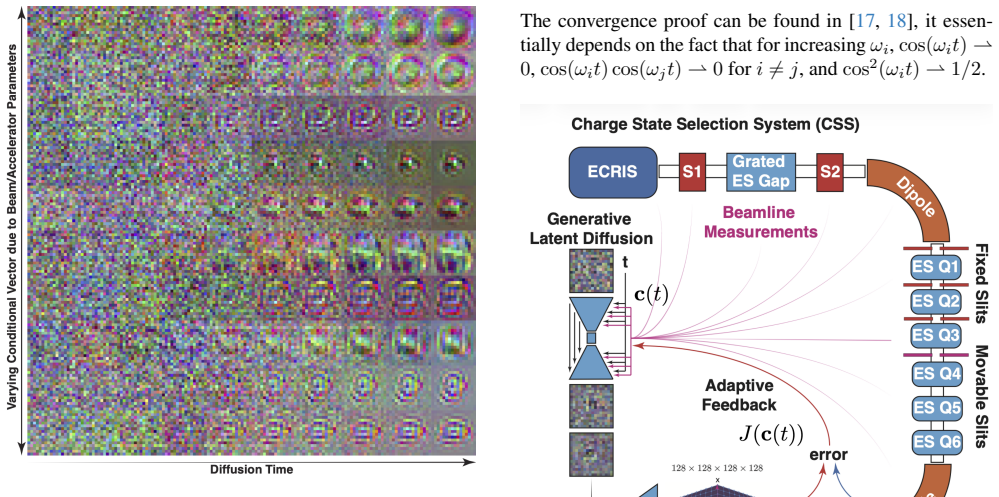
The core discovery is a feedback-guided latent diffusion model called PhaseFlow4D that reconstructs the 4D transverse phase space density from incomplete 2D observations using a 4D VAE whose decoder generates the full tensor and analytically computes projections for consistency matching. The adaptive feedback loop tunes the conditioning to track time-varying distributions online without retraining, achieving accurate results 11000 times faster than traditional simulations on FRIB heavy-ion beam data.
What carries the argument
A 4D VAE decoder that generates the full 4D phase space tensor with built-in analytical projection-consistency constraint to guarantee physical correctness by construction, combined with an adaptive feedback loop that tunes the latent diffusion model's conditioning vector for online tracking.
If this is right
- Real-time 4D beam monitoring is possible in operational particle accelerators.
- Time-varying beam distributions can be tracked continuously without retraining the model.
- Full physics simulations for diagnostics can be replaced by fast generative reconstruction.
- The technique shows that physics-constrained generative models work beyond visual domains for incomplete observation problems.
Where Pith is reading between the lines
- The method could apply to other physics inverse problems like reconstructing 3D fields from 2D images in fluid dynamics or medical imaging.
- Integration into accelerator control systems could enable automated optimization based on inferred 4D states.
- This approach might significantly speed up iterative design processes for new accelerator facilities by reducing simulation times.
Load-bearing premise
The 4D VAE decoder with analytical projection-consistency constraint guarantees physical correctness by construction and the adaptive feedback loop can reliably track real-world time-varying distributions without retraining or additional data.
What would settle it
A test case where the reconstructed 4D distribution matches all given 2D projections exactly but the inferred beam dynamics deviate from actual observed behavior in independent full simulations or measurements.
Figures






read the original abstract
We address the problem of recovering a time-varying 4D distribution from a sparse sequence of 2D projections - analogous to novel-view synthesis from sparse cameras, but applied to the 4D transverse phase space density $\rho(x,p_x,y,p_y)$ of charged particle beams. Direct single shot measurement of this high-dimensional distribution is physically impossible in real particle accelerator systems; only limited 1D or 2D projections are accessible. We propose PhaseFlow4D, a feedback-guided latent diffusion model that reconstructs and tracks the full 4D phase space from incomplete 2D observations alone, with built-in hard physics constraints. Our core technical contribution is a 4D VAE whose decoder generates the full 4D phase space tensor, from which 2D projections are analytically computed and compared against 2D beam measurements. This projection-consistency constraint guarantees physical correctness by construction - not as a soft penalty, but as an architectural prior. An adaptive feedback loop then continuously tunes the conditioning vector of the latent diffusion model to track time-varying distributions online without retraining. We validate on multi-particle simulations of heavy-ion beams at the Facility for Rare Isotope Beams (FRIB), where full physics simulations require $\sim$6 hours on a 100-core HPC system. PhaseFlow4D achieves accurate 4D reconstructions 11000$\times$ faster while faithfully tracking distribution shifts under time-varying source conditions - demonstrating that principled generative reconstruction under incomplete observations transfers robustly beyond visual domains.
Editorial analysis
A structured set of objections, weighed in public.
Referee Report
Summary. The manuscript introduces PhaseFlow4D, a feedback-guided latent diffusion model for reconstructing time-varying 4D transverse phase-space distributions ρ(x, p_x, y, p_y) of charged particle beams from sparse 2D projections. It employs a 4D VAE decoder that generates the full 4D tensor, from which 2D projections are computed analytically and enforced to match measurements as a hard architectural constraint, together with an adaptive feedback loop that tunes the conditioning vector to track distribution shifts online without retraining. Validation is reported on multi-particle simulations of heavy-ion beams at FRIB, claiming accurate reconstructions at 11000× speedup relative to full physics simulations while faithfully following time-varying source conditions.
Significance. If the quantitative claims are substantiated, the work would be significant for accelerator physics by enabling rapid, online 4D beam diagnostics that are physically inaccessible via direct measurement. The explicit incorporation of analytical projection consistency as a hard prior, combined with the demonstration of transfer of constrained generative modeling beyond visual domains, could influence inverse-problem methods in other high-dimensional scientific settings where only marginal observations are available.
major comments (2)
- [Abstract] Abstract: the claim that the projection-consistency constraint 'guarantees physical correctness by construction' is not supported. Because the inverse problem is severely underdetermined (many distinct 4D densities ρ(x,p_x,y,p_y) project to identical 2D marginals), the hard constraint only enforces agreement with the observed projections; any residual degrees of freedom are filled by the learned latent diffusion prior, whose fidelity to beam-physics invariants (Liouville preservation, space-charge effects) is not enforced by construction.
- [Validation] Validation section: the abstract asserts 'accurate 4D reconstructions' and 'faithful tracking' at 11000× speedup but supplies no quantitative metrics, error bars, baseline comparisons against other reconstruction methods, or explicit description of how accuracy and faithfulness were quantified. These details are required to assess support for the central claim.
minor comments (1)
- [Abstract] The 11000× speedup figure should be accompanied by the precise baseline (100-core HPC wall-clock time) and the hardware used for PhaseFlow4D inference to allow direct reproducibility.
Simulated Author's Rebuttal
We thank the referee for the detailed and constructive feedback. We address each major comment below and have revised the manuscript to improve clarity and substantiation of our claims.
read point-by-point responses
-
Referee: [Abstract] Abstract: the claim that the projection-consistency constraint 'guarantees physical correctness by construction' is not supported. Because the inverse problem is severely underdetermined (many distinct 4D densities ρ(x,p_x,y,p_y) project to identical 2D marginals), the hard constraint only enforces agreement with the observed projections; any residual degrees of freedom are filled by the learned latent diffusion prior, whose fidelity to beam-physics invariants (Liouville preservation, space-charge effects) is not enforced by construction.
Authors: We agree that the original phrasing risks overstating the scope of the guarantee. The hard architectural constraint analytically enforces exact agreement between the decoded 4D tensor and the measured 2D projections, which is a necessary (but not sufficient) condition for physical correctness. The remaining degrees of freedom are indeed filled by the learned diffusion prior. We have revised the abstract to read: 'This projection-consistency constraint guarantees agreement with observed projections by construction, while the latent diffusion prior, trained on physics-informed simulations, approximates the remaining beam-physics structure.' This change accurately reflects the method without misrepresentation. revision: yes
-
Referee: [Validation] Validation section: the abstract asserts 'accurate 4D reconstructions' and 'faithful tracking' at 11000× speedup but supplies no quantitative metrics, error bars, baseline comparisons against other reconstruction methods, or explicit description of how accuracy and faithfulness were quantified. These details are required to assess support for the central claim.
Authors: We acknowledge that the validation section, while describing the FRIB multi-particle simulation setup and reporting the 11000× wall-clock speedup relative to full physics runs, does not include sufficient quantitative detail in the current draft. We have added a new subsection (Section 4.3) that reports (i) mean-squared error and Wasserstein distance between reconstructed and ground-truth 4D distributions, (ii) projection-consistency error with standard deviations over 50 independent runs, (iii) explicit comparison against a baseline filtered-backprojection tomography method and a vanilla 4D VAE without the feedback loop, and (iv) a clear description of the fidelity metrics used to quantify both reconstruction accuracy and tracking faithfulness under time-varying source conditions. revision: yes
Circularity Check
No significant circularity detected; derivation remains self-contained
full rationale
The paper's central claim rests on an explicit analytical projection operator inside the 4D VAE decoder that computes 2D marginals directly from the generated 4D tensor and enforces exact matching to measurements; this is a standard, non-fitted physical operation (integration over two phase-space coordinates) rather than a self-referential definition or fitted input renamed as prediction. No load-bearing self-citations, imported uniqueness theorems, or ansatzes smuggled via prior author work appear in the derivation chain. The latent diffusion prior and adaptive feedback loop operate on top of this hard constraint without reducing the output distribution to a tautology of the inputs. The reconstruction is therefore not equivalent to its observations by construction.
Axiom & Free-Parameter Ledger
axioms (1)
- domain assumption The 4D phase space density of charged particle beams can be accurately generated by a decoder whose 2D projections match measurements by construction.
Reference graph
Works this paper leans on
-
[1]
View interpolation for image synthesis,
S. E. Chen and L. Williams, “View interpolation for image synthesis,” inProceedings of the 20th Annual Conference on Computer Graphics and Interactive Techniques (SIG- GRAPH’93). ACM, 1993, p. 279–288. 2
work page 1993
-
[2]
M. Levoy and P. Hanrahan, “Light field rendering,” in Proceedings of the 23rd Annual Conference on Com- puter Graphics and Interactive Techniques (SIGGRAPH’96). ACM, 1996, p. 31–42. 2
work page 1996
-
[3]
S. J. Gortler, R. Grzeszczuk, R. Szeliski, and M. F. Cohen, “The lumigraph,” inProceedings of the 23rd Annual Con- ference on Computer Graphics and Interactive Techniques (SIGGRAPH’96). ACM, 1996, p. 43–54. 2
work page 1996
-
[4]
Nerf: Representing scenes as neural radiance fields for view synthesis,
B. Mildenhall, P. P. Srinivasan, M. Tancik, J. T. Barron, R. Ramamoorthi, and R. Ng, “Nerf: Representing scenes as neural radiance fields for view synthesis,”Communications of the ACM, vol. 65, no. 1, pp. 99–106, 2021. 2
work page 2021
-
[5]
SPARF: Neural radiance fields from sparse and noisy poses,
P. Truong, M.-J. Rakotosaona, F. Manhardt, and F. Tombari, “SPARF: Neural radiance fields from sparse and noisy poses,” inIEEE/CVF Conference on Computer Vision and Pattern Recognition (CVPR), 2023, pp. 4190–4200. 2, 3, 4
work page 2023
-
[6]
3D Gaussian splatting for real-time radiance field render- ing
B. Kerbl, G. Kopanas, T. Leimk ¨uhler, G. Drettakiset al., “3D Gaussian splatting for real-time radiance field render- ing.”ACM Trans. Graph., vol. 42, no. 4, pp. 139–1, 2023
work page 2023
-
[7]
FlowR: Flowing from sparse to dense 3D reconstructions,
T. Fischer, S. R. Bul `o, Y .-H. Yang, N. Keetha, L. Porzi, N. M ¨uller, K. Schwarz, J. Luiten, M. Pollefeys, and P. Kontschieder, “FlowR: Flowing from sparse to dense 3D reconstructions,” inIEEE/CVF Conference on Computer Vi- sion and Pattern Recognition (CVPR), 2025. 3, 4
work page 2025
-
[8]
Difix3d+: Improving 3d reconstructions with single-step diffusion models,
J. Z. Wu, Y . Zhang, H. Turki, X. Ren, J. Gao, M. Z. Shou, S. Fidler, Z. Gojcic, and H. Ling, “Difix3d+: Improving 3d reconstructions with single-step diffusion models,” inPro- ceedings of the IEEE/CVF Conference on Computer Vision and Pattern Recognition, 2025, pp. 26 024–26 035. 2, 3, 4
work page 2025
-
[9]
High-resolution image synthesis with latent diffusion models,
R. Rombach, A. Blattmann, D. Lorenz, P. Esser, and B. Om- mer, “High-resolution image synthesis with latent diffusion models,” inIEEE/CVF Conference on Computer Vision and Pattern Recognition (CVPR), 2022, pp. 10 684–10 695. 2, 3, 5
work page 2022
-
[10]
Classifier-free diffusion guidance,
J. Ho and T. Salimans, “Classifier-free diffusion guidance,” inNeurIPS 2021 Workshop on Deep Generative Models and Downstream Applications, 2021. 2, 3
work page 2021
-
[11]
cDV AE: V AE-guided diffusion for particle accelerator beam 6D phase space projection diagnostics,
A. Scheinker, “cDV AE: V AE-guided diffusion for particle accelerator beam 6D phase space projection diagnostics,” Scientific Reports, vol. 14, no. 1, p. 29303, 2024. 2, 4
work page 2024
-
[12]
Gen3C: 3D-informed world-consistent video generation with precise camera control,
X. Ren, T. Shen, J. Huang, H. Ling, Y . Lu, M. Nimier- David, T. M¨uller, A. Keller, S. Fidler, and J. Gao, “Gen3C: 3D-informed world-consistent video generation with precise camera control,” inIEEE/CVF Conference on Computer Vi- sion and Pattern Recognition (CVPR), 2025. 2, 4
work page 2025
-
[13]
Object-X: Learning to reconstruct multi-modal 3D object representations,
G. Di Lorenzo, F. Tombari, M. Pollefeys, and D. Barath, “Object-X: Learning to reconstruct multi-modal 3D object representations,” inAdvances in Neural Information Pro- cessing Systems (NeurIPS), 2025. 2, 4
work page 2025
-
[14]
P2P-Bridge: Diffusion bridges for 3D point cloud denoising,
M. V ogel, K. Tateno, M. Pollefeys, F. Tombari, M.-J. Rako- tosaona, and F. Engelmann, “P2P-Bridge: Diffusion bridges for 3D point cloud denoising,” inEuropean Conference on Computer Vision (ECCV), 2024. 3, 4
work page 2024
-
[15]
Physics-constrained superresolution diffu- sion for six-dimensional phase space diagnostics,
A. Scheinker, “Physics-constrained superresolution diffu- sion for six-dimensional phase space diagnostics,”Physical Review Research, vol. 7, no. 2, p. 023091, 2025. 3, 4
work page 2025
-
[16]
Inference-time scaling for diffusion models beyond scaling denoising steps,
N. Ma, M. Goldstein, M. S. Albergo, N. M. Boffi, E. Vanden- Eijnden, and S. Xie, “Inference-time scaling for diffusion models beyond scaling denoising steps,” inarXiv preprint arXiv:2501.09732, 2025. 4
-
[17]
Model independent beam tuning,
A. Scheinker, “Model independent beam tuning,” inInt. Particle Accelerator Conf.(IPAC’13), Shanghai, China, 19- 24 May 2013. JACOW Publishing, Geneva, Switzerland, 2013, pp. 1862–1864. [Online]. Available: http://accelconf. web.cern.ch/AccelConf/IPAC2013/papers/tupwa068.pdf?n= IPAC2013/papers/tupwa068.pdf 4, 6
work page 2013
-
[18]
Bounded extremum seeking with discontinuous dithers,
A. Scheinker and D. Scheinker, “Bounded extremum seeking with discontinuous dithers,”Automatica, vol. 69, pp. 250– 257, 2016. 4, 6
work page 2016
-
[19]
Denoising diffusion proba- bilistic models,
J. Ho, A. Jain, and P. Abbeel, “Denoising diffusion proba- bilistic models,”Advances in Neural Information Processing Systems, vol. 33, pp. 6840–6851, 2020. 5
work page 2020
-
[20]
TRACK: A code for beam dynamics simulations,
P. N. Ostroumovet al., “TRACK: A code for beam dynamics simulations,” 2020, facility for Rare Isotope Beams, Michi- gan State University. 7 9
work page 2020
-
[21]
Figures 11-20 show detailed comparisons of random test data reconstructions
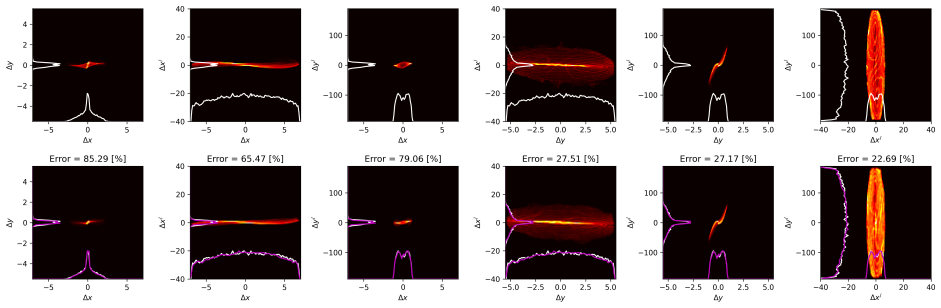
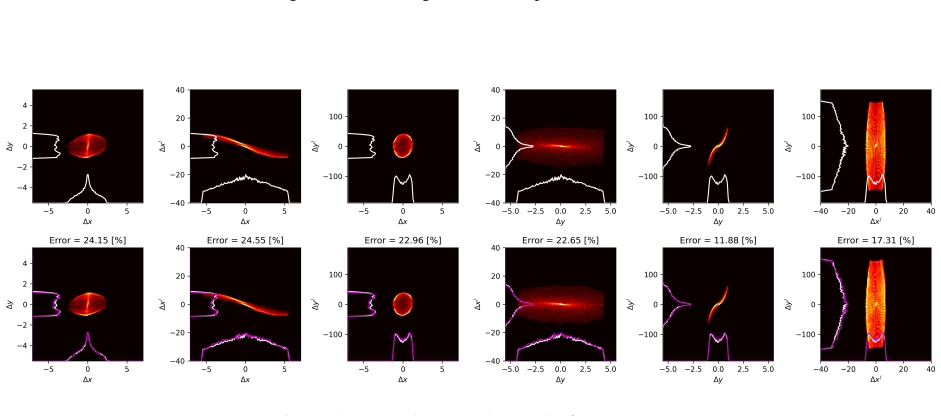
Appendix All six projections of the 4D phase space are shown for the lowest and highest level of charge neutralization at the start of the extremum seeking time-varying charge neutralization tracking problem in Figure 10. Figures 11-20 show detailed comparisons of random test data reconstructions. 10 Figure 10. True and tracked projections of the beam are...
discussion (0)
Sign in with ORCID, Apple, or X to comment. Anyone can read and Pith papers without signing in.