Recognition: no theorem link
Autoencoder-Based Parameter Estimation for Superposed Multi-Component Damped Sinusoidal Signals
Pith reviewed 2026-05-13 17:04 UTC · model grok-4.3
The pith
An autoencoder uses its latent space to estimate frequency, phase, decay time, and amplitude for each component in noisy superposed damped sinusoidal signals.
A machine-rendered reading of the paper's core claim, the machinery that carries it, and where it could break.
Core claim
The autoencoder-based method estimates the frequency, phase, decay time, and amplitude of each component in noisy multi-component damped sinusoidal signals by using its latent space, achieving high accuracy in challenging cases such as subdominant components or nearly opposite-phase signals, and showing robustness to less informative training distributions.
What carries the argument
The latent space of the autoencoder, which disentangles the parameters of each damped sinusoidal component directly from the observed superposed waveform.
If this is right
- Parameter estimates become available for short, noisy oscillatory records without requiring analytic expressions for the superposition.
- The same network can be retrained on different noise or decay regimes to match new experimental conditions.
- Accuracy persists when one component is much weaker or nearly out of phase, allowing analysis of signals that defeat conventional fitting.
- Training on Gaussian versus uniform parameter distributions shows the method tolerates mismatch between training and test statistics.
Where Pith is reading between the lines
- The same architecture could be applied to other additive oscillatory signals such as chirps or damped sinusoids with time-varying frequency.
- If the latent codes truly isolate each component, one could use them to synthesize new waveforms with controlled interference properties.
- Real-time deployment on streaming sensor data becomes feasible once the network is trained, offering a fast alternative to iterative optimization.
Load-bearing premise
The autoencoder latent space can reliably separate and encode the individual component parameters from the superposed noisy signal without any explicit model of how the components add together.
What would settle it
A set of test waveforms containing three or more components at noise levels higher than those seen in training, where the estimated parameters deviate systematically from the true values.
Figures







read the original abstract
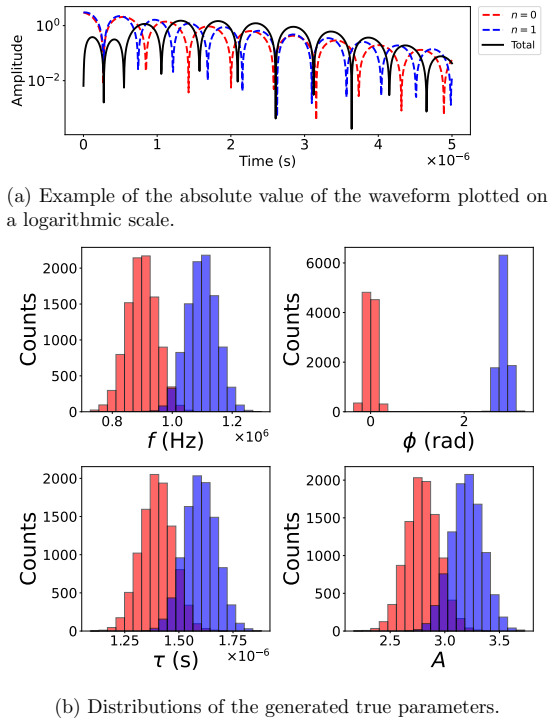
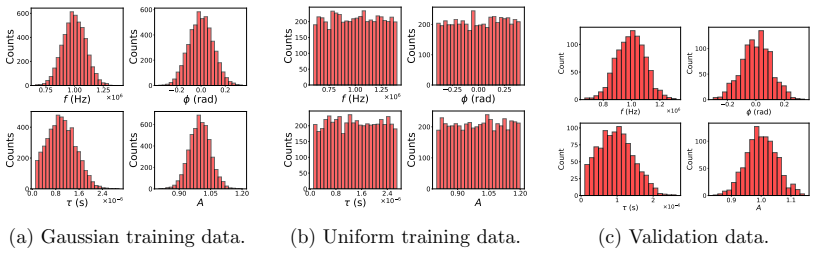
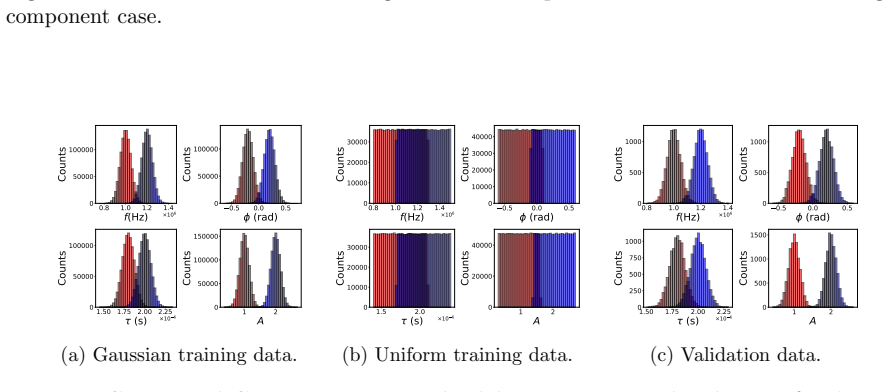
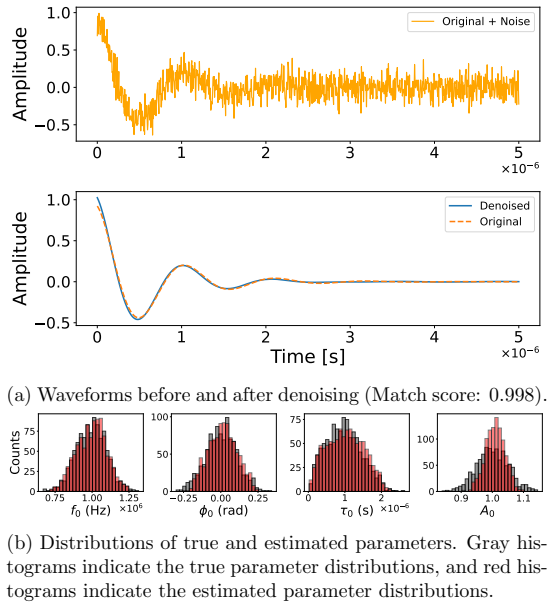
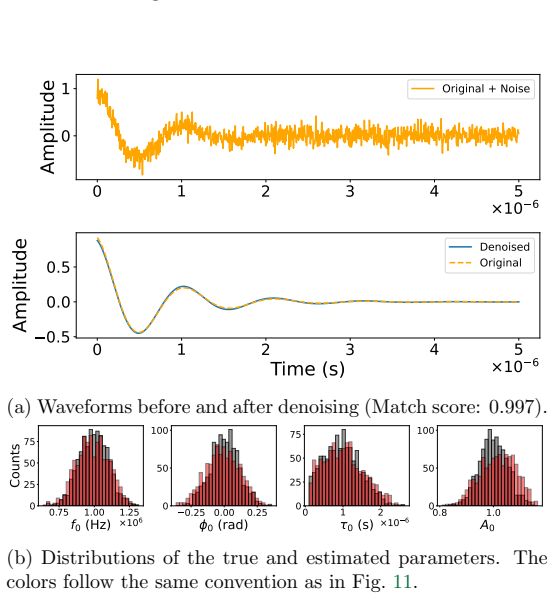
Damped sinusoidal oscillations are widely observed in many physical systems, and their analysis provides access to underlying physical properties. However, parameter estimation becomes difficult when the signal decays rapidly, multiple components are superposed, and observational noise is present. In this study, we develop an autoencoder-based method that uses the latent space to estimate the frequency, phase, decay time, and amplitude of each component in noisy multi-component damped sinusoidal signals. We investigate multi-component cases under Gaussian-distribution training and further examine the effect of the training-data distribution through comparisons between Gaussian and uniform training. The performance is evaluated through waveform reconstruction and parameter-estimation accuracy. We find that the proposed method can estimate the parameters with high accuracy even in challenging setups, such as those involving a subdominant component or nearly opposite-phase components, while remaining reasonably robust when the training distribution is less informative. This demonstrates its potential as a tool for analyzing short-duration, noisy signals.
Editorial analysis
A structured set of objections, weighed in public.
Referee Report
Summary. The manuscript proposes an autoencoder-based method to estimate the frequency, phase, decay time, and amplitude parameters of each component in noisy, superposed multi-component damped sinusoidal signals. The approach encodes the input waveform into a latent space and regresses the per-component parameters from it, with performance assessed via waveform reconstruction error and parameter estimation accuracy on synthetic data. Experiments compare Gaussian and uniform training distributions and highlight robustness in challenging regimes such as subdominant components or nearly opposite-phase signals.
Significance. If the reported accuracies hold under the quantitative tables in the full manuscript, the work supplies a practical supervised regression alternative to classical nonlinear fitting for short, noisy damped signals common in physics and engineering. The explicit comparison of training distributions and focus on difficult superposition cases add value by addressing distribution shift and identifiability issues that often limit traditional methods. The supervised nature of the latent-space regression (parameters matched to known generative values) avoids unsupervised disentanglement claims and supports reproducibility when code and data splits are released.
minor comments (3)
- Abstract: the claim of 'high accuracy' is not accompanied by any numerical thresholds or error metrics; a single sentence summarizing the key MAE or RMSE values from the results tables would make the abstract self-contained.
- Section 4 (Experimental Results): while tables report parameter errors, standard deviations or confidence intervals across repeated training runs are not shown; adding these would allow readers to judge estimate stability, especially for the subdominant-component rows.
- Figure 3 (reconstruction examples): the plots would be clearer if the residual waveform (data minus reconstruction) were included alongside the ground-truth and predicted traces for the near-opposite-phase case.
Simulated Author's Rebuttal
We thank the referee for the constructive and positive review, which accurately captures the contributions of our work on autoencoder-based parameter estimation for multi-component damped sinusoids. The recommendation for minor revision is appreciated, and we will prepare a revised manuscript accordingly. No major comments were raised that require substantive changes to the core claims or methodology.
Circularity Check
No significant circularity in empirical ML approach
full rationale
The paper presents a standard supervised autoencoder trained on simulated superposed damped sinusoid data to regress per-component parameters (frequency, phase, decay, amplitude). No mathematical derivations, first-principles claims, or load-bearing self-citations are present that reduce the reported accuracy to fitted quantities by construction. Evaluation relies on waveform reconstruction error and parameter recovery metrics on held-out test sets, which are independent of any internal redefinition or ansatz smuggling. The method is self-contained as a data-driven regression task.
Axiom & Free-Parameter Ledger
Reference graph
Works this paper leans on
-
[1]
G¨ unther.NMR Spectroscopy: Basic Principles, Concepts and Applications in Chem- istry
H. G¨ unther.NMR Spectroscopy: Basic Principles, Concepts and Applications in Chem- istry. 3rd ed. Weinheim: Wiley-VCH, 2013
work page 2013
-
[2]
NMR Detection with an Atomic Magnetometer
I. M. Savukov and M. V. Romalis. “NMR Detection with an Atomic Magnetometer”. Physical Review Letters94, 123001 (2005)
work page 2005
-
[3]
Free-Induction-Decay Magnetometer Based on a Microfabricated Cs Vapor Cell
D. Hunter et al. “Free-Induction-Decay Magnetometer Based on a Microfabricated Cs Vapor Cell”.Physical Review Applied10, 014002 (2018)
work page 2018
-
[4]
T. M¨ uller, K. B. Wiberg, and P. H. Vaccaro. “Cavity Ring-Down Polarimetry (CRDP): A New Scheme for Investigating Circular Birefringence and Circular Dichroism in the Gas Phase”.The Journal of Physical Chemistry A104, 5959–5968 (2000). Table 14: Mean values and standard deviations of the match score, the relative errors (rel.) in frequency, decay time, a...
work page 2000
-
[5]
Development of Cavity Ring-Down Ellipsometry with Spectral and Submicrosecond Time Resolution
V. Papadakis et al. “Development of Cavity Ring-Down Ellipsometry with Spectral and Submicrosecond Time Resolution”. In:Instrumentation, Metrology, and Standards for Nanomanufacturing, Optics, and Semiconductors V. Ed. by M. T. Postek. Vol. 8105. SPIE, 2011, 81050L
work page 2011
-
[6]
Comparison of techniques for modal analysis of concrete structures
J. Ndambi et al. “Comparison of techniques for modal analysis of concrete structures”. Engineering Structures22, 1159–1166 (2000)
work page 2000
-
[7]
Singular Spectrum Analysis for the Investigation of Structural Vibra- tions
I. Trendafilova. “Singular Spectrum Analysis for the Investigation of Structural Vibra- tions”.Engineering Structures242, 112531 (2021)
work page 2021
-
[8]
An Overview of Signal Processing Techniques for Joint Communication and Radar Sensing
J. A. Zhang et al. “An Overview of Signal Processing Techniques for Joint Communication and Radar Sensing”.IEEE Journal of Selected Topics in Signal Processing15, 1295–1315 (2021)
work page 2021
-
[9]
An Imaging Algorithm for High-Resolution Imaging Sonar System
P. Yang. “An Imaging Algorithm for High-Resolution Imaging Sonar System”.Multimedia Tools and Applications83, 31957–31973 (2024)
work page 2024
-
[10]
A. Chaaban, Z. Rezki, and M. Alouini. “On the Capacity of Intensity-Modulation Direct- Detection Gaussian Optical Wireless Communication Channels: A Tutorial”.IEEE Com- munications Surveys & Tutorials24, 455–491 (2022)
work page 2022
-
[11]
A. Bracco, E. G. Lanza, and A. Tamii. “Isoscalar and isovector dipole excitations: Nuclear properties from low-lying states and from the isovector giant dipole resonance”.Progress in Particle and Nuclear Physics106, 360–433 (2019)
work page 2019
-
[12]
Black hole spectroscopy: from theory to experiment
E. Berti et al.Black hole spectroscopy: from theory to experiment. [arXiv:2505.23895]
work page internal anchor Pith review Pith/arXiv arXiv
-
[13]
G. R. B. Prony. “Essai experimental et analytique sur les lois de la dilatabilite de flu- ides elastiques et sur celles da la force expansion de la vapeur de l’alcool, a differentes temperatures”.Journal de l’Ecole Polytechnique1 (1795)
-
[14]
Estimating the parameters of exponentially damped si- nusoids and pole-zero modeling in noise
R. Kumaresan and D. Tufts. “Estimating the parameters of exponentially damped si- nusoids and pole-zero modeling in noise”.IEEE Transactions on Acoustics, Speech, and Signal Processing30, 833–840 (1982)
work page 1982
-
[15]
Matrix pencil method for estimating parameters of exponentially damped/undamped sinusoids in noise
Y. Hua and T. Sarkar. “Matrix pencil method for estimating parameters of exponentially damped/undamped sinusoids in noise”.IEEE Transactions on Acoustics, Speech, and Signal Processing38, 814–824 (1990)
work page 1990
-
[16]
Multiple Emitter Location and Signal Parameter Estimation
R. O. Schmidt. “Multiple Emitter Location and Signal Parameter Estimation”.IEEE Transactions on Antennas and Propagation34, 276–280 (1986)
work page 1986
-
[17]
ESPRIT—Estimation of Signal Parameters via Rotational In- variance Techniques
R. Roy and T. Kailath. “ESPRIT—Estimation of Signal Parameters via Rotational In- variance Techniques”.IEEE Transactions on Acoustics, Speech, and Signal Processing37, 984–995 (1989)
work page 1989
-
[18]
S. M. Kay.Modern Spectral Estimation: Theory and Application. Englewood Cliffs, NJ: Prentice Hall, 1988
work page 1988
-
[19]
P. Stoica and R. L. Moses.Spectral Analysis of Signals. Upper Saddle River, NJ: Prentice Hall, 2005
work page 2005
-
[20]
Rapid parameter determination of discrete damped sinusoidal os- cillations
J. C. Visschers et al. “Rapid parameter determination of discrete damped sinusoidal os- cillations”.Opt. Express29, 6863–6878 (2021). [arXiv:2010.11690]
-
[21]
Michelucci.An Introduction to Autoencoders
U. Michelucci.An Introduction to Autoencoders. [arXiv:2201.03898]
-
[22]
Autoencoders and their applications in machine learning: a survey
K. Berahmand et al. “Autoencoders and their applications in machine learning: a survey”. Artificial Intelligence Review57, 28 (2024). 26
work page 2024
-
[23]
Rapid parameter estimation of discrete de- caying signals using autoencoder networks
J. C. Visschers, D. Budker, and L. Bougas. “Rapid parameter estimation of discrete de- caying signals using autoencoder networks”.Mach. Learn. Sci. Tech.2, 045024 (2021)
work page 2021
-
[24]
Fast exponential fitting algorithm for real-time instrumental use
D. Halmer et al. “Fast exponential fitting algorithm for real-time instrumental use”.Re- view of Scientific Instruments75, 2187–2191 (2004)
work page 2004
-
[25]
G. Bostrom, D. Atkinson, and A. Rice. “The discrete Fourier transform algorithm for determining decay constants—Implementation using a field programmable gate array”. Review of Scientific Instruments86, 043106 (2015)
work page 2015
-
[26]
Parameter Estimation of Two-Component Superposed Decaying Oscillation Signal Using Autoencoders
M. Iida, H. Motohashi, and H. Takahashi. “Parameter Estimation of Two-Component Superposed Decaying Oscillation Signal Using Autoencoders”.Journal of Japan Society for Fuzzy Theory and Intelligent Informatics38, 528–531 (2026)
work page 2026
-
[27]
Backpropagation and stochastic gradient descent method
S. Amari. “Backpropagation and stochastic gradient descent method”.Neurocomputing 5, 185–196 (1993)
work page 1993
-
[28]
D. P. Kingma and J. Ba.Adam: A Method for Stochastic Optimization. [arXiv:1412.6980]
work page internal anchor Pith review Pith/arXiv arXiv
-
[29]
Nitz et al.gwastro/pycbc: v2.2.2 release of PyCBC
A. Nitz et al.gwastro/pycbc: v2.2.2 release of PyCBC. 2023
work page 2023
-
[30]
Resonant Excitation of Quasinormal Modes of Black Holes,
H. Motohashi. “Resonant Excitation of Quasinormal Modes of Black Holes”.Phys. Rev. Lett.134, 141401 (2025). [arXiv:2407.15191]
-
[31]
Data-driven Parameter Estimation Of Contami- nated Damped Exponentials
Y. Xie, M. B. Wakin, and G. Tang. “Data-driven Parameter Estimation Of Contami- nated Damped Exponentials”. In:55th Asilomar Conference on Signals, Systems, and Computers. 2021, 800–804
work page 2021
-
[32]
M. Iida, H. Motohashi, and H. Takahashi.Parameter Estimation of Ringdown Quasinor- mal Modes with Autoencoder. in preparation. 27
discussion (0)
Sign in with ORCID, Apple, or X to comment. Anyone can read and Pith papers without signing in.