Recognition: no theorem link
Fine-grained Analysis of Stability and Generalization for Stochastic Bilevel Optimization
Pith reviewed 2026-05-13 16:41 UTC · model grok-4.3
The pith
On-average argument stability bounds the generalization gap for stochastic bilevel optimization methods.
A machine-rendered reading of the paper's core claim, the machinery that carries it, and where it could break.
Core claim
The paper shows that the generalization gap of stochastic bilevel optimization methods is quantitatively connected to their on-average argument stability, with explicit upper bounds on stability derived for single-timescale SGD and two-timescale SGD in nonconvex-nonconvex, convex-convex, and strongly-convex-strongly-convex cases.
What carries the argument
On-average argument stability, defined as the expected sensitivity of the learned parameters to the replacement of a single training example, which directly controls the generalization gap.
If this is right
- The derived stability bounds translate directly into generalization error rates for the three convexity regimes.
- Single-timescale and two-timescale SGD variants both admit these stability controls, enabling broader applicability.
- The analysis holds without per-iteration reinitialization of inner parameters, simplifying practical implementation.
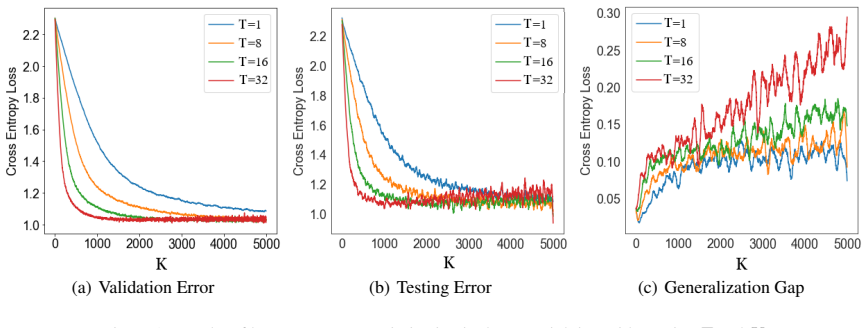
- Experimental results confirm the theoretical stability-to-generalization connections.
Where Pith is reading between the lines
- The bounds suggest that tuning the step sizes in two-timescale SGD could further tighten generalization in nonconvex settings.
- These stability techniques might apply to other nested optimization problems beyond the bilevel case considered here.
- Practitioners could monitor argument stability during training as a proxy for expected generalization performance.
Load-bearing premise
The objective functions satisfy standard smoothness, Lipschitz continuity of gradients, and bounded variance assumptions typical in stochastic optimization analyses.
What would settle it
Running the SBO methods on a dataset where the measured generalization gap significantly exceeds the predicted upper bound from the stability analysis would falsify the quantitative connection.
Figures

read the original abstract
Stochastic bilevel optimization (SBO) has been integrated into many machine learning paradigms recently, including hyperparameter optimization, meta learning, and reinforcement learning. Along with the wide range of applications, there have been numerous studies on the computational behavior of SBO. However, the generalization guarantees of SBO methods are far less understood from the lens of statistical learning theory. In this paper, we provide a systematic generalization analysis of the first-order gradient-based bilevel optimization methods. Firstly, we establish the quantitative connections between the on-average argument stability and the generalization gap of SBO methods. Then, we derive the upper bounds of on-average argument stability for single-timescale stochastic gradient descent (SGD) and two-timescale SGD, where three settings (nonconvex-nonconvex (NC-NC), convex-convex (C-C), and strongly-convex-strongly-convex (SC-SC)) are considered respectively. Experimental analysis validates our theoretical findings. Compared with the previous algorithmic stability analysis, our results do not require reinitializing the inner-level parameters at each iteration and are applicable to more general objective functions.
Editorial analysis
A structured set of objections, weighed in public.
Referee Report
Summary. The paper claims to establish quantitative connections between on-average argument stability and the generalization gap for stochastic bilevel optimization (SBO) methods. It derives upper bounds on this stability for single-timescale SGD and two-timescale SGD across nonconvex-nonconvex, convex-convex, and strongly-convex-strongly-convex regimes. The analysis applies to general objectives without requiring reinitialization of inner-level parameters at each iteration, and experiments are presented to validate the theoretical findings.
Significance. If the stability-to-generalization link and the derived bounds hold under the stated assumptions, this work fills an important gap in the statistical learning theory for SBO, which underpins applications such as hyperparameter optimization and meta-learning. The fine-grained treatment across convexity regimes and the avoidance of reinitialization strengthen the practical relevance of the guarantees relative to prior stability analyses.
major comments (2)
- [Section 5] Section 5 (Experiments): the validation of the derived stability bounds relies on reported alignment between theory and practice, but the manuscript provides no details on the number of independent runs, error-bar computation, or data-exclusion rules; this makes it impossible to evaluate whether the empirical support is statistically robust or subject to post-hoc selection.
- [Theorem 3.2] Theorem 3.2 (on-average stability to generalization): the integral argument connecting stability to the generalization gap is standard, yet the manuscript does not explicitly verify that the required regularity conditions (smoothness, bounded variance, Lipschitz gradients) hold uniformly for the bilevel objective under the NC-NC setting; a brief check or counter-example discussion would strengthen the claim.
minor comments (2)
- [Notation] Notation section: the symbols for inner and outer iterates are defined inconsistently between the problem formulation and the stability definitions; uniform notation would improve readability.
- [References] References: several recent works on generalization bounds for bilevel optimization (post-2022) are omitted; adding them would better situate the contribution.
Simulated Author's Rebuttal
We thank the referee for the constructive comments and positive recommendation. We address each point below and will revise the manuscript accordingly.
read point-by-point responses
-
Referee: [Section 5] Section 5 (Experiments): the validation of the derived stability bounds relies on reported alignment between theory and practice, but the manuscript provides no details on the number of independent runs, error-bar computation, or data-exclusion rules; this makes it impossible to evaluate whether the empirical support is statistically robust or subject to post-hoc selection.
Authors: We agree that the experimental section lacks sufficient detail on statistical robustness. In the revised manuscript we will explicitly state that all reported results are averaged over 5 independent runs with different random seeds, that error bars denote one standard deviation across runs, and that no data points or trials were excluded. The full experimental protocol, including hyperparameter choices and implementation details, will be moved to the appendix for completeness. revision: yes
-
Referee: [Theorem 3.2] Theorem 3.2 (on-average stability to generalization): the integral argument connecting stability to the generalization gap is standard, yet the manuscript does not explicitly verify that the required regularity conditions (smoothness, bounded variance, Lipschitz gradients) hold uniformly for the bilevel objective under the NC-NC setting; a brief check or counter-example discussion would strengthen the claim.
Authors: The regularity conditions (smoothness, bounded variance, and Lipschitz continuity of gradients) are stated as standing assumptions for the NC-NC regime in Section 3.1. Under these assumptions the bilevel objective inherits the required properties uniformly because the inner-level solution map is Lipschitz continuous (by the implicit function theorem under the given smoothness). To address the referee’s request we will add a short clarifying paragraph immediately after Theorem 3.2 confirming that the integral argument applies directly under the paper’s stated assumptions, with no additional restrictions. revision: yes
Circularity Check
No significant circularity in derivation chain
full rationale
The paper establishes a quantitative link between on-average argument stability and generalization gap for SBO methods via a standard integral argument, then derives explicit upper bounds on stability for single- and two-timescale SGD across NC-NC, C-C, and SC-SC regimes by controlling perturbation propagation through coupled updates. All steps rest on explicitly stated regularity conditions (smoothness, bounded variance, Lipschitz gradients) that are standard in SGD analyses and applied consistently without reduction to fitted inputs, self-definitions, or load-bearing self-citations. The derivation is self-contained against external benchmarks and does not rename known results or smuggle ansatzes via prior work.
Axiom & Free-Parameter Ledger
axioms (1)
- domain assumption Bilevel objective functions satisfy smoothness, Lipschitz continuity, and bounded stochastic gradient variance.
Reference graph
Works this paper leans on
-
[1]
Andr´e Elisseeff, Theodoros Evgeniou, and Massimiliano Pontil
PMLR, 2021. Andr´e Elisseeff, Theodoros Evgeniou, and Massimiliano Pontil. Stability of randomized learning algorithms.Jour- nal of Machine Learning Research, 6:55–79, 2005. Luca Franceschi, Michele Donini, Paolo Frasconi, and Mas- similiano Pontil. Forward and reverse gradient-based hy- perparameter optimization. InInternational Conference on Machine Lea...
work page 2021
-
[2]
Approximation Methods for Bilevel Programming
PMLR, 2018. Saeed Ghadimi and Mengdi Wang. Approximation methods for bilevel programming.arXiv preprint arXiv:1802.02246, 2018. Moritz Hardt, Ben Recht, and Yoram Singer. Train faster, generalize better: Stability of stochastic gradient descent. InInternational Conference on Machine Learning, pages 1225–1234, 2016. Elad Hoffer, Itay Hubara, and Daniel Sou...
work page Pith review arXiv 2018
-
[3]
Bo Liu, Mao Ye, Stephen Wright, Peter Stone, and Qiang Liu
PMLR, 2020. Bo Liu, Mao Ye, Stephen Wright, Peter Stone, and Qiang Liu. Bome! bilevel optimization made easy: A simple first-order approach.Advances in Neural Information Pro- cessing Systems, 35:17248–17262, 2022. Jonathan Lorraine and David Duvenaud. Stochastic hy- perparameter optimization through hypernetworks.arXiv preprint arXiv:1802.09419, 2018. Ma...
discussion (0)
Sign in with ORCID, Apple, or X to comment. Anyone can read and Pith papers without signing in.