Recognition: 1 theorem link
· Lean TheoremA Multi-Scale ResNet-augmented Fourier Neural Operator Framework for High-Frequency Sequence-to-Sequence Prediction of Magnetic Hysteresis
Pith reviewed 2026-05-13 16:46 UTC · model grok-4.3
The pith
The Res-FNO hybrid model predicts high-frequency magnetic hysteresis loops with ringing and minor loops across materials.
A machine-rendered reading of the paper's core claim, the machinery that carries it, and where it could break.
Core claim
The Res-FNO framework, using a hybrid input of sequential time-series data plus material labels and the dB/dt feature together with parallel FNO blocks and multi-scale ResNet refinement, accurately models both macro hysteresis structures and micro transient details such as ringing and minor loops, with demonstrated generalization across diverse magnetic materials from 79 to 3C90.
What carries the argument
The parallel multi-scale ResNet path integrated with FNO blocks, driven by a hybrid input that adds the time derivative of magnetic flux density to sequential data and material labels to increase sensitivity to high-frequency oscillations.
If this is right
- Core losses can be estimated directly from the predicted sequences in high-frequency power electronics simulations.
- The model produces usable hysteresis predictions for a range of materials without post-training adjustments.
- Transient effects that dominate losses in real converters are reproduced as part of the sequence output.
- Sequence-to-sequence operation preserves both large-scale loop geometry and fine temporal structure in one forward pass.
Where Pith is reading between the lines
- The same hybrid spectral-plus-local design could be tested on other nonlinear operators where spectral bias appears, such as circuit dynamics or wave equations.
- Adding explicit physical loss terms during training might further reduce errors on frequencies or amplitudes not seen in the current data.
- Real-time deployment in control loops would require checking inference speed on embedded hardware while retaining the reported accuracy.
Load-bearing premise
That the hybrid input of time-series with material labels and dB/dt plus the parallel multi-scale ResNet path is sufficient to overcome spectral bias and capture transients without extra physical constraints or per-material tuning.
What would settle it
Large prediction errors on minor loops or ringing for a magnetic material outside the tested set or at frequencies well beyond the training range would show the generalization claim does not hold.
Figures



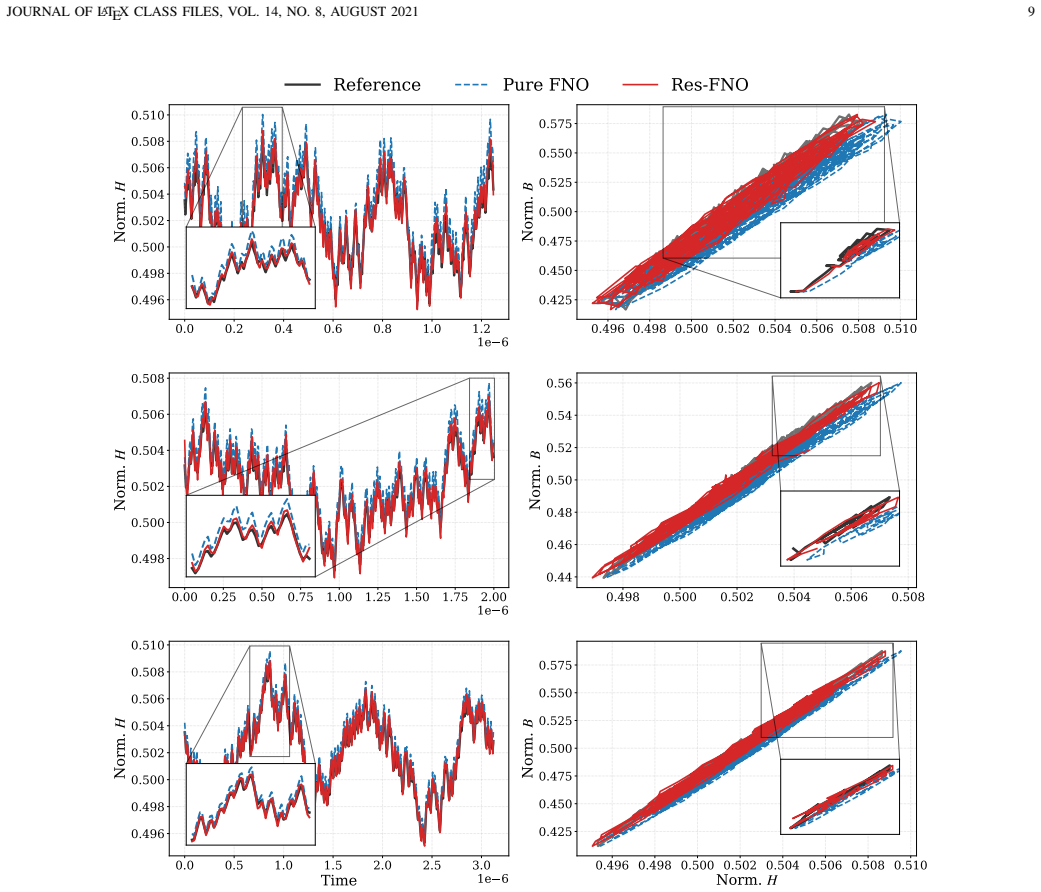
read the original abstract
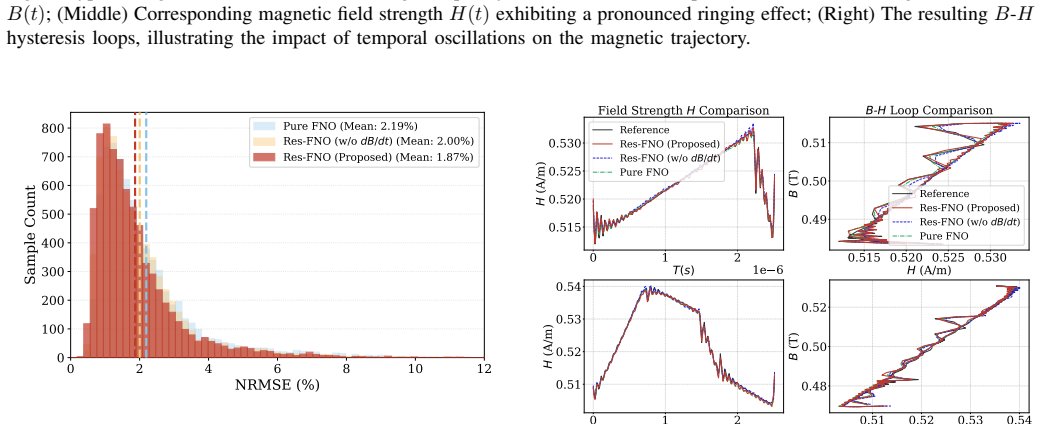
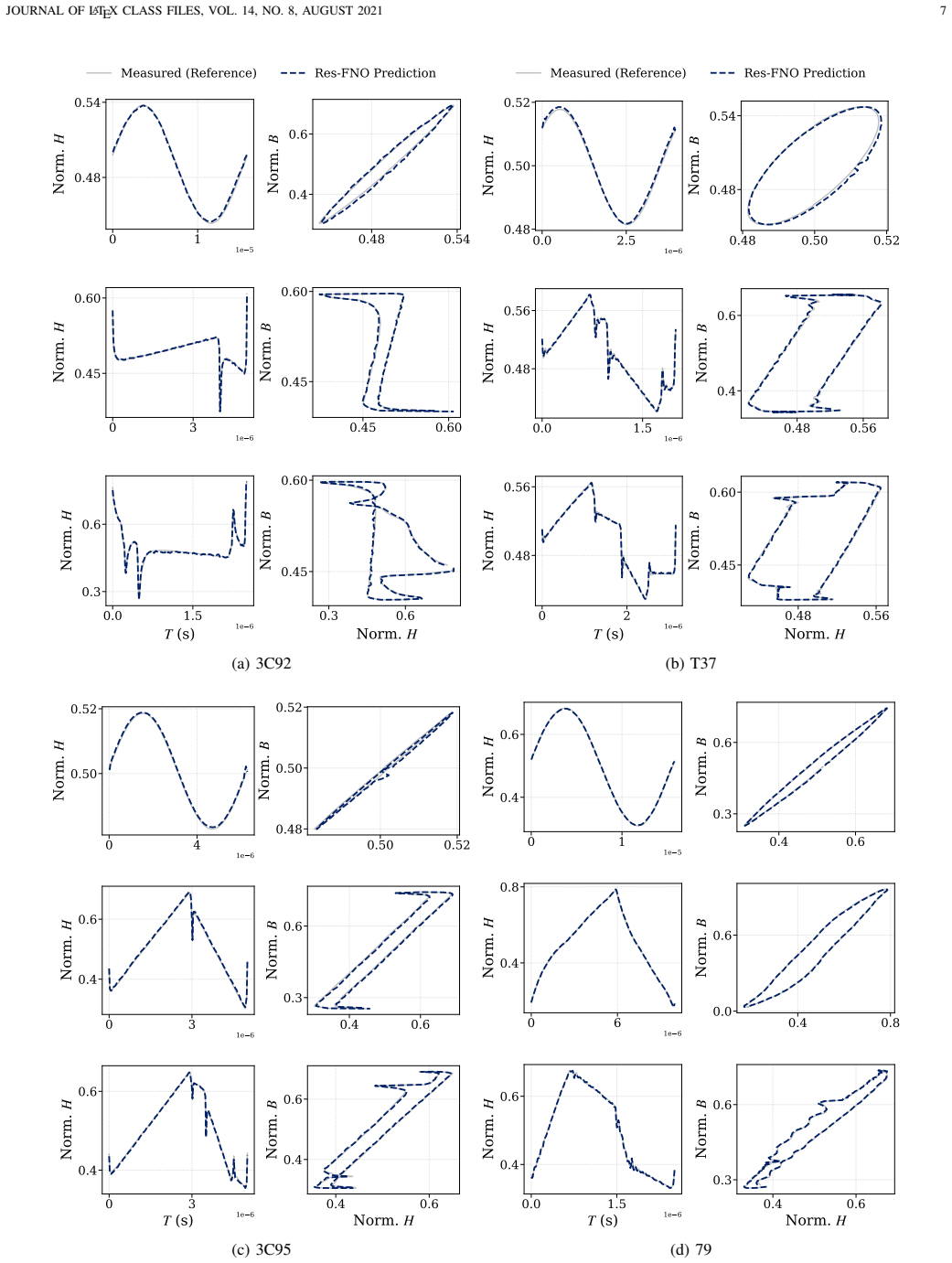
Accurate modeling of magnetic hysteresis is essential for high-fidelity power electronics device simulations. The transient hysteresis phenomena such as the ringing effect and the minor loops are the bottleneck for the accurate hysteresis modeling and the core losses estimation. To capture the hysteresis loops with both the macro structure and the micro transient details, in this paper, we propose the multi-scale ResNet augmented Fourier Neural Operator (Res-FNO). The framework employs a hybrid input structure that combines sequential time-series data with scalar material labels through specialized feature engineering. Specifically, the time derivative of magnetic flux density ($\frac{dB}{dt}$) is incorporated as a critical physical feature to enhance the model sensitivity to high-frequency oscillations and minor loop triggers. The proposed architecture synergizes global spectral modeling with localized refinement by integrating a multi-scale ResNet path in parallel with the FNO blocks. This design allows the global operator path to capture the underlying physical evolution while the local refinement path, compensates for spectral bias and reconstructs fine-grained temporal details. Extensive experimental validation across diverse magnetic materials from 79 to Material 3C90 demonstrates the strong generalization capability of the proposed Res-FNO, proving its robust ability to model complex ringing effects and minor loops in realistic power electronic applications.
Editorial analysis
A structured set of objections, weighed in public.
Referee Report
Summary. The manuscript proposes a multi-scale ResNet-augmented Fourier Neural Operator (Res-FNO) for high-frequency sequence-to-sequence prediction of magnetic hysteresis. The framework combines a hybrid input (time-series data, scalar material labels, and dB/dt) with parallel FNO blocks for global spectral modeling and a multi-scale ResNet path for local refinement, aiming to capture both macro hysteresis structure and micro-scale transient effects such as ringing and minor loops across diverse materials.
Significance. If the generalization claims hold with rigorous validation, the work could meaningfully advance data-driven operator learning for nonlinear magnetic phenomena in power electronics, offering a practical alternative to physics-based models for core-loss estimation under high-frequency excitations.
major comments (2)
- [Section 3] Section 3 (Architecture description): The assertion that the parallel multi-scale ResNet path compensates for FNO spectral bias and reconstructs high-frequency ringing lacks any explicit mechanism (e.g., frequency-weighted loss, energy-dissipation term, or loop-closure constraint) or supporting ablation; without this, the central claim that the hybrid input suffices for out-of-distribution transients remains unproven.
- [Section 4] Section 4 (Experimental validation): No quantitative metrics, error bars, baseline comparisons (e.g., against standard FNO, LSTM, or Preisach models), or dataset details (train/test splits, frequency ranges, material parameter coverage) are supplied to substantiate the reported generalization across materials 79 to 3C90; this directly undermines evaluation of the ringing and minor-loop modeling claims.
minor comments (2)
- [Abstract] Abstract: the phrasing 'from 79 to Material 3C90' is ambiguous; list the specific material identifiers used in the experiments.
- [Section 3.1] Notation: the hybrid input construction (time-series + scalar labels + dB/dt) should be formalized with an explicit equation showing feature concatenation or embedding.
Simulated Author's Rebuttal
We thank the referee for the constructive comments. We address each major point below and will revise the manuscript accordingly to improve clarity and provide the requested substantiation.
read point-by-point responses
-
Referee: [Section 3] Section 3 (Architecture description): The assertion that the parallel multi-scale ResNet path compensates for FNO spectral bias and reconstructs high-frequency ringing lacks any explicit mechanism (e.g., frequency-weighted loss, energy-dissipation term, or loop-closure constraint) or supporting ablation; without this, the central claim that the hybrid input suffices for out-of-distribution transients remains unproven.
Authors: We agree that the original Section 3 does not provide an ablation study or additional loss terms to explicitly demonstrate the compensation mechanism. The intended design is that the parallel multi-scale ResNet path supplies localized convolutional refinement to recover high-frequency components that global FNO layers tend to attenuate due to spectral bias, while the hybrid input (time series + material scalars + dB/dt) supplies the physical trigger for transients. However, without an ablation this remains an assertion. In revision we will expand Section 3 with a detailed description of the interaction between the two paths and add an ablation study (Res-FNO vs. FNO-only) reporting quantitative impact on ringing amplitude and minor-loop fidelity. revision: yes
-
Referee: [Section 4] Section 4 (Experimental validation): No quantitative metrics, error bars, baseline comparisons (e.g., against standard FNO, LSTM, or Preisach models), or dataset details (train/test splits, frequency ranges, material parameter coverage) are supplied to substantiate the reported generalization across materials 79 to 3C90; this directly undermines evaluation of the ringing and minor-loop modeling claims.
Authors: We acknowledge that the current presentation of Section 4 does not include the requested quantitative details with sufficient visibility. The full manuscript contains experimental results, but they were not presented with explicit tables, error bars, or direct baseline comparisons. In the revised version we will restructure Section 4 to include: (i) MSE/MAE and peak-error metrics with standard-deviation error bars across repeated runs, (ii) side-by-side comparisons against standard FNO, LSTM, and Preisach models, and (iii) explicit dataset specifications (train/test splits, frequency range coverage, and material parameter ranges from 79 to 3C90). This will allow direct evaluation of the ringing and minor-loop claims. revision: yes
Circularity Check
No circularity: data-driven neural operator trained on external measurements
full rationale
The paper defines a hybrid Res-FNO architecture that ingests time-series B(t), dB/dt, and scalar material labels, then produces predicted H(t) sequences via learned weights. No equation or training step reduces the output to an algebraic identity of the inputs; the forward pass depends on parameters fitted to held-out experimental data from multiple materials. Generalization claims rest on empirical validation rather than self-definition, self-citation chains, or renaming of known results. The derivation is therefore self-contained against external benchmarks.
Axiom & Free-Parameter Ledger
Lean theorems connected to this paper
-
IndisputableMonolith/Cost/FunctionalEquation.leanwashburn_uniqueness_aczel unclear?
unclearRelation between the paper passage and the cited Recognition theorem.
The proposed architecture synergizes global spectral modeling with localized refinement by integrating a multi-scale ResNet path in parallel with the FNO blocks... loss function is defined as... mean square error (MSE)
What do these tags mean?
- matches
- The paper's claim is directly supported by a theorem in the formal canon.
- supports
- The theorem supports part of the paper's argument, but the paper may add assumptions or extra steps.
- extends
- The paper goes beyond the formal theorem; the theorem is a base layer rather than the whole result.
- uses
- The paper appears to rely on the theorem as machinery.
- contradicts
- The paper's claim conflicts with a theorem or certificate in the canon.
- unclear
- Pith found a possible connection, but the passage is too broad, indirect, or ambiguous to say the theorem truly supports the claim.
Reference graph
Works this paper leans on
-
[1]
On size and magnetics: Why small efficient power inductors are rare,
C. R. Sullivan, B. A. Reese, A. L. F. Stein, and P. A. Kyaw, “On size and magnetics: Why small efficient power inductors are rare,” in 2016 International Symposium on 3D Power Electronics Integration and Manufacturing (3D-PEIM), 2016, pp. 1–23
work page 2016
-
[2]
How magnet: Machine learning framework for modeling power magnetic material characteristics,
H. Li, D. Serrano, T. Guillod, S. Wang, E. Dogariu, A. Nadler, M. Luo, V . Bansal, N. K. Jha, Y . Chenet al., “How magnet: Machine learning framework for modeling power magnetic material characteristics,”IEEE Transactions on Power Electronics, vol. 38, no. 12, pp. 15 829–15 853, 2023
work page 2023
-
[3]
Why magnet: Quantifying the complexity of modeling power magnetic material characteristics,
D. Serrano, H. Li, S. Wang, T. Guillod, M. Luo, V . Bansal, N. K. Jha, Y . Chen, C. R. Sullivan, and M. Chen, “Why magnet: Quantifying the complexity of modeling power magnetic material characteristics,”IEEE Transactions on Power Electronics, vol. 38, no. 11, pp. 14 292–14 316, 2023
work page 2023
-
[4]
Y . Dang, L. Zhu, Z. Liu, and S. Ji, “Multi-stage multi-fidelity optimal design method based on evolutionary computation with dynamic popula- tion for high-power high-voltage high-frequency transformers (H3FTs),” IEEE Transactions on Power Electronics, 2026
work page 2026
-
[5]
Loss modeling of inductive components employed in power electronic systems,
J. M ¨uhlethaler, J. Kolar, and A. Ecklebe, “Loss modeling of inductive components employed in power electronic systems,”8th International Conference on Power Electronics ECCE Asia, pp. 945–952, 2011
work page 2011
-
[6]
A study of flux distribution and impedance in solid and laminar ferrite cores,
M. Kackiet al., “A study of flux distribution and impedance in solid and laminar ferrite cores,” in2019 IEEE Applied Power Electronics Conference and Exposition (APEC). IEEE, 2019, pp. 2500–2506
work page 2019
-
[7]
C. P. Steinmetz, “On the law of hysteresis,”Proceedings of the IEEE, vol. 72, no. 2, pp. 197–221, 1984
work page 1984
-
[8]
K. Venkatachalam, C. Sullivan, T. Abdallah, and H. Tacca, “Accurate prediction of ferrite core loss with nonsinusoidal waveforms using only Steinmetz parameters,” inProc. IEEE Workshop on Computers in Power Electronics, 2002, pp. 36–41
work page 2002
-
[9]
Improved core- loss calculation for magnetic components employed in power electronic systems,
J. Muhlethaler, J. Biela, J. W. Kolar, and A. Ecklebe, “Improved core- loss calculation for magnetic components employed in power electronic systems,”IEEE Transactions on Power electronics, vol. 27, no. 2, pp. 964–973, 2011
work page 2011
-
[10]
Theory of ferromagnetic hysteresis,
D. Jiles and D. Atherton, “Theory of ferromagnetic hysteresis,”Journal of Magnetism and Magnetic Materials, vol. 61, no. 1-2, pp. 48–60, 1986
work page 1986
-
[11]
Generalized preisach model of hys- teresis,
I. Mayergoyz and G. Friedman, “Generalized preisach model of hys- teresis,”IEEE Transactions on Magnetics, vol. 24, no. 1, pp. 212–217, 1988
work page 1988
-
[12]
Energy-based hysteresis model for magnetostrictive transducers,
F. T. Calkins, R. C. Smith, and A. B. Flatau, “Energy-based hysteresis model for magnetostrictive transducers,”IEEE Transactions on Magnet- ics, vol. 36, no. 2, pp. 429–439, 2002
work page 2002
-
[13]
Machine learning framework for modeling power magnetic material characteristics,
H. Li, D. Serrano, T. Guillodet al., “Machine learning framework for modeling power magnetic material characteristics,”TechRxiv. Preprint, 2022
work page 2022
-
[14]
X. Shen, Y . Zuo, D. B. Cobaleda, and W. Martinez, “Iron loss ex- trapolation predictions for high-frequency magnetic components using denoising diffusion models,”IEEE Transactions on Power Electronics, vol. 40, no. 10, pp. 15 254–15 264, 2025
work page 2025
-
[15]
A magnetic core loss model based on physics-informed neural network with cross-attention,
Y . Xiao, C. Li, and Z. Zheng, “A magnetic core loss model based on physics-informed neural network with cross-attention,”IEEE Transac- tions on Power Electronics, vol. 41, no. 1, pp. 92–96, 2026
work page 2026
-
[16]
W. Kirchg ¨assner, N. F ¨orster, T. Piepenbrock, O. Schweins, and O. Wallscheid, “HARDCORE: H-Field and power loss estimation for arbitrary waveforms with residual, dilated convolutional neural networks in ferrite cores,”IEEE Transactions on Power Electronics, vol. 40, no. 2, pp. 3326–3335, 2025
work page 2025
-
[17]
Sequence to sequence learning with neural networks,
I. Sutskever, O. Vinyals, and Q. V . Le, “Sequence to sequence learning with neural networks,” inAdvances in Neural Information Processing Systems (NIPS), 2014
work page 2014
-
[18]
D. Serrano, H. Li, T. Guillodet al., “Neural network as datasheet: Modeling B-H loops of power magnetics with Sequence-to-Sequence LSTM Encoder-Decoder architecture,” inIEEE Workshop on Control and Modeling for Power Electronics (COMPEL), 2022, pp. 1–8
work page 2022
-
[19]
Dynamic ferro- magnetic hysteresis modelling using a preisach-recurrent neural network model,
C. Grech, M. Buzio, M. Pentella, and N. Sammut, “Dynamic ferro- magnetic hysteresis modelling using a preisach-recurrent neural network model,”Materials, vol. 13, no. 11, p. 2561, 2020
work page 2020
-
[20]
Neural network modeling of arbitrary hysteresis processes: Application to go ferromagnetic steel,
S. Quondam Antonio, V . Bonaiuto, F. Sargeni, and A. Salvini, “Neural network modeling of arbitrary hysteresis processes: Application to go ferromagnetic steel,”Magnetochemistry, vol. 8, no. 2, p. 18, 2022
work page 2022
-
[21]
Generalizable models of magnetic hys- teresis via physics-aware recurrent neural networks,
A. Chandra, T. Kapoor, B. Daniels, M. Curti, K. Tiels, D. M. Tar- takovsky, and E. A. Lomonova, “Generalizable models of magnetic hys- teresis via physics-aware recurrent neural networks,”Computer Physics Communications, vol. 314, p. 109650, 2025
work page 2025
-
[22]
Dynamic hysteresis model of Grain-Oriented ferromagnetic material using neural operators,
Z. Guo, B. H. Nguyen, H. Hamzehbahmani, and R. V . Sabariego, “Dynamic hysteresis model of Grain-Oriented ferromagnetic material using neural operators,”IEEE Transactions on Magnetics, vol. 61, no. 10, pp. 1–7, 2025
work page 2025
-
[23]
Mag- netic hysteresis modeling with neural operators,
A. Chandra, B. Daniels, M. Curti, K. Tiels, and E. A. Lomonova, “Mag- netic hysteresis modeling with neural operators,”IEEE Transactions on Magnetics, vol. 61, no. 1, pp. 1–11, 2024
work page 2024
-
[24]
Magnet challenge for data-driven power magnetics modeling,
M. Chen, H. Li, S. Wang, T. Guillod, D. Serrano, N. F ¨orster, W. Kirchg ¨assner, T. Piepenbrock, O. Schweins, O. Wallscheidet al., “Magnet challenge for data-driven power magnetics modeling,”IEEE Open Journal of Power Electronics, vol. 6, pp. 883–898, 2024
work page 2024
-
[25]
Magnet-ai: Neural network as datasheet for magnetics modeling and material recommendation,
H. Li, D. Serrano, S. Wang, and M. Chen, “Magnet-ai: Neural network as datasheet for magnetics modeling and material recommendation,”IEEE Transactions on Power Electronics, vol. 38, no. 12, pp. 15 854–15 869, 2023
work page 2023
-
[26]
H. Li, D. Serrano, S. Wang, T. Guillod, M. Luo, and M. Chen, “Predicting the bh loops of power magnetics with transformer-based encoder-projector-decoder neural network architecture,” in2023 IEEE Applied Power Electronics Conference and Exposition (APEC). IEEE, 2023, pp. 1543–1550
work page 2023
-
[27]
A. Vaswani, N. Shazeer, N. Parmaret al., “Attention is all you need,” inAdvances in Neural Information Processing Systems (NIPS), 2017
work page 2017
-
[28]
Q. Huang, Y . Li, Y . Dou, Y . Li, J. Zhu, and S. Li, “History-dependent prandtl–ishlinskii neural network for quasi-static core loss prediction under arbitrary excitation waveforms,”IEEE Transactions on Power Electronics, vol. 40, no. 7, pp. 9625–9637, 2025
work page 2025
-
[29]
Fourier neural operator with learned deformations for pdes on general geometries,
Z. Li, D. Z. Huang, B. Liu, and A. Anandkumar, “Fourier neural operator with learned deformations for pdes on general geometries,”Journal of Machine Learning Research, vol. 24, no. 388, pp. 1–26, 2023
work page 2023
-
[30]
Deep residual learning for image recognition,
K. He, X. Zhang, S. Ren, and J. Sun, “Deep residual learning for image recognition,” inProceedings of the IEEE conference on computer vision and pattern recognition, 2016, pp. 770–778
work page 2016
-
[31]
Batch normalization: Accelerating deep network training by reducing internal covariate shift,
S. Ioffe and C. Szegedy, “Batch normalization: Accelerating deep network training by reducing internal covariate shift,” inInternational conference on machine learning. PMLR, 2015, pp. 448–456
work page 2015
-
[32]
Delving deep into rectifiers: Surpassing human-level performance on imagenet classification,
K. He, X. Zhang, S. Ren, and J. Sun, “Delving deep into rectifiers: Surpassing human-level performance on imagenet classification,” in Proceedings of the IEEE international conference on computer vision, 2015, pp. 1026–1034
work page 2015
-
[33]
Fourier Neural Operator for Parametric Partial Differential Equations
Z. Li, N. Kovachki, K. Azizzadenesheliet al., “Fourier neural op- erator for parametric partial differential equations,”arXiv preprint arXiv:2010.08895, 2020
work page internal anchor Pith review Pith/arXiv arXiv 2010
-
[34]
Z. You, Z. Xu, and W. Cai, “Mscalefno: Multi-scale fourier neural op- erator learning for oscillatory functions and wave scattering problems,” Journal of Computational Physics, p. 114530, 2025
work page 2025
-
[35]
I. Goodfellow, Y . Bengio, and A. Courville,Deep Learning. MIT Press, 2016
work page 2016
discussion (0)
Sign in with ORCID, Apple, or X to comment. Anyone can read and Pith papers without signing in.