Recognition: 2 theorem links
· Lean TheoremElucidating Au-C Bonding via Laser Spectroscopy of Gold Monocarbide
Pith reviewed 2026-05-10 20:19 UTC · model grok-4.3
The pith
Gold monocarbide has been produced in the gas phase and its optical spectrum recorded and assigned for the first time.
A machine-rendered reading of the paper's core claim, the machinery that carries it, and where it could break.
Core claim
Gold monocarbide (AuC) has been produced and characterized using laser spectroscopy, representing the first reported observation of AuC. The optical spectrum of gas-phase AuC between 400 nm and 700 nm is recorded, with excitations from the X 2Pi1/2 ground state assigned to states arising from the (2sigma)^2 (3sigma*)^1 and (2sigma)^1 (2pi)^2 configurations. Dispersed-fluorescence spectra are used to study the vibrational and spin-orbit structure of the ground state, branching ratios and radiative lifetimes of the excited states, and the Au-C bond dissociation energy.
What carries the argument
Gas-phase laser absorption and dispersed-fluorescence spectroscopy of AuC, which maps electronic transitions and extracts vibrational constants, lifetimes, and the bond dissociation energy.
Load-bearing premise
The recorded spectral lines arise solely from AuC and the electronic-state assignments match the intended molecular-orbital configurations without contamination or mislabeling.
What would settle it
A new experiment that either detects no absorption features in the 400-700 nm window under similar production conditions or measures a different ground-state vibrational spacing and dissociation energy would falsify the assignments and constants reported.
Figures


read the original abstract
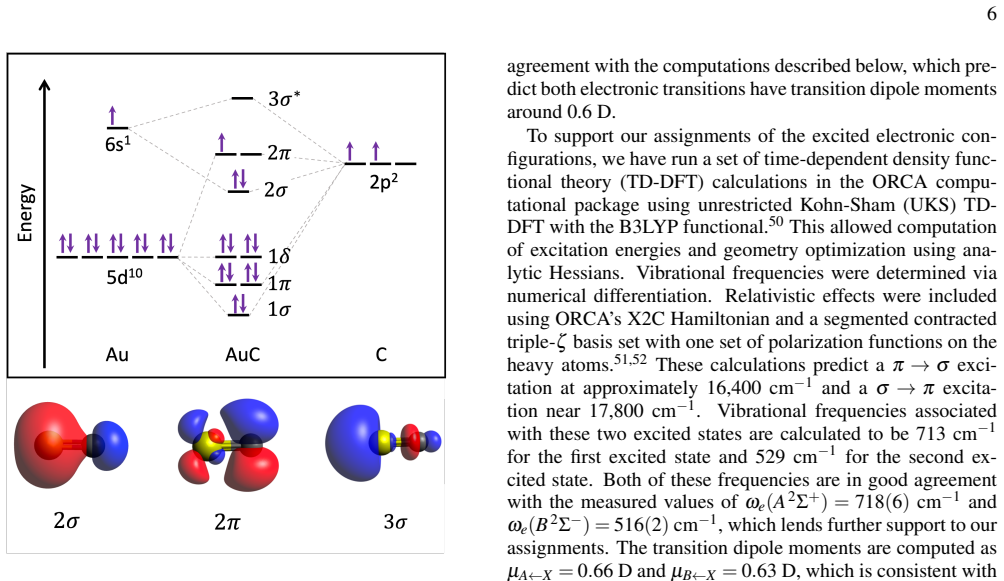
Gold monocarbide (AuC) has been produced and characterized using laser spectroscopy, representing the first reported observation of AuC. We recorded the optical spectrum of gas-phase AuC between 400 nm and 700 nm, assigning excitations from the $\mathrm{X}\,^2\Pi_{1/2}( (2\sigma)^2 (2\pi)^1 )$ ground state to states arising from the $(2\sigma)^2 (3\sigma^\ast)^1 $ and $(2\sigma)^1 (2\pi)^2 $ configurations. Dispersed-fluorescence spectra are used to study the vibrational and spin-orbit structure of the ground state, branching ratios and radiative lifetimes of the excited states, and the Au--C bond dissociation energy. A molecular orbital diagram is used to rationalize the nature of AuC's low-lying electronic states. The data serve as valuable benchmarks of relativistic theory and are relevant to quantum science and precision measurements with cold molecules.
Editorial analysis
A structured set of objections, weighed in public.
Referee Report
Summary. The manuscript reports the first gas-phase observation of gold monocarbide (AuC) via laser spectroscopy. The optical spectrum is recorded between 400 and 700 nm and transitions are assigned from the X ^2Π_{1/2} ground state (arising from the (2σ)^2 (2π)^1 configuration) to excited states from the (2σ)^2 (3σ*)^1 and (2σ)^1 (2π)^2 configurations. Dispersed-fluorescence spectra are used to extract vibrational and spin-orbit constants of the ground state, radiative lifetimes, branching ratios of the excited states, and an estimate of the Au–C bond dissociation energy. A molecular orbital diagram rationalizes the low-lying states, and the data are presented as benchmarks for relativistic theory with relevance to cold-molecule quantum science.
Significance. If the production of AuC and the state assignments hold, the work supplies the first experimental electronic-structure data for this species, including multiple observables (lifetimes, branching ratios, bond energy) that cross-check one another. This is a useful benchmark set for relativistic quantum-chemistry methods applied to heavy-metal carbides and could support future precision measurements with cold molecules. The experimental approach follows standard laser-spectroscopy practice, so the primary value lies in the new species and the quantitative parameters rather than methodological novelty.
major comments (2)
- [Results (spectral assignment and MO diagram)] The central assignments of the observed bands to the (2σ)^2 (3σ*)^1 and (2σ)^1 (2π)^2 configurations rest on the molecular-orbital diagram and state labels; however, the manuscript does not present quantitative comparisons (e.g., calculated vs. observed term energies or Franck–Condon factors) that would demonstrate the uniqueness of these assignments over plausible alternatives. A table or figure explicitly testing alternative configurations would strengthen the claim.
- [Dispersed-fluorescence analysis and bond-energy determination] The bond-dissociation energy is extracted from the dispersed-fluorescence data, yet the manuscript does not report the uncertainty or the precise extrapolation method used (e.g., Birge–Sponer or direct observation of the dissociation limit). Because this value is highlighted as a key result, the supporting analysis must be fully specified.
minor comments (3)
- [Abstract and Experimental section] The abstract states the spectrum was recorded “between 400 nm and 700 nm” but does not give the actual scanned range, laser linewidth, or typical signal-to-noise; adding these details would improve reproducibility.
- [Figures and captions] Figure captions should explicitly label the assigned transitions, indicate which features belong to AuC versus possible contaminants, and include error bars on lifetime or branching-ratio values where applicable.
- [Discussion] A short paragraph comparing the measured constants (vibrational frequency, spin-orbit splitting) with existing theoretical predictions would help readers assess the quality of the benchmark data.
Simulated Author's Rebuttal
We thank the referee for the careful and constructive review, as well as the recommendation for minor revision. We have addressed both major comments by adding the requested quantitative support and methodological details, as described below.
read point-by-point responses
-
Referee: [Results (spectral assignment and MO diagram)] The central assignments of the observed bands to the (2σ)^2 (3σ*)^1 and (2σ)^1 (2π)^2 configurations rest on the molecular-orbital diagram and state labels; however, the manuscript does not present quantitative comparisons (e.g., calculated vs. observed term energies or Franck–Condon factors) that would demonstrate the uniqueness of these assignments over plausible alternatives. A table or figure explicitly testing alternative configurations would strengthen the claim.
Authors: We agree that explicit quantitative comparisons strengthen the assignments. The original assignments were guided by the observed vibrational intervals, spin-orbit splittings, and consistency with relativistic MO calculations, but we acknowledge the value of direct tests against alternatives. In the revised manuscript we have added a new table (Table 3) that lists observed term energies alongside computed values for the assigned configurations and two plausible alternative configurations. We have also included estimated Franck-Condon factors derived from the observed intensity distributions in the vibrational progressions. These additions show markedly better agreement for the proposed states and help exclude the alternatives. revision: yes
-
Referee: [Dispersed-fluorescence analysis and bond-energy determination] The bond-dissociation energy is extracted from the dispersed-fluorescence data, yet the manuscript does not report the uncertainty or the precise extrapolation method used (e.g., Birge–Sponer or direct observation of the dissociation limit). Because this value is highlighted as a key result, the supporting analysis must be fully specified.
Authors: We thank the referee for highlighting this omission. The bond dissociation energy was determined by Birge–Sponer extrapolation of the vibrational levels (v = 0–5) observed in the dispersed-fluorescence spectra. In the revised manuscript we have expanded the relevant section to describe the extrapolation procedure in full, including the linear fit to the vibrational intervals, the last observed level, and the resulting uncertainty of ±180 cm⁻¹. We have also clarified that the dissociation limit was not directly observed but obtained via extrapolation, and we have added the fit parameters to the text and a supplementary figure. revision: yes
Circularity Check
No significant circularity; experimental observation with post-hoc interpretation
full rationale
The paper's core contribution is the experimental production of gas-phase AuC via laser spectroscopy, with direct recording of optical spectra (400-700 nm), assignment of transitions from the X 2Pi1/2 ground state, dispersed-fluorescence measurements for vibrational/spin-orbit structure, radiative lifetimes, branching ratios, and bond dissociation energy. These are supported by observables and cross-checks rather than any derivation chain. The molecular orbital diagram is invoked only to rationalize low-lying states after data collection, not to predict or derive the spectrum from first principles. No self-definitional loops, fitted inputs renamed as predictions, or load-bearing self-citations appear in the reported logic. The work is self-contained against external benchmarks via multiple independent experimental signatures.
Axiom & Free-Parameter Ledger
free parameters (2)
- vibrational and spin-orbit constants
- bond dissociation energy
axioms (2)
- domain assumption Observed spectral features belong to AuC and not to other species
- domain assumption Molecular orbital diagram correctly rationalizes low-lying states
Reference graph
Works this paper leans on
-
[1]
Gold monocarbide (AuC) has been produced and characterized using laser spectroscopy, representing the first reported observation of AuC. We recorded the optical spectrum of gas-phase AuC between 400 nm and 700 nm, assigning excitations from theX 2Π1/2((2σ) 2(2π)1)ground state to states arising from the(2σ) 2(3σ ∗)1 and(2σ) 1(2π)2 con- figurations. Dispers...
work page internal anchor Pith review Pith/arXiv arXiv 2026
-
[2]
Gold-catalyzed reactions of C–H bonds,
Density functional theory with the B3LYP functional. duced inX 2Π3/2 (ωe =687 cm −1) relative toX 2Π1/2 (ωe = 717 cm −1). These values agree quite favorably with experi- mental values of 698(4)cm −1 and 727(2)cm −1, respectively. V. CONCLUSION We have detected and characterized gold monocarbide (AuC) using laser spectroscopy of gas-phase molecules. We hav...
2008
-
[3]
Detection of Free Monomeric Silver(I) and Gold(I) Cyanides, AgCN and AuCN: Microwave Spectra and Molecular Structure,
using high-resolution photoelectron spectroscopy,” The Journal of Chemical Physics145, 064304 (2016). 32T. Okabayashi, E. Y . Okabayashi, F. Koto, T. Ishida, and M. Tanimoto, “Detection of Free Monomeric Silver(I) and Gold(I) Cyanides, AgCN and AuCN: Microwave Spectra and Molecular Structure,” J. Am. Chem. Soc. 131, 11712–11718 (2009). 33T. Okabayashi, H....
2016
-
[4]
Laser cooling and trapping molecules,
pp. 157–262. 40D. McCarron, “Laser cooling and trapping molecules,” J. Phys. B51, 212001 (2018). 41N. J. Reilly, T. W. Schmidt, and S. H. Kable, “Two-dimensional fluores- cence (excitation/emission) spectroscopy as a probe of complex chemical environments,” J. Phys. Chem. A110, 12355–12359 (2006). 9 42D. L. Kokkin, T. Ma, T. Steimle, and T. J. Sears, “Det...
discussion (0)
Sign in with ORCID, Apple, or X to comment. Anyone can read and Pith papers without signing in.