On the Optimality of Reduced-Order Models for Band Structure Computations: A Kolmogorov n-Width Perspective
Pith reviewed 2026-05-10 20:12 UTC · model grok-4.3
The pith
Kolmogorov n-widths of band structure solution manifolds decay exponentially at a rate set by the isolating spectral gap.
A machine-rendered reading of the paper's core claim, the machinery that carries it, and where it could break.
Core claim
The Kolmogorov n-width of the solution manifold for an isolated band or band cluster decays exponentially, with the decay constant controlled solely by the minimum gap to the remainder of the spectrum. For clusters the use of spectral projectors renders all internal crossings irrelevant, so that only the outer gap enters the rate. These widths therefore furnish a sharp, computable lower bound on the error of every linear dimension-reduction technique applied to band-structure calculations.
What carries the argument
The Kolmogorov n-width of the solution manifold, defined as the smallest possible worst-case approximation error by any n-dimensional linear subspace.
If this is right
- Any linear reduced-order model for band structures has an error at least as large as the n-width of the manifold.
- Exponential convergence in the number of basis functions is guaranteed once a positive isolating gap is present.
- For clusters of bands, projectors rather than individual eigenvectors suffice to achieve the optimal rate.
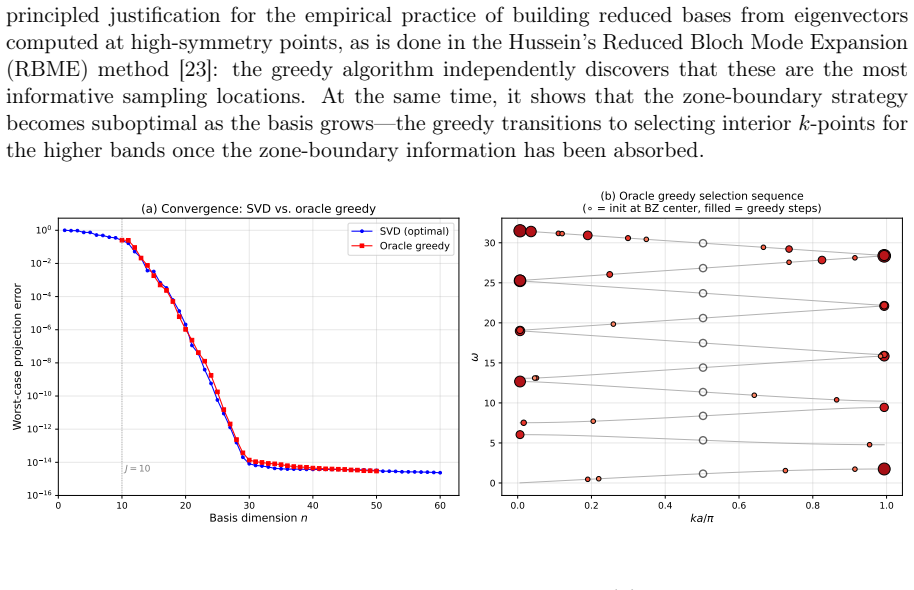
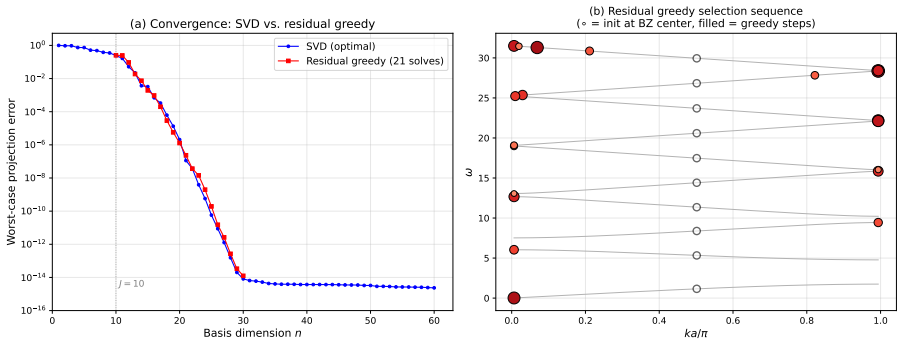
- A greedy selection algorithm attains near-optimal convergence rates on one- and two-dimensional test problems.
Where Pith is reading between the lines
- Near-gap-closing points the exponential rate must slow, suggesting that adaptive or nonlinear reduction strategies become necessary.
- The same holomorphic argument applies directly to other periodic eigenvalue problems whose coefficients depend analytically on a parameter.
- Three-dimensional computations could exploit the same gap-controlled bounds to decide in advance how many basis functions are required for a target accuracy.
Load-bearing premise
The Bloch-transformed operators are entire holomorphic functions of the wave vector, allowing Kato's analytic perturbation theory to guarantee that eigenpairs or projectors remain holomorphic wherever a positive spectral gap exists.
What would settle it
A concrete band-structure computation in which the best n-dimensional subspace approximation error for the manifold fails to decrease exponentially with n, even though a positive spectral gap isolates the band or cluster of interest.
Figures



read the original abstract
In this paper, we exploit the concept of Kolmogorov $n$-widths to establish optimality benchmarks for reduced-order methods used in phononic, acoustic, and photonic band structure calculations. The Bloch-transformed operators are entire holomorphic functions of the wave vector~$\kk$, and by Kato's analytic perturbation theory the eigenpairs inherit this holomorphy wherever the spectral gap is positive. The Kolmogorov $n$-width of the solution manifold therefore decays exponentially, at a rate controlled by the minimum spectral gap between the band of interest and its neighbors. For clusters of bands, we show that working with spectral projectors rather than individual eigenvectors renders all internal crossings -- avoided, symmetry-enforced, or conical -- irrelevant: only the gap separating the cluster from the remaining spectrum matters. These results provide a sharp lower bound on the error of any linear reduction method, against which existing approaches can be measured. Numerical experiments on one- and two-dimensional problems confirm the predicted exponential decay and demonstrate that a greedy algorithm achieves near-optimal convergence. It also provides a principled justification for the choice of basis vectors in highly successful reduced-order models like RBME.
Editorial analysis
A structured set of objections, weighed in public.
Referee Report
Summary. The paper claims that the Kolmogorov n-width of the solution manifold (or Grassmannian of spectral projectors for band clusters) for Bloch-transformed eigenvalue problems decays exponentially, with the rate governed by the minimum spectral gap to neighboring bands. This follows from the entire holomorphy of the Bloch operators in the wave vector k combined with Kato analytic perturbation theory, which yields holomorphic eigenpairs or projectors away from crossings. The result supplies a sharp lower bound on the approximation error of any linear reduced-order model for band-structure computations in phononics, acoustics, and photonics. Numerical tests on 1D and 2D problems confirm the predicted exponential decay and show that a greedy algorithm attains near-optimal rates, thereby justifying the basis selection in methods such as RBME.
Significance. If the derivations hold, the work supplies the first rigorous optimality benchmark for reduced-order models in periodic band-structure calculations. By linking n-width decay directly to the spectral gap and by showing that projector-based treatment eliminates the effect of internal crossings, it explains the practical success of existing greedy and reduced-basis approaches and provides a quantitative yardstick against which future methods can be measured. The combination of holomorphic-manifold theory with concrete numerical validation is a clear strength.
major comments (2)
- [§3.1, Theorem 3.3] §3.1, Theorem 3.3: the exponential n-width bound is stated for the solution manifold in the L2-norm on the torus; however, the proof sketch invokes a holomorphic extension whose radius is controlled by the gap, but it is not shown that the constant in the exponential is independent of the particular Bloch operator (i.e., of the periodic potential). A brief remark on uniformity would strengthen the claim that the bound is sharp for any linear reduction method.
- [§4.2, Figure 4] §4.2, Figure 4: the greedy algorithm is reported to achieve rates within a small factor of the theoretical n-width; yet the comparison is performed only against a fixed reduced-basis size rather than against the minimal possible error for that size. Adding the optimal n-width curve (computed via the singular-value decay of the snapshot matrix) would make the near-optimality statement quantitative rather than visual.
minor comments (3)
- [Introduction] The notation for the Brillouin zone and the wave-vector variable is introduced inconsistently (k vs. kk); a single symbol should be used throughout.
- [§2.2] In the statement of Kato’s theorem (p. 7), the reference to the original Kato monograph is missing; the 1966 or 1980 edition should be cited explicitly.
- [§4.1] The 2D numerical example uses a square lattice; it would be useful to state the number of k-points sampled in the Brillouin zone and the mesh size used for the finite-element discretization.
Simulated Author's Rebuttal
We thank the referee for the careful reading, positive evaluation, and constructive suggestions. Both major comments can be addressed by targeted revisions that strengthen the manuscript without altering its core claims.
read point-by-point responses
-
Referee: [§3.1, Theorem 3.3] §3.1, Theorem 3.3: the exponential n-width bound is stated for the solution manifold in the L2-norm on the torus; however, the proof sketch invokes a holomorphic extension whose radius is controlled by the gap, but it is not shown that the constant in the exponential is independent of the particular Bloch operator (i.e., of the periodic potential). A brief remark on uniformity would strengthen the claim that the bound is sharp for any linear reduction method.
Authors: The exponential decay rate is governed exclusively by the radius of holomorphy, which Kato theory ties directly to the minimum spectral gap and is therefore independent of the specific periodic potential. The multiplicative prefactor, however, does depend on the operator. We will insert a short clarifying paragraph immediately after Theorem 3.3 stating this distinction and noting that, for any fixed gap, the rate itself remains uniform across operators. This preserves the sharpness of the optimality benchmark while making the dependence explicit. revision: yes
-
Referee: [§4.2, Figure 4] §4.2, Figure 4: the greedy algorithm is reported to achieve rates within a small factor of the theoretical n-width; yet the comparison is performed only against a fixed reduced-basis size rather than against the minimal possible error for that size. Adding the optimal n-width curve (computed via the singular-value decay of the snapshot matrix) would make the near-optimality statement quantitative rather than visual.
Authors: We agree that plotting the optimal n-width obtained from the singular-value decay of the snapshot matrix will turn the visual comparison into a quantitative one. We will recompute the singular values for the same snapshot sets used in the 1-D and 2-D experiments and add the resulting optimal curve to Figure 4, together with a brief description in the caption and text of §4.2. revision: yes
Circularity Check
No significant circularity; derivation rests on external theorems
full rationale
The paper derives the exponential decay of the Kolmogorov n-width from the holomorphy of Bloch operators (quadratic polynomials in k) combined with Kato analytic perturbation theory, which guarantees holomorphic eigenpairs and projectors away from spectral gaps. Standard n-width results for holomorphic manifold-valued functions then supply the decay rate controlled by the minimum gap. This chain invokes external, independently verifiable mathematical facts rather than self-definitions, fitted parameters renamed as predictions, or load-bearing self-citations. Numerical experiments confirm rather than establish the claims, and the justification for RBME-type models follows from the derived bound without circular reduction. The argument is therefore self-contained against external benchmarks.
Axiom & Free-Parameter Ledger
axioms (2)
- domain assumption Bloch-transformed operators are entire holomorphic functions of the wave vector k
- standard math Kato's analytic perturbation theory implies that eigenpairs inherit holomorphy wherever the spectral gap is positive
Reference graph
Works this paper leans on
-
[1]
Inhibited spontaneous emission in solid-state physics and electronics
Eli Yablonovitch. Inhibited spontaneous emission in solid-state physics and electronics. Physical review letters, 58(20):2059, 1987
work page 2059
-
[2]
Strong localization of photons in certain disordered dielectric superlattices
Sajeev John. Strong localization of photons in certain disordered dielectric superlattices. Physical review letters, 58(23):2486, 1987
work page 1987
-
[3]
Molding the flow of light.Princet
John D Joannopoulos, Steven G Johnson, Joshua N Winn, and Robert D Meade. Molding the flow of light.Princet. Univ. Press. Princeton, NJ [ua], 12:33, 2008
work page 2008
-
[4]
Elastic and acoustic wave band structure.Journal of sound and vibra- tion, 158(2):377–382, 1992
Michael M Sigalas. Elastic and acoustic wave band structure.Journal of sound and vibra- tion, 158(2):377–382, 1992
work page 1992
-
[5]
Acoustic band structure of periodic elastic composites.Physical review letters, 71(13):2022, 1993
Manvir S Kushwaha, Peter Halevi, Leonard Dobrzynski, and Bahram Djafari-Rouhani. Acoustic band structure of periodic elastic composites.Physical review letters, 71(13):2022, 1993
work page 2022
-
[6]
Sound attenuation by sculpture.nature, 378(6554):241, 1995
Rosa Martínez-Sala, Jose Sancho, Juan V Sánchez, Vicente Gómez, Jaime Llinares, Fran- cisco Meseguer, et al. Sound attenuation by sculpture.nature, 378(6554):241, 1995
work page 1995
-
[7]
Mahmoud I Hussein, Michael J Leamy, and Massimo Ruzzene. Dynamics of phononic materials and structures: Historical origins, recent progress, and future outlook.Applied Mechanics Reviews, 66(4):040802, 2014
work page 2014
-
[8]
Ankit Srivastava. Elastic metamaterials and dynamic homogenization: a review.Interna- tional Journal of Smart and Nano Materials, 6(1):41–60, 2015
work page 2015
-
[9]
F. Bloch. Über die Quantenmechanik der Elektronen in Kristallgittern.Zeitschrift für Physik, 52:555–600, 1928
work page 1928
-
[10]
Wave propagation in periodic structures: electric filters and crystal lattices.(No Title), 1953
Léon Nicholas Brillouin. Wave propagation in periodic structures: electric filters and crystal lattices.(No Title), 1953
work page 1953
-
[11]
3-d phononic crystals with ultra-wide band gaps.Scientific reports, 7(1):43407, 2017
Yan Lu, Yang Yang, James K Guest, and Ankit Srivastava. 3-d phononic crystals with ultra-wide band gaps.Scientific reports, 7(1):43407, 2017
work page 2017
-
[12]
KM Ho, Che Ting Chan, and Costas M Soukoulis. Existence of a photonic gap in periodic dielectric structures.Physical review letters, 65(25):3152, 1990
work page 1990
-
[13]
Kok-Ming Leung and YF Liu. Full vector wave calculation of photonic band structures in face-centered-cubic dielectric media.Physical Review Letters, 65(21):2646, 1990
work page 1990
-
[14]
David C Dobson, Jayadeep Gopalakrishnan, and Joseph E Pasciak. An efficient method for band structure calculations in 3d photonic crystals.Journal of Computational Physics, 161(2):668–679, 2000
work page 2000
-
[15]
Eric B Chin, Amir Ashkan Mokhtari, Ankit Srivastava, and N Sukumar. Spectral extended finite element method for band structure calculations in phononic crystals.Journal of Computational Physics, 427:110066, 2021
work page 2021
-
[16]
Order-n spectral method for electromagnetic waves
Che Ting Chan, QL Yu, and KM Ho. Order-n spectral method for electromagnetic waves. Physical Review B, 51(23):16635, 1995
work page 1995
-
[17]
S. Nemat-Nasser. Harmonic waves in layered composites.Journal of Applied Mechanics, 39(3):850–852, 09 1972. 24
work page 1972
-
[18]
S Nemat-Nasser, FCL Fu, and S Minagawa. Harmonic waves in one-, two-and three- dimensional composites: Bounds for eigenfrequencies.International Journal of Solids and Structures, 11(5):617–642, 1975
work page 1975
-
[19]
Ankit Srivastava and Sia Nemat-Nasser. Mixed-variational formulation for phononic band- structure calculation of arbitrary unit cells.Mechanics of Materials, 74:67–75, 2014
work page 2014
-
[20]
Variational methods for phononic calculations.Wave Motion, 60:46–61, 2016
Yan Lu and Ankit Srivastava. Variational methods for phononic calculations.Wave Motion, 60:46–61, 2016
work page 2016
-
[21]
Yan Lu and Ankit Srivastava. Combining plane wave expansion and variational techniques for fast phononic computations.Journal of Engineering Mechanics, 143(12):04017141, 2017
work page 2017
-
[22]
Steven G Johnson and John D Joannopoulos. Block-iterative frequency-domain methods for maxwell’s equations in a planewave basis.Optics express, 8(3):173–190, 2001
work page 2001
-
[23]
Mahmoud I Hussein. Reduced bloch mode expansion for periodic media band structure calculations.Proceedings of the Royal Society A: Mathematical, Physical and Engineering Sciences, 465(2109):2825–2848, 2009
work page 2009
-
[24]
Mahmoud I Hussein and Gregory M Hulbert. Mode-enriched dispersion models of periodic materials within a multiscale mixed finite element framework.Finite elements in analysis and design, 42(7):602–612, 2006
work page 2006
-
[25]
Optimal basis sets for detailed brillouin-zone integrations.Physical Review B, 54(23):16464, 1996
Eric L Shirley. Optimal basis sets for detailed brillouin-zone integrations.Physical Review B, 54(23):16464, 1996
work page 1996
-
[26]
Coupling of substructures for dynamic analyses
Roy R Craig Jr and Mervyn CC Bampton. Coupling of substructures for dynamic analyses. AIAA journal, 6(7):1313–1319, 1968
work page 1968
-
[27]
Dimitri Krattiger and Mahmoud I Hussein. Bloch mode synthesis: Ultrafast methodology for elastic band-structure calculations.Physical Review E, 90(6):063306, 2014
work page 2014
-
[28]
DimitriKrattigerandMahmoudIHussein. Generalizedblochmodesynthesisforaccelerated calculation of elastic band structures.Journal of Computational Physics, 357:183–205, 2018
work page 2018
-
[29]
Antonio Palermo and Alessandro Marzani. Extended bloch mode synthesis: Ultrafast method for the computation of complex band structures in phononic media.International Journal of Solids and Structures, 100:29–40, 2016
work page 2016
-
[30]
Chenyang Xi and Hui Zheng. Improving the generalized bloch mode synthesis method using algebraic condensation.Computer Methods in Applied Mechanics and Engineering, 379:113758, 2021
work page 2021
-
[31]
Abdulaziz Aladwani, Mostafa Nouh, and Mahmoud I Hussein. State-space bloch mode synthesis for fast band-structure calculations of non-classically damped phononic materials. Computer Methods in Applied Mechanics and Engineering, 396:115018, 2022
work page 2022
-
[32]
Christian Scheiber, Alwin Schultschik, Oszkar Biro, and Romanus Dyczij-Edlinger. A model order reduction method for efficient band structure calculations of photonic crystals.IEEE transactions on magnetics, 47(5):1534–1537, 2011
work page 2011
-
[33]
Andrei Kolmogoroff. Über die beste annäherung von funktionen einer gegebenen funktio- nenklasse.Annals of Mathematics, 37(1):107–110, 1936
work page 1936
-
[34]
Springer Science & Business Media, 2012
Allan Pinkus.N-widths in Approximation Theory. Springer Science & Business Media, 2012. 25
work page 2012
-
[35]
Albert Cohen, Ronald Devore, and Christoph Schwab. Analytic regularity and polyno- mial approximation of parametric and stochastic elliptic pde’s.Analysis and Applications, 9(01):11–47, 2011
work page 2011
-
[36]
Approximation of high-dimensional parametric pdes
Albert Cohen and Ronald DeVore. Approximation of high-dimensional parametric pdes. Acta Numerica, 24:1–159, 2015
work page 2015
-
[37]
Kolmogorov widths and low-rank approximations of parametric elliptic pdes.Math
Markus Bachmayr and Albert Cohen. Kolmogorov widths and low-rank approximations of parametric elliptic pdes.Math. Comput., 86:701–724, 2015
work page 2015
-
[38]
Gianluigi Rozza, Dinh Bao Phuong Huynh, and Anthony T. Patera. Reduced basis approx- imation and a posteriori error estimation for affinely parametrized elliptic coercive partial differential equations.Archives of Computational Methods in Engineering, 15:1–47, 2007
work page 2007
-
[39]
Ronald A. DeVore. The theoretical foundation of reduced basis methods. 2014
work page 2014
-
[40]
DeVore, Guergana Petrova, and Przemyslaw Wojtaszczyk
Peter Binev, Albert Cohen, Wolfgang Dahmen, Ronald A. DeVore, Guergana Petrova, and Przemyslaw Wojtaszczyk. Convergence rates for greedy algorithms in reduced basis methods.SIAM J. Math. Anal., 43:1457–1472, 2010
work page 2010
-
[41]
C. Greif and Karsten Urban. Decay of the kolmogorov n-width for wave problems.Appl. Math. Lett., 96:216–222, 2019
work page 2019
-
[42]
Reduced basis methods: Success, limitations and future challenges.arXiv: Numerical Analysis, 2015
Mario Ohlberger and Stephan Rave. Reduced basis methods: Success, limitations and future challenges.arXiv: Numerical Analysis, 2015
work page 2015
-
[43]
Tosio Kato and Tosio Katåo.Perturbation theory for linear operators, volume 132. Springer, 1966
work page 1966
-
[44]
Yvon Maday, Anthony T. Patera, and Gabriel Turinici. A priori convergence theory for reduced-basis approximations of single-parameter elliptic partial differential equations. Journal of Scientific Computing, 17:437–446, 2002
work page 2002
-
[45]
Yvon Maday, Anthony T. Patera, and Gabriel Turinici. Global a priori convergence theory for reduced-basis approximations of single-parameter symmetric coercive elliptic partial differential equations.Comptes Rendus Mathematique, 335:289–294, 2002
work page 2002
-
[46]
Hayez, imprimeur des académies royales, 1912
Serge Bernstein.Sur l’ordre de la meilleure approximation des fonctions continues par des polynômes de degré donné, volume 4. Hayez, imprimeur des académies royales, 1912
work page 1912
- [47]
-
[48]
The approximation of one matrix by another of lower rank
Carl Eckart and Gale Young. The approximation of one matrix by another of lower rank. Psychometrika, 1:211–218, 1936
work page 1936
-
[49]
Machiels, Yvon Maday, An- thony T
Christophe Prud’homme, Dimitrios Rovas, Karen Veroy, L. Machiels, Yvon Maday, An- thony T. Patera, and Gabriel Turinici. Reliable real-time solution of parametrized par- tial differential equations: Reduced-basis output bound methods.Journal of Fluids Engineering-transactions of The Asme, 124:70–80, 2002
work page 2002
-
[50]
Karen Veroy, Christophe Prud’Homme, Dimitrios Rovas, and Anthony Patera. A posteriori error bounds for reduced-basis approximation of parametrized noncoercive and nonlinear el- liptic partial differential equations. In16th AIAA computational fluid dynamics conference, page 3847, 2003
work page 2003
-
[51]
Alfio Quarteroni, Andrea Manzoni, and Federico Negri.Reduced basis methods for partial differential equations: an introduction. Springer, 2015. 26
work page 2015
-
[52]
Hesthaven, Gianluigi Rozza, and Benjamin Stamm
Jan S. Hesthaven, Gianluigi Rozza, and Benjamin Stamm. Certified reduced basis methods for parametrized partial differential equations. 2015
work page 2015
-
[53]
Ivan Fumagalli, Andrea Manzoni, Nicola Parolini, and Marco Verani. Reduced basis ap- proximation and a posteriori error estimates for parametrized elliptic eigenvalue problems. Mathematical Modelling and Numerical Analysis, 50:1857–1885, 2016
work page 2016
-
[54]
Thomas Horger, Barbara I. Wohlmuth, and Thomas Dickopf. Simultaneous reduced basis approximation of parameterized elliptic eigenvalue problems.arXiv: Numerical Analysis, 2015
work page 2015
-
[55]
YanLuandAnkitSrivastava. Levelrepulsionandbandsortinginphononiccrystals.Journal of the Mechanics and Physics of Solids, 111:100–112, 2018
work page 2018
-
[56]
Michael V. Berry. Quantal phase factors accompanying adiabatic changes.Proceedings of the Royal Society of London. A. Mathematical and Physical Sciences, 392:45 – 57, 1984
work page 1984
-
[57]
Nicola Marzari and David Vanderbilt. Maximally localized generalized wannier functions for composite energy bands.Physical Review B, 56:12847–12865, 1997
work page 1997
-
[58]
Nicola Marzari, Arash A. Mostofi, Jonathan R. Yates, Ivo Souza, and David Vander- bilt. Maximally-localized wannier functions: Theory and applications.Reviews of Modern Physics, 84:1419–1475, 2011
work page 2011
-
[59]
Christophe Geuzaine and Jean-François Remacle. Gmsh: A 3-d finite element mesh gen- erator with built-in pre-and post-processing facilities.International journal for numerical methods in engineering, 79(11):1309–1331, 2009. 27
work page 2009
discussion (0)
Sign in with ORCID, Apple, or X to comment. Anyone can read and Pith papers without signing in.