Recognition: 2 theorem links
· Lean TheoremAutomatically Generating Hard Math Problems from Hypothesis-Driven Error Analysis
Pith reviewed 2026-05-10 19:34 UTC · model grok-4.3
The pith
AI-generated hypotheses about where LLMs fail in math can be used to create new benchmark problems that are substantially harder than existing ones.
A machine-rendered reading of the paper's core claim, the machinery that carries it, and where it could break.
Core claim
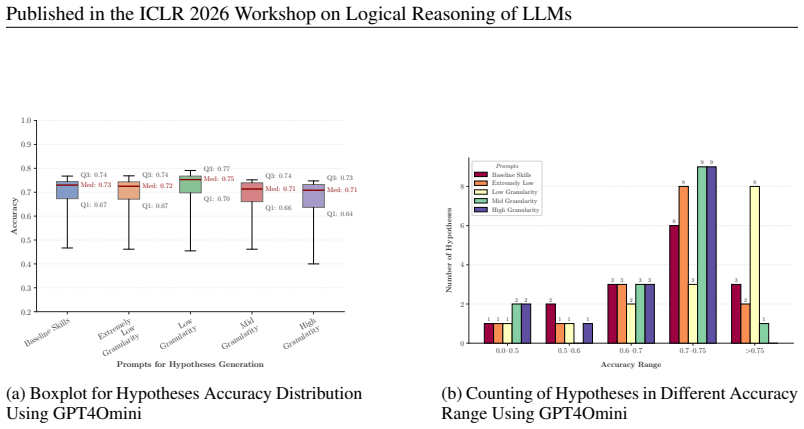
By using an LLM to generate hypotheses that isolate the precise math concepts and skills causing errors on existing problems, the pipeline can then produce new problems that systematically exploit those weaknesses; experiments confirm that higher hypothesis accuracy directly increases problem difficulty, with the strongest hypotheses lowering model accuracy to 45 percent versus 77 percent on the MATH benchmark.
What carries the argument
Hypothesis-driven error analysis pipeline that turns LLM error patterns into targeted problem generators.
If this is right
- Higher-quality hypotheses produce measurably harder problems that expose more model weaknesses.
- The same pipeline works for any category of math problem rather than being limited to fixed types.
- New instances can be generated on demand to prevent models from overfitting to static benchmarks.
- The approach requires far less human effort than manually designing or curating math tests.
Where Pith is reading between the lines
- The same error-hypothesis loop could be applied to non-math domains such as code generation or scientific reasoning to map model weaknesses automatically.
- Repeated use might reveal whether LLMs share consistent conceptual blind spots across different base models.
- If the correlation holds, benchmark creators could prioritize hypothesis refinement over problem volume.
Load-bearing premise
That the AI-generated hypotheses correctly identify the exact math concepts and skills responsible for an LLM's mistakes rather than unrelated patterns or artifacts.
What would settle it
Generate two sets of problems from high-accuracy versus low-accuracy hypotheses and check whether the high-accuracy set produces a reliably larger drop in the target LLM's accuracy than the low-accuracy set or the original benchmark.
Figures




read the original abstract
Numerous math benchmarks exist to evaluate LLMs' mathematical capabilities. However, most involve extensive manual effort and are difficult to scale. Consequently, they cannot keep pace with LLM development or easily provide new instances to mitigate overfitting. Some researchers have proposed automatic benchmark generation methods, but few focus on identifying the specific math concepts and skills on which LLMs are error-prone, and most can only generate category-specific benchmarks. To address these limitations, we propose a new math benchmark generation pipeline that uses AI-generated hypotheses to identify the specific math concepts and skills that LLMs struggle with, and then generates new benchmark problems targeting these weaknesses. Experiments show that hypothesis accuracy positively correlates with the difficulty of the generated problems: problems generated from the most accurate hypotheses reduce Llama-3.3-70B-Instruct's accuracy to as low as 45%, compared to 77% on the original MATH benchmark. Furthermore, our pipeline is highly adaptable and can be applied beyond math to explore a wide range of LLM capabilities, making it a valuable tool for investigating how LLMs perform across different domains.
Editorial analysis
A structured set of objections, weighed in public.
Referee Report
Summary. The paper proposes a pipeline that uses LLMs to generate hypotheses about specific math concepts and skills on which other LLMs err (starting from benchmarks like MATH), then automatically generates new problems targeting those hypotheses. Experiments report a positive correlation between hypothesis accuracy and generated-problem difficulty, with Llama-3.3-70B-Instruct accuracy falling from 77% on the original MATH benchmark to as low as 45% on problems derived from the most accurate hypotheses. The method is claimed to be scalable and extensible beyond mathematics.
Significance. If the correlation can be shown to arise from precise targeting of identified weaknesses rather than uncontrolled generation artifacts, the pipeline would offer a valuable, low-manual-effort route to creating adaptive, targeted math benchmarks that keep pace with LLM progress and reduce overfitting. The domain-agnostic framing is a further strength, potentially enabling similar hypothesis-driven evaluation in other LLM capability areas.
major comments (3)
- [Experiments] Experiments section: the central claim that higher-accuracy hypotheses produce harder problems specifically because they target the identified error-prone concepts is not supported by evidence that generation prompts, solution length, number of operations, or lexical complexity were held constant or balanced across hypothesis-accuracy bins; without these controls the observed accuracy drop (45% vs. 77%) cannot be attributed to the hypotheses rather than incidental problem-structure changes.
- [Evaluation] Evaluation subsection: no details are given on verification that the generated problems are mathematically correct, free of unintended shortcuts, or fair with respect to the original benchmark distribution; likewise absent are statistical tests for the reported correlation or accuracy differences.
- [Method] Method section: the procedure for validating that AI-generated hypotheses accurately isolate the precise skills causing LLM errors (as opposed to merely correlating with errors) is not described, leaving the weakest assumption of the pipeline untested.
minor comments (2)
- [Abstract] Abstract: the phrase 'hypothesis accuracy' is used without a brief definition or reference to how it is computed.
- [Experiments] The paper would benefit from a table summarizing the number of hypotheses, problems generated per bin, and exact accuracy numbers with confidence intervals.
Simulated Author's Rebuttal
We thank the referee for the detailed and constructive feedback. The comments highlight important areas for strengthening the attribution of results to the hypotheses, improving evaluation rigor, and clarifying methodological assumptions. We address each major comment below and will incorporate revisions to address the concerns.
read point-by-point responses
-
Referee: [Experiments] Experiments section: the central claim that higher-accuracy hypotheses produce harder problems specifically because they target the identified error-prone concepts is not supported by evidence that generation prompts, solution length, number of operations, or lexical complexity were held constant or balanced across hypothesis-accuracy bins; without these controls the observed accuracy drop (45% vs. 77%) cannot be attributed to the hypotheses rather than incidental problem-structure changes.
Authors: We agree that explicit controls and balancing checks are needed to strengthen causal attribution to the hypotheses. In the revised manuscript we will add a new analysis subsection reporting average solution length, number of operations, and lexical complexity (e.g., Flesch-Kincaid grade level) across hypothesis-accuracy bins, along with statistical comparisons showing no significant differences. We will also confirm that the core generation prompt template remains identical across conditions, with only the hypothesis text inserted. revision: yes
-
Referee: [Evaluation] Evaluation subsection: no details are given on verification that the generated problems are mathematically correct, free of unintended shortcuts, or fair with respect to the original benchmark distribution; likewise absent are statistical tests for the reported correlation or accuracy differences.
Authors: We acknowledge the omission of these details. The revised manuscript will expand the Evaluation subsection to describe the verification pipeline (LLM-based correctness checking followed by manual review of a random 10% sample by two authors, with inter-annotator agreement reported) and checks for shortcuts (e.g., keyword-overlap analysis with training data). We will also add Pearson correlation coefficients with p-values for hypothesis accuracy versus model accuracy, plus paired t-tests or Wilcoxon tests for the accuracy drops relative to the original MATH benchmark. revision: yes
-
Referee: [Method] Method section: the procedure for validating that AI-generated hypotheses accurately isolate the precise skills causing LLM errors (as opposed to merely correlating with errors) is not described, leaving the weakest assumption of the pipeline untested.
Authors: The current manuscript measures hypothesis accuracy via predictive performance on held-out error instances but does not include an explicit isolation test. We will revise the Method section to add a validation procedure: (1) expert annotation of a subset of hypotheses for skill specificity and (2) an ablation comparing problems generated from high-accuracy hypotheses versus matched problems generated from generic difficulty prompts. This will be reported with quantitative results. revision: yes
Circularity Check
No circularity; pipeline and evaluation are independent of reported outcomes
full rationale
The paper describes a hypothesis-driven pipeline that first elicits AI-generated hypotheses about LLM error patterns on MATH, then uses those hypotheses to prompt generation of new problems, and finally evaluates the generated problems on an external held-out model (Llama-3.3-70B-Instruct) against the original MATH benchmark. No equations, fitted parameters, or self-citations are invoked to derive the central correlation; the accuracy drop (45 % vs 77 %) is measured directly on external data. The derivation chain therefore remains self-contained and does not reduce any claimed result to its own inputs by construction.
Axiom & Free-Parameter Ledger
axioms (1)
- domain assumption AI-generated hypotheses from error analysis can accurately identify specific math concepts and skills where LLMs are error-prone
Lean theorems connected to this paper
-
IndisputableMonolith/Foundation/RealityFromDistinction.leanreality_from_one_distinction unclear?
unclearRelation between the paper passage and the cited Recognition theorem.
We introduce a benchmark generation pipeline that addresses all three gaps. Our pipeline uses Hypogenic (Zhou et al., 2024), an LLM-based hypothesis generator, to analyze problems that a target LLM consistently fails and produce hypotheses about the mathematical concepts and skills underlying those failures.
-
IndisputableMonolith/Cost/FunctionalEquation.leanwashburn_uniqueness_aczel unclear?
unclearRelation between the paper passage and the cited Recognition theorem.
Experiments show that hypothesis accuracy positively correlates with the difficulty of the generated problems: problems generated from the most accurate hypotheses reduce Llama-3.3-70B-Instruct's accuracy to as low as 45%.
What do these tags mean?
- matches
- The paper's claim is directly supported by a theorem in the formal canon.
- supports
- The theorem supports part of the paper's argument, but the paper may add assumptions or extra steps.
- extends
- The paper goes beyond the formal theorem; the theorem is a base layer rather than the whole result.
- uses
- The paper appears to rely on the theorem as machinery.
- contradicts
- The paper's claim conflicts with a theorem or certificate in the canon.
- unclear
- Pith found a possible connection, but the passage is too broad, indirect, or ambiguous to say the theorem truly supports the claim.
Reference graph
Works this paper leans on
-
[1]
write newline
" write newline "" before.all 'output.state := FUNCTION n.dashify 't := "" t empty not t #1 #1 substring "-" = t #1 #2 substring "--" = not "--" * t #2 global.max substring 't := t #1 #1 substring "-" = "-" * t #2 global.max substring 't := while if t #1 #1 substring * t #2 global.max substring 't := if while FUNCTION format.date year duplicate empty "emp...
-
[2]
U-math: A university-level benchmark for evaluating mathematical skills in llms
Konstantin Chernyshev, Vitaliy Polshkov, Ekaterina Artemova, Alex Myasnikov, Vlad Stepanov, Alexei Miasnikov, and Sergei Tilga. U-math: A university-level benchmark for evaluating mathematical skills in llms. arXiv preprint arXiv:2412.03205, 2024
-
[3]
Training Verifiers to Solve Math Word Problems
Karl Cobbe, Vineet Kosaraju, Mohammad Bavarian, Mark Chen, Heewoo Jun, Lukasz Kaiser, Matthias Plappert, Jerry Tworek, Jacob Hilton, Reiichiro Nakano, Christopher Hesse, and John Schulman. Training verifiers to solve math word problems. arXiv preprint arXiv:2110.14168, 2021
work page internal anchor Pith review Pith/arXiv arXiv 2021
-
[4]
Elliot Glazer, Ege Erdil, Tamay Besiroglu, Diego Chicharro, Evan Chen, Alex Gunning, Caroline Falkman Olsson, Jean-Stanislas Denain, Anson Ho, Emily de Oliveira Santos, et al. Frontiermath: A benchmark for evaluating advanced mathematical reasoning in ai. arXiv preprint arXiv:2411.04872, 2024
-
[5]
Measuring Mathematical Problem Solving With the MATH Dataset
Dan Hendrycks, Collin Burns, Saurav Kadavath, Akul Arora, Steven Basart, Eric Tang, Dawn Song, and Jacob Steinhardt. Measuring mathematical problem solving with the math dataset. arXiv preprint arXiv:2103.03874, 2021
work page internal anchor Pith review Pith/arXiv arXiv 2021
-
[6]
Datagen: Unified synthetic dataset generation via large language models
Yue Huang, Siyuan Wu, Chujie Gao, Dongping Chen, Qihui Zhang, Yao Wan, Tianyi Zhou, Chaowei Xiao, Jianfeng Gao, Lichao Sun, et al. Datagen: Unified synthetic dataset generation via large language models. In The Thirteenth International Conference on Learning Representations, 2024
2024
-
[7]
Llama-3.3-70B-Instruct
Meta . Llama-3.3-70B-Instruct . https://huggingface.co/meta-llama/Llama-3.3-70B-Instruct, Dec 2024
2024
-
[8]
Mathemagic: Generating dynamic mathematics benchmarks robust to memorization
Dayy \'a n O'Brien, Barry Haddow, Emily Allaway, and Pinzhen Chen. Mathemagic: Generating dynamic mathematics benchmarks robust to memorization. arXiv preprint arXiv:2510.05962, 2025
-
[9]
Proof2hybrid: Automatic mathematical benchmark synthesis for proof-centric problems
Yebo Peng, Zixiang Liu, Yaoming Li, Zhizhuo Yang, Xinye Xu, Bowen Ye, Weijun Yuan, Zihan Wang, and Tong Yang. Proof2hybrid: Automatic mathematical benchmark synthesis for proof-centric problems. arXiv preprint arXiv:2508.02208, 2025
-
[10]
Ai-assisted generation of difficult math questions, 2025
Vedant Shah, Dingli Yu, Kaifeng Lyu, Simon Park, Jiatong Yu, Yinghui He, Nan Rosemary Ke, Michael Mozer, Yoshua Bengio, Sanjeev Arora, and Anirudh Goyal. Ai-assisted generation of difficult math questions, 2025. URL https://arxiv.org/abs/2407.21009
-
[11]
Yourbench: Easy custom evaluation sets for everyone, 2025
Sumuk Shashidhar, Cl \'e mentine Fourrier, Alina Lozovskia, Thomas Wolf, Gokhan Tur, and Dilek Hakkani-T \"u r. Yourbench: Easy custom evaluation sets for everyone. arXiv preprint arXiv:2504.01833, 2025
-
[12]
arXiv preprint arXiv:2402.11443 , year=
Siyuan Wang, Zhuohan Long, Zhihao Fan, Zhongyu Wei, and Xuanjing Huang. Benchmark self-evolving: A multi-agent framework for dynamic llm evaluation. arXiv preprint arXiv:2402.11443, 2024
-
[13]
Llm-powered benchmark factory: Reliable, generic, and efficient
Peiwen Yuan, Shaoxiong Feng, Yiwei Li, Xinglin Wang, Yueqi Zhang, Jiayi Shi, Chuyi Tan, Boyuan Pan, Yao Hu, and Kan Li. Llm-powered benchmark factory: Reliable, generic, and efficient. arXiv preprint arXiv:2502.01683, 2025
-
[14]
Di Zhang, Jiatong Li, Xiaoshui Huang, Dongzhan Zhou, Yuqiang Li, and Wanli Ouyang. Accessing gpt-4 level mathematical olympiad solutions via monte carlo tree self-refine with llama-3 8b. arXiv preprint arXiv:2406.07394, 2024 a
-
[15]
Darg: Dynamic evaluation of large language models via adaptive reasoning graph
Zhehao Zhang, Jiaao Chen, and Diyi Yang. Darg: Dynamic evaluation of large language models via adaptive reasoning graph. Advances in Neural Information Processing Systems, 37: 0 135904--135942, 2024 b
2024
-
[16]
Hypothesis generation with large language models
Yangqiaoyu Zhou, Haokun Liu, Tejes Srivastava, Hongyuan Mei, and Chenhao Tan. Hypothesis generation with large language models. In Proceedings of EMNLP Workshop of NLP for Science, 2024. URL https://aclanthology.org/2024.nlp4science-1.10/
2024
-
[17]
@esa (Ref
\@ifxundefined[1] #1\@undefined \@firstoftwo \@secondoftwo \@ifnum[1] #1 \@firstoftwo \@secondoftwo \@ifx[1] #1 \@firstoftwo \@secondoftwo [2] @ #1 \@temptokena #2 #1 @ \@temptokena \@ifclassloaded agu2001 natbib The agu2001 class already includes natbib coding, so you should not add it explicitly Type <Return> for now, but then later remove the command n...
-
[18]
\@lbibitem[] @bibitem@first@sw\@secondoftwo \@lbibitem[#1]#2 \@extra@b@citeb \@ifundefined br@#2\@extra@b@citeb \@namedef br@#2 \@nameuse br@#2\@extra@b@citeb \@ifundefined b@#2\@extra@b@citeb @num @parse #2 @tmp #1 NAT@b@open@#2 NAT@b@shut@#2 \@ifnum @merge>\@ne @bibitem@first@sw \@firstoftwo \@ifundefined NAT@b*@#2 \@firstoftwo @num @NAT@ctr \@secondoft...
-
[19]
@open @close @open @close and [1] URL: #1 \@ifundefined chapter * \@mkboth \@ifxundefined @sectionbib * \@mkboth * \@mkboth\@gobbletwo \@ifclassloaded amsart * \@ifclassloaded amsbook * \@ifxundefined @heading @heading NAT@ctr thebibliography [1] @ \@biblabel @NAT@ctr \@bibsetup #1 @NAT@ctr @ @openbib .11em \@plus.33em \@minus.07em 4000 4000 `\.\@m @bibit...
discussion (0)
Sign in with ORCID, Apple, or X to comment. Anyone can read and Pith papers without signing in.