Recognition: 2 theorem links
· Lean TheoremA solvable model of noisy coupled oscillators with fully random interactions
Pith reviewed 2026-05-10 20:08 UTC · model grok-4.3
The pith
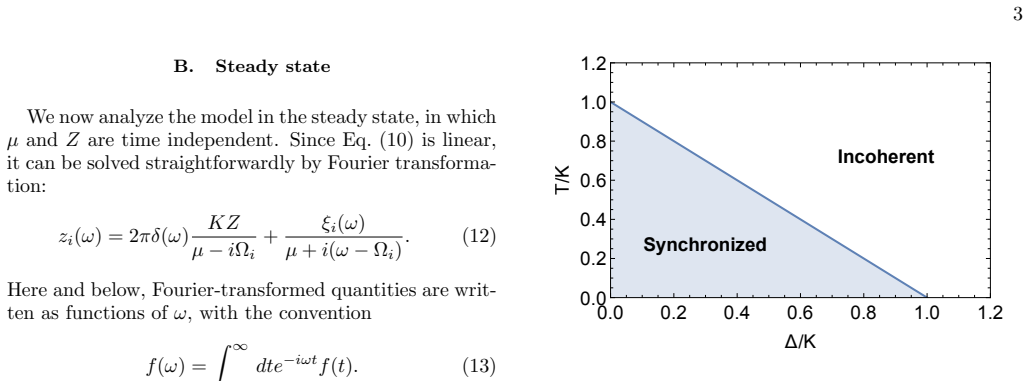
Any finite spread in natural frequencies eliminates the finite-temperature spin-glass transition in a solvable model of coupled oscillators.
A machine-rendered reading of the paper's core claim, the machinery that carries it, and where it could break.
Core claim
In this solvable spherical model, a finite-width distribution of natural frequencies removes the finite-temperature spin-glass transition because the resulting low-frequency singularity of the correlation function is incompatible with the spherical constraint. At zero temperature a spin-glass phase persists independently of the frequency dispersion. This residual zero-temperature glassiness is a special feature of the spherical dynamics and would be destroyed by local nonlinearities.
What carries the argument
Dynamical mean-field theory self-consistent equations for the steady-state correlation and response functions subject to the spherical constraint in the presence of distributed natural frequencies.
If this is right
- The finite-temperature spin-glass transition disappears for any nonzero width of the natural-frequency distribution.
- A zero-temperature spin-glass phase exists for arbitrary frequency dispersion.
- The model supplies an exactly solvable oscillator framework for examining how nonequilibrium perturbations suppress glassy freezing.
- Local nonlinearities are expected to eliminate the zero-temperature glass phase.
Where Pith is reading between the lines
- The result suggests that frequency heterogeneity may generically disrupt finite-temperature ordering in other mean-field oscillator networks.
- Finite-size numerical simulations of the oscillator equations could directly test the predicted suppression of the transition.
- The same DMFT setup could be adapted to probe glassy dynamics in related systems such as neural oscillator populations.
Load-bearing premise
The dynamics remain strictly spherical and local nonlinearities can be neglected.
What would settle it
Numerical solution of the self-consistent DMFT equations for a small but finite frequency dispersion, checking whether the glass order parameter appears only at T=0 or at a nonzero critical temperature.
Figures


read the original abstract
We introduce a solvable spherical model of coupled oscillators with fully random interactions and distributed natural frequencies. Using the dynamical mean-field theory, we derive self-consistent equations for the steady-state response and correlation functions. We show that any finite width of the natural-frequency distribution suppresses the finite-temperature spin-glass transition, because the resulting low-frequency singularity of the correlation function is incompatible with the spherical constraint. At zero temperature, however, a spin-glass phase persists for arbitrary frequency dispersion. This residual zero-temperature glassiness is likely a special feature of the spherical dynamics and would be destroyed by local nonlinearities. The model thus provides a solvable oscillator framework for studying how nonequilibrium perturbations suppress finite-temperature glassy freezing.
Editorial analysis
A structured set of objections, weighed in public.
Referee Report
Summary. The paper introduces a solvable spherical model of coupled oscillators with fully random interactions and distributed natural frequencies. Using dynamical mean-field theory (DMFT), it derives self-consistent equations for the steady-state response and correlation functions. The central claim is that any finite width of the natural-frequency distribution suppresses the finite-temperature spin-glass transition because the resulting low-frequency singularity in the correlation function is incompatible with the spherical constraint; at zero temperature, however, a spin-glass phase persists for arbitrary frequency dispersion. This zero-temperature glassiness is flagged as likely special to the spherical dynamics and would be destroyed by local nonlinearities.
Significance. If the results hold, this provides an exactly solvable oscillator framework for studying suppression of finite-temperature glassy freezing by nonequilibrium perturbations such as frequency dispersion. The analytical tractability via DMFT on the spherical model is a clear strength, enabling precise derivation of the singularity-constraint mismatch without fitted parameters. The persistence of T=0 glassiness offers a benchmark for more realistic models and highlights how the spherical constraint enables solvability in disordered dynamical systems.
major comments (1)
- [DMFT equations and results section] The derivation of the low-frequency singularity and its incompatibility with the spherical constraint (likely in the DMFT closure and constraint enforcement step) is load-bearing for the finite-T suppression claim; an explicit evaluation of the integral enforcing the spherical constraint at small but finite T would confirm that any nonzero width produces a divergence that cannot be satisfied.
minor comments (2)
- [Abstract] Abstract: the claim that zero-temperature glassiness 'would be destroyed by local nonlinearities' is stated without a supporting heuristic or reference; adding one sentence would clarify why this is expected to be special to spherical dynamics.
- [Model definition] Notation for the frequency distribution width and the response function should be introduced with a clear table or list of symbols to aid readability of the self-consistent equations.
Simulated Author's Rebuttal
We thank the referee for their positive assessment of our work and for the constructive suggestion regarding the explicit low-temperature evaluation. We address the comment below and will incorporate the requested clarification.
read point-by-point responses
-
Referee: [DMFT equations and results section] The derivation of the low-frequency singularity and its incompatibility with the spherical constraint (likely in the DMFT closure and constraint enforcement step) is load-bearing for the finite-T suppression claim; an explicit evaluation of the integral enforcing the spherical constraint at small but finite T would confirm that any nonzero width produces a divergence that cannot be satisfied.
Authors: We agree that an explicit evaluation of the spherical constraint integral at small but finite T would strengthen the presentation. In the revised manuscript we will add a direct computation in the DMFT results section showing that, for any nonzero frequency dispersion width, the low-frequency singularity in the correlation function produces a divergence (logarithmic or stronger) in the integral that cannot be canceled by the finite response function, thereby violating the spherical constraint. This confirms the suppression of the finite-T spin-glass transition. While the DMFT closure and singularity origin are already derived in the paper, we acknowledge that the explicit small-T integral was not evaluated and will include it as suggested. revision: yes
Circularity Check
No significant circularity; derivation self-contained via DMFT closure
full rationale
The central results follow directly from applying standard dynamical mean-field theory to the spherical model definition with random couplings and distributed frequencies. Self-consistent equations for the response and correlation functions are obtained from the model equations and DMFT closure without fitted parameters or self-referential definitions. The suppression of the finite-T transition arises from an explicit mismatch between the low-frequency singularity (induced by frequency dispersion) and the spherical constraint, which is an algebraic consequence of the model's equations rather than a renaming or imported uniqueness theorem. The T=0 persistence is likewise derived within the same framework, with the authors explicitly noting its dependence on spherical dynamics. No load-bearing self-citation, ansatz smuggling, or fitted-input-as-prediction steps are present; the derivation chain is independent of the target claims.
Axiom & Free-Parameter Ledger
free parameters (1)
- width of natural-frequency distribution
axioms (2)
- domain assumption Spherical constraint on oscillator amplitudes
- domain assumption Validity of dynamical mean-field theory for random interactions
Lean theorems connected to this paper
-
IndisputableMonolith/Cost/FunctionalEquation.leanwashburn_uniqueness_aczel unclear?
unclearRelation between the paper passage and the cited Recognition theorem.
any finite width of the natural-frequency distribution suppresses the finite-temperature spin-glass transition, because the resulting low-frequency singularity of the correlation function is incompatible with the spherical constraint
What do these tags mean?
- matches
- The paper's claim is directly supported by a theorem in the formal canon.
- supports
- The theorem supports part of the paper's argument, but the paper may add assumptions or extra steps.
- extends
- The paper goes beyond the formal theorem; the theorem is a base layer rather than the whole result.
- uses
- The paper appears to rely on the theorem as machinery.
- contradicts
- The paper's claim conflicts with a theorem or certificate in the canon.
- unclear
- Pith found a possible connection, but the passage is too broad, indirect, or ambiguous to say the theorem truly supports the claim.
Reference graph
Works this paper leans on
-
[1]
Kuramoto,Chemical Oscillations, Waves, and Turbu- lence(Springer Berlin Heidelberg, 1984)
Y. Kuramoto,Chemical Oscillations, Waves, and Turbu- lence(Springer Berlin Heidelberg, 1984)
1984
-
[2]
S. H. Strogatz, Physica D: Nonlinear Phenomena143, 1–20 (2000)
2000
-
[3]
J. A. Acebr´ on, L. L. Bonilla, C. J. P´ erez Vicente, F. Ri- tort, and R. Spigler, Reviews of Modern Physics77, 137–185 (2005)
2005
-
[4]
F. A. Rodrigues, T. K. D. Peron, P. Ji, and J. Kurths, Physics Reports610, 1–98 (2016)
2016
-
[5]
Daido, Phys
H. Daido, Phys. Rev. Lett.68, 1073 (1992)
1992
-
[6]
I. M. Kloumann, I. M. Lizarraga, and S. H. Strogatz, Phys. Rev. E89, 012904 (2014)
2014
-
[7]
Iatsenko, P
D. Iatsenko, P. V. McClintock, and A. Stefanovska, Na- ture communications5, 4118 (2014)
2014
-
[8]
Daido, Chaos: An Interdisciplinary Journal of Non- linear Science28, 045102 (2018)
H. Daido, Chaos: An Interdisciplinary Journal of Non- linear Science28, 045102 (2018)
2018
-
[9]
Ottino-L¨ offler and S
B. Ottino-L¨ offler and S. H. Strogatz, Phys. Rev. Lett. 120, 264102 (2018)
2018
-
[10]
Kimoto and T
T. Kimoto and T. Uezu, Phys. Rev. E100, 022213 (2019)
2019
-
[11]
Paz´ o and R
D. Paz´ o and R. Gallego, Phys. Rev. E108, 014202 (2023)
2023
-
[12]
Pr¨ user, S
A. Pr¨ user, S. Rosmej, and A. Engel, Phys. Rev. Lett. 132, 187201 (2024)
2024
-
[13]
Pikovsky and L
A. Pikovsky and L. A. Smirnov, Chaos: An Interdisci- plinary Journal of Nonlinear Science34, 073120 (2024)
2024
-
[14]
I. Le´ on and D. Paz´ o, Chaos: An Interdisciplinary Journal of Nonlinear Science35(2025), 10.1063/5.0272051
-
[15]
Juh´ asz and G
R. Juh´ asz and G. ´Odor, Chaos: An Interdisciplinary Journal of Nonlinear Science35, 053119 (2025)
2025
-
[16]
Bonilla, C
L. Bonilla, C. Perez Vicente, and J. Rubi, Journal of statistical physics70, 921 (1993). 10
1993
-
[17]
Sherrington and S
D. Sherrington and S. Kirkpatrick, Phys. Rev. Lett.35, 1792 (1975)
1975
-
[18]
J. M. Kosterlitz, D. J. Thouless, and R. C. Jones, Phys. Rev. Lett.36, 1217 (1976)
1976
-
[19]
Crisanti and H
A. Crisanti and H. Sompolinsky, Phys. Rev. A36, 4922 (1987)
1987
-
[20]
L. F. Cugliandolo and J. Kurchan, Phys. Rev. Lett.71, 173 (1993)
1993
-
[21]
L. F. Cugliandolo and D. S. Dean, Journal of Physics A: Mathematical and General28, 4213–4234 (1995)
1995
-
[22]
Garcia Lorenzana, A
G. Garcia Lorenzana, A. Altieri, G. Biroli, M. Fruchart, and V. Vitelli, Phys. Rev. Lett.135, 187402 (2025)
2025
-
[23]
Garcia Lorenzana, A
G. Garcia Lorenzana, A. Altieri, G. Biroli, M. Fruchart, and V. Vitelli, Phys. Rev. E112, 044154 (2025)
2025
-
[24]
T. H. Berlin and M. Kac, Phys. Rev.86, 821 (1952)
1952
-
[25]
Castellani and A
T. Castellani and A. Cavagna, Journal of Statistical Me- chanics: Theory and Experiment2005, P05012 (2005)
2005
-
[26]
Antenucci, A
F. Antenucci, A. Crisanti, and L. Leuzzi, Phys. Rev. A 91, 053816 (2015)
2015
-
[27]
Yamaguchi and H
Y. Yamaguchi and H. Shimizu, Physica D: Nonlinear Phenomena11, 212–226 (1984)
1984
-
[28]
P. C. Matthews and S. H. Strogatz, Phys. Rev. Lett.65, 1701 (1990)
1990
-
[29]
Ott and T
E. Ott and T. M. Antonsen, Chaos: An Interdisciplinary Journal of Nonlinear Science18, 037113 (2008)
2008
-
[30]
Sakaguchi, Progress of Theoretical Physics79, 39–46 (1988)
H. Sakaguchi, Progress of Theoretical Physics79, 39–46 (1988)
1988
-
[31]
S. H. Strogatz and R. E. Mirollo, Journal of Statistical Physics63, 613–635 (1991)
1991
-
[32]
Blumenthal, arXiv preprint arXiv:2507.16654 (2025)
E. Blumenthal, arXiv preprint arXiv:2507.16654 (2025)
-
[33]
R. Maire and L. Chaix, The Journal of Chemical Physics 163(2025), 10.1063/5.0300881
discussion (0)
Sign in with ORCID, Apple, or X to comment. Anyone can read and Pith papers without signing in.