Recognition: no theorem link
STEER: Structured Event Evidence for Video Reasoning via Multi-Objective Reinforcement Learning
Pith reviewed 2026-05-10 19:51 UTC · model grok-4.3
The pith
Structured event schemas let a 4B video model rival 7B baselines while using half the input frames.
A machine-rendered reading of the paper's core claim, the machinery that carries it, and where it could break.
Core claim
Representing a video as Structured Event Evidence—a compact, time-ordered schema of salient events with key attributes and inter-event temporal dependencies—enables evidence-grounded reasoning via constrained verification rather than unstructured chain-of-thought on raw tokens. Training proceeds through the STEER-60K dataset's four-stage pipeline of evidence training, format and thinking warm-starts, and RL post-training, where Pareto-Frontier guided Advantage Balancing (P-FAB) resolves reward conflicts along the Pareto front. The resulting STEER-4B model rivals 7B-scale baselines on video understanding tasks while processing only half the input frames.
What carries the argument
Structured Event Evidence, a compact time-ordered event schema that captures salient events, attributes, and temporal dependencies to support evidence-grounded reasoning.
If this is right
- Reasoning becomes more concise and interpretable by grounding outputs in explicit event structure.
- Drift typical of unconstrained chain-of-thought is reduced through constrained verification.
- Smaller models achieve competitive video understanding with substantially fewer input frames.
- Multi-objective RL can balance accuracy against reasoning length without neglecting hard samples.
Where Pith is reading between the lines
- The event-schema approach may transfer to other sequential domains such as audio streams or long text narratives.
- Automatic event extraction could become a lightweight preprocessing step that lowers overall compute for video pipelines.
- P-FAB-style Pareto balancing might help other multi-objective training settings where length and quality rewards conflict.
Load-bearing premise
That structured event evidence can be reliably extracted from videos and that P-FAB can resolve reward conflicts in RL without introducing bias or hurting target-task performance.
What would settle it
Evaluating the model on a held-out set of videos that contain ambiguous or overlapping events and checking whether its accuracy falls below that of unstructured chain-of-thought baselines.
Figures





read the original abstract
Human understanding of video dynamics relies on forming structured representations of entities, actions, and temporal relations before engaging in abstract reasoning. In contrast, existing Video-LLMs apply unstructured chain-of-thought directly to raw visual tokens, where critical temporal cues are buried in verbose narration and event-level structure is largely overlooked. We propose Structured Event Evidence, which represents a video as a compact, time-ordered event schema capturing salient events with key attributes and inter-event temporal dependencies, enabling evidence-grounded reasoning through a constrained verification process. This design promotes concise, interpretable reasoning while reducing the drift typical of unconstrained chain-of-thought. To train models under this paradigm, we introduce STEER-60K, a dataset with a four-stage progressive pipeline: evidence training, format warm-start, thinking warm-start, and RL post-training. During RL, CoT length and task accuracy often conflict while rewards for hard samples are too sparse, causing the policy to neglect challenging instances. We formulate this as a multi-objective Pareto optimality problem and propose Pareto-Frontier guided Advantage Balancing (P-FAB), which dynamically resolves reward conflicts and identifies balanced optimization directions along the Pareto frontier. The resulting model STEER-4B rivals 7B-scale baselines on video understanding tasks with half the input frames Code and data will be released.
Editorial analysis
A structured set of objections, weighed in public.
Referee Report
Summary. The paper proposes Structured Event Evidence (SEE) as a compact, time-ordered event schema capturing salient events, attributes, and temporal dependencies from videos to support evidence-grounded reasoning in Video-LLMs, contrasting with unstructured chain-of-thought on raw tokens. It introduces the STEER-60K dataset constructed via a four-stage progressive pipeline (evidence training, format warm-start, thinking warm-start, RL post-training) and P-FAB (Pareto-Frontier guided Advantage Balancing) to resolve multi-objective conflicts in RL such as CoT length versus accuracy and sparse hard-sample rewards. The central claim is that the resulting STEER-4B model rivals 7B-scale baselines on video understanding tasks while using only half the input frames.
Significance. If the empirical claims are substantiated, the work would be significant for efficient and interpretable video reasoning: structured event schemas could reduce token usage and reasoning drift while P-FAB offers a principled way to handle reward conflicts in LLM RL post-training. Releasing code and data would strengthen reproducibility and enable follow-up on the four-stage pipeline.
major comments (3)
- [Abstract] Abstract: the headline result that STEER-4B rivals 7B-scale baselines with half the input frames is stated without any reference to specific benchmarks, metrics, baselines, number of runs, or error bars, rendering the central performance claim impossible to evaluate from the provided description.
- [Method (Structured Event Evidence)] The manuscript provides no quantitative evaluation (e.g., precision/recall or human agreement) of the structured event evidence extraction step on complex videos; without this, it is impossible to verify that the schema avoids substantial information loss or hallucination, which is load-bearing for the claim that SEE enables superior reasoning with fewer frames.
- [RL post-training (P-FAB)] The P-FAB formulation is described only at a high level as resolving CoT length vs. accuracy conflicts via Pareto optimality; no equations, pseudocode, or ablation results are given showing that the dynamic advantage balancing improves hard-sample performance without degrading overall accuracy or introducing bias, which directly underpins the RL post-training stage.
minor comments (2)
- [Abstract] The title expands STEER but the abstract does not restate the full name on first use.
- [Abstract] The final sentence of the abstract is missing a period after 'frames'.
Simulated Author's Rebuttal
We thank the referee for their thorough review and constructive suggestions. We address each of the major comments below and indicate the revisions we will make to the manuscript.
read point-by-point responses
-
Referee: [Abstract] Abstract: the headline result that STEER-4B rivals 7B-scale baselines with half the input frames is stated without any reference to specific benchmarks, metrics, baselines, number of runs, or error bars, rendering the central performance claim impossible to evaluate from the provided description.
Authors: We agree that the abstract would benefit from more specific details to allow immediate evaluation of the claims. The full manuscript includes detailed results on benchmarks such as VideoMME, MSVD-QA, and ActivityNet-QA, reporting accuracy metrics against 7B baselines like Video-LLaVA and LLaVA-NeXT-Video, with results averaged over multiple runs. In the revised version, we will update the abstract to explicitly mention these benchmarks, the accuracy metric, the specific baselines, and note the use of 3 independent runs with reported standard deviations. This will substantiate the headline result. revision: yes
-
Referee: [Method (Structured Event Evidence)] The manuscript provides no quantitative evaluation (e.g., precision/recall or human agreement) of the structured event evidence extraction step on complex videos; without this, it is impossible to verify that the schema avoids substantial information loss or hallucination, which is load-bearing for the claim that SEE enables superior reasoning with fewer frames.
Authors: This is a valid point; the current manuscript emphasizes the end-to-end reasoning performance enabled by SEE but does not include a dedicated quantitative analysis of the event schema extraction quality. To address this, we will add a new subsection in the revised manuscript presenting precision and recall metrics for event extraction against human-annotated ground truth on a held-out set of complex videos, along with inter-annotator agreement scores. We will also include qualitative examples demonstrating that the schema captures key temporal dependencies without significant loss. This will directly support the claim regarding reduced frames and improved reasoning. revision: yes
-
Referee: [RL post-training (P-FAB)] The P-FAB formulation is described only at a high level as resolving CoT length vs. accuracy conflicts via Pareto optimality; no equations, pseudocode, or ablation results are given showing that the dynamic advantage balancing improves hard-sample performance without degrading overall accuracy or introducing bias, which directly underpins the RL post-training stage.
Authors: We acknowledge that the P-FAB method is presented at a conceptual level in the main text. The full paper includes the mathematical formulation in the appendix, but we agree more detail is needed in the main body. In the revision, we will move the key equations for Pareto-frontier guided advantage balancing to the main method section, add pseudocode for the algorithm, and include additional ablation studies demonstrating its effect on hard-sample rewards, overall accuracy, and potential biases. These ablations will show that P-FAB improves performance on challenging instances while maintaining or improving average accuracy compared to standard RL baselines. revision: yes
Circularity Check
No significant circularity in STEER derivation chain
full rationale
The paper introduces Structured Event Evidence as a novel video representation, a custom STEER-60K dataset built via an explicit four-stage pipeline, and P-FAB as a new multi-objective RL balancing technique. The headline performance claim (STEER-4B rivaling 7B baselines with half the frames) rests on empirical evaluation of these components rather than any reduction of outputs to fitted parameters, self-definitions, or load-bearing self-citations. No equations or steps in the abstract or description collapse by construction to the inputs; the method extends standard RL/LLM practices with independent design choices that remain falsifiable on external benchmarks.
Axiom & Free-Parameter Ledger
invented entities (2)
-
Structured Event Evidence
no independent evidence
-
P-FAB
no independent evidence
Reference graph
Works this paper leans on
-
[1]
Training language models to follow instructions with human feedback
URL https://openai.com/index/ gpt-4v-system-card/. OpenAI. Introducing gpt-5, 2025. Available from OpenAI announcement, August 7, 2025. Ouyang, L. and et al. Training language models to fol- low instructions with human feedback.arXiv preprint arXiv:2203.02155, 2022. Qian, R., Dong, X., Zhang, P., Zang, Y ., Ding, S., Lin, D., and Wang, J. Streaming long v...
work page internal anchor Pith review Pith/arXiv arXiv 2025
-
[2]
Perspective: You are watching the specific video segments defined by the input timestamps
-
[3]
You must STRICTLY iterate through the provided list of time segments
Segments Constraint: DO NOT segment the video yourself. You must STRICTLY iterate through the provided list of time segments. Analyze the video content strictly within these start and end times
-
[4]
Do not convert to MM:SS
Timestamp Format: Use the exact seconds format provided in the input list (e.g., 0.83 - 19.86). Do not convert to MM:SS
-
[5]
Use a comma-separated list
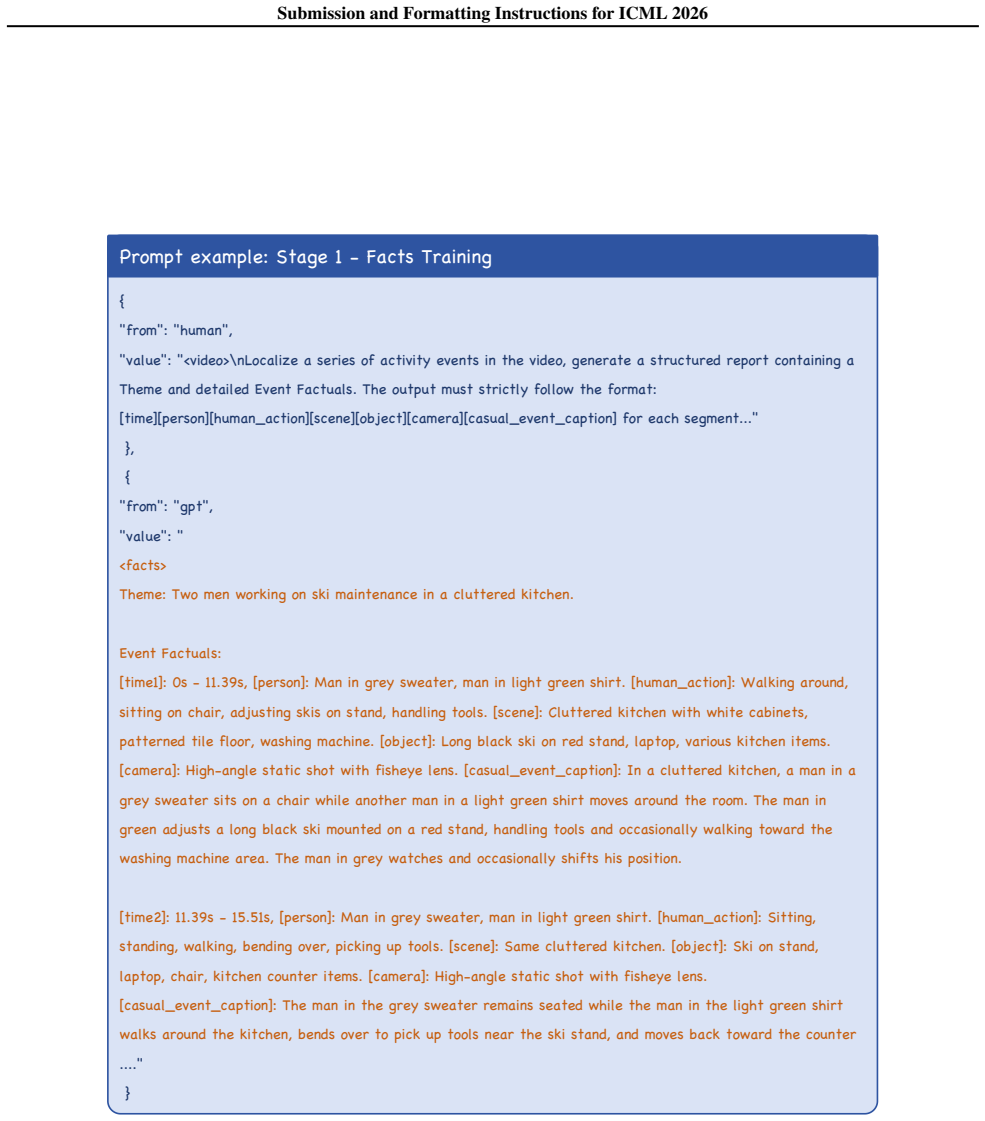
Description Structure: For each segment, include ALL these structured components: [person]: Who is in the scene. Use a comma-separated list. If no human is present, write 'None'. (e.g., 'woman in white apron', 'None') [human_action]: The specific physical movements or interactions performed by the human. * DEPENDENCY RULE: If [person] is 'None', then [hum...
-
[6]
I looked for words like 'screwing', 'removing'
Include all the content in between <facts></facts>. Example (Note the dependency logic): <facts> Theme: A nature documentary and a cooking tutorial. Event Factuals: [time1]: 0.83 - 19.86, [person]: Woman in white apron. [human_action]: Arranging ingredients, placing bowls. [scene]: Bright kitchen. [object]: Yellow bananas, glass bowls. [camera]: Static me...
2026
-
[8]
Goal!" and
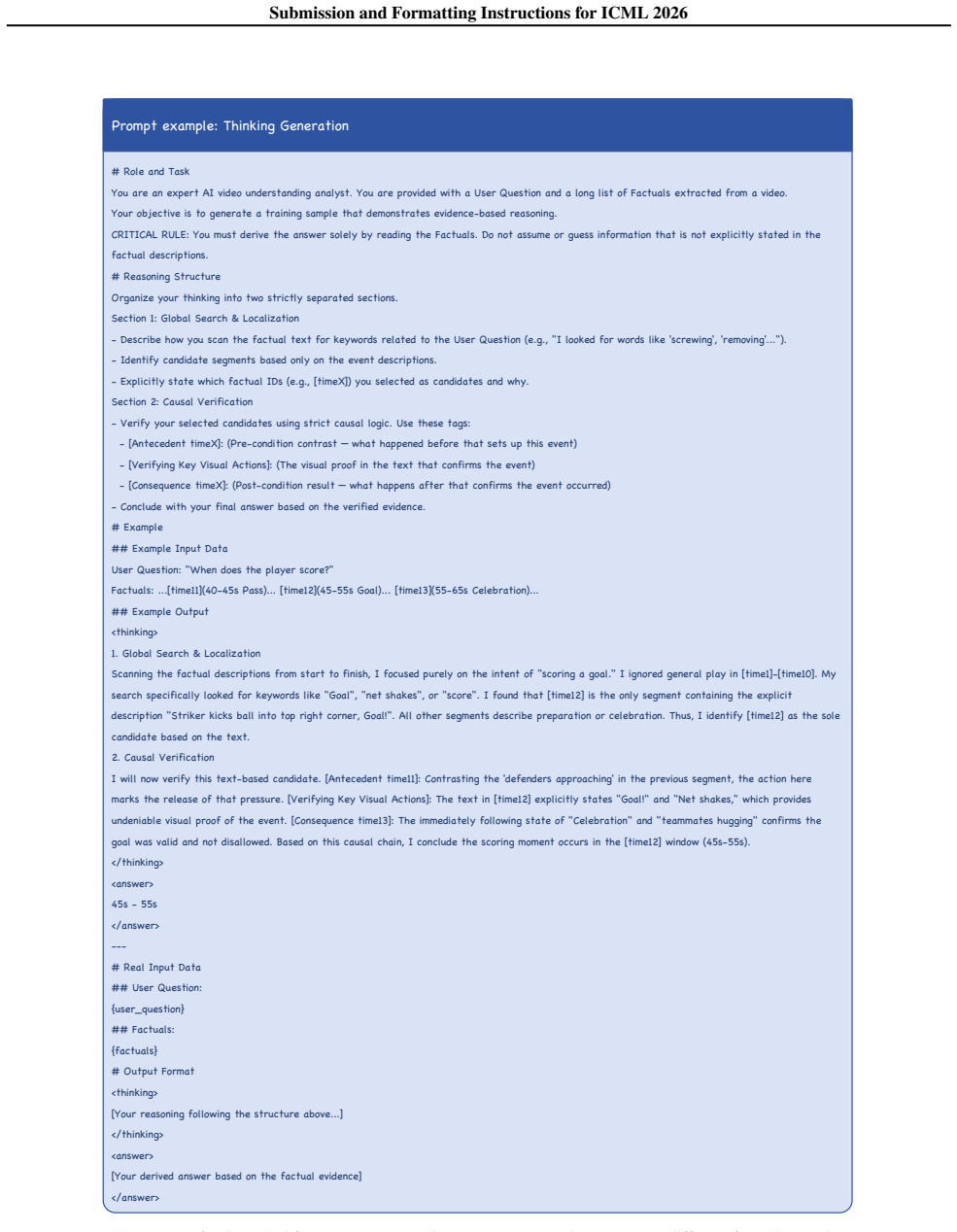
Causal Verification I will now verify this text-based candidate. [Antecedent time11]: Contrasting the 'defenders approaching' in the previous segment, the action here marks the release of that pressure. [Verifying Key Visual Actions]: The text in [time12] explicitly states "Goal!" and "Net shakes," which provides undeniable visual proof of the event. [Con...
2026
-
[9]
scoring a goal
Global Search & Localization Scanning the factual descriptions from start to finish, I focused purely on the intent of "scoring a goal." I ignored general play in [time1]-[time10]. My search specifically looked for keywords like "Goal", "net shakes", or "score". I found that [time12] is the only segment containing the explicit description "Striker kicks b...
-
[10]
Goal!" and
Causal Verification I will now verify this text-based candidate. [Antecedent time11]: Contrasting the 'defenders approaching' in the previous segment, the action here marks the release of that pressure. [Verifying Key Visual Actions]: The text in [time12] explicitly states "Goal!" and "Net shakes," which provides undeniable visual proof of the event. [Con...
2026
discussion (0)
Sign in with ORCID, Apple, or X to comment. Anyone can read and Pith papers without signing in.