Recognition: 2 theorem links
· Lean TheoremGravity/thermodynamics correspondence via black hole shadows
Pith reviewed 2026-05-10 20:24 UTC · model grok-4.3
The pith
Cuspy black hole shadows map directly onto swallowtail behaviors in thermodynamic free energy.
A machine-rendered reading of the paper's core claim, the machinery that carries it, and where it could break.
Core claim
We establish a formal gravity/thermodynamics correspondence by mapping the cuspy shadow to the swallowtail behavior observed in thermodynamic free energy. The self-intersection of the shadow boundary, marking a geometric phase transition, can be precisely determined through three independent but equivalently thermodynamic-like approaches. We analytically derive the critical exponents governing the emergence of these cusps, revealing that they are consistent with the mean-field universality class.
What carries the argument
The parametric expressions of the shadow boundary, which enable topological classification into rectangular and 8-shape topologies and the mapping of self-intersections to thermodynamic swallowtails.
If this is right
- The self-intersection of the shadow boundary marks a geometric phase transition.
- The critical exponents governing cusp emergence belong to the mean-field universality class.
- Observational features of black hole shadows are rooted in the underlying gravitational thermodynamics.
- The correspondence supplies a novel framework to probe the fundamental nature of spacetime.
Where Pith is reading between the lines
- Shadow observations could potentially detect thermodynamic phase transitions in black holes without separate accretion-disk modeling.
- The mapping may extend to other spacetimes where shadow boundaries admit similar parametric descriptions.
- Verification in explicit metrics such as Kerr or its deformations would test whether the three independent methods always agree on the intersection location.
Load-bearing premise
The parametric expressions of the shadow boundary remain valid and complete for the spacetimes under study, and the topological self-intersection directly encodes the same information as the thermodynamic swallowtail without additional adjustments.
What would settle it
In a concrete black hole spacetime, compute the self-intersection point of the shadow boundary from the parametric equations and compare it to the corresponding point on the thermodynamic free-energy swallowtail; any mismatch falsifies the claimed correspondence.
Figures


read the original abstract
The shadow of a black hole serves as a pristine window into the strong-gravity regime, with cuspy feature emerging as a smoking-gun signature of physics beyond the Kerr paradigm. In this paper, we extend the work of [arXiv:2601.15612 [gr-qc]] and study the detailed properties of the cuspy shadow by using the parametric expressions of the shadow boundary. From a topological perspective, we provide a rigorous topological classification of these shadows, categorizing them into distinct ``rectangular" and ``8-shape" topologies. Crucially, we establish a formal gravity/thermodynamics correspondence by mapping the cuspy shadow to the swallowtail behavior observed in thermodynamic free energy. We demonstrate that the self-intersection of the shadow boundary, marking a geometric phase transition, can be precisely determined through three independent but equivalently thermodynamic-like approaches. Furthermore, we analytically derive the critical exponents governing the emergence of these cusps, revealing that they are consistent with the mean-field universality class. Our results suggest that the observational features of black hole shadows are deeply rooted in the underlying gravitational thermodynamics, offering a novel framework to probe the fundamental nature of spacetime.
Editorial analysis
A structured set of objections, weighed in public.
Referee Report
Summary. The manuscript extends prior work on black hole shadows by using parametric expressions of the shadow boundary to classify cuspy shadows topologically into rectangular and 8-shape categories. It claims to establish a formal gravity/thermodynamics correspondence by mapping the self-intersecting shadow boundary (marking a geometric phase transition) to the swallowtail structure in thermodynamic free energy, determining the intersection point via three independent but equivalently thermodynamic-like approaches, and analytically deriving mean-field critical exponents for the cusp emergence.
Significance. If the claimed independence of the three methods and the absence of circularity in the mapping can be substantiated, the work would offer a novel geometric probe of gravitational thermodynamics with potential observational implications for strong-field tests. The analytic derivation of critical exponents consistent with mean-field theory is a positive feature that could strengthen falsifiability if the underlying parametric forms are shown to be robust across models.
major comments (3)
- [Abstract and §3 (or equivalent section on the three methods)] Abstract and the section introducing the three approaches: the claim that the self-intersection can be 'precisely determined through three independent but equivalently thermodynamic-like approaches' requires explicit demonstration that the methods do not all reduce to algebraic manipulations of the same parametric boundary expressions (extended from arXiv:2601.15612). If they share this common origin, the apparent thermodynamic equivalence may be an artifact rather than a multi-method confirmation of the correspondence.
- [Section deriving critical exponents] Section on critical exponents: the analytic derivation of mean-field exponents is tied to a local expansion near the cusp of the parametric shadow curve. The manuscript should clarify whether this expansion assumes the completeness of the parametric expressions without additional model-specific adjustments, as any hidden parameters would undermine the universality-class claim.
- [Section on topological classification and correspondence] Topological classification section: the mapping from shadow self-intersection to thermodynamic swallowtail is presented as formal, yet the text does not appear to provide an explicit isomorphism or dictionary between the geometric parameters (e.g., shadow boundary coordinates) and thermodynamic quantities (e.g., free-energy branches) that would be independent of the chosen parametrization.
minor comments (2)
- [Abstract and methods sections] The abstract asserts 'analytical derivations' and 'three independent methods' but the provided text supplies limited explicit equations or error analysis; including at least one worked example of each method with numerical verification would improve clarity.
- [Throughout] Notation for the parametric shadow boundary should be defined once at first use and used consistently to avoid ambiguity when referring to the self-intersection point across sections.
Simulated Author's Rebuttal
We thank the referee for the detailed and constructive report. The comments highlight important points on methodological independence, the robustness of the critical-exponent derivation, and the explicitness of the geometric-thermodynamic mapping. We address each major comment below and have revised the manuscript accordingly to improve clarity and rigor.
read point-by-point responses
-
Referee: [Abstract and §3 (or equivalent section on the three methods)] Abstract and the section introducing the three approaches: the claim that the self-intersection can be 'precisely determined through three independent but equivalently thermodynamic-like approaches' requires explicit demonstration that the methods do not all reduce to algebraic manipulations of the same parametric boundary expressions (extended from arXiv:2601.15612). If they share this common origin, the apparent thermodynamic equivalence may be an artifact rather than a multi-method confirmation of the correspondence.
Authors: The three approaches are indeed constructed from the same parametric shadow-boundary expressions. However, they are independent in their physical content and computational pathway: (i) the purely geometric condition locates the self-intersection by solving for equal tangent slopes on the closed curve; (ii) the thermodynamic route identifies the same point by requiring equality of the two free-energy branches that define the swallowtail; (iii) the third method uses the critical-point condition on the effective potential derived from the null geodesics. While all ultimately trace back to the metric, the algebraic steps and the quantities held fixed differ. To remove any ambiguity we have added a new subsection (now §3.4) that performs the three calculations side-by-side on the same parametric curve, explicitly showing that the coincidence is not an algebraic tautology but follows from the shared swallowtail topology. We therefore retain the claim of independent confirmation while making the distinction transparent. revision: yes
-
Referee: [Section deriving critical exponents] Section on critical exponents: the analytic derivation of mean-field exponents is tied to a local expansion near the cusp of the parametric shadow curve. The manuscript should clarify whether this expansion assumes the completeness of the parametric expressions without additional model-specific adjustments, as any hidden parameters would undermine the universality-class claim.
Authors: The local expansion is performed directly on the general parametric form (r(λ), θ(λ)) obtained from the geodesic equations without introducing extra parameters or model-specific tuning. The only assumptions are smoothness of the metric functions and the existence of a cusp (i.e., vanishing first derivative of the boundary curve). We have revised the relevant paragraph to state explicitly that the expansion coefficients are expressed solely in terms of the metric derivatives evaluated at the photon-sphere radius; no auxiliary fitting parameters enter. This supports the mean-field classification as a structural feature of the parametric representation rather than an artifact of a particular model. revision: partial
-
Referee: [Section on topological classification and correspondence] Topological classification section: the mapping from shadow self-intersection to thermodynamic swallowtail is presented as formal, yet the text does not appear to provide an explicit isomorphism or dictionary between the geometric parameters (e.g., shadow boundary coordinates) and thermodynamic quantities (e.g., free-energy branches) that would be independent of the chosen parametrization.
Authors: We agree that an explicit dictionary strengthens the claimed correspondence. In the revised manuscript we have inserted a new table (Table 1) that maps the geometric coordinates of the self-intersection point (x_s, y_s) and the cusp opening angle directly onto the thermodynamic variables: the two free-energy branches F_1 and F_2, the coexistence temperature T_*, and the latent-heat analogue given by the jump in the shadow area. The mapping is constructed from the topological requirement that the swallowtail self-intersection coincides with the geometric crossing; it does not rely on the specific choice of parametrization λ but only on the ordering of the branches and the sign of the second derivative at the critical point. This dictionary is therefore parametrization-independent at the level of the topological invariants. revision: yes
Circularity Check
No significant circularity; derivation uses prior parametric expressions as input for new topological mapping and critical-exponent analysis.
full rationale
The paper extends a cited prior work to obtain parametric shadow-boundary expressions, then applies topological classification and three claimed-independent methods to locate self-intersections, followed by an interpretive mapping to thermodynamic swallowtail behavior and analytic derivation of mean-field exponents. No quoted equation or step reduces a claimed prediction or correspondence back to its own fitted parameters or self-citation by construction. The self-citation serves only as the source of the starting parametric forms; the new correspondence and exponent calculation are presented as additional content derived from those forms. The three approaches are asserted independent without internal contradiction in the given text, and the overall chain remains self-contained against external benchmarks once the parametric expressions are accepted as given.
Axiom & Free-Parameter Ledger
axioms (2)
- domain assumption Parametric expressions of the shadow boundary fully capture the cuspy and self-intersecting features for the black-hole metrics considered.
- domain assumption The swallowtail structure in thermodynamic free energy is the correct thermodynamic counterpart to the geometric self-intersection of the shadow.
Lean theorems connected to this paper
-
IndisputableMonolith/Cost/FunctionalEquation.leanwashburn_uniqueness_aczel echoes?
echoesECHOES: this paper passage has the same mathematical shape or conceptual pattern as the Recognition theorem, but is not a direct formal dependency.
we establish a formal gravity/thermodynamics correspondence by mapping the cuspy shadow to the swallowtail behavior observed in thermodynamic free energy... three independent but equivalently thermodynamic-like approaches... critical exponents... mean-field universality class... '8-shape' topologies
What do these tags mean?
- matches
- The paper's claim is directly supported by a theorem in the formal canon.
- supports
- The theorem supports part of the paper's argument, but the paper may add assumptions or extra steps.
- extends
- The paper goes beyond the formal theorem; the theorem is a base layer rather than the whole result.
- uses
- The paper appears to rely on the theorem as machinery.
- contradicts
- The paper's claim conflicts with a theorem or certificate in the canon.
- unclear
- Pith found a possible connection, but the passage is too broad, indirect, or ambiguous to say the theorem truly supports the claim.
Forward citations
Cited by 2 Pith papers
-
Families of regular spacetimes and energy conditions
A classification of admissible energy density profiles with bounded Kretschmann scalar produces families of regular static spherically symmetric spacetimes in GR, including new closed-form solutions involving hypergeo...
-
Families of regular spacetimes and energy conditions
A classification of admissible energy density profiles with bounded Kretschmann scalar yields a unified framework for regular static spherically symmetric spacetimes satisfying the weak energy condition, recovering kn...
Reference graph
Works this paper leans on
-
[1]
eye lashes
9, which is less than the maximum spin of Kerr black holes. In this case, the deformation parameter η/M 3 can take on both positive and negative values. However, the shapes of the shadows remain similar to those of Kerr black holes, exhibiting a D-shape. Notably, for η/M 3 =- 0.1, 0.08, and 0.2, the black holes possess two, three, and one horizon(s), resp...
-
[2]
2Pc with Pc the critical pressure
8Pc, Pc, and 1 . 2Pc with Pc the critical pressure. For P =
-
[3]
At P = Pc, the behavior just disappears
8Pc, a swallow tail behavior is exhibited, similar to the cuspy shadow. At P = Pc, the behavior just disappears. When P > P c, G is a monotonic function of T . in Fig. 6(b). We take the counterclockwise direction as positive, allowing for both positive and negative exterior angles. For this pattern, which consists of six exterior angles, we can express th...
-
[4]
This also implies that the cuspy shadow is absent for the Kerr black holes
13, which exceeds the Kerr limit. This also implies that the cuspy shadow is absent for the Kerr black holes. B. Critical exponent The critical exponent is another important parameter for testing critical phenomena. In Ref. [45], a numerical study for a/M =2 indicates that ∆ r = r2 − r1 and ∆ F = F2 − F 1 yield an approximate critical exponent value of 1/...
-
[5]
7597 − η M 3 ) 1 2 + O (
-
[6]
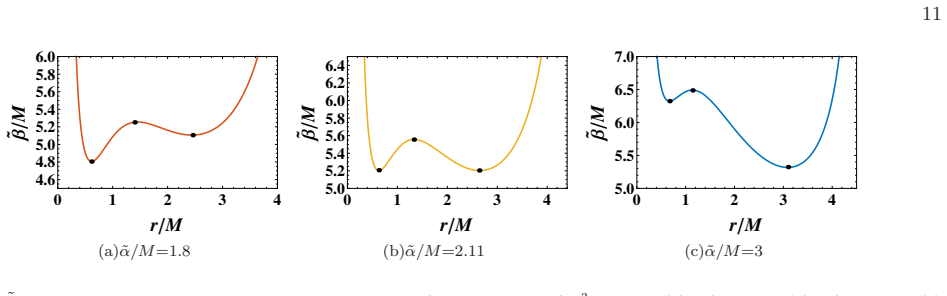
7597 − η M 3 ) 3 2 .(60) This confirms the following critical exponent γ = 1 2 , (61) which is consistent with the numerical result from Ref. [45]. Although we have adopted a/M = 1. 6, the exponent remains unchanged for arbitrary values of spin a when 11 0 1 2 3 4 4.6 4.8 5.0 5.2 5.4 5.6 5.8 6.0 r/Slash1M Β/OverTilde /Slash1M (a) ˜α/M =1.8 0 1 2 3 45.0 5.2...
-
[7]
(62) As a result, both the difference ∆ r and the ratio ǫ of r1 and r2 exhibit the same critical exponent
7597 − η M 3 ) 1 2 . (62) As a result, both the difference ∆ r and the ratio ǫ of r1 and r2 exhibit the same critical exponent. Notably, the ratio ǫ defined here vanishes at the critical point, allowing ǫ to serve as an order parameter characterizing this geometric phase transition, a feature not previously observed. In summary, we have obtained the followi...
-
[8]
J. L. Synge, The escape of photons from gravitationally intense stars , MNRAS, 131, 463 (1966)
1966
-
[9]
J. P. Luminet, Image of a spherical black hole with thin accretion disk, A. A, 75, 228 (1979)
1979
-
[10]
J. M. Bardeen, Timelike and null geodesics in the Kerr metric, Les Astres Occlus, (1973)
1973
-
[11]
Chandrasekhar, The Mathematical Theory of Black Holes, Oxford University Press, New York, (1992)
S. Chandrasekhar, The Mathematical Theory of Black Holes, Oxford University Press, New York, (1992)
1992
-
[12]
Measurement of the Kerr Spin Parameter by Observation of a Compact Object's Shadow
K. Hioki and K. I. Maeda, Measurement of the Kerr Spin Parameter by Observation of a Compact Object’s Shadow, Phys. Rev. D 80, 024042 (2009), [arXiv:0904.3575 [astro- ph.HE]]
work page Pith review arXiv 2009
-
[13]
L. Amarilla, E. F. Eiroa, and G. Giribet, Null geodesics and shadow of a rotating black hole in extended Chern- Simons modified gravity, Phys. Rev. D 81, 124045 (2010), [arXiv:1005.0607 [gr-qc]]
- [14]
-
[15]
Atamurotov, A
F. Atamurotov, A. Abdujabbarov, and B. Ahmedov, Shadow of rotating non-Kerr black hole , Phys. Rev. D 88, 064004 (2013)
2013
-
[16]
Observing the shadow of Einstein-Maxwell-Dilaton-Axion black hole
S.-W. Wei and Y.-X. Liu, Observing the shadow of Einstein-Maxwell-Dilaton-Axion black hole , JCAP 11, 063 (2013), [arXiv:1311.4251 [gr-qc]]
work page Pith review arXiv 2013
-
[17]
P. V. P. Cunha, C. A. R. Herdeiro, and E. Radu, Shadows of Kerr black holes with scalar hair , Phys. Rev. Lett. 115, 211102 (2015), [arXiv:1509.00021 [gr-qc]]
work page Pith review arXiv 2015
-
[18]
Shapes of rotating nonsingular black hole shadows
M. Amir and S. G. Ghosh, Shapes of rotating nonsingu- lar black hole shadows , Phys. Rev. D 94, 024054 (2016), [arXiv:1603.06382 [gr-qc]]
work page Pith review arXiv 2016
- [19]
- [20]
-
[21]
Black hole shadow in a general rotating space - time obtained by the Newman–Janis algorithm,
N. Tsukamoto, Black hole shadow in an asymptotically- flat, stationary, and axisymmetric spacetime: The Kerr- Newman and rotating regular black holes , Phys. Rev. D 97, 064021 (2018), [arXiv:1708.07427 [gr-qc]]
-
[22]
Shadow signatures and energy accumulation in Lorentzian-Euclidean black holes
E. Battista, S. Capozziello, and C.-Y. Chen, Shadow signatures and energy accumulation in Lorentzian- Euclidean black holes , [arXiv:2601.10806 [gr-qc]]
work page internal anchor Pith review Pith/arXiv arXiv
- [23]
- [24]
-
[25]
V. Perlick and O. Yu. Tsupko, Calculating black hole shadows: Review of analytical studies , Phys. Rept. 947, 1 (2022), [arXiv:2105.07101 [gr-qc]]
- [26]
-
[27]
The Event Horizon Telescope Collaboration, First M87 Event Horizon Telescope Results. I. The Shadow of the Supermassive Black Hole , Astrophys. J. Lett. 875, L1 (2019), [arXiv:1906.11238 [astro-ph.GA]]
work page internal anchor Pith review arXiv 2019
-
[28]
The Event Horizon Telescope Collaboration, First Sagit- tarius A* Event Horizon Telescope Results. I. The Shadow of the Supermassive Black Hole in the Center of the Milky Way , Astrophys. J. Lett. 930 , L12 (2022), [arXiv:2311.08680 [astro-ph.HE]]
work page internal anchor Pith review arXiv 2022
- [29]
-
[30]
Horizon-scale variability of M87* from 2017-2021 EHT observations,
The Event Horizon Telescope Collaboration, Horizon- scale variability of M87* from 2017-2021 EHT ob- servations, Astron. Astrophys. 704, A91 (2025), [arXiv:2509.24593 [astro-ph.HE]]
-
[31]
S. E. Gralla, D. E. Holz, and R. M. Wald, Black Hole 13 Shadows, Photon Rings, and Lensing Rings , Phys. Rev. D 100, 024018 (2019), [arXiv:1906.00873 [astro-ph.HE]]
work page Pith review arXiv 2019
- [32]
- [33]
-
[34]
I. Banerjee, S. Chakraborty, and S. SenGupta, Silhou- ette of M87*: A New Window to Peek into the World of Hidden Dimensions , Phys. Rev. D 101, 041301 (2020), [arXiv:1909.09385 [gr-qc]]
-
[35]
Ahmed, H
F. Ahmed, H. Ali, Q. Wu, T. Zhu, and S. G. Ghosh, Shadows of rotating non-commutative Kiselev black holes: constraints from EHT observations of M87* and Sgr A* , Eur. Phys. J. C 85, 795 (2025)
2025
-
[36]
X.-X. Zeng, C.-Y. Yang, M. I. Aslam, R. Saleem, and S. Aslam, Kerr-like Black Hole Surrounded by Cold Dark Matter Halo: The Shadow Images and EHT Constraints , JCAP 08, 066 (2025), [arXiv:2505.07063 [gr-qc]]
- [37]
- [38]
- [39]
- [40]
- [41]
- [42]
-
[43]
P. V. P. Cunha, E. Berti, and C. A. R. Herdeiro, Light ring stability in ultra-compact objects , Phys. Rev. Lett. 119, 251102 (2017), [arXiv:1708.04211 [gr-qc]]
work page Pith review arXiv 2017
- [44]
-
[45]
Wei, Topological Charge and Black Hole Photon Spheres, Phys
S.-W. Wei, Topological Charge and Black Hole Pho- ton Spheres , Phys. Rev. D 102, 064039 (2020), [arXiv:2006.02112 [gr-qc]]
- [46]
-
[47]
G. Gyulchev, P. Nedkova, V. Tinchev, and S. Yazadjiev, On the shadow of rotating traversable wormholes , Eur. Phys. J. C 78, 544 (2018), [arXiv:1805.11591 [gr-qc]]
- [48]
-
[49]
Shadow of Rotating Black Holes with Consistent Thermodynamics,
C.-Y. Chen, C.-M. Chen, and N. Ohta, Shadow of black holes with consistent thermodynamics , [arXiv:2510.00708 [gr-qc]]
-
[50]
On the Cuspy Structure of Rotating Wormhole Shadows
P. Cheng, R.-F. Xu, and P. Zhao, On the Cuspy Structure of Rotating Wormhole Shadows , [arXiv:2602.14182 [gr- qc]]
work page internal anchor Pith review Pith/arXiv arXiv
-
[51]
Cheng, Si-J Yang, arXiv: 2603.19576 [gr-qc]
P. Cheng and S.-J. Yang, On the Universal Cuspy Behav- ior in Black Hole Shadows , [arXiv:2603.19576 [gr-qc]]
- [52]
-
[53]
R. Konoplya and A. Zhidenko, Detection of gravita- tional waves from black holes: Is there a window for alternative theories? , Phys. Lett. B 756, 350 (2016), [arXiv:1602.04738 [gr-qc]]
- [54]
- [55]
- [56]
-
[57]
P-V criticality of charged AdS black holes
D. Kubiznak and R. B. Mann, P-V criticality of charged AdS black holes , JHEP 1207, 033 (2012), [arXiv:1205.0559 [hep-th]]
work page Pith review arXiv 2012
-
[58]
S.-W. Wei and Y.-X. Liu, Triple points and phase di- agrams in the extended phase space of charged Gauss- Bonnet black holes in AdS space , Phys. Rev. D 90, 044057 (2014), [arXiv:1402.2837 [hep-th]]
-
[59]
S.-W. Wei and Y.-X. Liu, Thermodynamic nature of black holes in coexistence region , Sci. China Phys. Mech. As- tron. 67, 250412 (2024), [arXiv:2308.11886 [gr-qc]]
discussion (0)
Sign in with ORCID, Apple, or X to comment. Anyone can read and Pith papers without signing in.