Recognition: 2 theorem links
· Lean TheoremOn the Cuspy Structure of Rotating Wormhole Shadows
Pith reviewed 2026-05-15 22:11 UTC · model grok-4.3
The pith
Cusps appear in rotating wormhole shadows only when the redshift parameter varies past a universal critical value.
A machine-rendered reading of the paper's core claim, the machinery that carries it, and where it could break.
Core claim
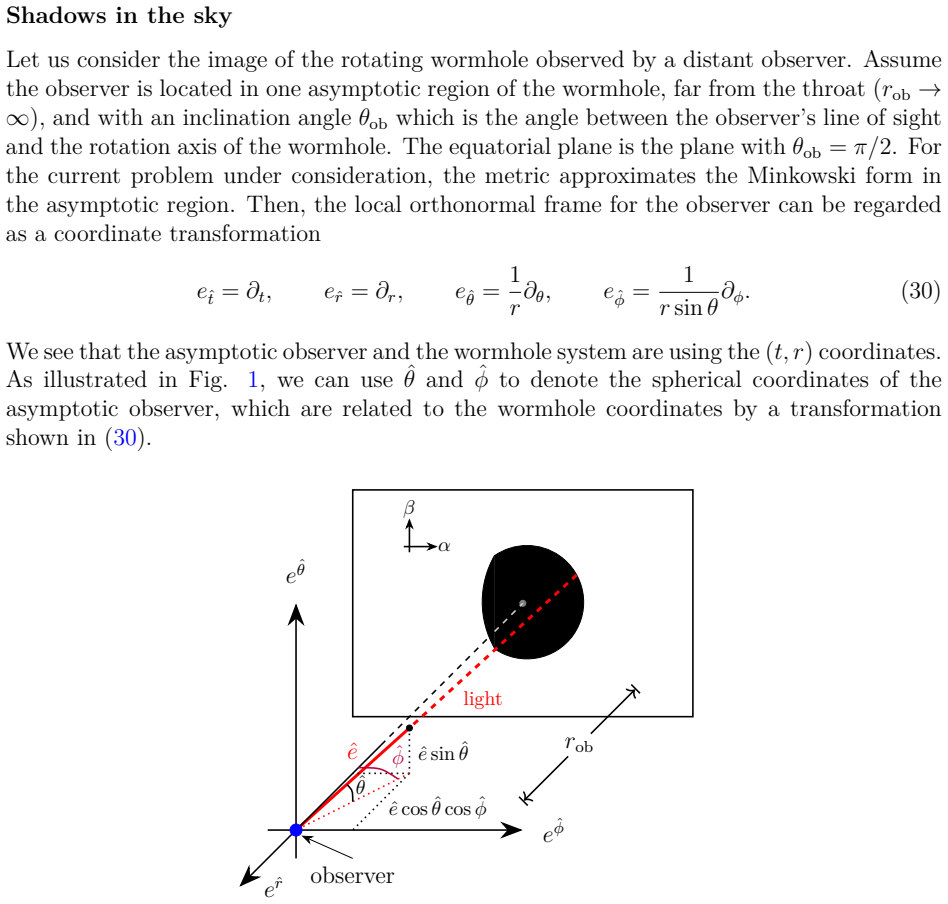
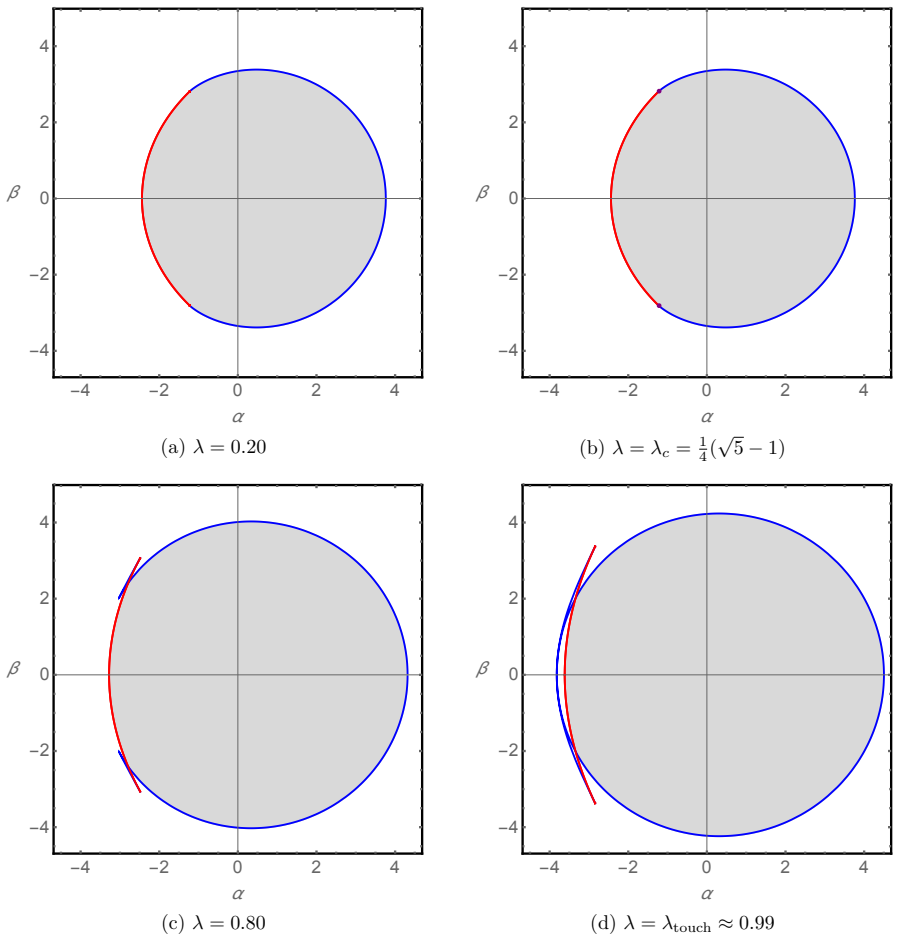
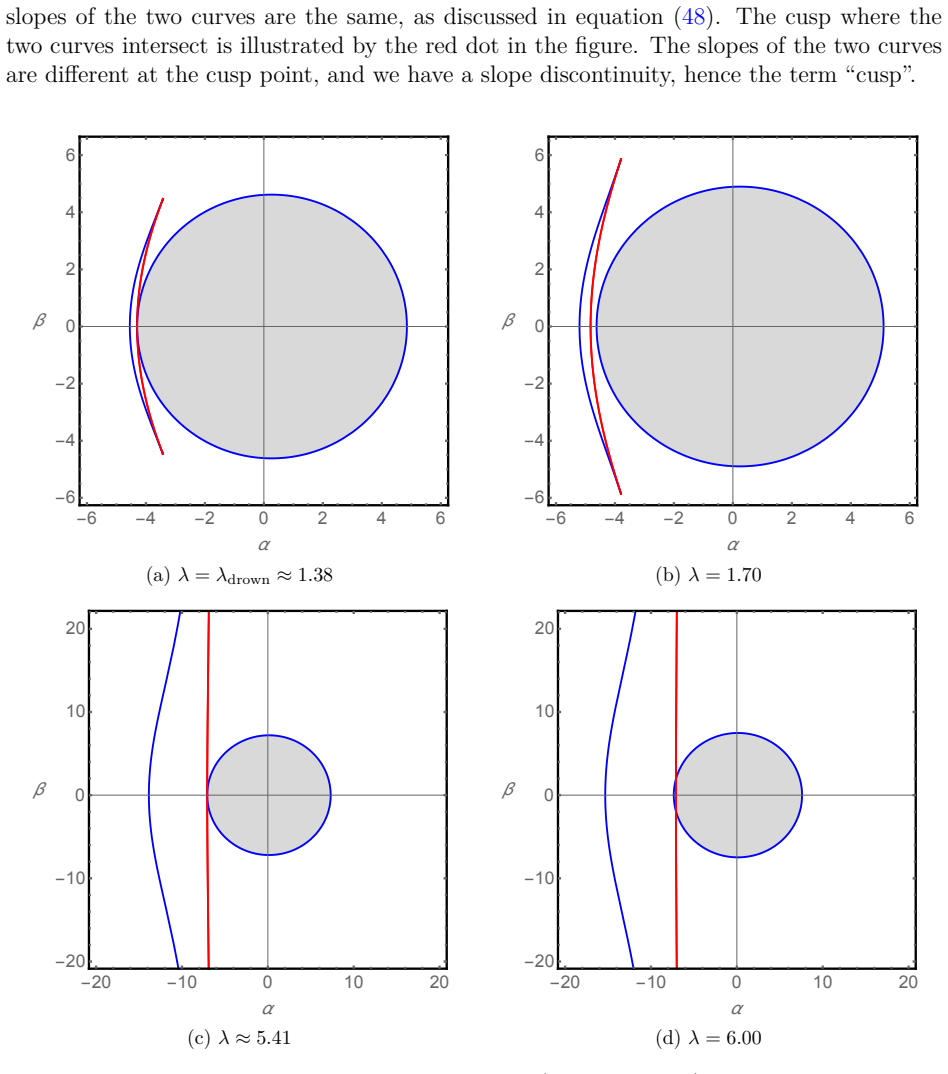
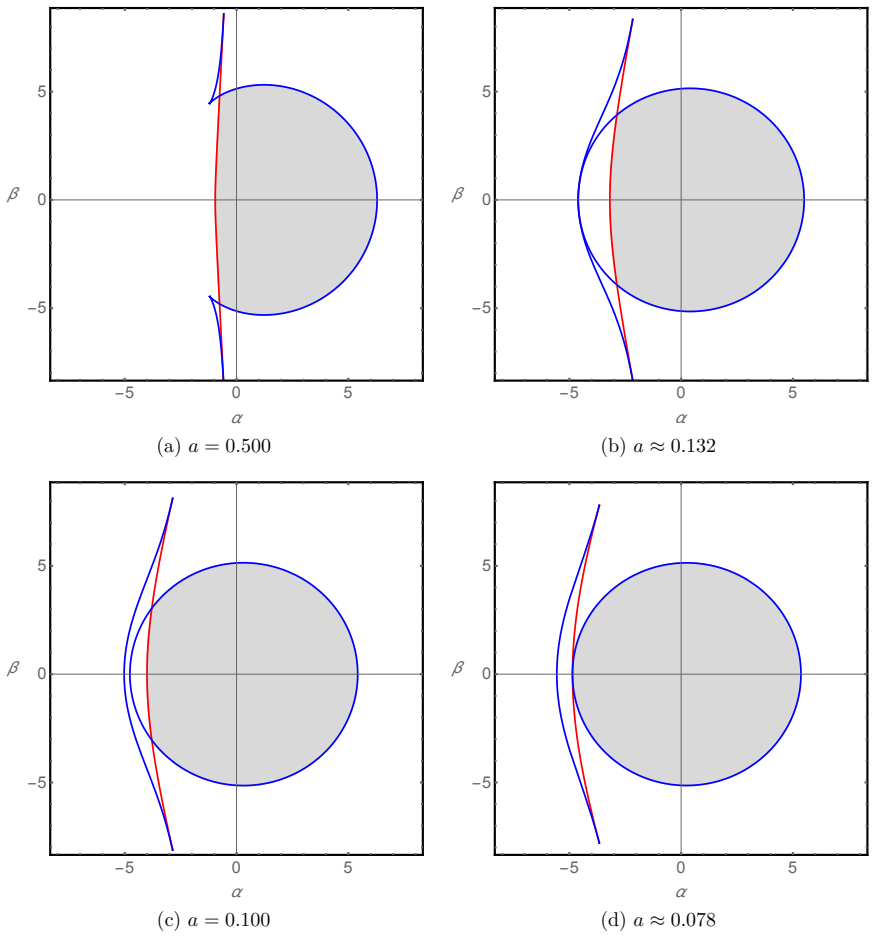
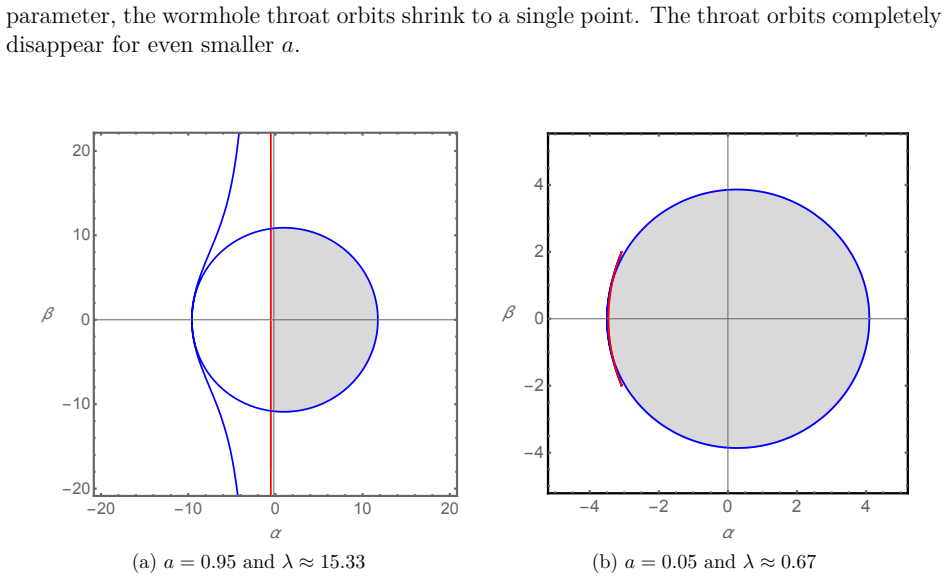
In the Teo class of rotating wormholes endowed with a general redshift function, the shadow boundary is the common envelope of unstable circular orbits outside the throat and orbits at the throat itself. Cusps marking the change from smooth to cuspy boundaries form only when the redshift parameter λ is allowed to vary, at a universal critical value λ_c. The phase diagram in spin and λ space shows four morphologies: smooth, cuspy, ears touching, and throat drowning.
What carries the argument
the common envelope of unstable circular orbits exterior to the throat and orbits at the throat, controlled by variation of the redshift parameter λ
If this is right
- Cusps form only when λ varies and only past the universal critical value λ_c.
- Four morphologies appear in the phase diagram of spin versus redshift parameter.
- The boundary cases include ears touching and throat drowning at specific parameter values.
- Shadow morphology supplies an observational diagnostic for distinguishing wormholes from other compact objects.
Where Pith is reading between the lines
- If actual wormholes have varying redshift functions, their shadows may display cusps absent in black-hole shadows, giving a potential observational distinction.
- The universal λ_c might appear in numerical studies of wormhole models outside the Teo class if similar orbit envelopes exist.
- Fixing the redshift function in advance could hide important morphological features when modeling wormhole shadows.
Load-bearing premise
The wormhole is in the Teo class and its shadow boundary is exactly the common envelope of those two orbit families, with redshift variation as the sole driver of cusp formation.
What would settle it
High-resolution images showing a cuspy shadow for a Teo wormhole with fixed constant redshift, or a smooth shadow when λ exceeds the critical value.
Figures



read the original abstract
We investigate the shadow cast by a rotating traversable wormhole in the Teo class endowed with a general redshift function, with particular emphasis on the emergence of cuspy structures. The shadow boundary is the common envelope of two critical orbit families: unstable circular orbits outside the throat and orbits at the throat itself. The formation of cusps, marking the transition between smooth and cuspy shadow boundaries, only becomes possible when the redshift parameter $\lambda$ is allowed to vary. Moreover, we uncover a universal critical value $\lambda_c$ that signals the onset of the cusp. A phase diagram characterized by the spin and redshift parameters reveals four distinct morphologies: smooth, cuspy, ears touching, and throat drowning. The morphology of the wormhole shadow may provide observational diagnostics for the different compact objects in future high-resolution imaging observations.
Editorial analysis
A structured set of objections, weighed in public.
Referee Report
Summary. The manuscript investigates the shadow cast by a rotating traversable wormhole in the Teo class with a general redshift function parameterized by λ. It claims that the shadow boundary is the common envelope of unstable circular photon orbits outside the throat and orbits at the throat itself. Cusps form only when λ is allowed to vary, with a universal critical value λ_c marking the transition; a phase diagram in spin and λ parameters yields four morphologies (smooth, cuspy, ears touching, throat drowning) that may serve as observational diagnostics.
Significance. If the central construction holds, the identification of a universal λ_c and the four-morphology phase diagram would supply a concrete, parameter-controlled signature for rotating wormholes that could be tested against future high-resolution imaging. The work builds on standard null-geodesic methods in a prescribed metric and isolates the redshift function as the driver of cusp formation.
major comments (1)
- [Abstract and shadow-boundary construction] Abstract and the section defining the shadow boundary: the claim that the observed edge is precisely the common envelope of the two critical-orbit families does not address null geodesics that cross the throat into the other asymptotic region. In a traversable wormhole such paths can reach a distant observer after threading the throat, potentially shifting or smoothing the boundary and altering the reported cusp at λ_c. This possibility must be ruled out by explicit integration or by showing that all crossing rays lie inside the envelope.
Simulated Author's Rebuttal
We are grateful to the referee for the careful reading and constructive comment. We address the major point below and will revise the manuscript accordingly to strengthen the presentation.
read point-by-point responses
-
Referee: [Abstract and shadow-boundary construction] Abstract and the section defining the shadow boundary: the claim that the observed edge is precisely the common envelope of the two critical-orbit families does not address null geodesics that cross the throat into the other asymptotic region. In a traversable wormhole such paths can reach a distant observer after threading the throat, potentially shifting or smoothing the boundary and altering the reported cusp at λ_c. This possibility must be ruled out by explicit integration or by showing that all crossing rays lie inside the envelope.
Authors: We agree that the original manuscript did not explicitly rule out the effect of throat-crossing null geodesics. For an observer in one asymptotic region the shadow boundary is defined by the critical geodesics separating captured from escaping rays. We will add a dedicated paragraph (with supporting numerical ray-tracing) demonstrating that geodesics threading the throat from the opposite side remain strictly inside the common envelope of the unstable exterior photon orbits and the throat orbits, for all values of λ considered. This verification leaves the reported universal λ_c and the four-morphology phase diagram unchanged. The revised text will clarify that the envelope construction already accounts for the traversable nature of the wormhole. revision: yes
Circularity Check
No circularity: derivation follows from geodesic equations in prescribed metric
full rationale
The paper derives the shadow boundary as the common envelope of unstable circular orbits and throat orbits directly from null geodesic integration in the Teo-class metric with redshift function parameterized by λ. The critical value λ_c and the four morphologies arise from solving the conditions for envelope cusps and varying the spin and λ parameters; no step reduces a prediction to a fitted input, self-definition, or self-citation chain. The calculation is self-contained against the metric and orbit classification, with no load-bearing claim equivalent to its inputs by construction.
Axiom & Free-Parameter Ledger
free parameters (1)
- λ (redshift parameter)
axioms (2)
- domain assumption Wormhole belongs to the Teo class with traversable throat and the given redshift function
- domain assumption Shadow boundary equals the common envelope of unstable circular orbits outside the throat and orbits at the throat
Lean theorems connected to this paper
-
IndisputableMonolith/Constants and Cost/FunctionalEquationphi_golden_ratio / phi_fixed_point / Jcost_pos_of_ne_one matches?
matchesMATCHES: this paper passage directly uses, restates, or depends on the cited Recognition theorem or module.
we uncover a universal critical value λ_c = (√5−1)/4 that signals the onset of the cusp... independent of spin and throat radius
-
IndisputableMonolith/Foundation/BranchSelection and Costbranch_selection / J_uniquely_calibrated_via_higher_derivative echoes?
echoesECHOES: this paper passage has the same mathematical shape or conceptual pattern as the Recognition theorem, but is not a direct formal dependency.
the shadow boundary is the common envelope of two critical orbit families... slope discontinuity at the cusp
What do these tags mean?
- matches
- The paper's claim is directly supported by a theorem in the formal canon.
- supports
- The theorem supports part of the paper's argument, but the paper may add assumptions or extra steps.
- extends
- The paper goes beyond the formal theorem; the theorem is a base layer rather than the whole result.
- uses
- The paper appears to rely on the theorem as machinery.
- contradicts
- The paper's claim conflicts with a theorem or certificate in the canon.
- unclear
- Pith found a possible connection, but the passage is too broad, indirect, or ambiguous to say the theorem truly supports the claim.
Forward citations
Cited by 2 Pith papers
-
Dynamics and Radiative Signatures of Accretion Flows onto a Kerr-like Wormhole
GRMHD and GRRT simulations of accretion onto a spinning Kerr-like wormhole show throat-dominated emission producing quasi-periodic modulations in 230 GHz light curves, distinct from Kerr black holes.
-
Gravity/thermodynamics correspondence via black hole shadows
Cuspy black hole shadows correspond to swallowtail thermodynamic free energy, with boundary self-intersections marking geometric phase transitions whose critical exponents fall in the mean-field class.
Reference graph
Works this paper leans on
-
[1]
First M87 Event Horizon Telescope Results. I. The Shadow of the Supermassive Black Hole
Event Horizon Telescope Collaboration, K. Akiyama et al., “First M87 Event Horizon Telescope Results. I. The Shadow of the Supermassive Black Hole,” Astrophys. J. Lett. 875 no. 1, (2019) L1, arXiv:1906.11238 [astro-ph.GA]
work page internal anchor Pith review Pith/arXiv arXiv 2019
-
[2]
Event Horizon Telescope Collaboration, K. Akiyama et al., “First Sagittarius A* Event Horizon Telescope Results. I. The Shadow of the Supermassive Black Hole in the Center of the Milky Way,” Astrophys. J. Lett. 930 no. 2, (2022) L12, arXiv:2311.08680 [astro-ph.HE]
work page internal anchor Pith review Pith/arXiv arXiv 2022
-
[3]
Constraints on black-hole charges with the 2017 EHT observations of M87*,
Event Horizon Telescope Collaboration, P. Kocherlakota et al., “Constraints on black-hole charges with the 2017 EHT observations of M87*,” Phys. Rev. D 103 no. 10, (2021) 104047, arXiv:2105.09343 [gr-qc] . 21
-
[4]
Black Hole Shadows, Photon Rings, and Lensing Rings
S. E. Gralla, D. E. Holz, and R. M. Wald, “Black Hole Shadows, Photon Rings, and Lensing Rings,” Phys. Rev. D 100 no. 2, (2019) 024018, arXiv:1906.00873 [astro-ph.HE]
work page internal anchor Pith review Pith/arXiv arXiv 2019
-
[5]
Shadows and strong gravitational lensing: a brief review
P. V. P. Cunha and C. A. R. Herdeiro, “Shadows and strong gravitational lensing: a brief review,” Gen. Rel. Grav. 50 no. 4, (2018) 42, arXiv:1801.00860 [gr-qc]
work page internal anchor Pith review Pith/arXiv arXiv 2018
-
[6]
Calculating black hole shadows: Review of analytical studies,
V. Perlick and O. Y. Tsupko, “Calculating black hole shadows: Review of analytical studies,” Phys. Rept. 947 (2022) 1–39, arXiv:2105.07101 [gr-qc]
-
[7]
N. Sakai, H. Saida, and T. Tamaki, “Gravastar shadows,” Phys. Rev. D 90 no. 10, (2014) 104013, arXiv:1408.6929 [gr-qc]
work page internal anchor Pith review Pith/arXiv arXiv 2014
-
[8]
Does the black hole shadow probe the event horizon geometry?
P. V. P. Cunha, C. A. R. Herdeiro, and M. J. Rodriguez, “Does the black hole shadow probe the event horizon geometry?,” Phys. Rev. D 97 no. 8, (2018) 084020, arXiv:1802.02675 [gr-qc]
work page internal anchor Pith review Pith/arXiv arXiv 2018
-
[9]
The Shadow of a Rotating Traversable Wormhole
P. G. Nedkova, V. K. Tinchev, and S. S. Yazadjiev, “Shadow of a rotating traversable wormhole,” Phys. Rev. D 88 no. 12, (2013) 124019, arXiv:1307.7647 [gr-qc]
work page internal anchor Pith review Pith/arXiv arXiv 2013
-
[10]
R. Shaikh, “Shadows of rotating wormholes,” Phys. Rev. D 98 no. 2, (2018) 024044, arXiv:1803.11422 [gr-qc]
work page internal anchor Pith review Pith/arXiv arXiv 2018
-
[11]
On the shadow of rotating traversable wormholes
G. Gyulchev, P. Nedkova, V. Tinchev, and S. Yazadjiev, “On the shadow of rotating traversable wormholes,” Eur. Phys. J. C 78 no. 7, (2018) 544, arXiv:1805.11591 [gr-qc]
work page internal anchor Pith review Pith/arXiv arXiv 2018
-
[12]
The Particle Problem in the General Theory of Relativity,
A. Einstein and N. Rosen, “The Particle Problem in the General Theory of Relativity,” Phys. Rev. 48 (1935) 73–77
work page 1935
-
[13]
J. A. Wheeler, “Geons,” Phys. Rev. 97 no. 2, (1955) 511–536
work page 1955
-
[14]
Can wormholes mirror the quasinormal mode spectrum of Schwarzschild black holes?,
C. De Simone, V. De Falco, and S. Capozziello, “Can wormholes mirror the quasinormal mode spectrum of Schwarzschild black holes?,” Phys. Rev. D 111 no. 6, (2025) 064021, arXiv:2502.12646 [gr-qc]
-
[15]
V. De Falco, E. Battista, S. Capozziello, and M. De Laurentis, “General relativistic Poynting-Robertson effect to diagnose wormholes existence: static and spherically symmetric case,” Phys. Rev. D 101 no. 10, (2020) 104037, arXiv:2004.14849 [gr-qc]
-
[16]
Testing wormhole solutions in extended gravity through the Poynting-Robertson effect,
V. De Falco, E. Battista, S. Capozziello, and M. De Laurentis, “Testing wormhole solutions in extended gravity through the Poynting-Robertson effect,” Phys. Rev. D 103 no. 4, (2021) 044007, arXiv:2101.04960 [gr-qc]
-
[17]
Epicyclic frequencies in static and spherically symmetric wormhole geometries,
V. De Falco, M. De Laurentis, and S. Capozziello, “Epicyclic frequencies in static and spherically symmetric wormhole geometries,” Phys. Rev. D 104 no. 2, (2021) 024053, arXiv:2106.12564 [gr-qc] . 22
-
[18]
V. De Falco, “Epicyclic frequencies in the equatorial plane around stationary and axially symmetric wormhole geometries,” Phys. Rev. D 108 no. 2, (2023) 024051, arXiv:2307.03151 [gr-qc]
-
[19]
D. C. Dai and D. Stojkovic, “Observing a Wormhole,” Phys. Rev. D 100 no. 8, (2019) 083513, arXiv:1910.00429 [gr-qc]
-
[20]
Sensitive searches for wormholes,
J. H. Simonetti, M. J. Kavic, D. Minic, D. Stojkovic, and D. C. Dai, “Sensitive searches for wormholes,” Phys. Rev. D 104 no. 8, (2021) L081502, arXiv:2007.12184 [gr-qc]
-
[21]
C. Bambi and D. Stojkovic, “Astrophysical Wormholes,” Universe 7 no. 5, (2021) 136, arXiv:2105.00881 [gr-qc]
-
[22]
Shadow images of Kerr-like wormholes,
M. Amir, K. Jusufi, A. Banerjee and S. Hansraj, “Shadow images of Kerr-like wormholes,” Class. Quant. Grav. 36 (2019) no.21, 215007, arXiv:1806.07782 [gr-qc]
-
[23]
Throat effects on shadows of Kerr-like wormholes,
S. Kasuya and M. Kobayashi, “Throat effects on shadows of Kerr-like wormholes,” Phys. Rev. D 103 (2021) no.10, 104050, arXiv:2103.13086 [gr-qc]
-
[24]
N. Tsukamoto, “Nonlogarithmic divergence of a deflection angle by a marginally unstable photon sphere of the Damour-Solodukhin wormhole in a strong deflection limit,” Phys. Rev. D 106 (2020) no.04, 049901, arXiv:2004.00822 [gr-qc]
-
[25]
N. Tsukamoto, “Comment on ‘Horizon-scale tests of gravity theories and fundamental physics from the Event Horizon Telescope image of Sagittarius A*’,” Class. Quant. Grav. 40 (2023) no.22, 228001, arXiv:2307.11303 [gr-qc]
-
[26]
Observational signatures of wormholes with thin accretion disks,
S. Paul, R. Shaikh, P. Banerjee and T. Sarkar, “Observational signatures of wormholes with thin accretion disks,” JCAP 03 (2020), 055, arXiv:1911.05525 [gr-qc]
-
[27]
M. S. Morris and K. S. Thorne, “Wormholes in space-time and their use for interstellar travel: A tool for teaching general relativity,” Am. J. Phys. 56 (1988) 395–412
work page 1988
-
[28]
Rotating traversable wormholes
E. Teo, “Rotating traversable wormholes,” Phys. Rev. D 58 (1998) 024014, arXiv:gr-qc/9803098
work page internal anchor Pith review Pith/arXiv arXiv 1998
-
[29]
Axially symmetric rotating traversable wormholes,
P. K. F. Kuhfittig, “Axially symmetric rotating traversable wormholes,” Phys. Rev. D 67 no. 6, (2003) 064015
work page 2003
-
[30]
Traversable wormholes: Some simple examples,
M. Visser, “Traversable wormholes: Some simple examples,” Phys. Rev. D 39 no. 10, (1989) 3182–3184
work page 1989
-
[31]
A selfconsistent semiclassical solution with a throat in the theory of gravity,
S. V. Sushkov, “A selfconsistent semiclassical solution with a throat in the theory of gravity,” Phys. Lett. A 164 no. 1, (1992) 33–37
work page 1992
-
[32]
Self-Consistent Wormhole Solutions of Semiclassical Gravity,
D. Hochberg, A. Popov, and S. V. Sushkov, “Self-Consistent Wormhole Solutions of Semiclassical Gravity,” Phys. Rev. Lett. 78 no. 11, (1997) 2050–2053. 23
work page 1997
-
[33]
Phantom energy traversable wormholes
F. S. N. Lobo, “Phantom energy traversable wormholes,” Phys. Rev. D 71 no. 8, (2005) 084011, arXiv:gr-qc/0502099 [gr-qc]
work page internal anchor Pith review Pith/arXiv arXiv 2005
-
[34]
Wormholes supported by a phantom energy
S. V. Sushkov, “Wormholes supported by a phantom energy,”Phys. Rev. D 71 no. 4, (2005) 043520, arXiv:gr-qc/0502084 [gr-qc]
work page internal anchor Pith review Pith/arXiv arXiv 2005
-
[35]
Wormholes in dilatonic Einstein-Gauss-Bonnet theory,
P. Kanti, B. Kleihaus, and J. Kunz, “Wormholes in dilatonic Einstein-Gauss-Bonnet theory,” Phys. Rev. Lett. 107 no. 27, (2011) 271101
work page 2011
-
[36]
D. C. Dai, D. Minic, and D. Stojkovic, “How to form a wormhole,”Eur. Phys. J. C 80 no. 12, (2020) 1103, arXiv:2010.03947 [gr-qc]
-
[37]
A new wormhole solution in de Sitter space
D. C. Dai, D. Minic, and D. Stojkovic, “New wormhole solution in de Sitter space,” Phys. Rev. D 98 no. 12, (2018) 124026, arXiv:1810.03432 [hep-th]
work page internal anchor Pith review Pith/arXiv arXiv 2018
-
[38]
Exact rotating wormholes via Ehlers transformations,
A. Cisterna, K. Müller, K. Pallikaris, and A. Viganò, “Exact rotating wormholes via Ehlers transformations,” Phys. Rev. D 108 no. 2, (2023) 024066, arXiv:2306.14541 [gr-qc]
-
[39]
Gravitational equal-area law and critical phenomena of cuspy black hole shadow,
S.-W. Wei, C.-H. Wang, Y.-P. Zhang, Y.-X. Liu, and R. B. Mann, “Gravitational equal-area law and critical phenomena of cuspy black hole shadow,” arXiv:2601.15612 [gr-qc]
-
[40]
Shadow casted by a Konoplya-Zhidenko rotating non-Kerr black hole
M. Wang, S. Chen, and J. Jing, “Shadow casted by a Konoplya-Zhidenko rotating non-Kerr black hole,” JCAP 10 (2017) 051, arXiv:1707.09451 [gr-qc]
work page internal anchor Pith review Pith/arXiv arXiv 2017
-
[41]
Shadow of black holes with consistent thermodynamics,
C.-Y. Chen, C.-M. Chen, and N. Ohta, “Shadow of black holes with consistent thermodynamics,” arXiv:2510.00708 [gr-qc]
-
[42]
Cuspy and fractured black hole shadows in a toy model with axisymmetry,
W.-L. Qian, S. Chen, C.-G. Shao, B. Wang, and R.-H. Yue, “Cuspy and fractured black hole shadows in a toy model with axisymmetry,” Eur. Phys. J. C 82 no. 1, (2022) 91, arXiv:2102.03820 [gr-qc]
-
[43]
Fundamental photon orbits: black hole shadows and spacetime instabilities
P. V. P. Cunha, C. A. R. Herdeiro, and E. Radu, “Fundamental photon orbits: black hole shadows and spacetime instabilities,” Phys. Rev. D 96 no. 2, (2017) 024039, arXiv:1705.05461 [gr-qc]
work page internal anchor Pith review Pith/arXiv arXiv 2017
-
[44]
Asymptotic safety casts its shadow
A. Held, R. Gold, and A. Eichhorn, “Asymptotic safety casts its shadow,” JCAP 06 (2019) 029, arXiv:1904.07133 [gr-qc]
work page internal anchor Pith review Pith/arXiv arXiv 2019
-
[45]
Shadow of rotating wormhole in plasma environment,
A. Abdujabbarov, B. Juraev, B. Ahmedov, and Z. Stuchlík, “Shadow of rotating wormhole in plasma environment,” Astrophys. Space Sci. 361 no. 7, (2016) 226
work page 2016
-
[46]
Thin accretion disks in stationary axisymmetric wormhole spacetimes
T. Harko, Z. Kovacs, and F. S. N. Lobo, “Thin accretion disks in stationary axisymmetric wormhole spacetimes,” Phys. Rev. D 79 (2009) 064001, arXiv:0901.3926 [gr-qc]
work page internal anchor Pith review Pith/arXiv arXiv 2009
-
[47]
Broad K$\alpha$ iron line from accretion disks around traversable wormholes
C. Bambi, “Broad Kα iron line from accretion disks around traversable wormholes,” Phys. Rev. D 87 (2013) 084039, arXiv:1303.0624 [gr-qc] . 24
work page internal anchor Pith review Pith/arXiv arXiv 2013
-
[48]
General parametrization of wormhole spacetimes and its application to shadows and quasinormal modes,
K. A. Bronnikov, R. A. Konoplya and T. D. Pappas, “General parametrization of wormhole spacetimes and its application to shadows and quasinormal modes,” Phys. Rev. D 103 (2021) 124062, arXiv:2102.10679 [gr-qc]
-
[49]
Timelike and null geodesics in the Kerr metric,
J. M. Bardeen, “Timelike and null geodesics in the Kerr metric,” Proceedings, Ecole d’Eté de Physique Théorique: Les Astres Occlus : Les Houches, France, August, 1972, 215-240 (1973) 215–240. 25
work page 1972
discussion (0)
Sign in with ORCID, Apple, or X to comment. Anyone can read and Pith papers without signing in.