Recognition: 3 theorem links
· Lean TheoremThe Bott Metric: A Real-Space Bridge Between Topology and Quantum Metric
Pith reviewed 2026-05-10 19:46 UTC · model grok-4.3
The pith
The Bott metric converges to the trace of the integrated quantum metric in the thermodynamic limit.
A machine-rendered reading of the paper's core claim, the machinery that carries it, and where it could break.
Core claim
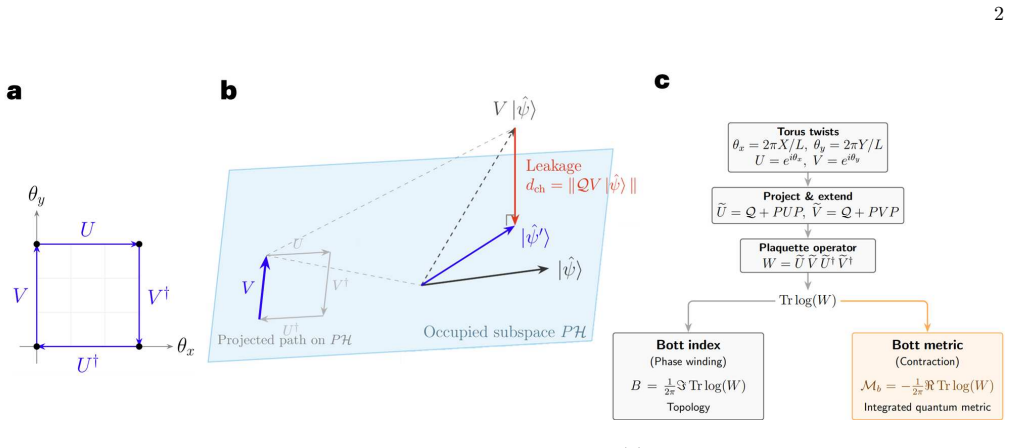
We define the Bott metric from the amplitude part of the plaquette operator. In the thermodynamic limit, the Bott metric converges to the trace of the integrated quantum metric. Our definition unifies topological invariants and quantum metric under the same plaquette operator and provides a route to quantum metric in non-periodic systems, demonstrated in disordered and amorphous examples.
What carries the argument
The Bott metric, which extracts amplitude information from the plaquette operator to measure the system's quantum metric.
If this is right
- The quantum metric structure becomes computable in real space for systems without translational invariance.
- The plaquette operator now serves as a common foundation for both topological and geometric quantities.
- Disordered and amorphous models can be analyzed for their quantum metric using this approach.
- This unifies the treatment of topology and quantum geometry in a single construction.
Where Pith is reading between the lines
- Extensions to other real-space topological measures could similarly incorporate metric information.
- The method may allow direct links between calculated quantum metrics and measurable responses in complex materials.
- Finite-size studies of the Bott metric could quantify how quantum geometry emerges with increasing system size.
Load-bearing premise
The amplitude information from the plaquette operator is well-defined and converges properly in the thermodynamic limit for disordered and amorphous models.
What would settle it
Numerical evaluation of the Bott metric and the integrated quantum metric trace in increasingly large disordered systems; failure to converge to the same value would refute the claim.
Figures


read the original abstract
The Bott index has become an indispensable tool to probe the topology of quantum matter, particularly in systems lacking translational symmetry. Constructed from a plaquette operator, it retains the phase information while discarding the amplitude. Here we introduce and develop the Bott metric, which captures this complementary amplitude information and provides a measure of the underlying quantum metric of the system. We show that, in the thermodynamic limit, the Bott metric converges to the trace of the integrated quantum metric. Our framework provides a new route to reveal the quantum metric structure in non-periodic systems, which we illustrate using representative examples ranging from disordered to amorphous models. More broadly, our definition of the Bott metric unifies the notion of topological invariants and quantum metric under the same overarching plaquette operator construction.
Editorial analysis
A structured set of objections, weighed in public.
Referee Report
Summary. The manuscript introduces the Bott metric, extracted from the amplitude information of the plaquette operator underlying the Bott index for topological invariants in non-periodic systems. It claims that, in the thermodynamic limit, the Bott metric converges to the trace of the integrated quantum metric, thereby providing a real-space bridge between topology and quantum geometry. The framework is illustrated with examples in disordered and amorphous models, unifying both concepts under a single plaquette-operator construction.
Significance. If the claimed convergence holds with appropriate rigor, the result would offer a practical real-space diagnostic for the quantum metric in systems lacking translational symmetry, where momentum-space definitions are unavailable. This could be useful for numerical studies of disordered topological phases and amorphous materials, extending existing tools like the Bott index. The unification under one operator is conceptually appealing, though its broader impact depends on the generality of the thermodynamic-limit result.
major comments (2)
- [§3 and §5] The central convergence claim (abstract and §3) that the Bott metric equals Tr(∫g) in the thermodynamic limit is load-bearing for the entire framework, yet the derivation appears to require unstated assumptions on correlation decay or localization length; without explicit bounds, the result may not hold uniformly for the strong-disorder and amorphous cases shown in §5.
- [Eq. (8)] Eq. (8) defines the Bott metric via the amplitude of the plaquette operator; it is unclear whether this is exactly the integrated quantum metric or an approximation, and whether finite-size corrections or disorder averaging are controlled in the limit.
minor comments (3)
- [§2] Notation for the plaquette operator and its decomposition into phase/amplitude should be introduced earlier and used consistently across sections.
- [§5] Figure captions for the numerical examples in §5 lack details on system sizes, disorder realizations, and error bars, making it hard to assess convergence.
- [Introduction] A brief comparison table or paragraph contrasting the Bott metric with existing real-space quantum-metric proxies would improve clarity.
Simulated Author's Rebuttal
We thank the referee for their careful reading of the manuscript and for the constructive comments that help clarify the scope and rigor of our results. We address each major point below and have revised the manuscript to incorporate additional discussion of assumptions and controls.
read point-by-point responses
-
Referee: [§3 and §5] The central convergence claim (abstract and §3) that the Bott metric equals Tr(∫g) in the thermodynamic limit is load-bearing for the entire framework, yet the derivation appears to require unstated assumptions on correlation decay or localization length; without explicit bounds, the result may not hold uniformly for the strong-disorder and amorphous cases shown in §5.
Authors: We thank the referee for highlighting this point. The derivation in §3 assumes a gapped phase in which single-particle states are localized with a finite localization length, implying exponential decay of correlations; these conditions are the same as those required for the Bott index to be well-defined and quantized. In the strong-disorder and amorphous examples of §5 the localization length remains finite, so the thermodynamic-limit convergence holds. To make the assumptions explicit we have added a dedicated paragraph in §3 stating the required correlation decay and noting that the numerical data in §5 confirm convergence under these conditions. We do not provide model-specific explicit bounds on the rate of convergence, as that would require a separate, more technical analysis outside the present scope; the central claim remains the existence of the limit under the stated physical conditions. revision: yes
-
Referee: [Eq. (8)] Eq. (8) defines the Bott metric via the amplitude of the plaquette operator; it is unclear whether this is exactly the integrated quantum metric or an approximation, and whether finite-size corrections or disorder averaging are controlled in the limit.
Authors: Equation (8) supplies the exact definition of the Bott metric as the amplitude extracted from the plaquette operator. The equality to Tr(∫g) is not an approximation; it is a theorem that becomes exact in the thermodynamic limit, as shown in §3. We have revised the text immediately following Eq. (8) to emphasize this distinction. Finite-size corrections are now discussed in a new paragraph in §3, where we note the scaling of the difference with system size. In the numerical examples of §5 the Bott metric is computed after averaging over disorder realizations, and the thermodynamic limit is taken on the averaged quantity; we have updated the relevant figure captions and the paragraph after Eq. (8) to state this procedure explicitly. revision: yes
Circularity Check
Bott metric defined from plaquette amplitude; convergence to integrated quantum metric trace shown as independent limit result
full rationale
The paper constructs the Bott metric explicitly as the amplitude complement to the established Bott index (phase part) from the same plaquette operator. The central claim—that this quantity converges in the thermodynamic limit to Tr(∫g) where g is the quantum metric—is presented as a derived result illustrated on disordered and amorphous examples, not as a definitional identity or renormalization. No equations reduce the convergence to a fitted parameter, self-citation chain, or ansatz imported from prior author work; the derivation remains self-contained against external benchmarks for the quantum metric and Bott index. This is the normal non-circular case.
Axiom & Free-Parameter Ledger
axioms (2)
- domain assumption The plaquette operator retains phase information while discarding amplitude.
- standard math Averages over plaquettes converge to integrated quantities in the thermodynamic limit.
invented entities (1)
-
Bott metric
no independent evidence
Lean theorems connected to this paper
-
IndisputableMonolith/Foundation/RealityFromDistinction.leanreality_from_one_distinction unclearWe show that, in the thermodynamic limit, the Bott metric converges to the trace of the integrated quantum metric... Mb := −1/2π Re Tr log(W)
-
IndisputableMonolith/Cost/FunctionalEquation.leanwashburn_uniqueness_aczel unclear− log |det(WP)| = − Re Tr log(WP) ... lim L→∞ Mb = Tr(G)
-
IndisputableMonolith/Foundation/AlexanderDuality.leanalexander_duality_circle_linking unclearThe Bott metric... unifies the notion of topological invariants and quantum metric under the same overarching plaquette operator construction
Reference graph
Works this paper leans on
-
[1]
(7) Here the right-hand side is the squared chordal Fubini- Study distance between the ray of U |ψ ⟩ and the ray of its normalized projection back into P H [ 3, 23, 24]
then gives us ∥QU |ψ ⟩∥2 = 1 − ⏐ ⏐⟨ψ |U †|ψ proj ⟩ ⏐ ⏐2 . (7) Here the right-hand side is the squared chordal Fubini- Study distance between the ray of U |ψ ⟩ and the ray of its normalized projection back into P H [ 3, 23, 24]. For a 3 twist step of 2 π/L the distance is quadratic in the step size, with the leading term given by the quantum met- ric [ 3, ...
2023
-
[2]
M. V. Berry, Proceedings of the Royal Society of London. A. Mathematical and Physical Sciences 392, 45 (1984)
1984
-
[3]
D. J. Thouless, M. Kohmoto, M. P. Nightingale, and M. den Nijs, Phys. Rev. Lett. 49, 405 (1982)
1982
-
[4]
Provost and G
J.-P. Provost and G. Vall´ ee, Communications in Mathe- matical Physics 76, 289 (1980)
1980
-
[5]
Liu, X.-B
T. Liu, X.-B. Qiang, H.-Z. Lu, and X. C. Xie, National Science Review 12, nwae334 (2025)
2025
-
[6]
Verma, P
N. Verma, P. J. Moll, T. Holder, and R. Queiroz, Nature Reviews Physics , 1 (2026)
2026
-
[7]
Peotta and P
S. Peotta and P. T¨ orm¨ a, Nature Communications6, 8944 (2015)
2015
-
[8]
Julku, T
A. Julku, T. J. Peltonen, L. Liang, T. T. Heikkil¨ a, and P. T¨ orm¨ a, Physical Review B101, 060505 (2020)
2020
-
[9]
F. Xie, Z. Song, and B. Lian, Physical Review Letters 124, 167002 (2020)
2020
-
[10]
Marzari and D
N. Marzari and D. Vanderbilt, Physical Review B 56, 12847 (1997)
1997
-
[11]
Marrazzo and R
A. Marrazzo and R. Resta, Physical Review Letters 122, 166602 (2019)
2019
-
[12]
Resta, The European Physical Journal B 79, 121 (2011)
R. Resta, The European Physical Journal B 79, 121 (2011)
2011
-
[13]
Souza, T
I. Souza, T. Wilkens, and R. M. Martin, Physical Review B 62, 1666 (2000)
2000
-
[14]
Onishi and L
Y. Onishi and L. Fu, Physical Review X 14, 011052 (2024)
2024
-
[15]
M. B. Hastings and T. A. Loring, Journal of Mathemat- ical Physics 51, 015214 (2010)
2010
-
[16]
T. A. Loring and M. B. Hastings, Europhysics Letters 92, 67004 (2010)
2010
-
[17]
Prodan, Journal of Physics A: Mathematical and The- oretical 44, 113001 (2011)
E. Prodan, Journal of Physics A: Mathematical and The- oretical 44, 113001 (2011)
2011
-
[18]
Huang and F
H. Huang and F. Liu, Phys. Rev. Lett. 121, 126401 (2018)
2018
-
[19]
Marsal, D
Q. Marsal, D. Varjas, and A. G. Grushin, Proceedings of the National Academy of Sciences 117, 30260 (2020)
2020
-
[20]
Toniolo, Physical Review B 98, 235425 (2018)
D. Toniolo, Physical Review B 98, 235425 (2018)
2018
-
[21]
Bellissard, A
J. Bellissard, A. van Elst, and H. Schulz-Baldes, Journal of Mathematical Physics 35, 5373 (1994)
1994
-
[22]
Kramer and A
B. Kramer and A. MacKinnon, Rep. Prog. Phys. 56, 1469 (1993)
1993
-
[23]
Toniolo, Letters in Mathematical Physics 112, 126 (2022)
D. Toniolo, Letters in Mathematical Physics 112, 126 (2022)
2022
-
[24]
Bengtsson and K
I. Bengtsson and K. ˙Zyczkowski, Geometry of Quantum States: An Introduction to Quantum Entanglement , 2nd ed. (Cambridge University Press, 2017)
2017
-
[25]
D. C. Brody and L. P. Hughston, Journal of Geometry and Physics 38, 19 (2001)
2001
-
[26]
Kolodrubetz, D
M. Kolodrubetz, D. Sels, P. Mehta, and A. Polkovnikov, Physics Reports 697, 1 (2017)
2017
-
[27]
J. M. Romeral, A. W. Cummings, and S. Roche, Phys. Rev. B 111, 134201 (2025)
2025
-
[28]
See Supplemental Material for additional derivations, nu- merical checks, and model details
-
[29]
Qi, Y.-S
X.-L. Qi, Y.-S. Wu, and S.-C. Zhang, Physical Review B 74, 085308 (2006)
2006
-
[30]
N. P. Mitchell, L. M. Nash, D. Hexner, A. M. Turner, and W. T. M. Irvine, Nature Physics 14, 380 (2018)
2018
-
[31]
Corbae, S
P. Corbae, S. M. Griffin, and A. G. Grushin, Europhysics Letters 142, 66001 (2023)
2023
-
[32]
Mu˜ noz-Segovia, P
D. Mu˜ noz-Segovia, P. Corbae, D. Varjas, F. Hellman, S. M. Griffin, and A. G. Grushin, Physical Review Re- search 5, L042011 (2023)
2023
-
[33]
Agarwala and V
A. Agarwala and V. B. Shenoy, Physical Review Letters 118, 236402 (2017)
2017
-
[34]
Titum, N
P. Titum, N. H. Lindner, M. C. Rechtsman, and G. Re- fael, Physical Review Letters 114, 056801 (2015)
2015
-
[35]
S. Kim, A. Agarwala, and D. Chowdhury, Phys. Rev. Lett. 130, 026202 (2023)
2023
-
[36]
Zeng, Y.-B
Q.-B. Zeng, Y.-B. Yang, and Y. Xu, Physical Review B 101, 020201 (2020)
2020
-
[37]
C. Wang, T. Cheng, Z. Liu, F. Liu, and H. Huang, Phys. Rev. Lett. 128, 056401 (2022)
2022
-
[38]
X. S. Wang, A. Brataas, and R. E. Troncoso, Physical Review Letters 125, 217202 (2020)
2020
-
[39]
S. Yu, X. Piao, and N. Park, Physical Review Letters 125, 053901 (2020)
2020
-
[40]
A. J. Koll´ ar, M. Fitzpatrick, and A. A. Houck, Nature 571, 45 (2019)
2019
-
[41]
Tang, L.-F
L.-Z. Tang, L.-F. Zhang, G.-Q. Zhang, and D.-W. Zhang, Physical Review A 101, 063612 (2020)
2020
-
[42]
Xue and E
Y. Xue and E. Prodan, Physical Review B 87, 115141 (2013)
2013
-
[43]
Priest, S
J. Priest, S. P. Lim, and D. N. Sheng, Physical Review B 89, 165422 (2014)
2014
-
[44]
J. P. Dahlhaus, R. Ilan, M. Freedman, and J. E. Moore, Physical Review B 91, 245107 (2015)
2015
-
[45]
Ulˇ cakar, J
L. Ulˇ cakar, J. Mravlje, and T. Rejec, Physical Review Letters 125, 216601 (2020)
2020
-
[46]
Prodan and H
E. Prodan and H. Schulz-Baldes, Bulk and Boundary In- variants for Complex Topological Insulators: From K- Theory to Physics (Springer, Cham, 2016)
2016
-
[47]
Loring, A guide to the Bott index and localizer index (2019), arXiv:1907.11791
T. Loring, A guide to the Bott index and localizer index (2019), arXiv:1907.11791
discussion (0)
Sign in with ORCID, Apple, or X to comment. Anyone can read and Pith papers without signing in.