Recognition: no theorem link
Training-Free Image Editing with Visual Context Integration and Concept Alignment
Pith reviewed 2026-05-10 20:14 UTC · model grok-4.3
The pith
VicoEdit edits images by directly transforming a source using visual context in a pretrained model without any training or inversion.
A machine-rendered reading of the paper's core claim, the machinery that carries it, and where it could break.
Core claim
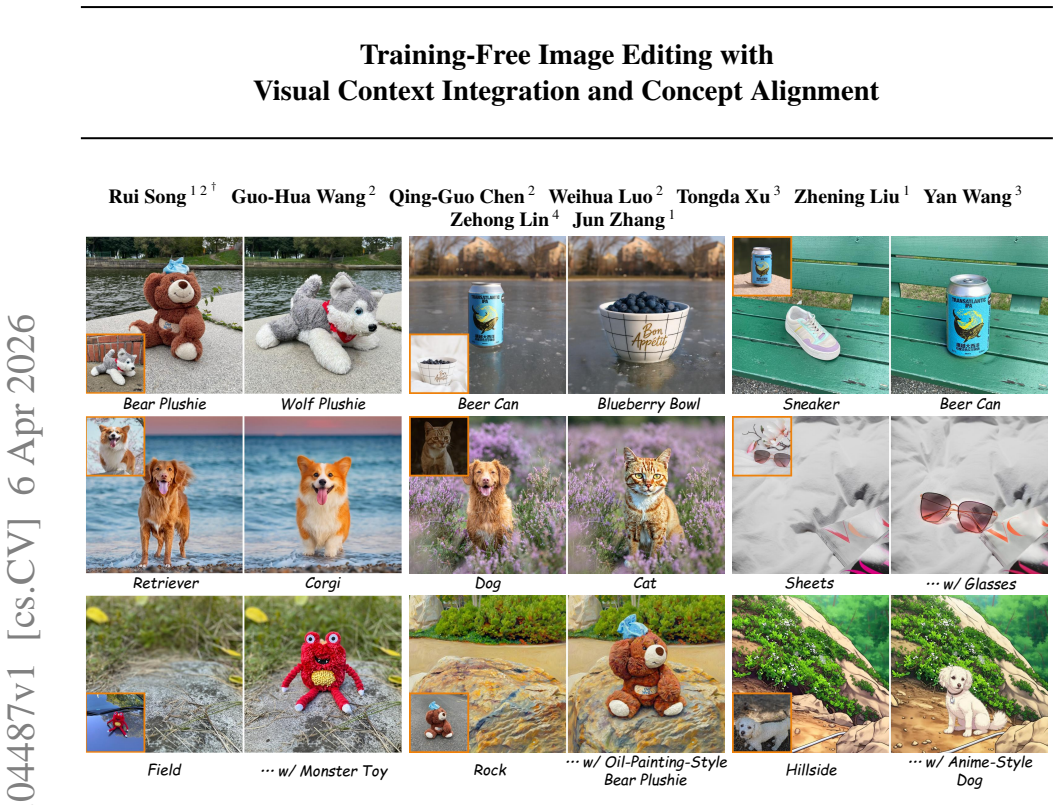
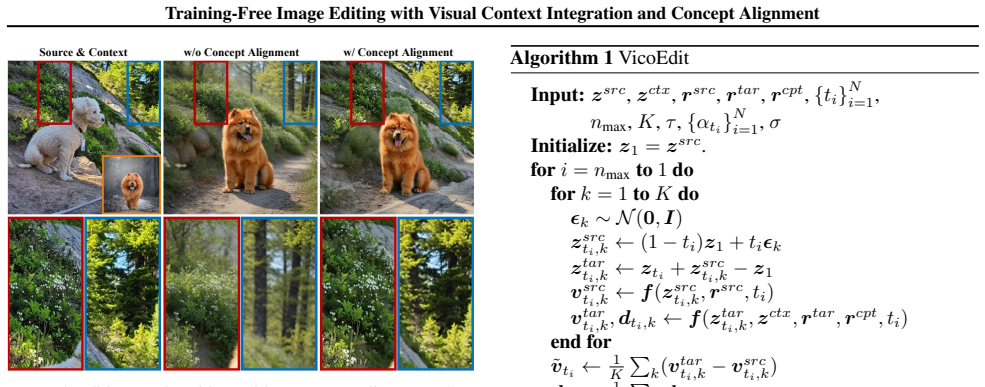
VicoEdit injects visual context into pretrained text-prompted editing models by directly transforming the source image into the target one, thereby eliminating the need for inversion that can lead to deviated trajectories, and designs a posterior sampling approach guided by concept alignment to enhance the editing consistency.
What carries the argument
Direct source-to-target transformation combined with concept-alignment-guided posterior sampling inside a pretrained diffusion editing pipeline.
If this is right
- Image editing becomes possible without collecting specialized training datasets or running fine-tuning steps.
- Consistency improves because the method avoids the trajectory deviations common in inversion-based training-free editors.
- Pretrained text-to-image models can be reused directly for context-aware tasks with only inference-time additions.
- Editing quality can exceed that of current training-based methods according to empirical results.
Where Pith is reading between the lines
- The direct transformation idea could apply to other diffusion tasks such as video or 3D editing where inversion is costly.
- Concept alignment might serve as a general technique to replace inversion in broader generative pipelines.
- Real-time or on-device editing tools become more feasible since no training is required at deployment.
Load-bearing premise
That a posterior sampling approach guided by concept alignment can reliably enhance editing consistency and flexibility without diffusion inversion or any training.
What would settle it
A side-by-side comparison on standard editing benchmarks where VicoEdit outputs show lower visual fidelity to the context image or more artifacts than a trained baseline model would falsify the performance claim.
Figures






read the original abstract
In image editing, it is essential to incorporate a context image to convey the user's precise requirements, such as subject appearance or image style. Existing training-based visual context-aware editing methods incur data collection effort and training cost. On the other hand, the training-free alternatives are typically established on diffusion inversion, which struggles with consistency and flexibility. In this work, we propose VicoEdit, a training-free and inversion-free method to inject the visual context into the pretrained text-prompted editing model. More specifically, VicoEdit directly transforms the source image into the target one based on the visual context, thereby eliminating the need for inversion that can lead to deviated trajectories. Moreover, we design a posterior sampling approach guided by concept alignment to enhance the editing consistency. Empirical results demonstrate that our training-free method achieves even better editing performance than the state-of-the-art training-based models.
Editorial analysis
A structured set of objections, weighed in public.
Referee Report
Summary. The paper proposes VicoEdit, a training-free and inversion-free method for image editing that injects visual context from a reference image into pretrained text-prompted diffusion models. It directly transforms the source image using the visual context and introduces a posterior sampling approach guided by concept alignment to improve editing consistency and flexibility, claiming superior performance to state-of-the-art training-based models.
Significance. If the empirical results are substantiated, the work would be significant for removing both training costs and diffusion inversion artifacts, which are common bottlenecks in visual-context-aware editing. The approach could enable more consistent and flexible editing without additional data collection or fine-tuning, addressing practical limitations in current generative editing pipelines.
minor comments (1)
- Abstract: the claim of outperforming SOTA training-based models is stated without reference to specific quantitative metrics, datasets, or baselines, which makes the strength of the central empirical assertion difficult to assess from the provided summary.
Simulated Author's Rebuttal
We thank the referee for their review of our manuscript on VicoEdit. We appreciate the acknowledgment that a training-free, inversion-free approach to visual-context-aware image editing could address important practical bottlenecks if the results hold. The recommendation of 'uncertain' appears tied to verification of the empirical claims; we believe the experiments in the paper substantiate the superiority over training-based baselines in consistency and flexibility. No specific major comments were enumerated in the report, so we provide no point-by-point responses below.
Circularity Check
No significant circularity detected
full rationale
The paper presents VicoEdit as a new training-free, inversion-free editing method that directly transforms source images using visual context and posterior sampling guided by concept alignment on existing pretrained text-prompted diffusion models. No equations, derivations, fitted parameters, or self-referential definitions appear in the abstract or high-level description; the central claim is an empirical demonstration of performance rather than a mathematical reduction. The approach is framed as building upon pretrained models without load-bearing self-citations, uniqueness theorems, or ansatzes that collapse to the inputs by construction. This is a standard proposal of a novel technique evaluated externally, warranting a score of 0.
Axiom & Free-Parameter Ledger
axioms (1)
- domain assumption Pretrained text-prompted diffusion editing models can serve as a reliable base for context injection.
Reference graph
Works this paper leans on
-
[1]
Bai, S., Chen, K., Liu, X., Wang, J., Ge, W., Song, S., Dang, K., Wang, P., Wang, S., Tang, J., et al. Qwen2.5- VL Technical Report.arXiv preprint arXiv:2502.13923,
work page internal anchor Pith review Pith/arXiv arXiv
-
[2]
Batifol, S., Blattmann, A., Boesel, F., Consul, S., Diagne, C., Dockhorn, T., English, J., English, Z., Esser, P., Kulal, S., et al. FLUX. 1 Kontext: Flow Matching for In-Context Image Generation and Editing in Latent Space.arXiv preprint arXiv:2506.15742,
work page internal anchor Pith review Pith/arXiv arXiv
-
[3]
Chen, B., Zhao, M., Sun, H., Chen, L., Wang, X., Du, K., and Wu, X. XVerse: Consistent Multi-Subject Control of Identity and Semantic Attributes via DiT Modulation. arXiv preprint arXiv:2506.21416,
-
[4]
Flow matching in latent space.arXiv preprint arXiv:2307.08698,
Dao, Q., Phung, H., Nguyen, B., and Tran, A. Flow match- ing in latent space.arXiv preprint arXiv:2307.08698,
-
[5]
Emerging Properties in Unified Multimodal Pretraining
Deng, C., Zhu, D., Li, K., Gou, C., Li, F., Wang, Z., Zhong, S., Yu, W., Nie, X., Song, Z., et al. Emerging proper- ties in unified multimodal pretraining.arXiv preprint arXiv:2505.14683,
work page internal anchor Pith review Pith/arXiv arXiv
-
[6]
Classifier-Free Diffusion Guidance
Ho, J. and Salimans, T. Classifier-free diffusion guidance. arXiv preprint arXiv:2207.12598,
work page internal anchor Pith review Pith/arXiv arXiv
-
[7]
Dreamo: A unified framework for image customization.arXiv preprint arXiv:2504.16915,
Mou, C., Wu, Y ., Wu, W., Guo, Z., Zhang, P., Cheng, Y ., Luo, Y ., Ding, F., Zhang, S., Li, X., et al. DreamO: A unified framework for image customization.arXiv preprint arXiv:2504.16915,
-
[8]
She, D., Fu, S., Liu, M., Jin, Q., Wang, H., Liu, M., and Jiang, J. MOSAIC: Multi-subject personalized genera- tion via correspondence-aware alignment and disentan- glement.arXiv preprint arXiv:2509.01977,
-
[9]
Song, J., Meng, C., and Ermon, S. Denoising diffusion implicit models. InInternational Conference on Learning Representations, 2021a. Song, Y ., Sohl-Dickstein, J., Kingma, D. P., Kumar, A., Er- mon, S., and Poole, B. Score-based generative modeling through stochastic differential equations. InInternational Conference on Learning Representations, 2021b. W...
- [10]
-
[11]
Theoretical Analysis A.1
12 Training-Free Image Editing with Visual Context Integration and Concept Alignment Appendix A. Theoretical Analysis A.1. Velocity Field Decomposition This section derives the velocity field decomposition ut(zt|y) =u t(zt) +b t∇zt logp(y|z t) (Eq. 11 in the main text). As shown by Zheng et al., the conditional velocity field ut(z|y) in flow matching is d...
2021
-
[12]
Finally, Eq
also generate samples from p(z0|y) at t= 0 . Finally, Eq. 22 proves that combining the unconditional velocity field and the classifier guidance reaches p(z0|y)att= 0as well. A.2. Diffusion Posterior Sampling This section introduces the diffusion posterior sampling (DPS) (Chung et al., 2023). DPS aims to estimate the image x0 based on its partial measureme...
2023
-
[13]
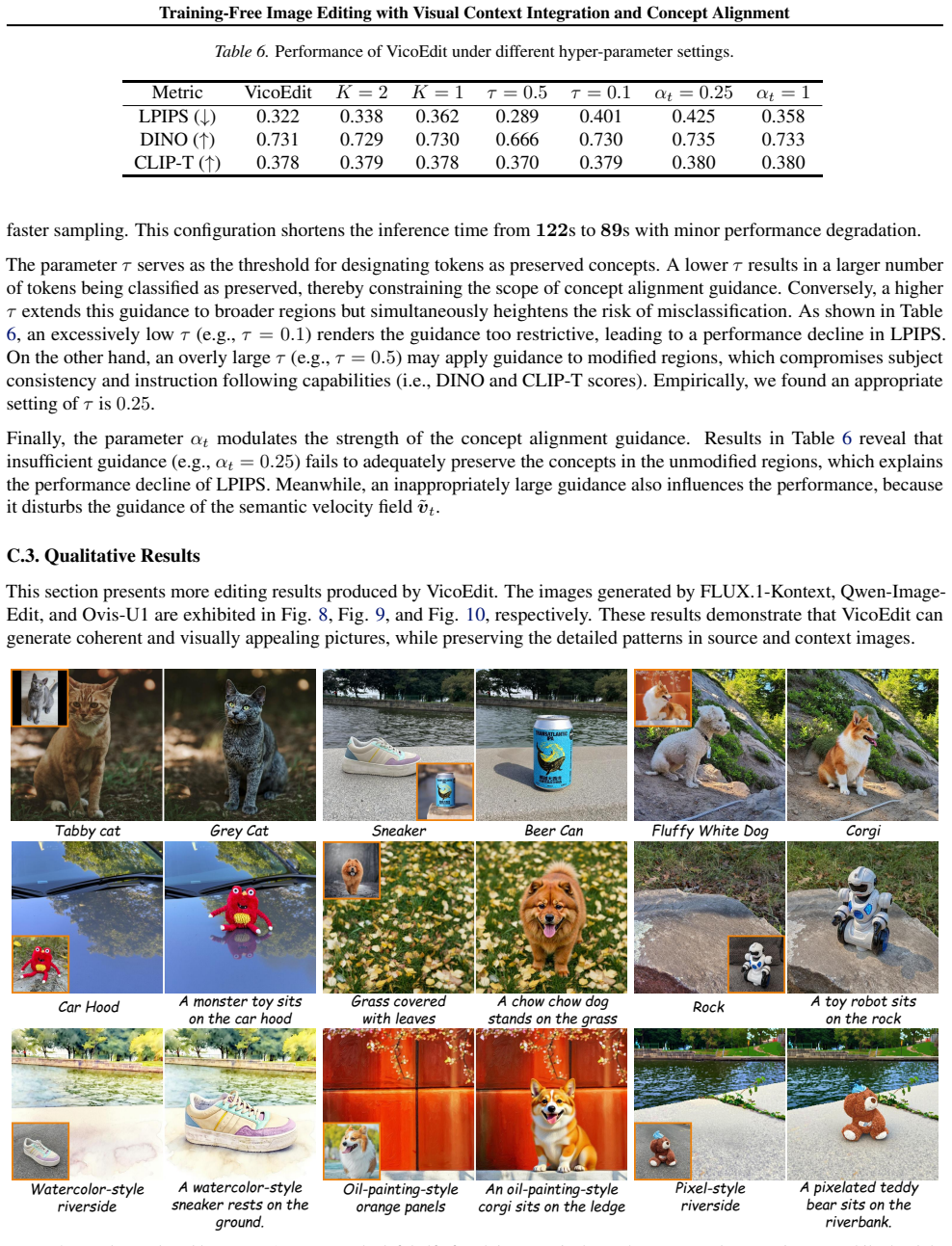
We use a template that combines editing instructions with image captions, as our experiments indicate this approach outperforms using either the instruction or the caption alone. The templates for different tasks are listed below: 14 Training-Free Image Editing with Visual Context Integration and Concept Alignment Table 4.Hyper-parameters of VicoEdit.c ta...
discussion (0)
Sign in with ORCID, Apple, or X to comment. Anyone can read and Pith papers without signing in.