Recognition: no theorem link
Kleisli semantics and hypergraph composition for Greimasian narrative programs
Pith reviewed 2026-05-10 19:44 UTC · model grok-4.3
The pith
Greimasian narrative programs are formalized as morphisms in a symmetric monoidal hypergraph category using Kleisli semantics from monads.
A machine-rendered reading of the paper's core claim, the machinery that carries it, and where it could break.
Core claim
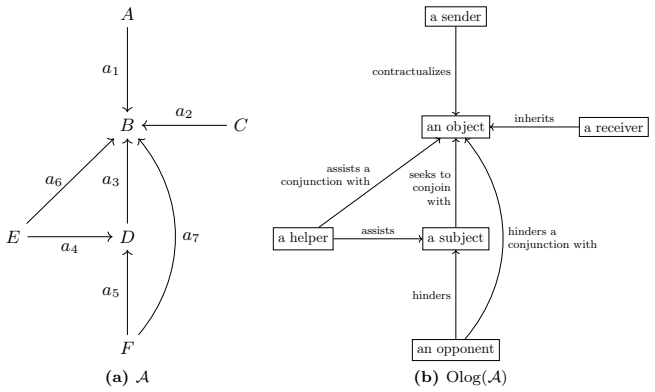
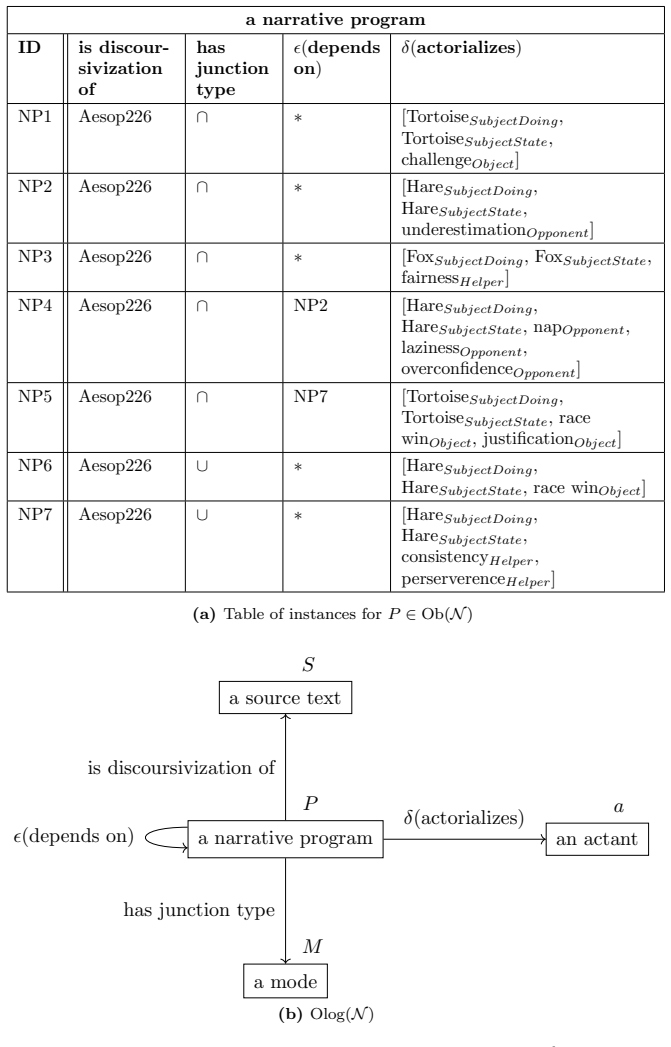
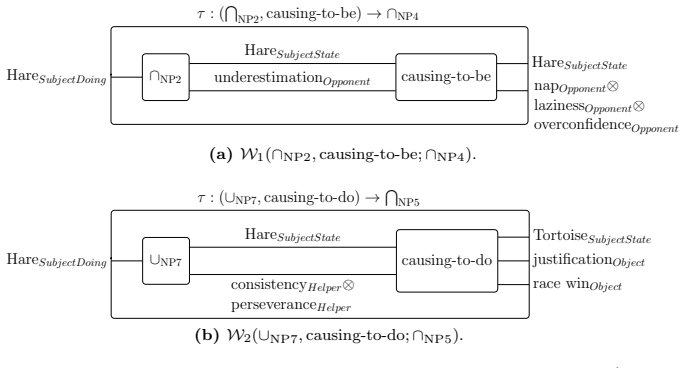
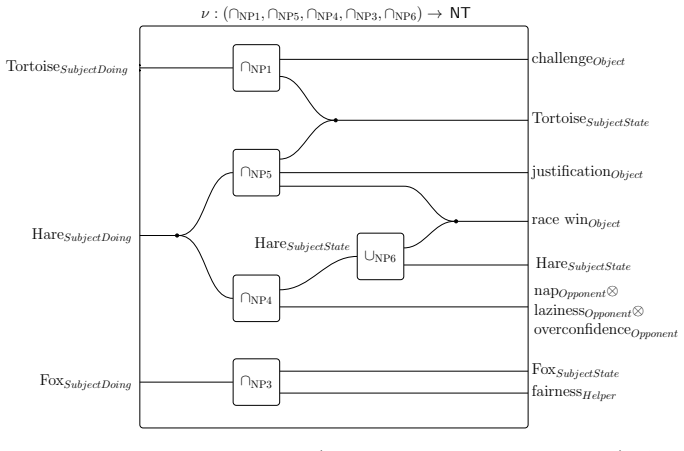
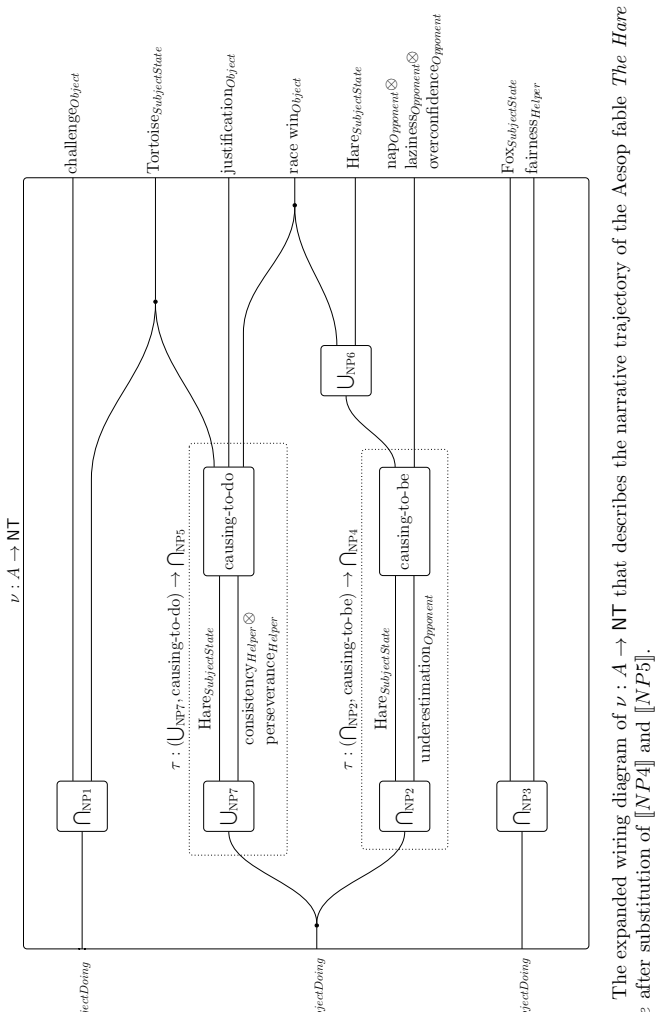
Narrative programs are represented within a categorical schema whose morphisms are interpreted using monads on Set; in particular the List monad provides Kleisli semantics for modeling non-atomic list-valued actantial configurations while the Maybe monad encodes optional dependencies, and the entire structure is lifted into a diagrammatic setting by freely generating a symmetric monoidal hypergraph category from the set of actants so that narrative programs act as generators of morphisms whose composition is realized through wiring diagrams and a narrative trajectory is interpreted as a single composite morphism.
What carries the argument
The freely generated symmetric monoidal hypergraph category whose objects are actants and whose morphisms are generated by narrative programs, with composition realized by wiring diagrams.
If this is right
- Narrative programs receive a minimal representation as structured data equipped with an intrinsic compositional interpretation.
- A narrative trajectory becomes a single composite morphism in the hypergraph category.
- Data-level representations of narrative elements are connected directly to their compositional realization in discourse.
- Structural semiotics obtains a unified mathematical framework that treats narrative formation as categorical composition.
Where Pith is reading between the lines
- The same wiring-diagram presentation could be used to automate detection of narrative coherence or rupture in large text corpora.
- The construction invites analogous categorical reconstructions for other structuralist schemas such as Proppian functions or Levi-Straussian mythemes.
- If the Kleisli semantics prove faithful, existing tools for string diagrams and hypergraph rewriting become directly applicable to semiotic analysis.
Load-bearing premise
That Greimasian actants and narrative programs can be faithfully captured as morphisms in a freely generated symmetric monoidal hypergraph category without loss of semantic content.
What would settle it
A concrete Greimasian narrative program whose semantic relations cannot be expressed as a morphism in any hypergraph category generated from the actant set without altering the original actantial dependencies or optionalities.
Figures
read the original abstract
This article proposes a category-theoretic formalization of Greimasian narrative programs (NPs) that makes their compositional structure mathematically precise. Building on a reconstruction of the actantial model as a categorical schema, we introduce a refined typological schema of actants and derive Set-valued instances corresponding to role-indexed elements of a narrative. NPs are represented within a categorical schema whose morphisms are interpreted using monads on Set. In particular, the List monad provides a Kleisli semantics for modeling non-atomic, list-valued actantial configurations, while the Maybe monad encodes optional dependencies between programs. This yields a minimal representation of narrative programs as structured data with an intrinsic compositional interpretation. To account for the dynamics of narrative formation, we lift these constructions into a diagrammatic setting by freely generating a symmetric monoidal category, and subsequently a hypergraph category, from the set of actants. In this framework, narrative programs act as generators of morphisms, and their composition is realized through wiring diagrams. A narrative trajectory is thereby interpreted as a single composite morphism. This approach provides a unified mathematical framework for structural semiotics, connecting data-level representations of narrative elements with their compositional realization in discourse.
Editorial analysis
A structured set of objections, weighed in public.
Referee Report
Summary. The manuscript proposes a category-theoretic formalization of Greimasian narrative programs by reconstructing the actantial model as a categorical schema, deriving Set-valued instances via a typological schema, interpreting morphisms via the List monad (for non-atomic configurations) and Maybe monad (for optional dependencies) in Kleisli semantics, and lifting the structure to a freely generated symmetric monoidal hypergraph category in which narrative programs act as generators whose composition is realized by wiring diagrams, yielding a unified framework connecting data-level representations to discourse-level composition.
Significance. If the constructions can be shown to faithfully encode Greimasian constraints without semantic loss, the work would offer a precise compositional semantics for structural semiotics, with potential for applications in formal narrative analysis; the Kleisli treatment of List and Maybe monads is a technically natural choice for modeling the relevant actantial features.
major comments (1)
- [Abstract (hypergraph category lifting)] The lifting to a freely generated symmetric monoidal hypergraph category (described in the abstract) imposes no relations on the generators beyond the monoidal structure. Greimasian theory requires specific non-free constraints (subject-object pairing, sender-receiver transmission, helper-opponent opposition, and program transformations); the free construction therefore admits wirings that violate these constraints, so the resulting composite morphisms may fail to preserve the intended semantics. This directly affects the central claim of faithful capture.
minor comments (1)
- [Abstract] The abstract supplies only a high-level description; concrete examples of a narrative program, its monadic interpretation, and the corresponding wiring diagram would substantially strengthen the presentation.
Simulated Author's Rebuttal
We thank the referee for their careful reading and for identifying a substantive issue with the hypergraph category construction. We address the major comment below and agree that the current free generation requires modification to enforce the necessary Greimasian constraints.
read point-by-point responses
-
Referee: [Abstract (hypergraph category lifting)] The lifting to a freely generated symmetric monoidal hypergraph category (described in the abstract) imposes no relations on the generators beyond the monoidal structure. Greimasian theory requires specific non-free constraints (subject-object pairing, sender-receiver transmission, helper-opponent opposition, and program transformations); the free construction therefore admits wirings that violate these constraints, so the resulting composite morphisms may fail to preserve the intended semantics. This directly affects the central claim of faithful capture.
Authors: We agree that the freely generated symmetric monoidal hypergraph category, as stated in the abstract and developed in the manuscript, imposes only monoidal structure and therefore permits wirings that violate core Greimasian constraints such as subject-object pairing, sender-receiver transmission, and helper-opponent opposition. This is a valid observation that weakens the claim of faithful semantic capture. In the revised version we will replace the free generation with a quotient construction: the hypergraph category will be presented as the free symmetric monoidal hypergraph category on the actant generators, quotiented by the congruence generated by the required relations (explicitly including the pairings, transmissions, oppositions, and program transformations). We will update the abstract, add a new subsection detailing the relations and the resulting quotient, and verify that the Kleisli semantics on Set-valued instances remains compatible with the quotient. This change preserves the compositional wiring-diagram interpretation while ensuring only semantically valid trajectories are represented as morphisms. revision: yes
Circularity Check
No circularity: standard categorical constructions applied to Greimasian elements
full rationale
The derivation begins with a reconstruction of the actantial model as a categorical schema, introduces a typological schema, interprets narrative programs via the List and Maybe monads on Set, and lifts the structure by freely generating a symmetric monoidal hypergraph category whose generators are the actants and whose morphisms are the narrative programs. Each step is an explicit, standard construction in category theory (free generation, Kleisli semantics, wiring diagrams) whose output is not forced by any fitted parameter, self-citation, or definitional renaming of the input data. No load-bearing claim reduces to a prior result by the same author or to an ansatz smuggled through citation; the framework is self-contained as a modeling choice rather than a prediction equivalent to its inputs.
Axiom & Free-Parameter Ledger
axioms (1)
- standard math Axioms of categories, monads, and symmetric monoidal categories
Reference graph
Works this paper leans on
-
[1]
Greimas, A
Formalizing Structural Semiotics: A Category-Theoretic Approach to Actantial Systems.Axioms,15(3).https://www.mdpi.com/ 2075-1680/15/3/211. Greimas, A. J. 1983.Structural Semantics: An Attempt at a Method. Lincoln: University of Nebraska Press. Greimas, A. J. 1987.On Meaning: Selected Writings in Semiotic Theory. The- ory and History of Literature, vol
2075
-
[2]
Greimas, A
Minneapolis: University of Minnesota. Greimas, A. J., & Court´ es, J. 1979.Semiotics and Language: An Analytical Dictionary. Bloomington: Indiana University Press. translated by Larry Crist, Daniel Patte, James Lee, Edward McMahon II, Gary Phillips, and Michael Rengstorf. Greimas, Algirdas Julien, Collins, Frank, & Perron, Paul
1979
-
[3]
Figurative Semiotics and the Semiotics of the Plastic Arts.New Literary History,20(3), 627–649. H´ ebert, Louis. 2020.An Introduction to Applied Semiotics: Tools for Text and Image Analysis. London: Routledge. Parret, H. 1983.Semiotics and Pragmatics: An Evaluative Comparison of Con- ceptual Frameworks. Pragmatics & Beyond. Amsterdam: J. Benjamins. Perron...
-
[4]
http://arxiv.org/abs/1009.1166
Functorial Data Migration.CoRR,abs/1009.1166. http://arxiv.org/abs/1009.1166. Spivak, David I. 2012.Kleisli Database Instances.https://arxiv.org/abs/ 1209.1011. 26 Spivak, David I., & Kent, Robert E
discussion (0)
Sign in with ORCID, Apple, or X to comment. Anyone can read and Pith papers without signing in.