pith. machine review for the scientific record. sign in

math.CT

Category Theory

Enriched categories, topoi, abelian categories, monoidal categories, homological algebra

0
math.CT 2026-05-11 2 theorems

Yoshida algebra center matches groupoid algebra center

Yoshida algebra for groupoids

Surjective homomorphism from crossed Burnside ring onto the center holds for any finite groupoid.

abstract click to expand
In this paper, we extend the notion of the Yoshida algebra of a finite group introduced in \cite{Yos83} to finite groupoids and investigate its fundamental properties. Our main results show that the center of the Yoshida algebra of a finite groupoid is isomorphic to the center of the corresponding groupoid algebra, and that there exists a surjective ring homomorphism from the crossed Burnside ring of a finite groupoid, introduced in \cite{Shi26+}, onto the center of the Yoshida algebra of a finite groupoid.
0
0
math.CT 2026-05-11 1 theorem

Parity complexes equivalent to strong Steiner complexes

Parity complexes redux

Selected axioms from Street yield the equivalence, with multisets replacing subsets in the bases

abstract click to expand
We fix the notion of parity complex by a judicious selection from among the axioms originally considered by Street. We show that parity complexes so defined, together with the morphisms of parity complexes defined by Verity, form a category equivalent to the category of strong Steiner complexes (n\'es augmented directed complexes with strongly loop-free unital bases). To this end, we isolate the purely combinatorial structure possessed by the bases of free augmented directed complexes. This analysis reveals the essential advantage of Steiner's formalism to be that the role of subsets in Street's formalism is played instead by multisets.
0
0
math.CT 2026-05-11 Recognition

Simple pp expansions match mono-reflective subcategories

A categorical description of simple Beth companions

The forgetful functor from M to K realizes each simple expansion as a mono-reflective subcategory, implying uniqueness for simple Bethcompan

abstract click to expand
A pp expansion of a quasivariety $\mathsf{K}$ is said to be simple when it is of the form $\mathsf{K}[\mathscr{L}_\mathcal{F}]$. For instance, when $\mathsf{K}$ has the amalgamation property, all its pp expansions are simple. It is shown that the simple pp expansions of a quasivariety $\mathsf{K}$ coincide with the quasivarieties $\mathsf{M}$ for which the forgetful functor $U \colon \mathsf{M} \to \mathsf{K}$ is well defined and induces an isomorphism from $\mathsf{M}$ to a mono-reflective subcategory of $\mathsf{K}$. As a consequence, if a quasivariety $\mathsf{K}$ possesses a simple Beth companion $\mathsf{M}$, then $\mathsf{M}$ is the unique (up to term equivalence) quasivariety whose monomorphisms are regular that, moreover, satisfy the categorical description of simple pp expansions of $\mathsf{K}$ given above.
0
0
math.CT 2026-05-07

Models of enhanced 2-sketches are algebras over enhanced 2-monads

Enhanced 2-categories of models of sketches as enhanced 2-categories of algebras over monads

The equivalence includes loose morphisms and shows the model 2-category inherits exactly the w-rigged limits.

abstract click to expand
We establish the equivalence between models of enhanced $2$-sketches and algebras over monads, including the (co)lax morphisms. More precisely, for any enhanced limit $2$-sketch $\mathbb{T}$ with tight cones, the enhanced $2$-category $\mathbb{M}\mathrm{od}_{s, w}(\mathbb{T}, \mathbb{K})$ of models of $\mathbb{T}$ in a locally presentable enhanced $2$-category $\mathbb{K}$, in which the tight and the loose morphisms are the $\mathscr{F}$-natural transformations and the loose $w$-natural transformations, respectively, is equivalent to the enhanced $2$-category ${\mathrm{T}\text{-}\mathbb{A}\mathrm{lg}}_{s, w}$ of algebras over an enhanced $2$-monad $T$ on the models $\mathbb{M}\mathrm{od}(\mathcal{T}_\tau, \mathbb{K})$ restricted to the tights with strict $T$-morphisms and $w$-$T$-morphisms. As a consequence, we completely characterise the limits in the enhanced $2$-category $\mathbb{M}\mathrm{od}_{s, w}(\mathbb{T}, \mathbb{K})$ of models with loose $w$-natural transformations, and conclude that $\mathbb{M}\mathrm{od}_{s, w}(\mathbb{T}, \mathbb{K})$ inherits precisely all $w$-rigged limits. Along the way, we establish an enriched analogue of the Orthogonal Sub-category Theorem, and generalise results on the reflectivity and the monadicity of models of enriched limit sketches in the base of enrichment to any arbitrary locally presentable enriched category.
0
0
math.CT 2026-05-06 4 theorems

Point-free relations recovered from a parallel pair of frame operators

Localic Relations with Open Cones

An adjunction with identity counit places open-cone localic relations inside conic frames and generalises Kock's Godement theorem.

abstract click to expand
Localic relations are relations internal to the category of locales, forming the point-free analogues of set-theoretic relations, and providing the general backdrop of localic order theory. This work studies 'open cone' localic relations, whose source and target maps are open, and provides a frame-theoretic description via point-free up and down closure operators, called 'cones'. The cones arising from open cone localic relations form join-preserving and 'parallel' pairs of maps on the underlying frame. Axiomatising this structure, a frame equipped with such a pair of cones is called a 'conic frame'. The main construction shows that, conversely, any conic frame induces a localic relation with open cones, whose cones are exactly the given ones. The main result is an adjunction with identity counit between the category of locales equipped with open cone localic relations, and the opposite of the category of conic frames. The unit gives a strongly dense inclusion of an open cone localic relation into the relation induced by its own cones. Fixed points of the adjunction are those relations recovered by their cones, and include kernel pairs of open maps and all weakly closed localic relations with open cones. As a special case we recover Kock's Godement theorem for locales. Moreover, for fixed points, internal reflexivity and transitivity are completely characterised in terms of the cones.
0
0
math.CT 2026-05-06

Groupoid crossed Burnside rings decompose as products of group rings

Crossed Burnside rings for groupoids

A monoidal structure on crossed groupoid-sets yields a decomposition theorem that reduces the ring to the group case.

abstract click to expand
In this paper, we extend the classical theory of crossed $G$-sets and the crossed Burnside ring from a finite group $G$ to a finite groupoid $\mathcal{G}$. We introduce a natural monoidal structure on the category of crossed $\mathcal{G}$-sets over a $\mathcal{G}$-monoid and construct the corresponding crossed Burnside ring of a $\mathcal{G}$-monoid. Finally, we prove a decomposition theorem that expresses the crossed Burnside ring of a groupoid as a product of crossed Burnside rings of groups.
0
0
math.CT 2026-05-06

Groupoid double cosets counted via extended Cauchy-Frobenius lemma

Double coset for groupoids

Two approaches, one from actions and one from representations, generalize orbit counting to groupoid symmetries.

abstract click to expand
We investigate the double cosets of a groupoid, focusing primarily on their enumeration, by means of two different approaches. The first approach extends the Cauchy-Frobenius lemma to groupoids and interprets it in terms of groupoid actions. The second approach is based on linear representations of a groupoid arising from its action on a set of functions.
0
0
math.CT 2026-05-05

Colimit over monoidal envelope computes free O-algebras

Free algebras via monoidal envelopes

A map of infinity-operads P to O turns the free O-algebra on a P-algebra into an explicit colimit, giving a direct existence proof.

abstract click to expand
For any morphism of $\infty$-operads $\mathcal{P} \to \mathcal{O}$, we show that the free $\mathcal{O}$-algebra on a $\mathcal{P}$-algebra admits an explicit formula as the colimit over the $\mathcal{O}$-monoidal envelope of $\mathcal{P}$, providing a new and simple proof of the existence of relative free $\mathcal{O}$-algebras.
0
0
math.CT 2026-05-05

Gorenstein injective cotorsion pairs complete iff Tate trivial generators exist

Accessibility and Gorenstein injective envelopes

The condition is necessary and sufficient in Grothendieck categories and yields model structures plus envelopes without projective objects.

abstract click to expand
Let $\mathcal{G}$ be a Grothendieck category. We prove completeness of the Gorenstein injective cotorsion pair whenever $\mathcal{G}$ admits a set of Tate trivial generators, and show that having such generators is necessary for completeness. In this case it must be a perfect cotorsion pair, cogenerated by a set, and equivalent to an injective abelian model structure on $\mathcal{G}$. Examples include Grothendieck categories (possibly without enough projectives) that admit a generating set consisting of objects of finite projective dimension, such as the category of quasi-coherent sheaves on a quasi-compact and semi-separated scheme. More generally, for a given set $\mathcal{S}$, we characterize the completeness of the Gorenstein $\mathcal{B}$-injective cotorsion pair, where $\mathcal{B} = \mathcal{S}^\perp$, in terms of the existence of a set of $\mathcal{B}$-Tate trivial generators for $\mathcal{G}$. The key ingredient to our proof is the fact that any class of the form $\mathcal{B} :=\mathcal{S}^\perp$ is an accessibly embedded, accessible subcategory of $\mathcal{G}$. The general approach allows for further applications such as the existence of Ding injective envelopes and other relative Gorenstein injective envelopes without imposing additional assumptions on $\mathcal{G}$.
0
0
math.CT 2026-05-05

Effective epi topology equals canonical on (n,1)-topoi

Geometric Categories and Sheaves on Topoi

Sheaves on finite topoi therefore match (n-1)-truncated sheaves on associated (∞,1)-topoi.

abstract click to expand
We introduce the notion of a geometric $(\infty,1)$-category, the protopyical example of which is an $(\infty,1)$-topos. We study (hyper)sheaves on geometric $(\infty,1)$-categories, proving that these are characterized by a form of \v{C}ech (hyper)descent. As an application we study (hyper)sheaves on $(n,1)$-topoi for all $n\in \mathbf{Z}_{\geq 1}\cup \{\infty\}$, and prove that the effective epimorphism topology on an $(n,1)$-topos $\mathcal{X}$ may be identified as the canonical topology on $\mathcal{X}$. Moreover, we show that for finite $n\in \mathbf{Z}_{\geq 1}$ the study of sheaves on an $(n,1)$-topos $\mathcal{X}$ is equivalent to the study of $(n-1)$-truncated sheaves on certain $(\infty,1)$-topoi. We then globalize our study to consider sheaves on $\infty\mathcal{T} op$. In the appendix, we study the behavior of modules under a reflective monoidal $(\infty,1)$-functor $L^\otimes:\mathcal{C}^{\otimes}\rightarrow \mathcal{D}^{\otimes}$, and study (hyper)sheafification under a change of universe.
0
0
math.CT 2026-05-04 3 theorems

Operadic spectrum controls functor calculus with error bounds

Spectral Operadic Calculus: Norm-Analytic Functor Calculus

Analytic functors reconstruct from derivatives via plethysm, unlike homotopy-based methods

abstract click to expand
Classical spectral theory provides powerful tools for analyzing linear operators, but does not extend naturally to nonlinear or compositional settings. In particular, there is no general way to transport spectral invariants in a functorial manner across structured categories. In earlier work, we showed that this failure is fundamental and introduced an operadic notion of spectrum that provides a canonical replacement. In this paper, we develop the analytic consequences of this construction and show that the operadic spectrum acts as a control parameter for a calculus of functors. We establish a criterion for polynomial behavior based on higher cross-effects, and prove convergence results for the associated Taylor tower, including explicit exponential error bounds. We further show that the derivatives of a functor form a structured algebraic object with symmetric and operadic features, and satisfy a chain rule governed by a natural composition operation (operadic plethysm). This leads to a reconstruction theorem, showing that analytic functors are completely determined by their derivative data, and hence to a classification in terms of algebraic structures. Compared with classical Goodwillie calculus, which is governed by homotopy-theoretic conditions, the present framework is analytic and quantitative in nature, providing explicit control over convergence and approximation. These results place functor calculus in a setting that combines spectral ideas, analytic methods, and operadic algebra, and suggest further connections with deformation theory and geometry.
0
0
math.CT 2026-05-04

Sierpiński cone classifies partial maps only in localised Segal subuniverse

The Synthetic Sierpi\'nski Cone

The largest such subuniverse is the accessible localisation at interval embeddings and is strictly smaller than all Segal types when the 0-1

abstract click to expand
In domains, categories, and toposes, the Sierpi\'nski cone construction glues onto a space a universal closed point lying below all the other points. Although this is a lax colimit, it also enjoys a well-known right-handed universal property: the Sierpi\'nski cone classifies partial maps defined on an open subspace. The situation proves more subtle in synthetic models of space based on extending homotopy type theory with an interval, as in several recent approaches to synthetic higher categories and domains: although globally it may well be the case that the Sierpi\'nski cone classifies partial maps, this property cannot hold of all parameterised types without degenerating the theory. On the other hand, there are reflective subuniverses within which the classifying property nonetheless holds. We show that the largest subuniverse in which the Sierpi\'nski cone classifies partial maps is the accessible localisation at a family of embeddings parameterised in the interval, and this subuniverse is contained within the Segal types; this containment is moreover strict in the sense that when the interval is non-trivial, it is not possible for all Segal types to lie in the subuniverse. We finally extend these results from Sierpi\'nski cones to mapping cylinders, providing a new right-handed universal property for the latter.
0
0
math.CT 2026-05-01

Local reverse-mode gradients work for acyclic stochastic diagrams

Colored Markov polycategories and diagrammatic differentiation

Colored Markov polycategories reduce the derivative of an expected objective to independent contributions at each parameterized vertex.

abstract click to expand
Many stochastic systems are built by wiring typed components together, but the wiring is often neither purely sequential nor type-homogeneous. This paper develops categorical semantics for such systems using ordered polycategories whose morphisms are Markov kernels. The basic operation is kernel slotwise composition, which connects one output slot of a many-output kernel to one input slot of another and marginalizes the internal wire. We prove its structural laws by assigning trace semantics to finite acyclic diagrams. We then introduce colored Markov polycategories, where objects and kernels carry colors and typed connections are realized by coherent interface kernels. This gives a colored kernel slotwise composition and trace semantics for typed stochastic diagrams. To describe systems whose structure changes, we co-index colored Markov polycategories and parameter spaces over an indexing category. Finally, for finite acyclic parameterized diagrams, we prove a diagrammatic differentiation result. The derivative of an expected scalar objective is obtained from local reverse-mode contributions at the parameterized vertices, with stochastic and deterministic kernels handled through admissible local gradient operators. The construction gives a typed, compositional language for finite acyclic stochastic systems and their parameter sensitivities.
0
0
math.CT 2026-05-01

Quasi-pseudometric modular spaces form quantale-enriched categories

Quasi-pseudometric modular spaces as mathscr{Q}-categories

The category with nonexpansive maps is isomorphic to a Q-category over isotone functions, equating their topologies.

abstract click to expand
We prove that the category of quasi-pseudometric modular spaces whose morphisms are the nonexpansive mappings is isomorphic to a quantale enriched category. To achieve this, we construct an appropriate quantale of isotone functions. We also show that, by means of this isomorphism, the topology associated with a quasi-pseudometric modular coincides with that generated by its corresponding quantale enriched category. Furthermore, we demonstrate that the class of quasi-pseudometrizable topological spaces coincides with the topological spaces whose topology is induced by a quasi-pseudometric modular.
0
0
math.CT 2026-04-30

Aggregation functions are exactly lax quantale morphisms

Aggregation functions as lax morphisms of quantales

The identification supplies one framework that recovers known results on metric and fuzzy-metric aggregation.

abstract click to expand
We will generalize the concept of aggregation function for mathematical structures as a certain function between quantales. In fact, these functions turn to be exactly the lax morphism of quantales. This provides a global framework for the study of aggregation functions. As a consequence of our theory, we are able to deduce several known results about the aggregation of metrics and fuzzy metrics.
0
0
math.CT 2026-04-30

Silting subcategory finiteness equivalent to t-structure restriction

Metrics on triangulated categories and restrictions of (co)-t-structures

The equivalence supplies a categorical characterization of right coherent rings via restriction to the bounded homotopy category of project

abstract click to expand
This paper explores the restriction behavior of silting-induced $t$-structures and co-$t$-structures on triangulated categories endowed with metrics. For compactly generated triangulated categories admitting small coproducts, silting subcategories of compact objects give rise to canonical $t$-structures. We establish that a silting subcategory being contravariantly finite in the precompletion (or completion) is equivalent to the canonical $t$-structure restricting to this precompletion (or completion). This result yields a purely categorical characterization of right coherent rings: a ring $R$ is right coherent if and only if the standard $t$-structure on $\mathcal{D}({\sf Mod}\text{-}R)$ restricts to a $t$-structure on $\mathcal{K}^{-,b}({\sf proj}\text{-}R)$. Furthermore, we show that the correspondences between silting objects, bounded (co)-$t$-structures, and simple-minded collections given by Koenig and Yang can be extended to the metric framework of triangulated categories, and still commute with mutation operations and preserve natural partial orders.
0
0
math.CT 2026-04-28

Diagrams turn lax monoidal functors into strict ones from L(C)

Diagrammatics for lax and Frobenius monoidal functors and weak morphism classifiers

An elementary construction builds L(C) so its strict monoidal functors match all lax functors out of C, with parallel versions for oplax and

abstract click to expand
The theory of 2-monads entails that, for a strict monoidal category C, there is a strict monoidal category L(C) such that strict monoidal functors from L(C) are precisely the lax monoidal functors from C. We give an elementary, diagrammatic, construction of L(C) and of its variants for oplax and Frobenius lax functors. The diagrams used are analogous to the diagrammatics for lax monoidal functors studied by McCurdy.
0
0
math.CT 2026-04-27

2-nilpotent groups admit weak action representation by abelian groups

Weak action representability of 2-nilpotent groups

Central automorphisms characterize the actions, and amalgamation of their abelian subgroups yields the weak actors.

abstract click to expand
In this article, we investigate the representability of actions of the category $\mathsf{Nil}_2(\mathsf{Grp})$ of $2$-nilpotent groups. We first provide an algebraic characterisation of derived actions in $\mathsf{Nil}_2(\mathsf{Grp})$ by determining a universal strict general actor of an object $X$, which turns out to be the group $\operatorname{Aut}_c(X)$ of central automorphisms of $X$. We also characterise the morphisms $B \to \operatorname{Aut}_c(X)$ that define an action of $B$ on $X$ in $\mathsf{Nil}_2(\mathsf{Grp})$. We then show that $\mathsf{Nil}_2(\mathsf{Grp})$ is not action representable, and that the existence of a weak representation is related to the amalgamation property. Using the construction of an amalgam of a suitable family of abelian subgroups of $\operatorname{Aut}_c(X)$, we prove that the category $\mathsf{Nil}_2(\mathsf{Grp})$ is weakly action representable, and that a weak representing object can be chosen to be an abelian group. Finally, we show that $\mathsf{Nil}_2(\mathsf{Grp})$ is not locally algebraically cartesian closed.
0
0
math.CT 2026-04-27

Presheaf constructions exhibit free cocompletions in virtual equipments

Presheaves and cocompletions in formal category theory

The result unifies two concepts and constructs cocompletions for categories enriched in monoidal categories or bicategories under arbitrary

abstract click to expand
We study the relationship between presheaf constructions and free cocompletions in the context of formal category theory, elucidating the coincidence between the two concepts in familiar settings. We show that, in a virtual equipment satisfying mild assumptions, free cocompletions under classes of weights are exhibited by presheaf constructions. We furthermore extend the theory of weighted colimits from enriched category theory to this setting, developing the concepts of atomicity and rank, and providing recognition theorems for presheaf objects, free cocompletions, and cocomplete objects. As an application of our methods, we construct free cocompletions, under arbitrary classes of colimit-small weights, of (possibly large) categories enriched in (not necessarily symmetric) monoidal categories and bicategories; this resolves a longstanding omission in the literature on enriched category theory.
0
0
math.CT 2026-04-27

E-triangle morphisms decompose into homotopic compositions

Homotopic morphisms and diagram theorems in extriangulated categories

The result enables diagram theorems such as the 4x4 lemma and its variants in extriangulated categories.

abstract click to expand
Homotopic morphisms of $\mathbb E$-triangles in extriangulated categories are introduced. Any morphism of $\mathbb E$-triangles is a composition of homotopic morphisms. Any morphism $(\alpha_1, \alpha_2, \alpha_3)$ of $\mathbb E$-triangles can be modified to be homotopic, by changing one of $\alpha_i$; moreover, all the 15 cases where $\alpha_i$ is an $\mathbb E$-inflation ($\mathbb E$-deflation) are analyzed. Some diagram theorems, especially $4\times 4$ Lemma and its $14$ variants, including $3\times 3$ diagram and Horseshoe Lemma, are investigated. A relation between homotopic morphisms and (middling) good morphisms in triangulated categories are given. Weakly idempotent complete extriangulated categories are characterized.
0
0
math.CT 2026-04-23

Stone dualities link modal frames to spaces with binary relations

Topological Dualities for Modal Algebras

Different morphisms vary the dual point construction, but semicontinuous relations allow direct axiom-to-property mappings.

abstract click to expand
We display a family of Stone-type dualities linking categories of frames carrying pairs of modal operators to categories of spaces carrying a binary relation. Different notions of morphism used on the relational side lead to significant variations in the point construction. We show how the situation simplifies in the case of semicontinuous relations, allowing for straightforward correspondences between modal axioms and relational properties.
0
0
math.CT 2026-04-23

AB5 categories can have no non-zero injectives

Injectivity paucity in AB5 categories of oversize chains

A 2-functorial attachment of endomorphism families to Rickard examples produces AB5 abelian categories with only the zero object injective.

abstract click to expand
We construct examples of abelian categories with no non-zero injective (or projective) objects satisfying Grothendieck's AB5 condition. The procedure combines Rickard's examples of AB5 categories without products but some non-trivial injectives (also addressing an apparent gap in the literature) with a 2-functorial construct attaching to any category $\mathcal{C}$ that of $\mathcal{C}$-objects equipped with set-indexed families of endomorphisms.
0
0
math.CT 2026-04-22

No-barber principle excludes classical categories in inaccessible game

The No Barber Principle: Towards Formalised Selection in the Inaccessible Game

By treating Russell's paradox as a Lawvere diagonalisation, the principle shows that categories with copying maps cannot supply internal, un

abstract click to expand
The inaccessible game (Lawrence, 2025, 2026) is an information-theoretic dynamical system governed by three information loss axioms, a marginal entropy conservation constraint and maximum entropy dynamics. In this paper we look at selection in the game. Our aim is to develop a selection policy for the game rules based on a minimal set of assumptions. We seek necessary consistency constraints for self-determining dynamical systems. Specifically, we suggest that rules that quantify over distinctions they cannot internally represent risk impredicative-style circularity. Our criterion is motivated by an analogy with Russell's paradox. We formulate a no-barber principle which prohibits dynamics that appeal to external adjudicators or structure lying outside the system. To motivate our principle we examine Russell's paradox through its structural formalisation as a Lawvere diagonalisation. The marginal-entropy conservation in the game is a nontrivial entropy constraint which prohibits external structure. Through the no-barber principle we argue (i) the classical category FinProb, in which Shannon entropy is characterised, is cartesian and provides canonical diagonal (copying) maps that make Lawvere-style constructions expressible and is structurally incompatible with the no-copying instantiation of the no-barber principle studied here. (ii) the noncommutative category NCFinProb, in which von Neumann entropy is characterised, is symmetric monoidal and lacks canonical copying maps, making it a more natural candidate for the game's internal language.
0
0
math.CT 2026-04-21

Cocartesian fibrations close via new adjunction equivalence

Fibrations in Directed Type Theory

Synthetic simplicial type theory defines them and uses the link to initial sections to prove closure properties.

Figure from the paper full image
abstract click to expand
We study $\infty$-categories in the synthetic simplicial type theory developed by Riehl and Shulman. In particular, we define cocartesian fibrations and prove their closure properties using a novel equivalence between LARI adjunctions and initial sections. We formalize our work using the experimental proof assistant rzk and upstream our work to the formalization effort by Riehl et al. In addition to our new work, we also give an introduction to general type theory, homotopy type theory, and the simplicial type theory used by the rest of the thesis.
0
0
math.CT 2026-04-21

Biset category of finite groups implemented in CAP

Implementing the biset category of finite groups

Composition of bisets realized as Kleisli composition using coequalizer completions of one-object groupoids and orbit algorithms.

abstract click to expand
We describe an implementation of the biset category of finite groups as a tower of standard categorical constructions, all of which are implemented in the software project CAP for algorithmic category theory. In particular, we describe the composition of bisets as a composition in a Kleisli category of some biadjunction monad. This composition relies on the universal property of the coequalizer completion of a group viewed as a groupoid on one object. Implementing this universal property makes nontrivial use of the Schreier-Sims orbit algorithm.
0
0
math.CT 2026-04-20

Symmetric weak multicategories induce biprops

Biprops

Biprops are bicategories with free-monoid objects and symmetric strict tensor structure, generalizing coloured props.

Figure from the paper full image
abstract click to expand
We define biprops as a generalization of coloured props and of symmetric weak multicategories. These are bicategories whose objects form a free monoid. They are equipped with some structure resembling a symmetric strict tensor product. We prove that a symmetric weak multicategory gives rise to a biprop and a symmetric weak multifunctor gives rise to a morphism of biprops. This is a functor from the category of symmetric weak multicategories to the category of biprops.
0
0
math.CT 2026-04-20

No functorial transport of spectra along strong monoidal functors

The Operadic Spectrum and Obstructions to Spectral Base Change

A universal operadic residue instead supplies a canonical spectrum that reduces to the classical one for the trivial operad.

abstract click to expand
We introduce an operadic notion of spectrum for algebras over colored operads in a symmetric monoidal category. The construction is defined via a canonical Hochschild-type object together with an operadic residue, which together encode spectral information in a manner compatible with operadic composition. A central result of this work is that classical spectral invariants do not, in general, admit a natural base change in the operadic setting. More precisely, we show that there is no functorial procedure that transports spectra along strong monoidal functors while preserving their expected structural properties. This establishes a fundamental obstruction to spectral base change. To address this issue, we construct a universal operadic residue object and show that it induces a well-defined and functorial notion of operadic spectrum. We further prove that this construction is canonical and reduces to the classical spectrum in the case of the trivial operad. These results provide a conceptual foundation for spectral theory in operadic and higher algebraic contexts, and clarify the limitations of extending classical spectral invariants beyond the linear setting.
1 0
0
math.CT 2026-04-20 3 theorems

Axioms let categories build convex cells that encode homology

Cells, convexity and contractibility in general categories

Maps into these contractible cells recover both homology and homotopy in any category meeting the axioms.

Figure from the paper full image
abstract click to expand
The two pillars of Algebraic topology - Homology and homotopy theory rely on the availability of basic building blocks called cells. Cells take the form of simplexes, and have properties such as faces, sub-cells, convexity and contractibility. The first two cells, namely the line and points lead to the concept of homotopy. The collection of maps from the cells and the redundancies among them determine the homology of objects. This article presents a procedure in which such cells can be built in categories satisfying some simply axioms. The cells satisfy the categorical analogs of convexity and contractibility. The article also shows how these secondary properties are sufficient to reconstruct Homology and Homotopy for the arbitrary category.
0
0
math.CT 2026-04-20

Simple axioms let general categories build cells for homology

Cells, convexity and contractibility in general categories

A construction produces categorical convexity and contractibility, so homology follows from maps and redundancies while homotopy follows the

Figure from the paper full image
abstract click to expand
The two pillars of Algebraic topology - Homology and homotopy theory rely on the availability of basic building blocks called cells. Cells take the form of simplexes, and have properties such as faces, sub-cells, convexity and contractibility. The first two cells, namely the line and points lead to the concept of homotopy. The collection of maps from the cells and the redundancies among them determine the homology of objects. This article presents a procedure in which such cells can be built in categories satisfying some simply axioms. The cells satisfy the categorical analogs of convexity and contractibility. The article also shows how these secondary properties are sufficient to reconstruct Homology and Homotopy for the arbitrary category.
0
0
math.CT 2026-04-20

Every differential modality extracts to an N-filtered version

Extracting an mathbb{N}-filtered differential modality from a differential modality

The resulting !≤n functors interpret maps as polynomials of degree less than n whose (n+1)th derivative vanishes.

abstract click to expand
A differential modality is a comonad on an additive symmetric monoidal category $(\mathsf{C},\otimes,I)$, whose underlying functor we denote $!\colon\mathsf{C} \rightarrow \mathsf{C}$, together with some additional structure including a differential operator $\partial\colon!A \otimes A \rightarrow !A$. A morphism $f\colon !A \rightarrow B$ is interpreted as a smooth function from $A$ to $B$. The notion of an $\mathbb{N}$-filtered differential modality is a variant in which a notion of degree is present. Instead of a single functor $!\colon \mathsf{C} \rightarrow \mathsf{C}$, we ask for a family of functors $!_{\le n}\colon\mathsf{C} \rightarrow \mathsf{C}$ where $n \in \mathbb{N}$. Now, a morphism $f\colon !_{\le n} A \rightarrow B$ is interpreted as a smooth function from $A$ to $B$, with degree less than $n$ for some notion of degree. We prove that under mild conditions, every differential modality on an additive symmetric monoidal category with underlying functor $!\colon \mathsf{C} \rightarrow \mathsf{C}$ yields an $\mathbb{N}$-filtered differential modality with underlying functors $!_{\le n}\colon\mathsf{C} \rightarrow \mathsf{C}$. A morphism $f\colon !_{\le n}A \rightarrow B$ corresponds to a polynomial map of degree less than $n$ from $A$ to $B$, in the sense that the $(n+1)$-th derivative of $f$ is $0$.
0
0
math.CT 2026-04-17

Parity on invertible morphisms proves coherence theorem

Invertibility and parity in symmetric monoidal categories

Defined independently of permutation signs, the notion classifies equivalences in the free structure via super integers.

abstract click to expand
We introduce a notion of parity for formal morphisms between invertible objects and use it to prove a corresponding coherence theorem. Parity is conceptually similar to the sign of underlying permutations, but not defined as such. To give complete details, this work includes a thorough treatment of the free permutative category on an invertible generator, its skeletal model, known as the super integers, and an equivalence between them classified by the pair of integers $\pm$1. Our approach is organized and clarified as an application of 2-monadic algebra, particularly the concept of flexibility and the Lack model structure. The final section contains a number of examples applying the main results.
0
0
math.CT 2026-04-17

The paper shows how neural network architectures can be represented as coherent…

Presenting Neural Networks via Coherent Functors

Dense feed-forward neural networks over floats can be presented as coherent categories G whose Set-models are the networks, with inference…

Figure from the paper full image
abstract click to expand
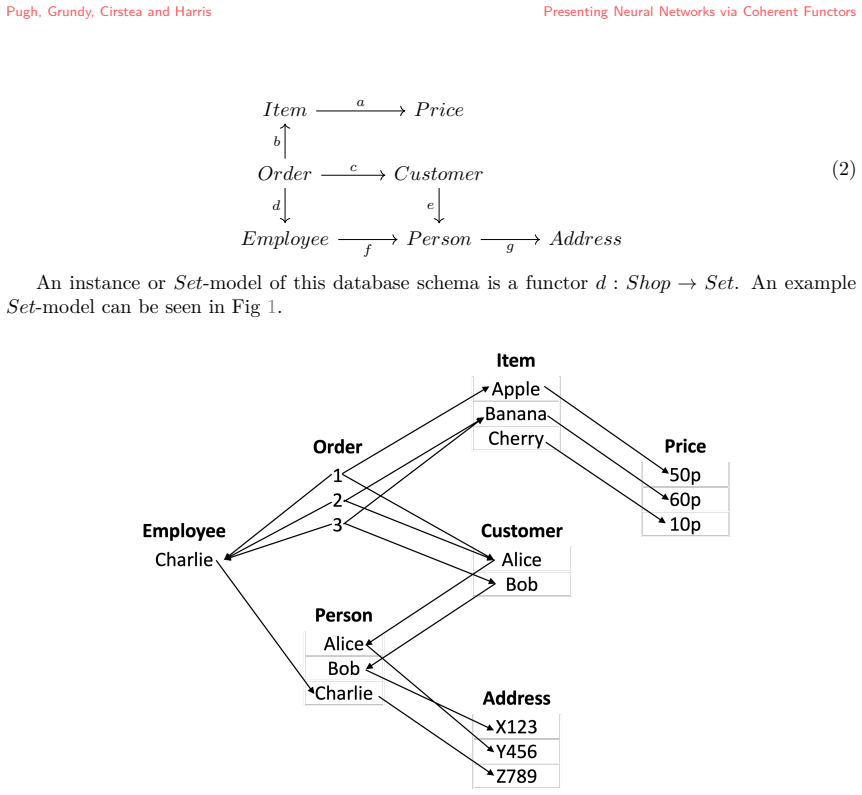
This paper develops a methodology for representing machine learning models as models of formal theories, grounded in the perspective that machine learning models are a form of database and that databases are models of theories in coherent logic. Two intermediate results support this approach: any functorial database schema has an associated $\kappa$-coherent theory whose models coincide with its instances, and data may be hard-coded into a coherent category such that any model of the resulting theory necessarily contains it. These tools are used to show that any dense feed-forward neural network architecture over the floating point numbers may be presented as a coherent category $G$ whose $Set$-models are the networks of that architecture, with inference arising as the precomposition functor $Coh(\iota, Set)$ along a coherent functor $\iota : RSpan(a_0, a_n) \rightarrow G$. This representation is extended to networks with weight and bias fixing and tying, encompassing sparse and convolutional architectures, via a 2-coequaliser construction in $Coh_\sim$. Taken together, these results recast neural network inference as an extension problem in the 2-category $Coh_\sim$ of coherent categories, supporting the interpretation of a network architecture as a formal hypothesis about the structure of data and of model training as a lifting of a dataset into a more constrained theory.
0
0
math.CT 2026-04-16 Recognition

Right-preordered groups admit internal categories under Schreier splits

Internal structures in the category of right-preordered groups

S-protomodularity and action representability hold on this class, letting S-crossed modules match Schreier internal categories exactly.

abstract click to expand
We give explicit axioms for the algebraic theory of the quasivarieties of right-preordered groups and preordered groups. We then look at lattices of effective equivalence relations, which turn out to be similar to the lattices of equivalence relations in the category of groups. Once this is established, we study internal structures in the category of right-preordered groups. We start with some general results and then prove the S-protomodularity of the category of right-preordered groups, when considering the class S of Schreier split epimorphisms. Following this, we investigate further and prove that the category of right-preordered groups turns out to be action representable when we restrict our attention to split epimorphisms in S. Relatively to this class of split epimorphisms, we define the notion of S-precrossed modules, and then of S-crossed modules; that correspond exactly to Schreier internal reflexive graphs and Schreier internal categories, respectively. Lastly, we characterize groupoids among Schreier internal categories and give some examples.
0
0
math.CT 2026-04-16

Right-preordered groups form a quasivariety whose internal categories match S-crossed

Internal structures in the category of right-preordered groups

Schreier split epimorphisms turn the category action representable and give exact algebraic descriptions of its reflexive graphs and group

abstract click to expand
We give explicit axioms for the algebraic theory of the quasivarieties of right-preordered groups and preordered groups. We then look at lattices of effective equivalence relations, which turn out to be similar to the lattices of equivalence relations in the category of groups. Once this is established, we study internal structures in the category of right-preordered groups. We start with some general results and then prove the S-protomodularity of the category of right-preordered groups, when considering the class S of Schreier split epimorphisms. Following this, we investigate further and prove that the category of right-preordered groups turns out to be action representable when we restrict our attention to split epimorphisms in S. Relatively to this class of split epimorphisms, we define the notion of S-precrossed modules, and then of S-crossed modules; that correspond exactly to Schreier internal reflexive graphs and Schreier internal categories, respectively. Lastly, we characterize groupoids among Schreier internal categories and give some examples.
0
0
math.CT 2026-04-16

Contravariant adjunction links two transition-structure categories

Topologically valued transition structures

Topological restrictions on objects and morphisms produce the connection between the categories.

abstract click to expand
We investigate several categories related to transition structures, using a mixture of algebraic and topological methods. We show how two such categories are connected by a contravariant adjunction. This is the most detailed of a family of such results depending on topological restrictions on objects and morphisms.
0
0
math.CT 2026-04-14

Tame realization matches execution paths to tame d-paths in any precubical set

Directed path and Moore flow

The construction works in the non-regular case and yields Moore flow functors naturally weakly equivalent to colimit-preserving m-cofibrant

abstract click to expand
This addendum extends prior work to the non-regular setting by introducing the tame realization of a precubical set as a multipointed $d$-space. Its execution paths are precisely the nonconstant tame $d$-paths in the geometric realization of the precubical set. The associated Moore flow induces a functor from precubical sets to Moore flows, which is naturally weakly equivalent, within the $h$-model structure, to a colimit-preserving functor whose image is included in the class of m-cofibrant Moore flows. For spatial (and thus proper) precubical sets, these functors coincide.
0
0
math.CT 2026-04-13 2 theorems

Extra axiom equates two definitions of 2-rings

On the (algebraic) notion of 2-ring

Ann-categories and categorical rings share the same data but differ in axioms; one added condition makes them equivalent.

abstract click to expand
By a 2-ring we mean a groupoid with a structure analogous to that of a ring, up to coherent isomorphisms. Two different notions of 2-ring appear in the literature: the notion of {\em Ann-category}, due to Quang, and the notion of {\em categorical ring}, due to Jibladze and Pirashvili. The underlying data are the same in both cases, but the required axioms differ. In this note, we clarify the relationship between these notions by explaining why an additional axiom must be imposed for the two notions to be equivalent. Essential to this analysis is an equivalent description of a symmetric monoidal category.
0
0
math.CT 2026-04-13

Inductive transfers establish Generalized Homotopy Hypothesis

An Inductive Strategy Towards a Solution to the Generalized Homotopy Hypothesis

A condition for moving model structures from n-groupoids to (n+1)-groupoids is given; repeated success proves the hypothesis.

abstract click to expand
Using the theory of distributive series of monads, we construct an $(\infty,0)$-coherator called the \emph{inductive coherator}. The category of models out of the inductive coherator serve as a model for $\infty$-groupoids that possess an underlying globular set. Once we establish the construction for the inductive coherator, we provide the framework for an inductive strategy to prove the Generalized Homotopy Hypothesis obtained by transferring model structure off of the category of $n$-groupoids onto the category of $(n+1)$-groupoids. Moreover, we provide a necessary and sufficient condition for the transfer of model structure to be successful. We conclude by showing if the transfer of model structure may be completed successively, then the Generalized Homotopy Hypothesis is true.
0
0
math.CT 2026-04-13

Enriched operad coalgebras are comonadic when C is semicartesian

Enriched coalgebras are sometimes comonadic

The V-endofunctor from P becomes a comonad whose coalgebras match the enriched P-coalgebras, recovering topology and Fox cases.

abstract click to expand
We introduce an enriched notion of a coalgebra over an operad P in a symmetric monoidal V-category C. When C is semicartesian and P is unital, we construct a V-endofunctor on C associated to P and give conditions under which it is a V-comonad with co-Eilenberg-Moore V-category isomorphic to the V-category of P-coalgebras in C. In many cases, this permits computation of V-categories of coalgebras. The key example is the category of pointed topological spaces with wedge product, enriched over topological spaces with Cartesian product, where this construction recovers the comonadic description of C_n-coalgebras of Moreno-Fern\'andez, Wierstra and the present author. We further recover one direction of Fox's theorem.
0
0
math.CT 2026-04-13

Four axioms define universal quotient for banking APIs

A Universal Quotient of Banking APIs

The quotient reveals 14 independent dimensions of value transfer invariant across jurisdictions and standards.

abstract click to expand
Four axioms of immutable ledger, linear consent, payment irreversibility, and bounded credit manifest themselves as institutional facts codified by banking practice for the transfer of monetary value. These axioms certify the independence of 14 empirically observed and jurisdictionally invariant dimensions. Morphisms of the ambient category do not admit sections that would reconstruct one dimension from another, and every morphism admits epi-mono factorisation through the universal quotient Q_public. This factorisation is forced by definite causal order under classical realisation and echoes the factorisation theorem of Gogioso et al. Gaussian elimination across 4,590 endpoints from BIAN, CDR, and OBIE confirms rank 14 and witnesses the jurisdictional invariance of the quotient object. The axioms similarly constrain the monoidal structure. The information dominance preorder is a thin category; all five Szlachanyi conditions follow, establishing that Q_public carries left skew monoidal structure.
0
0
math.CT 2026-04-10 Recognition

Proofs form symmetric monoidal category via spans in formal systems

Metacat: a categorical framework for formal systems

Metacat encodes rules with metavariable spans over cartesian PROP syntax and uses substitution to enable proof checking, as demonstrated in

Figure from the paper full image
abstract click to expand
We present a categorical framework for formal systems in which inference rules with $m$ metavariables over a category of syntax $\mathscr{S}$, taken to be a cartesian PROP, are represented by operations of arity $k \to n$ equipped with spans $k \leftarrow m \to n$ in $\mathscr{S}$, encoding the hypotheses and conclusions in a common metavariable context. Composition is by substitution of metavariables, which is the sole primitive operation, as in Metamath. Proofs in this setting form a symmetric monoidal category whose monoidal structure encodes the combination and reuse of hypotheses. This structure admits a proof-checking algorithm; we provide an open-source implementation together with a surface syntax for defining formal systems. As a demonstration, we encode the formulae and inference rules of first-order logic in Metacat, and give axioms and representative derivations as examples.
0
0
math.CT 2026-04-09 Recognition

Twice applying the normal functor symmetrizes immersion squares

On the normal functor in the category of smooth vector bundles

Pullback and quotient operations on double vector bundles ensure compatibility after two iterations.

abstract click to expand
This article is dedicated to the study of the normal functor in the category of smooth real vector bundles. Particularly, we focus on a symmetry phenomena which occurs after iterating two times the normal functor on a commutative square of smooth immersions. To do so, a theory of pullback and quotient is developed for double vector bundles but also for some classes of morphisms. These two operations turn out to be the key ingredients in order to study the naturality of the normal functor. The expected symmetry is then obtained thanks to the universal behavior and the mutual compatibility of these operations.
1 0
0
math.CT 2026-04-09 Recognition

Boolean ample monoids fully embed in Boolean inverse monoids

Embedding Boolean ample monoids as full submonoids of Boolean inverse monoids

The result generalizes right reversible cancellative monoids embedding into groups, proved via groupoids of fractions and non-commutative St

abstract click to expand
We show that, in certain circumstances, a Boolean ample monoid may be fully embedded into a Boolean inverse monoid in a way that generalizes how right reversible cancellative monoids may be embedded into groups. We use groupoids of fractions and non-commutative Stone duality to prove the result.
0
0
math.CT 2026-04-08 2 theorems

Syntactic methods count regular factors in strong epimorphism decompositions

On the decomposition of a strong epimorphism into regular epimorphisms

In locally presentable categories, partial Horn and generalized algebraic theories give the minimal ordinal length of any such transfinite复合

Figure from the paper full image
abstract click to expand
Strong epimorphisms and regular epimorphisms are two important classes of morphisms, and they do not coincide in general. Yet, in a locally presentable category, it is known that any strong epimorphism can be decomposed into a transfinite composite of regular epimorphisms. In this paper, we provide two syntactic methods to determine how many regular epimorphisms are needed in such a decomposition, using partial Horn theory and generalized algebraic theory. We start by discussing a general problem of decomposing a morphism into a transfinite composite of morphisms in a given class, which also covers the decomposition of an adjoint functor into monadic functors.
0
0
math.CT 2026-04-08 2 theorems

n-exact dg-categories induce n-exangulated structures on homotopy categories

Higher exact dg-categories

When Hom-cohomologies vanish, the homotopy category inherits a natural n-exangulated structure and n-cluster tilting subcategories become n-

abstract click to expand
We introduce the notion of an $n$-exact dg-category. This notion provides a higher analogue of Chen's exact dg-category, in the sense that the case where $n$ equals 1 recovers exact dg-categories. We prove that, under a suitable vanishing condition on the cohomologies of $\mathrm{Hom}$-complexes of an $n$-exact dg-category $\mathscr{A}$, its homotopy category admits a natural $n$-exangulated structure. Thus $n$-exact dg-categories provide dg-enhancements of $n$-exangulated categories. At the same time, our framework can be regarded as a dg-categorical generalization of $n$-exangulated categories applicable even without the vanishing condition. In the latter part of the article, we show that an $n$-cluster tilting subcategory of an exact dg-category naturally carries the structure of an $n$-exact dg-category. This result indicates that $n$-exact dg-structures provide an intrinsic dg-categorical axiomatization of $n$-cluster tilting subcategories, highlighting the advantages of studying dg-generalizations of $n$-exangulated categories.
0
0
math.CT 2026-04-07 2 theorems

One theorem unifies all Lyapunov stabilities for hybrid systems

Hybrid Systems as Coalgebras: Lyapunov Morphisms for Zeno Stability

By writing hybrids as coalgebras, Lyapunov functions become morphisms to different stable targets and new conditions appear for Zeno cases.

Figure from the paper full image
abstract click to expand
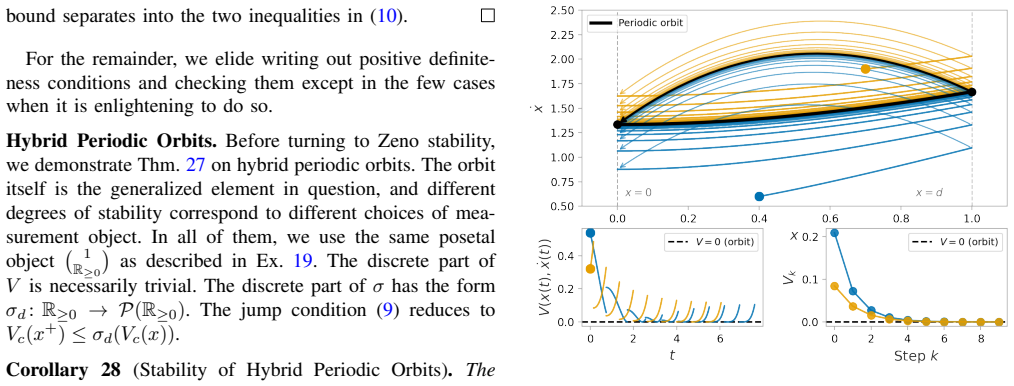
Hybrid dynamical systems exhibit a diverse array of stability phenomena, each currently addressed by separate Lyapunov-like results. We show that these results are all instances of a single theorem: a Lyapunov function is a morphism from a hybrid system into a simple stable target system $\sigma$, and different stability notions such as Lyapunov stability, asymptotic stability, exponential stability, and Zeno stability correspond to different choices of $\sigma$. This unification is achieved by expressing hybrid systems as coalgebras of an endofunctor $\mathcal H$ on a category $\mathsf{Chart}$ that naturally blends continuous and discrete dynamics. Instantiating a general categorical Lyapunov theorem for coalgebras to this setting results in new Lypaunov-like conditions for the stability of Zeno equilibria and the existence of Zeno behavior in hybrid systems.
0
0
math.CT 2026-04-07 2 theorems

Schur reduction of reaction networks equals categorical complement

Categorical Perspectives on Chemical Reaction Networks

The equivalence makes simplification functorial inside the arrow category of vector spaces and supplies a universal diagrammatic origin for

abstract click to expand
We show that the Schur-complement reduction of a chemical reaction network (CRN) from Hirono et al. is the categorical complement of the stoichiometric arrow in the arrow category $[\mathbf{A}_2,\mathbf{Vect}]$. This identifies the ambient category in which topological reduction of chemical reaction networks is functorial and explains the reduced stoichiometric matrix as a universal diagrammatic construction. We further define a reconstruction functor from a restricted subcategory of $[\mathbf{A}_2, \mathbf{Vect}]$ back to CRNs and prove an adjunction with the stoichiometric functor.
0
0
math.CT 2026-04-07 Recognition

Kleisli monads and hypergraphs formalize Greimasian narrative programs

Kleisli semantics and hypergraph composition for Greimasian narrative programs

Actantial schemas become morphisms composed by wiring diagrams, turning trajectories into single composites.

Figure from the paper full image
abstract click to expand
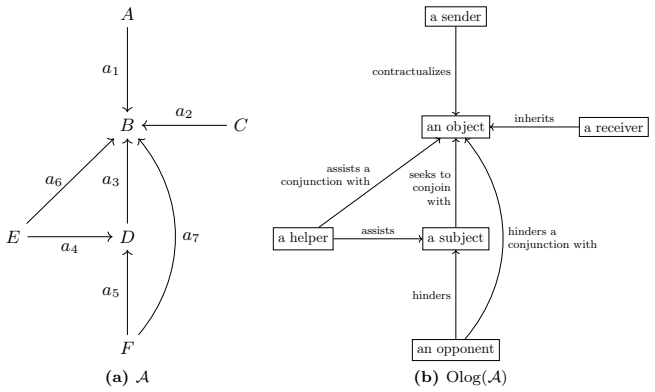
This article proposes a category-theoretic formalization of Greimasian narrative programs (NPs) that makes their compositional structure mathematically precise. Building on a reconstruction of the actantial model as a categorical schema, we introduce a refined typological schema of actants and derive Set-valued instances corresponding to role-indexed elements of a narrative. NPs are represented within a categorical schema whose morphisms are interpreted using monads on Set. In particular, the List monad provides a Kleisli semantics for modeling non-atomic, list-valued actantial configurations, while the Maybe monad encodes optional dependencies between programs. This yields a minimal representation of narrative programs as structured data with an intrinsic compositional interpretation. To account for the dynamics of narrative formation, we lift these constructions into a diagrammatic setting by freely generating a symmetric monoidal category, and subsequently a hypergraph category, from the set of actants. In this framework, narrative programs act as generators of morphisms, and their composition is realized through wiring diagrams. A narrative trajectory is thereby interpreted as a single composite morphism. This approach provides a unified mathematical framework for structural semiotics, connecting data-level representations of narrative elements with their compositional realization in discourse.
0
0
math.CT 2026-04-06 Recognition

Frobenius quotient maps three-weight line bundles to monomorphism grids

Frobenius quotients, inflation categories and weighted projective lines

Explicit construction sends the category of vector bundles on weighted projective lines with three weights to a category of monomorphism gr

Figure from the paper full image
abstract click to expand
We propose the notion of Frobenius quotients between Frobenius exact categories. It turns out that any Frobenius quotient induces Frobenius quotients between the corresponding inflation categories. We obtain an explicit Frobenius quotient from the category of vector bundles on weighted projective lines with three weights to a certain category consisting of monomorphism grids.
0

browse all of math.CT → full archive · search · sub-categories