Recognition: no theorem link
Dissipative spin hydrodynamics in Bjorken flow and thermal dilepton production
Pith reviewed 2026-05-10 19:54 UTC · model grok-4.3
The pith
Spin dynamics in expanding plasma modifies temperature and increases thermal dilepton production compared to standard viscous hydrodynamics.
A machine-rendered reading of the paper's core claim, the machinery that carries it, and where it could break.
Core claim
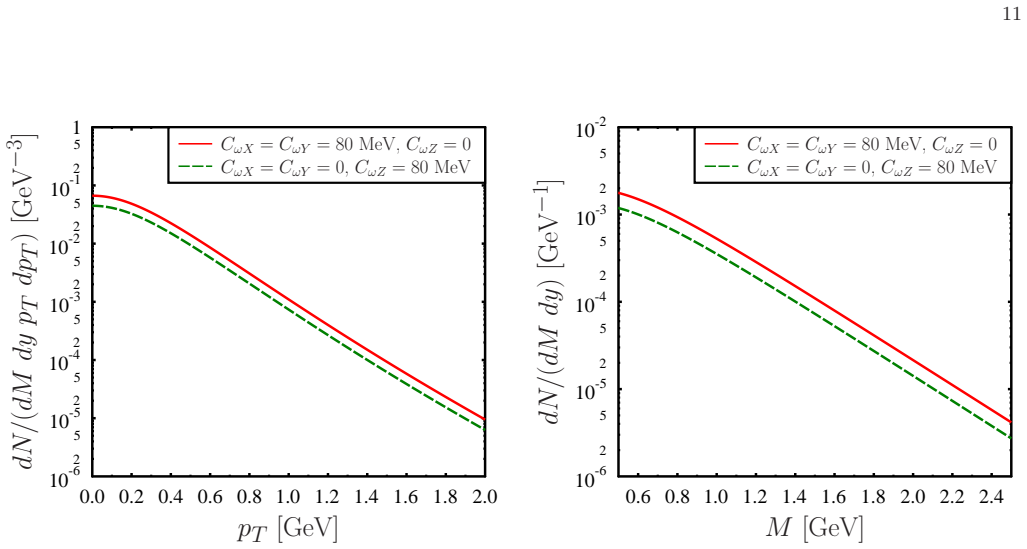
Within the first-order spin hydrodynamic framework applied to Bjorken flow, the evolution of magnetic-like spin chemical potential components depends on spin transport coefficients and modifies the medium temperature profile, resulting in higher thermal dilepton yields from quark-antiquark annihilation than those predicted by standard dissipative hydrodynamics alone, with the size of the increase controlled by the values of the spin diffusion coefficients.
What carries the argument
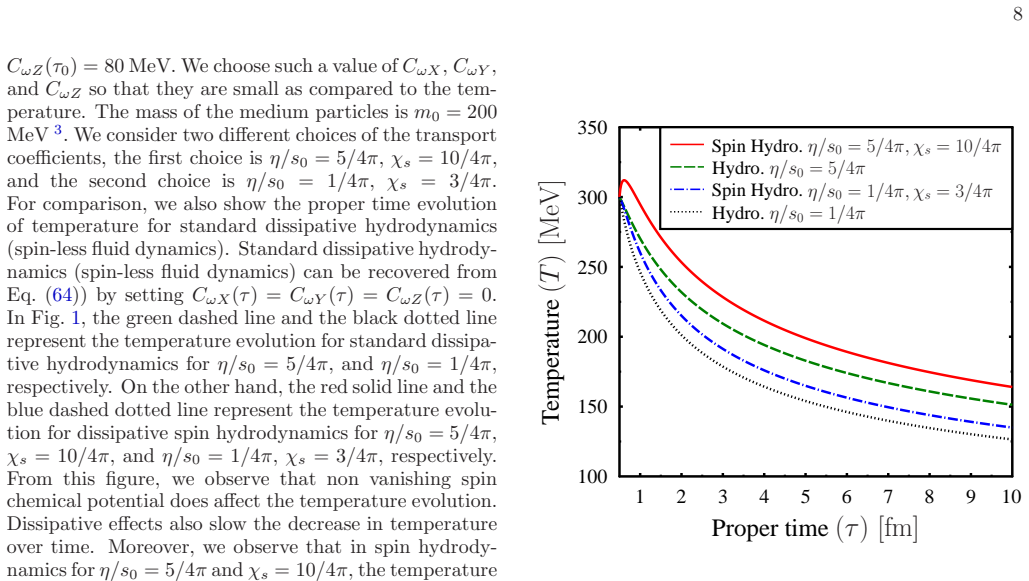
The coupled evolution equations for medium temperature and independent components of the spin chemical potential, restricted to surviving magnetic-like components in boost-invariant flow, where spin dissipation causes faster decay of transverse components.
If this is right
- Thermal dileptons can serve as an indirect probe of spin dynamics and spin transport coefficients in the quark-gluon plasma.
- The magnitude of the dilepton yield enhancement scales directly with the specific values chosen for the spin transport coefficients.
- The longitudinal spin chemical potential component persists longer than transverse components, influencing dilepton production at later stages of the expansion.
- The temperature evolution deviates from pure viscous hydrodynamics once spin degrees of freedom are included.
Where Pith is reading between the lines
- Dilepton data from heavy-ion collisions could be reanalyzed to place bounds on spin transport coefficients if the enhancement is confirmed.
- The same spin-modified temperature profiles would likely affect other electromagnetic observables such as direct photons.
- Extending the framework beyond boost invariance could reveal how spin effects behave in more realistic, non-central collision geometries.
Load-bearing premise
The spin chemical potential can be treated as a leading-order hydrodynamic variable throughout the expansion inside a first-order theory that uses a symmetric energy-momentum tensor and assumes the spin tensor is conserved independently.
What would settle it
A measured dilepton invariant-mass spectrum that matches the yield calculated from standard dissipative hydrodynamics with no additional enhancement from spin-modified temperature profiles.
Figures


read the original abstract
We investigate the boost-invariant expansion of a recently developed first-order spin hydrodynamic framework in which the spin chemical potential is treated as a leading-order hydrodynamic variable. Considering a symmetric energy-momentum tensor and a separately conserved spin tensor, we derive the coupled evolution equations for the medium temperature and the independent components of the spin chemical potential in the presence of both viscous and spin-diffusive transport coefficients. For a boost-invariant system, only the magnetic-like components of the spin chemical potential survive, and their evolution is shown to depend sensitively on the spin transport coefficients. The transverse spin components decay more rapidly due to spin dissipation, while the longitudinal component survives for a longer duration. We further demonstrate that the evolution of the spin degrees of freedom modifies the temperature profile of the expanding medium. Using the resulting temperature profiles, we calculate thermal dilepton production rates from quark-antiquark annihilation. We find that the presence of spin dynamics enhances the dilepton yield relative to standard dissipative hydrodynamics, with the magnitude of the enhancement depending on the spin transport coefficients. Our results indicate that thermal dileptons can provide an indirect probe of spin dynamics and spin transport in the quark-gluon plasma.
Editorial analysis
A structured set of objections, weighed in public.
Referee Report
Summary. The manuscript develops a first-order dissipative spin hydrodynamics framework for boost-invariant Bjorken flow, treating the spin chemical potential as a leading-order variable with a symmetric energy-momentum tensor and separately conserved spin tensor. It derives coupled evolution equations for the medium temperature T(τ) and the surviving magnetic-like components of the spin chemical potential, demonstrates that spin dissipation modifies the temperature profile, and computes the resulting thermal dilepton yield from quark-antiquark annihilation, finding an enhancement relative to standard viscous hydrodynamics whose magnitude depends on the spin transport coefficients.
Significance. If the hydrodynamic ordering holds, the work provides a concrete link between spin transport and an electromagnetic observable, offering a potential indirect probe of spin dynamics in the QGP. The explicit derivation of the coupled T(τ) and μ_s equations and the demonstration of back-reaction on the temperature profile are strengths that make the result falsifiable once specific spin transport coefficients are fixed.
major comments (2)
- [Bjorken flow section (coupled evolution equations for T(τ) and μ_s)] The central claim that spin dynamics modifies the temperature profile and enhances the dilepton yield rests on the validity of the coupled evolution equations throughout the expansion. However, in boost-invariant Bjorken flow the initial expansion rate 1/τ diverges as τ→0+, so the Knudsen number in the spin sector is not parametrically small; the assumption that the spin chemical potential remains O(1) while spin diffusion is O(∂) may break down at early times, rendering the reported temperature modification unreliable. This issue is load-bearing for the dilepton enhancement result.
- [Dilepton production rate calculation (temperature profiles and rate integral)] The enhancement of the dilepton yield is stated to depend on the spin transport coefficients, yet the manuscript provides neither explicit functional forms or numerical values for these coefficients nor sensitivity studies showing how the yield changes across plausible ranges. Without such checks, it is unclear whether the enhancement survives when the coefficients are varied consistently with the first-order framework.
minor comments (1)
- [Abstract] The abstract claims that 'only the magnetic-like components of the spin chemical potential survive' but does not define the decomposition into magnetic-like versus other components or state the initial conditions used for the longitudinal and transverse modes.
Simulated Author's Rebuttal
We thank the referee for the careful reading of our manuscript and the constructive comments. We address each major comment point by point below, providing the strongest honest defense of our results while acknowledging where clarifications or additions are warranted.
read point-by-point responses
-
Referee: [Bjorken flow section (coupled evolution equations for T(τ) and μ_s)] The central claim that spin dynamics modifies the temperature profile and enhances the dilepton yield rests on the validity of the coupled evolution equations throughout the expansion. However, in boost-invariant Bjorken flow the initial expansion rate 1/τ diverges as τ→0+, so the Knudsen number in the spin sector is not parametrically small; the assumption that the spin chemical potential remains O(1) while spin diffusion is O(∂) may break down at early times, rendering the reported temperature modification unreliable. This issue is load-bearing for the dilepton enhancement result.
Authors: We agree that the formal divergence of the expansion rate as τ→0+ challenges the hydrodynamic ordering at the absolute earliest times. However, our numerical implementation of the coupled evolution equations begins at a finite initial proper time τ₀ (chosen such that the Knudsen number remains small, consistent with standard practice in Bjorken-flow hydrodynamics). The spin chemical potential is initialized at this τ₀ and evolves forward; the back-reaction on T(τ) and the resulting dilepton yield are therefore computed only in the regime where the first-order spin-hydrodynamic ordering is under control. We will revise the manuscript to state the specific τ₀ employed, to display the Knudsen number evolution explicitly, and to add a short paragraph discussing the domain of validity of the framework. revision: partial
-
Referee: [Dilepton production rate calculation (temperature profiles and rate integral)] The enhancement of the dilepton yield is stated to depend on the spin transport coefficients, yet the manuscript provides neither explicit functional forms or numerical values for these coefficients nor sensitivity studies showing how the yield changes across plausible ranges. Without such checks, it is unclear whether the enhancement survives when the coefficients are varied consistently with the first-order framework.
Authors: We accept that the dependence on the spin transport coefficients must be made quantitative. In the revised version we will specify the numerical values (or functional forms) of the spin diffusion and relaxation coefficients used in our benchmark calculations, drawing from existing kinetic-theory and holographic estimates. We will also include a dedicated sensitivity study in which these coefficients are varied over a range still compatible with the first-order dissipative ordering, and we will show the corresponding dilepton spectra. This will demonstrate that the reported enhancement persists for physically motivated choices of the coefficients. revision: yes
Circularity Check
No significant circularity in derivation chain
full rationale
The paper starts from conservation of a symmetric energy-momentum tensor and a separately conserved spin tensor, derives the coupled evolution equations for temperature and the surviving magnetic-like components of the spin chemical potential in Bjorken flow, solves them with spin transport coefficients supplied as external inputs, and integrates the resulting temperature profiles to obtain dilepton yields. The enhancement is stated to depend on the values of those coefficients rather than being forced by the equations themselves. No self-definitional steps, fitted inputs relabeled as predictions, or load-bearing self-citations that reduce the central result to its own inputs are present in the provided abstract or summary. The modeling choice to treat the spin chemical potential as leading-order is an explicit assumption of the framework, not a circular derivation.
Axiom & Free-Parameter Ledger
free parameters (1)
- spin transport coefficients
axioms (3)
- domain assumption Spin chemical potential treated as leading-order hydrodynamic variable
- domain assumption Symmetric energy-momentum tensor and separately conserved spin tensor
- domain assumption Boost-invariant Bjorken flow geometry
Forward citations
Cited by 2 Pith papers
-
Exact expectation values in a boost-invariant fluid of Dirac fermions with finite spin density
Exact calculations in a boost-invariant free Dirac fermion fluid show spin polarization arises only from finite spin potential, with shear-induced polarization and spin Hall effect absent.
-
Boost-invariant and cylindrically symmetric perfect spin hydrodynamics
In boost-invariant cylindrical spin hydrodynamics, azimuthal-longitudinal coupling in the spin tensor produces nonzero total polarization only via the longitudinal magnetic component coupled to the azimuthal electric ...
Reference graph
Works this paper leans on
-
[1]
Moreover, in the limit ω αβ → 0, one obtains P (T, ω µν ) = P0(T ), which is the pressure for the spin-less fluid
Note that in our calculation both T , and ω µν are leading order in the hydrodynamic gradient ex- pansion, hence P (T, ω µν ) ∼ O (1). Moreover, in the limit ω αβ → 0, one obtains P (T, ω µν ) = P0(T ), which is the pressure for the spin-less fluid. Using the expression of P (T, ω µν ) in Eq. (
-
[2]
For a baryon free system and for Bjorken flow hµ identically vanishes
one finds, Sµν (T, ω µν ) = ∂P ∂ω µν ⏐ ⏐ ⏐ ⏐ T = S0(T )ω µν , (23) − κ 11 Sαβ ε+P ∇ µ (βω αβ ) − κ 12∇ µ α [47]. For a baryon free system and for Bjorken flow hµ identically vanishes. Naturally, one can apply the Landau frame condition. 2 Here we have not incorporated higher order terms in ω µν ω µν , e.g., ( ω µν ω µν )2, because we consider ω µν /T small....
-
[3]
is the projection of ∂µ T µν = 0 along the direc- tion of uµ . Eq. ( 27) is the projection of ∂µ T µν = 0 nor- mal to the the direction of uµ , i.e., ∆ α ν ∂µ T µν = 0. The third equation (Eq. ( 28)) is nothing but the conservation of the total angular momentum tensor. Note that in our calculation, we consider a symmetric energy-momentum tensor, hence ∂µ ...
-
[4]
(42) The condition S0i FC = 0 (for i = 1, 2, 3) implies CκX = 0, CκY = 0, and CκZ = 0, i.e., κ µ = 0
S0i FC (for i = 1 , 2, 3) can be expressed as [ 52], S01 FC = − 2πR 2τ S0 CκX sinh ( ηFC 2 ) , (40) S02 FC = − 2πR 2τ S0CκY sinh ( ηFC 2 ) (41) S03 FC = − πR 2τ S0CκZ ηFC. (42) The condition S0i FC = 0 (for i = 1, 2, 3) implies CκX = 0, CκY = 0, and CκZ = 0, i.e., κ µ = 0. Therefore, for the boost invariant system, the electric-like components (κ µ ) of t...
-
[5]
in Eqs. (22), (24), and (25) the equilibrium thermodynamic quantities can be expressed as, P (T, ω µν ) = P0(T ) + S0(T ) C2, (48) ε(T, ω µν ) = ε0(T ) + [ S0(T ) + T S′ 0(T ) ] C2, (49) s(T, ω µν ) = s0(T ) + S′ 0(T )C2. (50) IV. SPIN HYDRODYNAMIC EQUATIONS FOR A BOOST-INV ARIANT SYSTEM For a boost invariant system, Eq. ( 27) is trivially satis- fied (see...
-
[6]
No non-trivial equations are obtained when we contract Eq
with Xα uβ , Yα uβ , Zα uβ , Xα Yβ , Xα Zβ , and Yα Zβ . No non-trivial equations are obtained when we contract Eq. ( 52) with Xα uβ , Yα uβ , and Zα uβ . How- ever, when we contract Eq. ( 52) with Yα Zβ , Xα Zβ , and Xα Yβ we find the proper time evolution of CωX , CωY , and CωZ , respectively (see Appendix B for details), dCωX dτ + CωX ( S′ 0(T ) S0(T ) ...
2019
-
[7]
Appendix B: Derivation of Eqs
is trivially satisfied. Appendix B: Derivation of Eqs. (61)-(63) Contracting Eq. ( 52) with uα Xβ one finds, uα Xβ [ ∂S αβ ∂τ + Sαβ τ + ∂µ Sµαβ (1) ] = 0. (B1) Now, uα Xβ ∂S αβ ∂τ = ∂ ∂τ [ uα Xβ Sαβ ] = ∂ ∂τ [ S0(T )uα Xβ ω αβ ] = ∂ ∂τ [ S0(T )uα Xβ ǫαβγδ uγ ω δ ] = 0. (B2) Similarly it can be shown that, uα Xβ Sαβ = 0. Moreover, uα Xβ ∂µ Sµαβ (1) = uα Xβ ∂...
-
[8]
Global $\Lambda$ hyperon polarization in nuclear collisions: evidence for the most vortical fluid
STAR Collaboration, L. Adamczyk et al. , “Global Λ hyperon polarization in nuclear collisions: evidence for the most vortical fluid,” Nature 548 (2017) 62–65 , arXiv:1701.06657 [nucl-ex]
work page Pith review arXiv 2017
-
[9]
STAR Collaboration, J. Adam et al. , “Global polarization of Λ hyperons in Au+Au collisions at √ sN N = 200 GeV,” Phys. Rev. C 98 (2018) 014910 , arXiv:1805.04400 [nucl-ex]
-
[10]
STAR Collaboration, J. Adam et al. , “Polarization of Λ ( ¯Λ) hyperons along the beam direction in Au+Au collisions at √ sN N = 200 GeV,” Phys. Rev. Lett. 123 no. 13, (2019) 132301 , arXiv:1905.11917 [nucl-ex]
-
[11]
ALICE Collaboration, S. Acharya et al. , “Global polarization of Λ ¯Λ hyperons in Pb-Pb collisions at√ sN N = 2.76 and 5.02 TeV,” Phys. Rev. C 101 no. 4, (2020) 044611 , arXiv:1909.01281 [nucl-ex]
-
[12]
Λ Polarization in Au+Au Collisions at √ sN N = 2. 4 GeV Measured with HADES,
HADES Collaboration, F. J. Kornas, “Λ Polarization in Au+Au Collisions at √ sN N = 2. 4 GeV Measured with HADES,” Springer Proc. Phys. 250 (2020) 435–439
2020
-
[13]
Globally Polarized Quark-gluon Plasma in Non-central A+A Collisions
Z.-T. Liang and X.-N. Wang, “Globally polarized quark-gluon plasma in non-central A+A collisions,” Phys. Rev. Lett. 94 (2005) 102301 , arXiv:nucl-th/0410079 [nucl-th] . [Erratum: Phys. Rev. Lett.96,039901(2006)]
work page Pith review arXiv 2005
-
[14]
Angular momentum conservation in heavy ion collisions at very high energy
F. Becattini, F. Piccinini, and J. Rizzo, “Angular momentum conservation in heavy ion collisions at very high energy,” Phys. Rev. C77 (2008) 024906 , arXiv:0711.1253 [nucl-th]
work page Pith review arXiv 2008
-
[15]
Global quark polarization in non-central A+A collisions,
J.-H. Gao, S.-W. Chen, W.-T. Deng, Z.-T. Liang, Q. Wang, and X.-N. Wang, “Global quark polarization in non-central A+A collisions,” Phys. Rev. C77 (2008) 044902 , arXiv:0710.2943 [nucl-th]
-
[16]
Quark Polarization in a Viscous Quark-Gluon Plasma,
X.-G. Huang, P. Huovinen, and X.-N. Wang, “Quark Polarization in a Viscous Quark-Gluon Plasma,” Phys. Rev. C 84 (2011) 054910 , arXiv:1108.5649 [nucl-th]
-
[17]
Relativistic distribution function for particles with spin at local thermodynamical equilibrium
F. Becattini, V. Chandra, L. Del Zanna, and E. Grossi, “Relativistic distribution function for particles with spin at local thermodynamical equilibrium,” Annals Phys. 338 (2013) 32–49 , arXiv:1303.3431 [nucl-th]
work page Pith review arXiv 2013
-
[18]
Polarization of massive fermions in a vortical fluid,
R.-H. Fang, L.-G. Pang, Q. Wang, and X.-N. Wang, “Polarization of massive fermions in a vortical fluid,” Phys. Rev. C94 no. 2, (2016) 024904 , arXiv:1604.04036 [nucl-th]
-
[19]
Polarized secondary particles in unpolarized high energy hadron-hadron collisions?,
S. A. Voloshin, “Polarized secondary particles in unpolarized high energy hadron-hadron collisions?,” arXiv:nucl-th/0410089 [nucl-th]
-
[20]
Polarization probes of vorticity in heavy ion collisions,
B. Betz, M. Gyulassy, and G. Torrieri, “Polarization probes of vorticity in heavy ion collisions,” Phys. Rev. C76 (2007) 044901 , arXiv:0708.0035 [nucl-th]
-
[21]
F. Becattini, G. Inghirami, V. Rolando, A. Beraudo, L. Del Zanna, A. De Pace, M. Nardi, G. Pagliara, and V. Chandra, “A study of vorticity formation in high energy nuclear collisions,” Eur. Phys. J. C75 no. 9, (2015) 406 , arXiv:1501.04468 [nucl-th] . [Erratum: Eur. Phys. J.C78,no.5,354(2018)]
-
[22]
Spin and polarization: a new direction in relativistic heavy ion physics,
F. Becattini, “Spin and polarization: a new direction i n relativistic heavy ion physics,” Rept. Prog. Phys. 85 no. 12, (2022) 122301 , arXiv:2204.01144 [nucl-th]
-
[23]
Relativistic viscous hydrodynamics for heavy-ion collisions with ECHO-QGP
L. Del Zanna, V. Chandra, G. Inghirami, V. Rolando, A. Beraudo, A. De Pace, G. Pagliara, A. Drago, and F. Becattini, “Relativistic viscous hydrodynamics for heavy-ion collisions with ECHO-QGP,” Eur. Phys. J. C 73 (2013) 2524 , arXiv:1305.7052 [nucl-th]
work page Pith review arXiv 2013
-
[24]
A 3+1 dimensional viscous hydrodynamic code for relativistic heavy ion collisions
I. Karpenko, P. Huovinen, and M. Bleicher, “A 3+1 dimensional viscous hydrodynamic code for relativistic heavy ion collisions,” Comput. Phys. Commun. 185 (2014) 3016–3027 , arXiv:1312.4160 [nucl-th]
work page Pith review arXiv 2014
-
[25]
Estimates of hyperon polarization in heavy-ion collisions at collision energies √sN N = 4–40 GeV,
Y. B. Ivanov, V. D. Toneev, and A. A. Soldatov, “Estimates of hyperon polarization in heavy-ion collisions at collision energies √ sN N = 4–40 GeV,” Phys. Rev. C 100 no. 1, (2019) 014908 , arXiv:1903.05455 [nucl-th]
-
[26]
Global $\Lambda$ polarization in heavy-ion collisions from a transport model
H. Li, L.-G. Pang, Q. Wang, and X.-L. Xia, “Global Λ polarization in heavy-ion collisions from a transport model,” Phys. Rev. C96 no. 5, (2017) 054908 , arXiv:1704.01507 [nucl-th]
work page Pith review arXiv 2017
-
[27]
Is different Λ and ¯Λ polarization caused by different spatio-temporal freeze-out picture?,
O. Vitiuk, L. V. Bravina, and E. E. Zabrodin, “Is different Λ and ¯Λ polarization caused by different spatio-temporal freeze-out picture?,” Phys. Lett. B 803 (2020) 135298 , arXiv:1910.06292 [hep-ph]
-
[28]
Lambda hyperon polarization in relativistic heavy ion collisions from the chiral kinetic approach
Y. Sun and C. M. Ko, “Λ hyperon polarization in relativistic heavy ion collisions from a chiral kinetic approach,” Phys. Rev. C96 no. 2, (2017) 024906 , arXiv:1706.09467 [nucl-th]
work page Pith review arXiv 2017
-
[29]
Polarization and Vorticity in the Quark–Gluon Plasma,
F. Becattini and M. A. Lisa, “Polarization and Vorticit y in the Quark–Gluon Plasma,” Ann. Rev. Nucl. Part. Sci. 70 (2020) 395–423 , arXiv:2003.03640 [nucl-ex]
-
[30]
Spin-thermal shear coupling in a relativistic fluid,
F. Becattini, M. Buzzegoli, and A. Palermo, “Spin-thermal shear coupling in a relativistic fluid,” Phys. Lett. B 820 (2021) 136519 , arXiv:2103.10917 [nucl-th]
-
[31]
Spin polarization induced by the hydrodynamic gradients,
S. Y. F. Liu and Y. Yin, “Spin polarization induced by the hydrodynamic gradients,” JHEP 07 (2021) 188 , arXiv:2103.09200 [hep-ph]
-
[32]
Local Polarization and Isothermal Local Equilibrium in Relativistic Heavy Ion Collisions,
F. Becattini, M. Buzzegoli, G. Inghirami, I. Karpenko, and A. Palermo, “Local Polarization and Isothermal Local Equilibrium in Relativistic Heavy Ion Collisions,” Phys. Rev. Lett. 127 no. 27, (2021) 272302 , arXiv:2103.14621 [nucl-th]
-
[33]
Shear-Induced Spin Polarization in Heavy-Ion Collisions,
B. Fu, S. Y. F. Liu, L. Pang, H. Song, and Y. Yin, “Shear-Induced Spin Polarization in Heavy-Ion Collisions,” Phys. Rev. Lett. 127 no. 14, (2021) 142301 , arXiv:2103.10403 [hep-ph]
-
[34]
Relativistic hydrodynamics for spin-polarized fluids,
W. Florkowski, A. Kumar, and R. Ryblewski, “Relativistic hydrodynamics for spin-polarized fluids,” Prog. Part. Nucl. Phys. 108 (2019) 103709 , arXiv:1811.04409 [nucl-th]
-
[35]
Thermodynamic versus kinetic approach to polarization-vorticity coupling
W. Florkowski, A. Kumar, and R. Ryblewski, “Thermodynamic versus kinetic approach to 16 polarization-vorticity coupling,” Phys. Rev. C98 (2018) 044906 , arXiv:1806.02616 [hep-ph]
work page Pith review arXiv 2018
-
[36]
Spin-dependent distribution functions for relativistic hydrodynamics of spin-1/2 particles
W. Florkowski, B. Friman, A. Jaiswal, R. Ryblewski, and E. Speranza, “Spin-dependent distribution functions for relativistic hydrodynamics of spin-1/2 particles,” Phys. Rev. D97 no. 11, (2018) 116017 , arXiv:1712.07676 [nucl-th]
work page Pith review arXiv 2018
-
[37]
Relativistic fluid dynamics with spin
W. Florkowski, B. Friman, A. Jaiswal, and E. Speranza, “Relativistic fluid dynamics with spin,” Phys. Rev. C97 no. 4, (2018) 041901 , arXiv:1705.00587 [nucl-th]
work page Pith review arXiv 2018
-
[38]
Spin polarization evolution in a boost invariant hydrodynamical background
W. Florkowski, A. Kumar, R. Ryblewski, and R. Singh, “Spin polarization evolution in a boost invariant hydrodynamical background,” Phys. Rev. C99 no. 4, (2019) 044910 , arXiv:1901.09655 [hep-ph]
work page Pith review arXiv 2019
-
[39]
Longitudinal spin polarization in a thermal model,
W. Florkowski, A. Kumar, R. Ryblewski, and A. Mazeliauskas, “Longitudinal spin polarization in a thermal model,” Phys. Rev. C100 no. 5, (2019) 054907 , arXiv:1904.00002 [nucl-th]
-
[40]
Fate of spin polarization in a relativistic fluid: An entropy-current analysis
K. Hattori, M. Hongo, X.-G. Huang, M. Matsuo, and H. Taya, “Fate of spin polarization in a relativistic fluid: An entropy-current analysis,” Phys. Lett. B795 (2019) 100–106 , arXiv:1901.06615 [hep-th]
work page Pith review arXiv 2019
-
[41]
K. Fukushima and S. Pu, “Spin hydrodynamics and symmetric energy-momentum tensors – A current induced by the spin vorticity –,” Phys. Lett. B 817 (2021) 136346 , arXiv:2010.01608 [hep-th]
-
[42]
Nondissipative Second-Order Transport, Spin, and Pseudogauge Transformations in Hydrodynamics,
S. Li, M. A. Stephanov, and H.-U. Yee, “Nondissipative Second-Order Transport, Spin, and Pseudogauge Transformations in Hydrodynamics,” Phys. Rev. Lett. 127 no. 8, (2021) 082302 , arXiv:2011.12318 [hep-th]
-
[43]
Relativistic viscous hydrodynamics with angular momentum,
D. She, A. Huang, D. Hou, and J. Liao, “Relativistic viscous hydrodynamics with angular momentum,” Sci. Bull. 67 (2022) 2265–2268 , arXiv:2105.04060 [nucl-th]
-
[44]
Sound waves and vortices in a polarized relativistic fluid
D. Montenegro, L. Tinti, and G. Torrieri, “Sound waves and vortices in a polarized relativistic fluid,” Phys. Rev. D96 no. 7, (2017) 076016 , arXiv:1703.03079 [hep-th]
work page Pith review arXiv 2017
-
[45]
The ideal relativistic fluid limit for a medium with polarization
D. Montenegro, L. Tinti, and G. Torrieri, “The ideal relativistic fluid limit for a medium with polarization,” Phys. Rev. D96 no. 5, (2017) 056012 , arXiv:1701.08263 [hep-th]
work page Pith review arXiv 2017
-
[46]
Perfect-fluid hydrodynamics with constant acceleration along the stream lines and spin polarization
W. Florkowski, E. Speranza, and F. Becattini, “Perfect-fluid hydrodynamics with constant acceleration along the stream lines and spin polarization,” Acta Phys. Polon. B49 (2018) 1409 , arXiv:1803.11098 [nucl-th]
work page Pith review arXiv 2018
-
[47]
Relativistic dissipative spin dynamics in the relaxation time approximation,
S. Bhadury, W. Florkowski, A. Jaiswal, A. Kumar, and R. Ryblewski, “Relativistic dissipative spin dynamics in the relaxation time approximation,” Phys. Lett. B 814 (2021) 136096 , arXiv:2002.03937 [hep-ph]
-
[48]
From Chiral Kinetic Theory To Spin Hydrodynamics,
S. Shi, C. Gale, and S. Jeon, “From Chiral Kinetic Theory To Spin Hydrodynamics,” Nucl. Phys. A 1005 (2021) 121949 , arXiv:2002.01911 [nucl-th]
-
[49]
Relativistic second-order dissipative spin hydrodynamics from the method of moments,
N. Weickgenannt, D. Wagner, E. Speranza, and D. H. Rischke, “Relativistic second-order dissipative spin hydrodynamics from the method of moments,” Phys. Rev. D 106 no. 9, (2022) 096014 , arXiv:2203.04766 [nucl-th]
-
[50]
Kinetic theory for massive spin-1/2 particles from the Wigner-function formalism,
N. Weickgenannt, X.-L. Sheng, E. Speranza, Q. Wang, and D. H. Rischke, “Kinetic theory for massive spin-1/2 particles from the Wigner-function formalism,” arXiv:1902.06513 [hep-ph]
-
[51]
Generating Spin Polarization from Vorticity through Nonlocal Collisions,
N. Weickgenannt, E. Speranza, X.-l. Sheng, Q. Wang, and D. H. Rischke, “Generating Spin Polarization from Vorticity through Nonlocal Collisions,” Phys. Rev. Lett. 127 no. 5, (2021) 052301 , arXiv:2005.01506 [hep-ph]
-
[52]
Spin dynamics with realistic hydrodynamic background for relativistic heavy-ion collisions,
S. K. Singh, R. Ryblewski, and W. Florkowski, “Spin dynamics with realistic hydrodynamic background for relativistic heavy-ion collisions,” Phys. Rev. C 111 no. 2, (2025) 024907 , arXiv:2411.08223 [hep-ph]
-
[53]
Spin polarization of Λ hyperons from dissipative spin hydrodynamics,
Sapna, S. K. Singh, and D. Wagner, “Spin polarization of Λ hyperons from dissipative spin hydrodynamics,” Phys. Rev. C 112 no. 5, (2025) 054902 , arXiv:2503.22552 [hep-ph]
-
[54]
S. Dey and A. Das, “Kubo formula for spin hydrodynamics: Spin chemical potential as the leading order term in a gradient expansion,” Phys. Rev. D 111 no. 7, (2025) 074037 , arXiv:2410.04141 [nucl-th]
-
[55]
Analytic solutions of relativistic dissipative spin hydrodynamics with Bjorken expansion,
D.-L. Wang, S. Fang, and S. Pu, “Analytic solutions of relativistic dissipative spin hydrodynamics with Bjorken expansion,” Phys. Rev. D 104 no. 11, (2021) 114043 , arXiv:2107.11726 [nucl-th]
-
[56]
Canonical and phenomenological formulations of spin hydrodynamics,
A. Daher, A. Das, W. Florkowski, and R. Ryblewski, “Canonical and phenomenological formulations of spin hydrodynamics,” Phys. Rev. C 108 no. 2, (2023) 024902 , arXiv:2202.12609 [nucl-th]
- [57]
-
[58]
Stability studies of first-order spin-hydrodynamic frameworks,
A. Daher, A. Das, and R. Ryblewski, “Stability studies of first-order spin-hydrodynamic frameworks,” Phys. Rev. D 107 no. 5, (2023) 054043 , arXiv:2209.10460 [nucl-th]
-
[59]
Boost invariant spin hydrodynamics within the first order in derivative expansion,
R. Biswas, A. Daher, A. Das, W. Florkowski, and R. Ryblewski, “Boost invariant spin hydrodynamics within the first order in derivative expansion,” Phys. Rev. D 107 no. 9, (2023) 094022 , arXiv:2211.02934 [nucl-th]
-
[60]
Z. Drogosz, W. Florkowski, N. /suppress Lygan, and R. Ryblewski, “Boost-invariant spin hydrodynamics with spin feedback effects,” Phys. Rev. C 111 no. 2, (2025) 024909 , arXiv:2411.06154 [hep-ph]
-
[61]
Florkowski, Phenomenology of Ultra-Relativistic Heavy-Ion Collisions
W. Florkowski, Phenomenology of Ultra-Relativistic Heavy-Ion Collisions . 2010
2010
-
[62]
Vogt, Ultrarelativistic heavy-ion collisions
R. Vogt, Ultrarelativistic heavy-ion collisions . Elsevier, Amsterdam, 2007
2007
-
[63]
Electromagnetic probes of quark gluon plasma,
J. Alam, B. Sinha, and S. Raha, “Electromagnetic probes of quark gluon plasma,” Phys. Rept. 273 (1996) 243–362
1996
-
[64]
First-order relativistic hydrodynamics is stable,
P. Kovtun, “First-order relativistic hydrodynamics i s stable,” JHEP 10 (2019) 034 , arXiv:1907.08191 [hep-th] . 17
-
[65]
Relativistic second-order spin hydrodynamics: An entropy-current analysis,
R. Biswas, A. Daher, A. Das, W. Florkowski, and R. Ryblewski, “Relativistic second-order spin hydrodynamics: An entropy-current analysis,” Phys. Rev. D 108 no. 1, (2023) 014024 , arXiv:2304.01009 [nucl-th]
-
[66]
Rindori,Entropy current in relativistic quantum statistical mechanics
D. Rindori, Entropy current in relativistic quantum statistical mechanics. PhD thesis, U. Florence (main), Florence U., 2020. arXiv:2110.07662 [hep-th]
-
[67]
Coleman, Lectures of Sidney Coleman on Quantum Field Theory
S. Coleman, Lectures of Sidney Coleman on Quantum Field Theory . WSP, Hackensack, 12, 2018
2018
-
[68]
On the energy tensor of spinning massive matter in classical field theory and general relativity,
F. W. Hehl, “On the energy tensor of spinning massive matter in classical field theory and general relativity,” Reports on Mathematical Physics 9 no. 1, (1976) 55–82
1976
-
[69]
Spin tensor and pseudo-gauges: from nuclear collisions to gravitational physics,
E. Speranza and N. Weickgenannt, “Spin tensor and pseudo-gauges: from nuclear collisions to gravitational physics,” Eur. Phys. J. A 57 no. 5, (2021) 155 , arXiv:2007.00138 [nucl-th]
-
[70]
On the spin angular momentum of mesons,
F. Belinfante, “On the spin angular momentum of mesons,” Physica 6 no. 7, (1939) 887–898
1939
-
[71]
On the current and the density of the electric charge, the energy, the linear momentum and the angular momentum of arbitrary fields,
F. Belinfante, “On the current and the density of the electric charge, the energy, the linear momentum and the angular momentum of arbitrary fields,” Physica 7 no. 5, (1940) 449–474
1940
-
[72]
Rosenfeld Mem
L. Rosenfeld Mem. Acad. Roy. Bel. 18 no. 1, (1940)
1940
-
[73]
S. R. De Groot, W. A. Van Leeuwen, and C. G. Van Weert, Relativistic Kinetic Theory. Principles and Applications. North-Holland Publishing Company, 1980
1980
-
[74]
On the spin angular momentum of the dirac particle,
J. Hilgevoord and S. Wouthuysen, “On the spin angular momentum of the dirac particle,” Nuclear Physics 40 (1963) 1 – 12
1963
-
[75]
The covariant definition of spin in relativistic quantum field theory,
J. Hilgevoord and E. De Kerf, “The covariant definition of spin in relativistic quantum field theory,” Physica 31 no. 7, (1965) 1002–1016
1965
-
[76]
Relativistic dynamics of spin-fluids and spin-particles,
J. Weyssenhoff and A. Raabe, “Relativistic dynamics of spin-fluids and spin-particles,” Acta Phys. Polon. 9 (1947) 7–18
1947
-
[77]
Highly Relativistic Nucleus-Nucleus Collisions: The Central Rapidity Region,
J. D. Bjorken, “Highly Relativistic Nucleus-Nucleus Collisions: The Central Rapidity Region,” Phys. Rev. D27 (1983) 140–151
1983
-
[78]
Reif, Fundamentals of Statistical and Thermal Physics
F. Reif, Fundamentals of Statistical and Thermal Physics. 1965
1965
-
[79]
Markoff Random Processes and the Statistical Mechanics of Time-Dependent Phenomena. II. Irreversible Processes in Fluids,
M. S. Green, “Markoff Random Processes and the Statistical Mechanics of Time-Dependent Phenomena. II. Irreversible Processes in Fluids,” J. Chem. Phys. 22 (1954) 398
1954
-
[80]
Statistical mechanical theory of irreversib le processes. 1. General theory and simple applications in magnetic and conduction problems,
R. Kubo, “Statistical mechanical theory of irreversib le processes. 1. General theory and simple applications in magnetic and conduction problems,” J. Phys. Soc. Jap. 12 (1957) 570–586
1957
discussion (0)
Sign in with ORCID, Apple, or X to comment. Anyone can read and Pith papers without signing in.