Recognition: no theorem link
Statistical Model Checking of the Island Model: An Established Economic Agent-Based Model of Endogenous Growth
Pith reviewed 2026-05-10 19:49 UTC · model grok-4.3
The pith
Statistical model checking supplies formal confidence intervals and sensitivity tests for the Island Model of endogenous growth.
A machine-rendered reading of the paper's core claim, the machinery that carries it, and where it could break.
Core claim
Applying Multi-VeStA statistical model checking to the Island Model reproduces its key stylized facts with confidence intervals, confirms that moderate exploration rates maximize growth, and performs a sensitivity analysis on returns to scale, skill transfer, and knowledge locality. Six of seven pairwise parameter comparisons produce statistically distinct growth trajectories under Welch's t-test, while the seventh reveals a saturation effect once knowledge locality reaches a threshold.
What carries the argument
Multi-VeStA statistical model checker applied to the Island Model's agent-based exploration-exploitation dynamics.
If this is right
- Moderate exploration rates remain the growth-maximizing choice across the tested parameter space.
- Most parameter alterations produce growth trajectories that are statistically distinguishable from one another.
- Knowledge locality stops affecting outcomes once a saturation threshold is crossed.
- Statistical model checking supplies a reproducible pipeline for quantitative claims about agent-based economic models.
Where Pith is reading between the lines
- The same checking approach could be applied to other established agent-based models to strengthen or revise their qualitative conclusions.
- Policy experiments run inside such models could carry explicit statistical statements about robustness rather than point estimates alone.
- Saturation effects identified in one parameter might prompt targeted experiments on whether similar thresholds exist in related dimensions such as skill transfer.
Load-bearing premise
The reimplementation of the Island Model inside the statistical model checking tool exactly matches the original Fagiolo-Dosi dynamics without introducing new artifacts.
What would settle it
A side-by-side run in which the confidence intervals around growth rates or the optimality ranking of exploration levels from the SMC analysis fail to overlap with the values reported in the original Island Model paper.
Figures
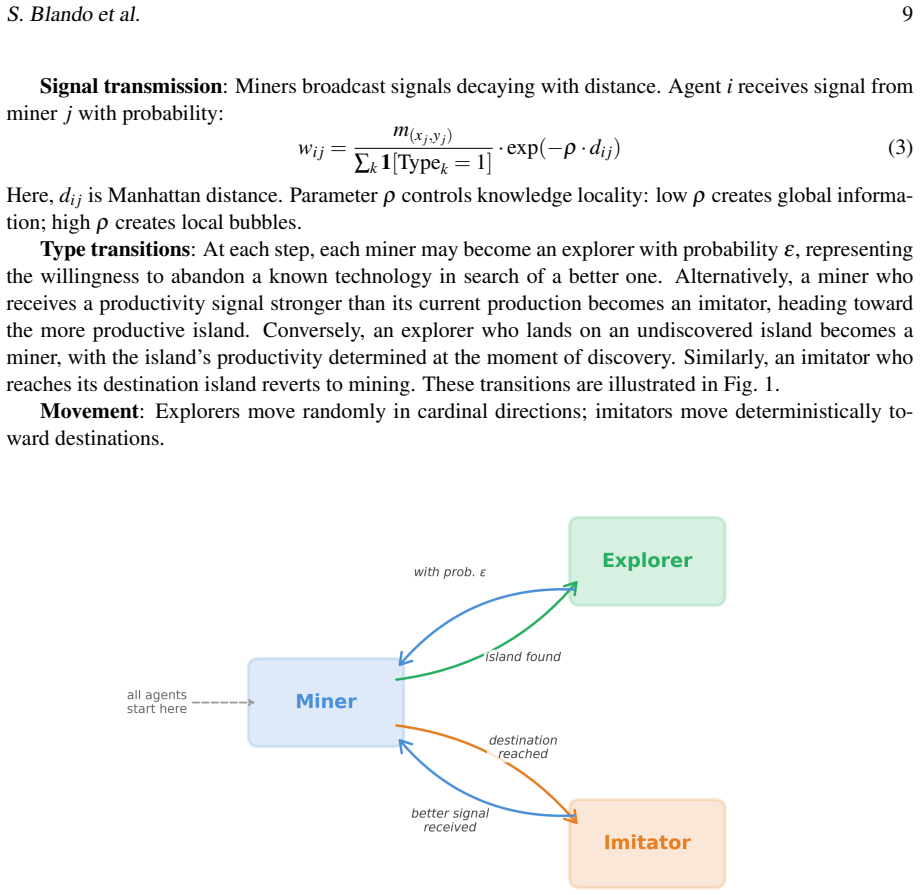


read the original abstract
Agent-based models (ABMs) are increasingly used to study complex economic phenomena such as endogenous growth, but their analysis typically relies on ad-hoc Monte Carlo exercises without formal statistical guarantees. We show how statistical model checking (SMC), and in particular Multi-VeStA, can automate and enrich the analysis of a seminal ABM: the Island Model of Fagiolo and Dosi, which captures the exploration-exploitation trade-off in technological search. We reproduce key stylized facts from the original model with formal confidence intervals, confirm the optimality of moderate exploration rates, and perform a counterfactual sensitivity analysis across returns to scale, skill transfer, and knowledge locality. Using MultiVeStA's built-in Welch's t-test, 6 out of 7 pairwise parameter comparisons yield statistically different growth trajectories, while the exception reveals a saturation effect in knowledge locality. Our results demonstrate that SMC offers a principled, reproducible methodology for the quantitative analysis of agent-based economic models.
Editorial analysis
A structured set of objections, weighed in public.
Referee Report
Summary. The paper applies statistical model checking (SMC) via the Multi-VeStA tool to the Island Model of Fagiolo and Dosi, an established ABM of endogenous growth that captures the exploration-exploitation trade-off in technological search. It reports reproduction of key stylized facts with formal confidence intervals, confirmation that moderate exploration rates are optimal, and a counterfactual sensitivity analysis varying returns to scale, skill transfer, and knowledge locality. Using Multi-VeStA's built-in Welch t-test, the authors find statistically significant differences in growth trajectories for 6 out of 7 pairwise parameter comparisons, with the exception indicating a saturation effect in knowledge locality. The central claim is that SMC supplies a principled, reproducible methodology for quantitative analysis of agent-based economic models.
Significance. If the embedded implementation of the Island Model faithfully reproduces the original Fagiolo-Dosi dynamics, the work would provide a useful demonstration of how SMC tools can replace ad-hoc Monte Carlo exercises with statistically guaranteed procedures for validating stylized facts and conducting sensitivity analysis in economic ABMs. The identification of a saturation effect in knowledge locality and the formal confidence intervals on growth trajectories could serve as a template for other complex ABMs in the field.
major comments (1)
- [Abstract] Abstract: The central claim that SMC via Multi-VeStA supplies a 'principled, reproducible methodology' for ABM analysis rests on the unverified assumption that the Island Model implementation inside the SMC framework exactly reproduces the original Fagiolo-Dosi agent search, knowledge spillovers, returns to scale, and locality rules. No quantitative benchmark (e.g., comparison of output distributions, mean growth rates, or variance) against the original model is reported, so any divergence in random-number handling or update rules would directly undermine the reported optimality of moderate exploration rates and the 6/7 statistically significant counterfactual differences.
minor comments (1)
- [Abstract] Abstract: The exception among the 7 pairwise comparisons is described only as revealing 'a saturation effect in knowledge locality,' without identifying the specific parameter pair or providing the associated p-value or effect size.
Simulated Author's Rebuttal
We thank the referee for their careful reading of our manuscript and for highlighting an important aspect of our validation strategy. We address the concern regarding the implementation fidelity below.
read point-by-point responses
-
Referee: The central claim that SMC via Multi-VeStA supplies a 'principled, reproducible methodology' for ABM analysis rests on the unverified assumption that the Island Model implementation inside the SMC framework exactly reproduces the original Fagiolo-Dosi agent search, knowledge spillovers, returns to scale, and locality rules. No quantitative benchmark (e.g., comparison of output distributions, mean growth rates, or variance) against the original model is reported, so any divergence in random-number handling or update rules would directly undermine the reported optimality of moderate exploration rates and the 6/7 statistically significant counterfactual differences.
Authors: We acknowledge the referee's point that a direct quantitative benchmark against the original Fagiolo and Dosi model would provide stronger evidence of faithful reproduction. Our current validation relies on reproducing the key stylized facts (such as the exploration-exploitation trade-off effects and growth patterns) with confidence intervals, which is the common practice in the ABM literature for model validation. However, to address this concern directly, we will revise the manuscript to include a dedicated benchmark section. This will report comparisons of summary statistics like average GDP growth rates, variance in firm sizes, and innovation frequencies from our Multi-VeStA simulations against the values and behaviors described in the original Fagiolo and Dosi (2003) paper. We will also clarify the implementation details, including random number generation and update rules, to ensure transparency. This revision will be incorporated in the next version of the paper. revision: yes
Circularity Check
No circularity: SMC application to external established ABM is self-contained
full rationale
The paper applies the pre-existing Multi-VeStA SMC tool to the independently published Island Model of Fagiolo and Dosi. Reproduction of stylized facts uses the tool's built-in confidence intervals and Welch t-tests on model outputs; no parameters are fitted to the reported optimality or sensitivity results and then re-presented as predictions. The model implementation is asserted to match the prior specification without any self-referential equations or definitions that would make the growth trajectories tautological. Self-citation to the original Island Model is to an external, falsifiable benchmark rather than a load-bearing uniqueness theorem or ansatz invented by the present authors. The methodological claim (SMC supplies principled analysis) therefore rests on independent tool behavior and external model dynamics, not on any reduction of outputs to inputs by construction.
Axiom & Free-Parameter Ledger
axioms (1)
- domain assumption Statistical model checking provides formal probabilistic guarantees for properties of stochastic simulation models
Reference graph
Works this paper leans on
-
[1]
ACM Transactions on Modeling and Computer Simulation 28(1), pp
Gul Agha & Karl Palmskog (2018): A Survey of Statistical Model Checking. ACM Transactions on Modeling and Computer Simulation 28(1), pp. 1–39, doi:10.1145/3158668
-
[2]
Econo- metrica60(2), 323–351 (1992)
Philippe Aghion & Peter Howitt (1992): A Model of Growth Through Creative Destruction . Econometrica 60(2), pp. 323–351, doi:10.2307/2951599
-
[3]
Studies in Nonlinear Dynamics & Econometrics 16(4), doi:10.1515/1558-3708.1903
Mikhail Anufriev & Giulio Bottazzi (2012): Asset Pricing with Heterogeneous Investment Horizons. Studies in Nonlinear Dynamics & Econometrics 16(4), doi:10.1515/1558-3708.1903
-
[4]
The Review of Eco- nomic Studies29(3), 155–173 (1962)
Kenneth J. Arrow (1962): The Economic Implications of Learning by Doing . The Review of Economic Studies 29(3), pp. 155–173, doi:10.2307/2295952
-
[5]
W. Brian Arthur, John H. Holland, Blake LeBaron, Richard Palmer & Paul Tayler (1996): Asset Pricing Under Endogenous Expectations in an Artificial Stock Market . In: The Economy as an Evolving Complex System II, Addison-Wesley, pp. 15–44, doi:10.1201/9780429496639-2
-
[6]
Christel Baier & Joost-Pieter Katoen (2008): Principles of model checking . MIT Press, doi:10.1093/comjnl/bxp025
-
[7]
Massimo Bartoletti, James Hsin-yu Chiang, Tommi A. Junttila, Alberto Lluch-Lafuente, Massimiliano Mirelli & Andrea Vandin (2022): Formal Analysis of Lending Pools in Decentralized Finance . In Tiziana Margaria & Bernhard Steffen, editors: Leveraging Applications of Formal Methods, Verification and Val- idation. Adaptation and Learning - 11th International...
-
[8]
Doyne Farmer, Andreas Flache, Diego Garlaschelli, Andrew G
Stefano Battiston, J. Doyne Farmer, Andreas Flache, Diego Garlaschelli, Andrew G. Haldane, Hans Heester- beek, Cars Hommes, Carlo Jaeger, Robert May & Marten Scheffer (2016):Complexity Theory and Financial Regulation. Science 351(6275), pp. 818–819, doi:10.1126/science.aad0299
-
[9]
IEEE Transactions on Robotics , author=
Maurice H. ter Beek, Axel Legay, Alberto Lluch-Lafuente & Andrea Vandin (2020):A Framework for Quan- titative Modeling and Analysis of Highly (Re)configurable Systems . IEEE Trans. Software Eng. 46(3), pp. 321–345, doi:10.1109/TSE.2018.2853726
-
[10]
Maurice H. ter Beek, Axel Legay, Alberto Lluch-Lafuente & Andrea Vandin (2021): Quantita- tive Security Risk Modeling and Analysis with RisQFLan . Computers & Security 109, p. 102381, doi:10.1016/j.cose.2021.102381
-
[11]
Lenz Belzner, Rocco De Nicola, Andrea Vandin & Martin Wirsing (2014): Reasoning (on) Service Compo- nent Ensembles in Rewriting Logic. In Shusaku Iida, José Meseguer & Kazuhiro Ogata, editors: Specifica- tion, Algebra, and Software - Essays Dedicated to Kokichi Futatsugi , Lecture Notes in Computer Science 8373, Springer, pp. 188–211, doi:10.1007/978-3-64...
-
[12]
Journal of Mathematical Economics 41(1-2), pp
Giulio Bottazzi, Giovanni Dosi & Igor Rebesco (2005): Institutional architectures and behavioral ecolo- gies in the dynamics of financial markets . Journal of Mathematical Economics 41(1-2), pp. 197–228, doi:10.1016/j.jmateco.2004.02.006
-
[13]
Physica A: Statistical Mechanics and its Applications 471, pp
Giulio Bottazzi & Daniele Giachini (2017): Wealth and price distribution by diffusive approximation in a repeated prediction market . Physica A: Statistical Mechanics and its Applications 471, pp. 473–479, doi:10.1016/j.physa.2016.12.012. S. Blando et al. 19
-
[14]
Roberto Bruni, Andrea Corradini, Fabio Gadducci, Alberto Lluch-Lafuente & Andrea Vandin (2015): Mod- elling and analyzing adaptive self-assembly strategies with Maude . Sci. Comput. Program. 99, pp. 75–94, doi:10.1016/j.scico.2013.11.043
-
[15]
https://doi.org/10.1007/s40821-019-00121-0
Gianluca Capone, Franco Malerba, Richard R. Nelson, Luigi Orsenigo & Sidney G. Winter (2019): His- tory friendly models: retrospective and future perspectives . Eurasian Business Review 9(1), pp. 1–23, doi:10.1007/s40821-019-00121-0
-
[16]
Journal of Systems and Software 210, doi:10.1016/j.jss.2024.111983
Roberto Casaluce, Andrea Burattin, Francesca Chiaromonte, Alberto Lluch Lafuente & Andrea Vandin (2024): White-box validation of quantitative product lines by statistical model checking and process min- ing. Journal of Systems and Software 210, doi:10.1016/j.jss.2024.111983
-
[17]
Roberto Casaluce, Andrea Burattin, Francesca Chiaromonte & Andrea Vandin (2023): Process Mining Meets Statistical Model Checking: Towards a Novel Approach to Model Validation and Enhancement. In Cristina Cabanillas, Niels Frederik Garmann-Johnsen & Agnes Koschmider, editors: Business Process Management Workshops, Springer International Publishing, Cham, p...
-
[18]
Roberto Casaluce, Andrea Burratin, Francesca Chiaromonte, Alberto Lluch-Lafuente & Andrea Vandin (2024): Enhancing Threat Model Validation: A White-Box Approach based on Statistical Model Check- ing and Process Mining. In Bernardo Breve, Giuseppe Desolda, Vincenzo Deufemia & Lucio Davide Spano, editors: Proceedings of the First International Workshop on D...
2024
-
[19]
Roberto Casaluce, Max Tschaikowski & Andrea Vandin (2024): White-Box Validation of Collective Adaptive Systems by Statistical Model Checking and Process Mining. In Tiziana Margaria & Bernhard Steffen, editors: Leveraging Applications of Formal Methods, Verification and Validation. REoCAS Colloquium in Honor of Rocco De Nicola - 12th International Symposiu...
-
[20]
Vincenzo Ciancia, Diego Latella, Mieke Massink, Rytis Paskauskas & Andrea Vandin (2016): A Tool-Chain for Statistical Spatio-Temporal Model Checking of Bike Sharing Systems . In Tiziana Margaria & Bernhard Steffen, editors: Leveraging Applications of Formal Methods, Verification and Validation: Foundational Techniques - 7th International Symposium, ISoLA ...
-
[21]
Clarke, Orna Grumberg, Daniel Kroening, Doron A
Edmund M. Clarke, Orna Grumberg, Daniel Kroening, Doron A. Peled & Helmut Veith (2018): Model checking, 2nd Edition . MIT Press. Available at https://mitpress.mit.edu/books/ model-checking-second-edition
2018
-
[22]
Flavio Corradini, Fabrizio Fornari, Andrea Polini, Barbara Re, Francesco Tiezzi & Andrea Vandin (2021): A formal approach for the analysis of BPMN collaboration models . J. Syst. Softw. 180, p. 111007, doi:10.1016/j.jss.2021.111007
-
[23]
Flavio Corradini, Sara Pettinari, Barbara Re, Lorenzo Rossi & Francesco Tiezzi (2024): A technique for discovering BPMN collaboration diagrams. Softw. Syst. Model.23(6), pp. 1323–1343, doi:10.1007/s10270- 024-01153-5
-
[24]
In: Handbook of Computa- tional Economics, 4, Elsevier, pp
Herbert Dawid & Domenico Delli Gatti (2018): Agent-Based Macroeconomics. In: Handbook of Computa- tional Economics, 4, Elsevier, pp. 63–156, doi:10.2139/ssrn.3112074
-
[25]
Technical Report 05-2012, Bielefeld University, doi:10.2139/ssrn.2408969
Herbert Dawid, Simon Gemkow, Philipp Harting, Sander van der Hoog & Michael Neugart (2012): The EURACE@Unibi Model: An Agent-Based Macroeconomic Model for Economic Policy Analysis . Technical Report 05-2012, Bielefeld University, doi:10.2139/ssrn.2408969. 20 Statistical Model Checking of the Island Model
-
[26]
Journal of Economic Dynamics and Control34(9), 1748–1767 (2010)
Giovanni Dosi, Giorgio Fagiolo & Andrea Roventini (2010): Schumpeter Meeting Keynes: A Policy-Friendly Model of Endogenous Growth and Business Cycles. Journal of Economic Dynamics and Control 34(9), pp. 1748–1767, doi:10.1016/j.jedc.2010.06.018
-
[27]
Journal of Evolutionary Economics 27(1), 63–90 (2017)
Giovanni Dosi, Marcelo C. Pereira, Andrea Roventini & Maria Enrica Virgillito (2017): Micro and Macro Policies in the Keynes+Schumpeter Evolutionary Models . Journal of Evolutionary Economics 27(1), pp. 63–90, doi:10.1007/s00191-016-0466-4
-
[28]
Journal of Economic Interaction and Coordination 8(2), pp
Annalisa Fabretti (2013): On the Problem of Calibrating an Agent Based Model for Financial Markets . Journal of Economic Interaction and Coordination 8(2), pp. 277–293, doi:10.1007/s11403-012-0096-3
-
[29]
Structural Change and Economic Dynamics 14(3), pp
Giorgio Fagiolo & Giovanni Dosi (2003): Exploitation, Exploration and Innovation in a Model of Endoge- nous Growth with Locally Interacting Agents . Structural Change and Economic Dynamics 14(3), pp. 237– 273, doi:10.1016/s0954-349x(03)00022-5
-
[30]
https://doi.org/10.1007/s11403-019-00258-1, https://doi.org/ 10.1007/s11403-019-00258-1
Giorgio Fagiolo, Daniele Giachini & Andrea Roventini (2020): Innovation, finance, and economic growth: an agent-based approach . Journal of Economic Interaction and Coordination 15(3), pp. 703–736, doi:10.1007/s11403-019-00258-1
-
[31]
In: Computer Simulation Validation, pp
Giorgio Fagiolo, Mattia Guerini, Francesco Lamperti, Alessio Moneta & Andrea Roventini (2019): Valida- tion of Agent-Based Models in Economics and Finance . In: Computer Simulation Validation, Springer, pp. 763–787, doi:10.1007/978-3-319-70766-2_31
-
[32]
Computational Economics 30(3), pp
Giorgio Fagiolo, Alessio Moneta & Paul Windrum (2007): A Critical Guide to Empirical Validation of Agent- Based Models in Economics: Methodologies, Procedures, and Open Problems . Computational Economics 30(3), pp. 195–226, doi:10.1007/s10614-007-9104-4
-
[33]
Lee Fleming (2001): Recombinant Uncertainty in Technological Search . Management Science 47(1), pp. 117–132, doi:10.1287/mnsc.47.1.117.10671
-
[34]
Vashti Galpin, Anastasis Georgoulas, Michele Loreti & Andrea Vandin (2018): Statistical Analysis of CARMA Models: an Advanced Tutorial . In Björn Johansson & Sanjay Jain, editors: 2018 Winter Simulation Conference, WSC 2018, Gothenburg, Sweden, December 9-12, 2018 , IEEE, pp. 395–409, doi:10.1109/WSC.2018.8632456
-
[35]
Stephen Gilmore, Daniel Reijsbergen & Andrea Vandin (2017): Transient and Steady-State Statistical Analy- sis for Discrete Event Simulators. In: Integrated Formal Methods - 13th International Conference, IFM 2017, Turin, Italy, September 20-22, 2017, Proceedings, pp. 145–160, doi:10.1007/978-3-319-66845-1_10
-
[36]
Stephen Gilmore, Mirco Tribastone & Andrea Vandin (2014): An Analysis Pathway for the Quantitative Evaluation of Public Transport Systems . In Elvira Albert & Emil Sekerinski, editors: Integrated Formal Methods - 11th International Conference, IFM 2014, Bertinoro, Italy, September 9-11, 2014, Proceedings , Lecture Notes in Computer Science 8739, Springer,...
-
[37]
In: Hand- book of Computational Economics, vol
Cars H. Hommes (2006): Heterogeneous Agent Models in Economics and Finance. In: Handbook of Com- putational Economics, 2, Elsevier, pp. 1109–1186, doi:10.1016/s1574-0021(05)02023-x
-
[38]
Adam B. Jaffe, Manuel Trajtenberg & Rebecca Henderson (1993): Geographic Localization of Knowledge Spillovers as Evidenced by Patent Citations . The Quarterly Journal of Economics 108(3), pp. 577–598, doi:10.2307/2118401
-
[39]
Robert E. Lucas Jr. (1988): On the Mechanics of Economic Development . Journal of Monetary Economics 22(1), pp. 3–42, doi:10.1016/0304-3932(88)90168-7
-
[40]
Hanf normal form for first-order logic with unary counting quantifiers
Joost-Pieter Katoen (2016): The Probabilistic Model Checking Landscape . In: Proceedings of the 31st Annual ACM/IEEE Symposium on Logic in Computer Science , LICS ’16, Association for Computing Ma- chinery, New York, NY , USA, p. 31–45, doi:10.1145/2933575.2934574
-
[41]
Kauffman (1993): The Origins of Order: Self-Organization and Selection in Evolution
Stuart A. Kauffman (1993): The Origins of Order: Self-Organization and Selection in Evolution . Oxford University Press, New York, doi:10.1126/science.260.5113.1531
-
[42]
Alan Kirman (2011): Complex Economics: Individual and Collective Rationality . Routledge, London, doi:10.23941/ejpe.v4i2.81. S. Blando et al. 21
-
[43]
Jack P. C. Kleijnen (2015): Design and Analysis of Simulation Experiments , 2nd edition. Springer, doi:10.1007/978-3-319-18087-8
-
[44]
Journal of Political Economy 99(3), pp
Paul Krugman (1991): Increasing Returns and Economic Geography . Journal of Political Economy 99(3), pp. 483–499, doi:10.1086/261763
-
[45]
Journal of Economic Dynamics and Control90, 366–389 (2018)
Francesco Lamperti, Andrea Roventini & Amir Sani (2018): Agent-based model calibration us- ing machine learning surrogates . Journal of Economic Dynamics and Control 90, pp. 366–389, doi:10.1016/j.jedc.2018.03.011
-
[46]
In: Runtime Verification (RV 2010)
Axel Legay, Benoît Delahaye & Saddek Bensalem (2010): Statistical Model Checking: An Overview . In: Runtime Verification (RV 2010), LNCS 6418, Springer, pp. 122–135, doi:10.1007/978-3-642-16612-9_11
-
[47]
Daniel A. Levinthal & James G. March (1993): The Myopia of Learning . Strategic Management Journal 14(S2), pp. 95–112, doi:10.1002/smj.4250141009
-
[48]
Thomas Lux & Frank Westerhoff (2009): Economics Crisis . Nature Physics 5(1), pp. 2–3, doi:10.1038/nphys1163
-
[49]
March (1991): Exploration and Exploitation in Organizational Learning
James G. March (1991): Exploration and Exploitation in Organizational Learning . Organization Science 2(1), pp. 71–87, doi:10.1287/orsc.2.1.71
-
[50]
Harvard University Press, Cambridge, MA (1982)
Richard R. Nelson & Sidney G. Winter (1982): An Evolutionary Theory of Economic Change . Harvard University Press, Cambridge, MA, doi:10.1086/261177
-
[51]
Marco Pangallo, Daniele Giachini & Andrea Vandin (2025): Statistical Model Checking of NetLogo Models. CoRR abs/2509.10977, doi:10.48550/ARXIV .2509.10977
work page internal anchor Pith review doi:10.48550/arxiv 2025
-
[52]
Phelps (1969): The New Microeconomics in Inflation and Employment Theory
Edmund S. Phelps (1969): The New Microeconomics in Inflation and Employment Theory . American Eco- nomic Review 59(2), pp. 147–160, doi:10.1016/B978-0-12-554001-8.50009-0
-
[53]
Danilo Pianini, Stefano Sebastio & Andrea Vandin (2014): Distributed statistical analysis of com- plex systems modeled through a chemical metaphor . In: International Conference on High Perfor- mance Computing & Simulation, HPCS 2014, Bologna, Italy, 21-25 July, 2014 , IEEE, pp. 416–423, doi:10.1109/HPCSIM.2014.6903715
-
[54]
Romer (1990): Endogenous Technological Change
Paul M. Romer (1990): Endogenous Technological Change. Journal of Political Economy 98(5), pp. S71– S102, doi:10.1086/261725
-
[55]
Romer (1994): The Origins of Endogenous Growth
Paul M. Romer (1994): The Origins of Endogenous Growth . Journal of Economic Perspectives 8(1), pp. 3–22, doi:10.1257/jep.8.1.3
-
[56]
Wiley, doi:10.1111/j.1751-5823.2008.00062_17.x
Andrea Saltelli, Marco Ratto, Terry Andres, Francesca Campolongo, Jessica Cariboni, Debora Gatelli, Michaela Saisana & Stefano Tarantola (2008): Global Sensitivity Analysis: The Primer . Wiley, doi:10.1111/j.1751-5823.2008.00062_17.x
-
[57]
Schelling (1971): Dynamic Models of Segregation
Thomas C. Schelling (1971): Dynamic Models of Segregation. Journal of Mathematical Sociology 1(2), pp. 143–186, doi:10.1080/0022250x.1971.9989794
-
[58]
Performance Evaluation 70(6), pp
Stefano Sebastio & Andrea Vandin (2013): MultiVeStA: Statistical model checking for discrete event simula- tors. Performance Evaluation 70(6), pp. 457–475, doi:10.4108/icst.valuetools.2013.254377
-
[59]
Computational and Math- ematical Organization Theory23(1), 94–121 (2017)
Davide Secchi & Raffaello Seri (2017): Controlling for false negatives in agent-based models: a review of power analysis in organizational research. Computational and Mathematical Organization Theory23(1), pp. 94–121, doi:10.1007/s10588-016-9218-0
-
[60]
The Quarterly Journal of Economics69(1), 99–118 (1955)
Herbert A. Simon (1955): A Behavioral Model of Rational Choice . The Quarterly Journal of Economics 69(1), pp. 99–118, doi:10.2307/1884852
-
[61]
Solow (1956): A Contribution to the Theory of Economic Growth
Robert M. Solow (1956): A Contribution to the Theory of Economic Growth . The Quarterly Journal of Economics 70(1), pp. 65–94, doi:10.2307/1884513
-
[62]
Richard S. Sutton & Andrew G. Barto (2018): Reinforcement Learning: An Introduction , second edition. MIT Press, Cambridge, MA, doi:10.1017/s0263574799211174
-
[63]
Judd (2006): Handbook of Computational Economics: Agent-Based Compu- tational Economics
Leigh Tesfatsion & Kenneth L. Judd (2006): Handbook of Computational Economics: Agent-Based Compu- tational Economics. 2, Elsevier, Amsterdam, doi:10.1109/mci.2008.929849. 22 Statistical Model Checking of the Island Model
-
[64]
Andrea Vandin (2024): Statistical Model Checking of Python Agent-Based Models: An Integration of Mul- tiVeStA and Mesa. In Bernhard Steffen, editor: Bridging the Gap Between AI and Reality - Second Inter- national Conference, AISoLA 2024, Crete, Greece, October 30 - November 3, 2024, Proceedings , Lecture Notes in Computer Science 15217, Springer, pp. 398...
-
[65]
Andrea Vandin, Maurice H. ter Beek, Axel Legay & Alberto Lluch-Lafuente (2018): QFLan: A Tool for the Quantitative Analysis of Highly Reconfigurable Systems . In Klaus Havelund, Jan Peleska, Bill Roscoe & Erik P. de Vink, editors: Formal Methods - 22nd International Symposium, FM 2018, Held as Part of the Federated Logic Conference, FloC 2018, Oxford, UK,...
-
[66]
Journal of Economic Dynamics and Control143(10 2022)
Andrea Vandin, Daniele Giachini, Francesco Lamperti & Francesca Chiaromonte (2022): Automated and distributed statistical analysis of economic agent-based models. Journal of Economic Dynamics and Control 143, doi:10.1016/j.jedc.2022.104458
-
[67]
Sequential Tests of Statistical Hypotheses
Abraham Wald (1945): Sequential Tests of Statistical Hypotheses . The Annals of Mathematical Statistics 16(2), pp. 117–186, doi:10.1214/aoms/1177731118
-
[68]
Bernard L. Welch (1947): The Generalization of ‘Student’s’ Problem when Several Different Population Variances are Involved. Biometrika 34(1–2), pp. 28–35, doi:10.2307/2332510
-
[69]
Journal of Artificial Societies and Social Simulation 10(2), doi:10.1007/s10614- 007-9104-4
Paul Windrum, Giorgio Fagiolo & Alessio Moneta (2007): Empirical Validation of Agent-Based Models: Alternatives and Prospects. Journal of Artificial Societies and Social Simulation 10(2), doi:10.1007/s10614- 007-9104-4
-
[70]
Wiley Publishing, doi:10.5555/1695886
Michael Wooldridge (2009): An Introduction to MultiAgent Systems . Wiley Publishing, doi:10.5555/1695886
discussion (0)
Sign in with ORCID, Apple, or X to comment. Anyone can read and Pith papers without signing in.