Recognition: 2 theorem links
· Lean TheoremStationary Einstein-vector-Gauss-Bonnet black holes
Pith reviewed 2026-05-10 20:19 UTC · model grok-4.3
The pith
Einstein-vector-Gauss-Bonnet theory admits uncharged axially symmetric black holes with magnetic dipole moments.
A machine-rendered reading of the paper's core claim, the machinery that carries it, and where it could break.
Core claim
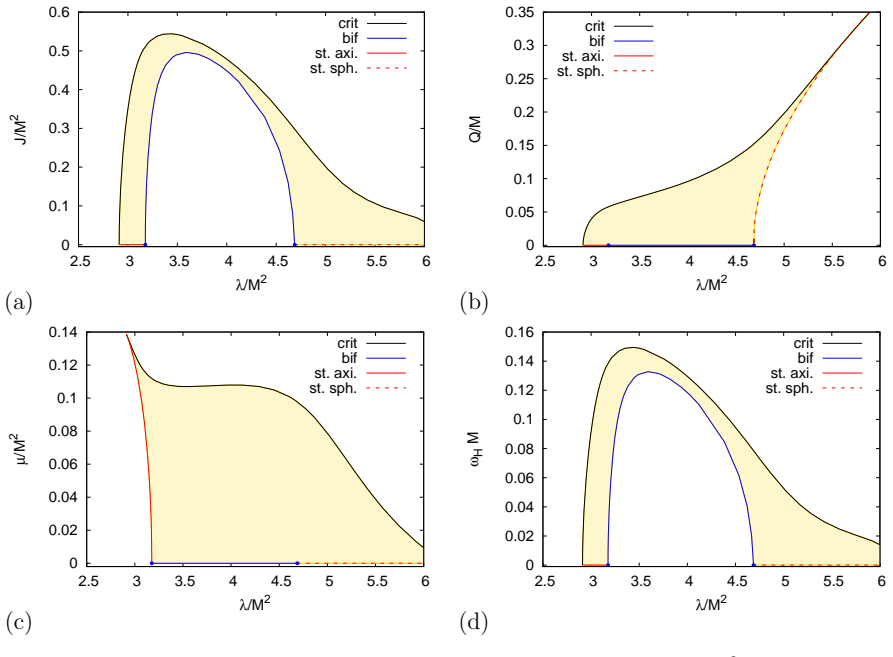
Besides the static, spherically symmetric black holes carrying an electric charge, there are uncharged static, axially symmetric black holes that possess a magnetic dipole moment. Both types possess radial excitations. The magnetic black holes are prolate. They are hotter than the Schwarzschild black holes and possess lower free energy. The domain of existence of the rotating vectorized black holes is bounded by the Kerr black holes, the spherically and axially symmetric static black holes, and the critical solutions.
What carries the argument
Spontaneous vectorization enabled by the quadratic coupling function between the vector field and the Gauss-Bonnet term.
Load-bearing premise
The quadratic coupling function permits the existence of vectorized black hole solutions without violating energy conditions or introducing instabilities not seen in the numerical construction.
What would settle it
A complete numerical scan that finds no axially symmetric uncharged solutions satisfying the field equations or shows that all rotating solutions reduce exactly to Kerr metrics.
Figures




read the original abstract
We study spontaneously vectorized black holes in Einstein-vector-Gauss-Bonnet theory with a quadratic coupling function. Besides the static, spherically symmetric black holes carrying an electric charge, there are uncharged static, axially symmetric black holes that possess a magnetic dipole moment. Both types possess radial excitations. The magnetic black holes are prolate. They are hotter than the Schwarzschild black holes and possess lower free energy. The domain of existence of the rotating vectorized black holes is bounded by the Kerr black holes, the spherically and axially symmetric static black holes, and the critical solutions.
Editorial analysis
A structured set of objections, weighed in public.
Referee Report
Summary. The paper studies spontaneously vectorized black holes in Einstein-vector-Gauss-Bonnet gravity with a quadratic coupling function. It reports the existence of static spherically symmetric charged solutions carrying electric charge, uncharged static axially symmetric solutions with a magnetic dipole moment (prolate in shape), radial excitations of both families, and rotating extensions. The domain of existence for the rotating vectorized black holes is bounded by the Kerr solutions, the static branches, and critical solutions. The magnetic black holes are stated to be hotter than Schwarzschild black holes and to possess lower free energy.
Significance. If the numerical solutions are robustly constructed and verified, the work extends the catalog of black-hole solutions with vector hair in modified gravity, providing concrete examples of spontaneous vectorization in the presence of the Gauss-Bonnet term. The bounded domain of existence and the comparison of thermodynamic quantities (temperature, free energy) with the Schwarzschild and Kerr families offer testable predictions for the theory and could inform studies of stability and observational signatures.
major comments (3)
- The manuscript provides no details on the numerical methods employed to construct the solutions (discretization scheme, gauge choice, boundary-condition implementation, convergence tests, or error control). Since the central claims rest entirely on the existence and properties of these numerical solutions, this omission prevents independent verification of the reported branches, radial excitations, and domain boundaries.
- The domain of existence for the rotating vectorized black holes is described as bounded by Kerr, the static spherically and axially symmetric branches, and critical solutions, but no quantitative criteria (e.g., turning-point method, eigenvalue analysis, or explicit parameter scans) are supplied to establish these boundaries or to confirm that the critical solutions terminate the branches.
- Thermodynamic comparisons (higher temperature and lower free energy relative to Schwarzschild) are stated for the magnetic black holes, yet the manuscript does not specify how the mass, temperature, and free energy are extracted from the numerical data or whether the first law is verified to machine precision for the constructed solutions.
minor comments (1)
- The abstract and introduction should explicitly reference the sections containing the numerical setup and convergence diagnostics so that readers can locate the supporting evidence for the existence claims.
Simulated Author's Rebuttal
We thank the referee for the careful reading of our manuscript and the constructive comments. We agree that additional details are needed for reproducibility and will revise the manuscript to include them. We address each major comment point by point below.
read point-by-point responses
-
Referee: The manuscript provides no details on the numerical methods employed to construct the solutions (discretization scheme, gauge choice, boundary-condition implementation, convergence tests, or error control). Since the central claims rest entirely on the existence and properties of these numerical solutions, this omission prevents independent verification of the reported branches, radial excitations, and domain boundaries.
Authors: We fully agree with this assessment and apologize for the lack of detail in the original submission. In the revised version, we will insert a dedicated section describing the numerical methods. This will include the discretization scheme (a combination of finite differences on a compactified radial coordinate and spectral methods in angular directions), the gauge choice (isotropic coordinates with a specific metric ansatz for axial symmetry), implementation of boundary conditions (regularity at the horizon, asymptotic flatness at infinity, and symmetry conditions on the axis), convergence tests (by doubling the grid points and checking relative errors below 10^{-4}), and error control (monitoring the Hamiltonian constraint violation). These additions will enable independent verification. revision: yes
-
Referee: The domain of existence for the rotating vectorized black holes is described as bounded by Kerr, the static spherically and axially symmetric branches, and critical solutions, but no quantitative criteria (e.g., turning-point method, eigenvalue analysis, or explicit parameter scans) are supplied to establish these boundaries or to confirm that the critical solutions terminate the branches.
Authors: The referee correctly notes that the quantitative criteria are not explicitly provided. The domain boundaries were established via systematic parameter scans in the space of the Gauss-Bonnet coupling, electric charge (for spherical), and angular momentum. Branches terminate when the vector field vanishes (recovering Kerr or Schwarzschild) or when the solutions reach a critical point where the metric functions develop cusps or the solver fails to converge. In the revision, we will add a subsection explaining these criteria, including references to turning-point methods in the context of the bifurcation from the vacuum solutions, and include figures showing the parameter space with marked boundaries. revision: yes
-
Referee: Thermodynamic comparisons (higher temperature and lower free energy relative to Schwarzschild) are stated for the magnetic black holes, yet the manuscript does not specify how the mass, temperature, and free energy are extracted from the numerical data or whether the first law is verified to machine precision for the constructed solutions.
Authors: We will provide the missing details in the revision. The mass is extracted from the leading 1/r term in the asymptotic expansion of the metric function g_{tt}. The Hawking temperature is computed from the surface gravity using the Killing horizon. The free energy is obtained from the Euclidean on-shell action after regularization. We have checked that the first law holds to machine precision (relative error < 10^{-8}) for all reported solutions. A new paragraph will be added to the thermodynamics section detailing these procedures and the verification results. revision: yes
Circularity Check
No significant circularity detected
full rationale
The paper constructs stationary black-hole solutions numerically by solving the coupled Einstein-vector-Gauss-Bonnet field equations with a quadratic coupling function. The metric and vector-field ansatz for spherical and axial symmetry, the boundary conditions at the horizon and infinity, and the reported properties (charge, dipole moment, prolateness, temperature, free energy, and domain boundaries) are obtained directly from the numerical integration. No parameter is fitted to a subset of data and then relabeled as a prediction, no result is defined in terms of itself, and no load-bearing step reduces to a self-citation whose validity is presupposed by the present work. The domain limits are set by independently known solutions (Kerr, Schwarzschild) that serve as external benchmarks rather than internal tautologies. The derivation chain is therefore self-contained and non-circular.
Axiom & Free-Parameter Ledger
axioms (1)
- domain assumption Einstein-vector-Gauss-Bonnet theory with quadratic coupling function admits spontaneous vectorization around black holes.
Lean theorems connected to this paper
-
IndisputableMonolith/Foundation/AlexanderDuality.leanalexander_duality_circle_linking unclear?
unclearRelation between the paper passage and the cited Recognition theorem.
We study spontaneously vectorized black holes in Einstein-vector-Gauss-Bonnet theory with a quadratic coupling function... The domain of existence of the rotating vectorized black holes is bounded by the Kerr black holes, the spherically and axially symmetric static black holes, and the critical solutions.
-
IndisputableMonolith/Cost/FunctionalEquation.leanwashburn_uniqueness_aczel unclear?
unclearRelation between the paper passage and the cited Recognition theorem.
The effective stress-energy tensor T(eff)μν = T(A)μν − 2T(GB)μν ...
What do these tags mean?
- matches
- The paper's claim is directly supported by a theorem in the formal canon.
- supports
- The theorem supports part of the paper's argument, but the paper may add assumptions or extra steps.
- extends
- The paper goes beyond the formal theorem; the theorem is a base layer rather than the whole result.
- uses
- The paper appears to rely on the theorem as machinery.
- contradicts
- The paper's claim conflicts with a theorem or certificate in the canon.
- unclear
- Pith found a possible connection, but the passage is too broad, indirect, or ambiguous to say the theorem truly supports the claim.
Forward citations
Cited by 1 Pith paper
-
No-go theorem for spontaneous vectorization
A no-go theorem shows that negative effective mass squared for the vector field in vector-tensor gravity always accompanies ghost or gradient instabilities, blocking spontaneous vectorization in stationary axisymmetri...
Reference graph
Works this paper leans on
-
[1]
J. F. Donoghue, [arXiv:gr-qc/9512024 [gr-qc]]
work page internal anchor Pith review arXiv
-
[2]
C. P. Burgess, Living Rev. Rel. 7, 5 (2004)
2004
-
[3]
Berti, E
E. Berti, E. Barausse, V. Cardoso, L. Gualtieri, P. Pani, U. Sper hake, L. C. Stein, N. Wex, K. Yagi and T. Baker, et al. Class. Quant. Grav. 32, 243001 (2015)
2015
-
[4]
E. N. Saridakis et al. [CANTATA],Modified Gravity and Cosmology: An Update by the CANTATA Network, (Springer, Cham, 2021)
2021
-
[5]
Faraoni and S
V. Faraoni and S. Capozziello, Beyond Einstein Gravity: A Survey of Gravitational Theories for Cosmology and Astrophysics , (Springer, Dordrecht, 2011)
2011
-
[6]
G. W. Horndeski, Int. J. Theor. Phys. 10, 363 (1974)
1974
-
[7]
Charmousis, E
C. Charmousis, E. J. Copeland, A. Padilla and P. M. Saffin, Phys. Re v. Lett. 108, 051101 (2012)
2012
-
[8]
Kobayashi, M
T. Kobayashi, M. Yamaguchi and J. Yokoyama, Prog. Theor. Ph ys. 126, 511 (2011)
2011
-
[9]
D. D. Doneva, F. M. Ramazano˘ glu, H. O. Silva, T. P. Sotiriou and S . S. Yazadjiev, Rev. Mod. Phys. 96, 015004 (2024)
2024
-
[10]
Damour and G
T. Damour and G. Esposito-Farese, Phys. Rev. Lett. 70, 2220 (1993) 15
1993
-
[11]
D. D. Doneva and S. S. Yazadjiev, Phys. Rev. Lett. 120, 131103 (2018)
2018
-
[12]
H. O. Silva, J. Sakstein, L. Gualtieri, T. P. Sotiriou and E. Berti, Phys. Rev. Lett. 120, 131104 (2018)
2018
-
[13]
Antoniou, A
G. Antoniou, A. Bakopoulos and P. Kanti, Phys. Rev. Lett. 120, 131102 (2018)
2018
-
[14]
P. V. P. Cunha, C. A. R. Herdeiro and E. Radu, Phys. Rev. Lett. 123, 011101 (2019)
2019
-
[15]
L. G. Collodel, B. Kleihaus, J. Kunz and E. Berti, Class. Quant. Grav. 37, 075018 (2020)
2020
-
[16]
A. Dima, E. Barausse, N. Franchini and T. P. Sotiriou, Phys. Rev. Lett. 125, 231101 (2020)
2020
-
[17]
Hod, Phys
S. Hod, Phys. Rev. D 102, 084060 (2020)
2020
-
[18]
D. D. Doneva, L. G. Collodel, C. J. Kr¨ uger and S. S. Yazadjiev, Phys. Rev. D 102, 104027 (2020)
2020
-
[19]
C. A. R. Herdeiro, E. Radu, H. O. Silva, T. P. Sotiriou and N. Yune s, Phys. Rev. Lett. 126, 011103 (2021)
2021
-
[20]
Berti, L
E. Berti, L. G. Collodel, B. Kleihaus and J. Kunz, Phys. Rev. Lett. 126, 011104 (2021)
2021
-
[21]
D. D. Doneva and S. S. Yazadjiev, Phys. Rev. D 105, L041502 (2022)
2022
-
[22]
J. L. Bl´ azquez-Salcedo, D. D. Doneva, J. Kunz and S. S. Yaza djiev, Phys. Rev. D 105, 124005 (2022)
2022
-
[23]
D. D. Doneva, L. G. Collodel and S. S. Yazadjiev, Phys. Rev. D 106, 104027 (2022)
2022
-
[24]
M. Y. Lai, D. C. Zou, R. H. Yue and Y. S. Myung, Phys. Rev. D 108, 084007 (2023)
2023
-
[25]
Kanti, N
P. Kanti, N. E. Mavromatos, J. Rizos, K. Tamvakis and E. Winsta nley, Phys. Rev. D 54, 5049 (1996)
1996
-
[26]
Torii, H
T. Torii, H. Yajima and K. i. Maeda, Phys. Rev. D 55, 739 (1997)
1997
-
[27]
Pani and V
P. Pani and V. Cardoso, Phys. Rev. D 79, 084031 (2009)
2009
-
[28]
Kleihaus, J
B. Kleihaus, J. Kunz and E. Radu, Phys. Rev. Lett. 106, 151104 (2011)
2011
-
[29]
T. P. Sotiriou and S. Y. Zhou, Phys. Rev. D 90, 124063 (2014)
2014
-
[30]
G. W. Horndeski, J. Math. Phys. 17, 1980 (1976)
1980
-
[31]
Tasinato, JHEP 04, 067 (2014)
G. Tasinato, JHEP 04, 067 (2014)
2014
-
[32]
Heisenberg, JCAP 05, 015 (2014) 16
L. Heisenberg, JCAP 05, 015 (2014) 16
2014
-
[33]
Tasinato, Class
G. Tasinato, Class. Quant. Grav. 31, 225004 (2014)
2014
-
[34]
Chagoya, G
J. Chagoya, G. Niz and G. Tasinato, Class. Quant. Grav. 33, 175007 (2016)
2016
-
[35]
Z. Y. Fan, JHEP 09, 039 (2016)
2016
-
[36]
Babichev, C
E. Babichev, C. Charmousis and M. Hassaine, JHEP 05, 114 (2017)
2017
-
[37]
Chagoya, G
J. Chagoya, G. Niz and G. Tasinato, Class. Quant. Grav. 34, 165002 (2017). [38]
2017
-
[38]
Heisenberg, R
L. Heisenberg, R. Kase, M. Minamitsuji and S. Tsujikawa, Phys . Rev. D 96, 084049 (2017)
2017
-
[39]
Heisenberg, R
L. Heisenberg, R. Kase, M. Minamitsuji and S. Tsujikawa, JCAP 1708, 024 (2017)
2017
-
[40]
Verbin, Phys
Y. Verbin, Phys. Rev. D 106, 2 (2022)
2022
-
[41]
J. M. S. Oliveira and A. M. Pombo, Phys. Rev. D 103, 044004 (2021)
2021
-
[42]
Barton, B
S. Barton, B. Hartmann, B. Kleihaus and J. Kunz, Phys. Lett. B 817, 136336 (2021)
2021
-
[43]
Minamitsuji and K
M. Minamitsuji and K. i. Maeda, Phys. Rev. D 110, 024047 (2024)
2024
-
[44]
Charmousis, P
C. Charmousis, P. G. S. Fernandes and M. Hassaine, Phys. Rev . D 111, 12 (2025)
2025
-
[45]
Eichhorn and P
A. Eichhorn and P. G. S. Fernandes, Phys. Rev. D 113, L081501 (2026)
2026
-
[46]
R. A. Konoplya and A. Zhidenko, Phys. Lett. B 872, 140108 (2026)
2026
-
[47]
B. C. L¨ utf¨ uo˘ glu, Eur. Phys. J. C85, 1076 (2025)
2025
-
[48]
R. A. Konoplya, D. Ovchinnikov and J. Schee, Phys. Rev. D 113, 024059 (2026)
2026
- [49]
-
[50]
F. M. Ramazano˘ glu, Phys. Rev. D 96, 064009 (2017)
2017
-
[51]
F. M. Ramazano˘ glu, Phys. Rev. D 98, 044013 (2018)
2018
-
[52]
F. M. Ramazano˘ glu, Phys. Rev. D 99, 084015 (2019)
2019
-
[53]
F. M. Ramazano˘ glu and K. ˙I. ¨Unl¨ ut¨ urk, Phys. Rev. D100, 084026 (2019)
2019
-
[54]
General Relativity,
R. M. Wald, “General Relativity,” (Chicago Univ. Pr., Chicago, USA , 1984)
1984
-
[55]
Lee and R
J. Lee and R. M. Wald, J. Math. Phys. 31, 725 (1990)
1990
-
[56]
R. M. Wald, Phys. Rev. D 48, 3427 (1993)
1993
-
[57]
Iyer and R
V. Iyer and R. M. Wald, Phys. Rev. D 50, 846 (1994) 17
1994
-
[58]
Hajian and M
K. Hajian and M. M. Sheikh-Jabbari, Phys. Rev. D 93, 044074 (2016)
2016
-
[59]
Ghodrati, K
M. Ghodrati, K. Hajian and M. R. Setare, Eur. Phys. J. C 76, 701 (2016)
2016
-
[60]
Hajian, S
K. Hajian, S. Liberati, M. M. Sheikh-Jabbari and M. H. Vahidinia, Phys. Lett. B 812, 136002 (2020)
2020
-
[61]
Israel, Phys
W. Israel, Phys. Rev. 164, 1776 (1967)
1967
-
[62]
Black hole spectroscopy: from theory to experiment
E. Berti, V. Cardoso, G. Carullo, J. Abedi, N. Afshordi, S. Alban esi, V. Baibhav, S. Bhagwat, J. L. Bl´ azquez-Salcedo and B. Bonga, et al. [arXiv:2505.23895 [gr-qc]]
work page internal anchor Pith review arXiv
-
[63]
J. L. Bl´ azquez-Salcedo, F. S. Khoo, J. Kunz and L. M. Gonz´ a lez-Romero, Phys. Rev. D 109 (2024) 064028
2024
-
[64]
A. K. W. Chung and N. Yunes, Phys. Rev. Lett. 133, 181401 (2024)
2024
-
[65]
A. K. W. Chung and N. Yunes, Phys. Rev. D 110 (2024) 064019
2024
-
[66]
J. L. Bl´ azquez-Salcedo, F. S. Khoo, B. Kleihaus and J. Kunz, P hys. Rev. D 111, L021505 (2025) 18
2025
discussion (0)
Sign in with ORCID, Apple, or X to comment. Anyone can read and Pith papers without signing in.