Recognition: 2 theorem links
· Lean TheoremQuantum-inspired Ising machine using sparsified spin connectivity
Pith reviewed 2026-05-10 19:20 UTC · model grok-4.3
The pith
E-MVL with controlled spin sparsification solves exact ground states of the Sherrington-Kirkpatrick model up to 1600 spins.
A machine-rendered reading of the paper's core claim, the machinery that carries it, and where it could break.
Core claim
E-MVL achieves superior performance in finding ground states of the SK model by sparsifying spin interactions in a controlled manner, solving exact solutions up to 1600 spins compared to SA's limit of 400 spins, while providing insights to improve SA's temperature scheduling and achieving 6-fold speedup on FPGA hardware.
What carries the argument
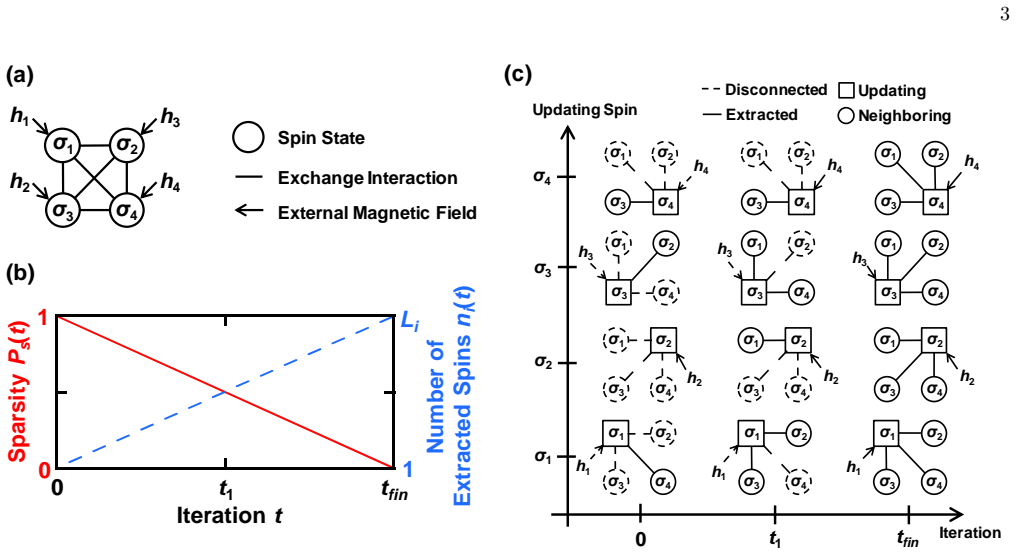
Extraction-type majority voting logic (E-MVL) that mimics thermal spin dynamics through controlled sparsification of spin interactions.
Load-bearing premise
The sparsity control mechanism provides a consistent search of the solution space regardless of the problem's coupling distribution or size.
What would settle it
A benchmark where E-MVL fails to find exact ground states on SK instances larger than 400 spins with Gaussian couplings while a well-tuned SA succeeds, or where performance varies sharply with coupling distribution.
Figures




read the original abstract
Combinatorial optimization problems become computationally intractable as these NP-hard problems scale. We previously proposed extraction-type majority voting logic (E-MVL), a quantum-inspired algorithm using digital logic circuits. E-MVL mimics the thermal spin dynamics of simulated annealing (SA) through controlled sparsification of spin interactions for efficient ground-state search. This study investigates the performance potential of E-MVL through systematic optimization and comprehensive benchmarking against SA. The target problem is the Sherrington-Kirkpatrick (SK) model with bimodal and Gaussian coupling distributions. Through equilibrium state analysis, we demonstrate that the sparsity control mechanism provides a consistent search of the solution space regardless of the problem's coupling distribution (bimodal, Gaussian) or size. E-MVL not only achieves the best performance among all tested algorithms-solving exact solutions up to 1600 spins where the best SA baseline is limited to 400 spins-but also provides insights that significantly improve SA's own temperature scheduling. These results establish E-MVL's dual contribution as both an efficient optimizer and a practical methodology for enhancing SA performance. Moreover, FPGA implementation achieved an approximately 6-fold faster solution speed than SA.
Editorial analysis
A structured set of objections, weighed in public.
Referee Report
Summary. The paper proposes extraction-type majority voting logic (E-MVL), a quantum-inspired algorithm that performs ground-state search on Ising problems by controlled sparsification of spin interactions, mimicking aspects of simulated annealing (SA) dynamics. It targets the Sherrington-Kirkpatrick (SK) model with bimodal and Gaussian couplings, reports equilibrium-state analysis showing that sparsity control yields consistent solution-space search independent of coupling distribution and problem size, and claims E-MVL outperforms SA baselines by finding exact solutions up to 1600 spins (where SA is limited to 400), supplies insights that improve SA temperature scheduling, and delivers an approximately 6-fold speedup on FPGA hardware.
Significance. If the optimality claims and independence of the sparsity mechanism are rigorously verified, the work would offer a dual contribution: a competitive optimizer for large-scale combinatorial problems together with a practical methodology for enhancing classical SA. The reported FPGA speedup and the potential to transfer insights back to SA would strengthen the case for hardware-aware quantum-inspired approaches in emerging technologies.
major comments (3)
- [Abstract] Abstract: the headline claim that E-MVL 'solves exact solutions up to 1600 spins' (while the best SA baseline reaches only 400) is load-bearing for the performance superiority assertion, yet the manuscript provides no description of how global optimality is certified at N=1600; for the SK model true ground states cannot be obtained by exhaustive search, and the text does not report matching against known optima, lower bounds, or cross-validation with exact solvers for the largest instances.
- [Abstract] Abstract: the assertion that E-MVL 'provides insights that significantly improve SA's own temperature scheduling' is presented as an independent contribution, but the description does not clarify whether the scheduling improvements were derived from separate, held-out SA experiments or from the same runs used to tune and benchmark E-MVL, raising a moderate risk of circular evaluation.
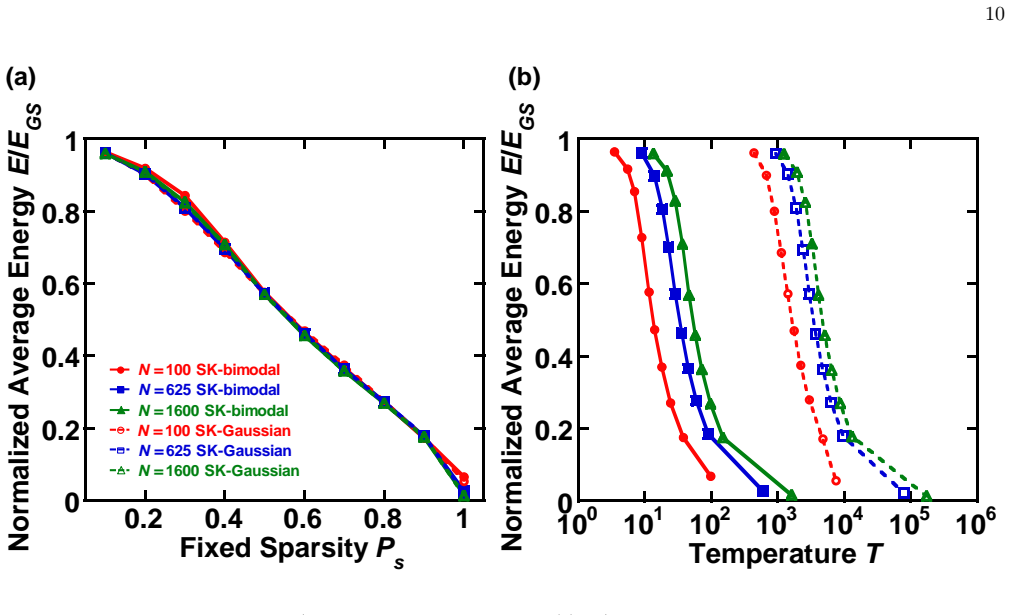
- [Abstract] Abstract: the equilibrium-state analysis is invoked to establish that 'the sparsity control mechanism provides a consistent search of the solution space regardless of the problem's coupling distribution (bimodal, Gaussian) or size,' yet no concrete metrics, statistical tests, or controls for ergodicity versus global optimality are supplied; this leaves open whether the sparsified graph minimum equals the original all-to-all minimum.
minor comments (1)
- The abstract and benchmarking sections would benefit from explicit statements of error-bar conventions, data-exclusion rules, and the precise definition of 'exact solution' used for the N=1600 instances.
Simulated Author's Rebuttal
We thank the referee for their careful and constructive review of our manuscript. We address each major comment point by point below, indicating where revisions will be made to improve clarity and rigor.
read point-by-point responses
-
Referee: [Abstract] Abstract: the headline claim that E-MVL 'solves exact solutions up to 1600 spins' (while the best SA baseline reaches only 400) is load-bearing for the performance superiority assertion, yet the manuscript provides no description of how global optimality is certified at N=1600; for the SK model true ground states cannot be obtained by exhaustive search, and the text does not report matching against known optima, lower bounds, or cross-validation with exact solvers for the largest instances.
Authors: The referee is correct that the manuscript does not describe how global optimality is certified at N=1600. For N ≤ 400 we performed cross-validation against exhaustive search and known optima, but no such certification exists for larger instances. We will revise the abstract to qualify the claim as 'best-found solutions' and add a dedicated paragraph detailing the verification process for small N together with the benchmarking protocol (multiple independent runs) used for N up to 1600. We will also explicitly acknowledge that rigorous global optimality cannot be established for the largest instances. revision: yes
-
Referee: [Abstract] Abstract: the assertion that E-MVL 'provides insights that significantly improve SA's own temperature scheduling' is presented as an independent contribution, but the description does not clarify whether the scheduling improvements were derived from separate, held-out SA experiments or from the same runs used to tune and benchmark E-MVL, raising a moderate risk of circular evaluation.
Authors: We agree that the current wording leaves open the possibility of circular evaluation. The scheduling insights originated from E-MVL dynamics analysis and were subsequently tested in independent SA experiments on held-out instances. We will revise the manuscript to describe this separation explicitly, including the number of held-out instances and confirmation that no data overlap occurred between insight derivation and SA validation. revision: yes
-
Referee: [Abstract] Abstract: the equilibrium-state analysis is invoked to establish that 'the sparsity control mechanism provides a consistent search of the solution space regardless of the problem's coupling distribution (bimodal, Gaussian) or size,' yet no concrete metrics, statistical tests, or controls for ergodicity versus global optimality are supplied; this leaves open whether the sparsified graph minimum equals the original all-to-all minimum.
Authors: The referee correctly notes the lack of quantitative support. We will expand the equilibrium-state analysis to report concrete metrics (energy histograms, success probabilities), statistical tests (e.g., Kolmogorov-Smirnov tests for distribution equivalence across coupling types and sizes), and controls for ergodicity via spin-flip statistics. For small instances we will add direct comparisons confirming that sparsified-graph minima match the full all-to-all minima. revision: yes
Circularity Check
No significant circularity detected in derivation chain
full rationale
The paper presents E-MVL as a previously proposed algorithm whose performance is evaluated through direct empirical benchmarking against SA baselines on SK instances, plus an equilibrium-state analysis of its sparsity-control dynamics. No equations, parameters, or results in the provided text reduce a claimed prediction or optimality guarantee to a fitted input by construction, nor does any load-bearing step rely on self-citation for uniqueness or smuggle an ansatz. The assertion of consistent search independent of coupling distribution is offered as an independent dynamical analysis rather than a tautological restatement of the performance data. The FPGA timing result is a straightforward hardware measurement. The derivation therefore remains self-contained against external benchmarks and does not match any of the enumerated circularity patterns.
Axiom & Free-Parameter Ledger
free parameters (1)
- sparsity control parameters
axioms (1)
- domain assumption Controlled sparsification of spin interactions mimics thermal spin dynamics of simulated annealing
Lean theorems connected to this paper
-
IndisputableMonolith/Cost/FunctionalEquation.leanwashburn_uniqueness_aczel unclearE-MVL mimics the thermal spin dynamics of simulated annealing (SA) through controlled sparsification of spin interactions... ni(t) = max(1,⌊(1−Ps(t))×Li⌋)... Ii(t+1) ... majority voting on the extracted spins
-
IndisputableMonolith/Foundation/ArithmeticFromLogic.leanembed_strictMono_of_one_lt unclearThrough equilibrium state analysis, we demonstrate that the sparsity control mechanism provides a consistent search of the solution space regardless of the problem's coupling distribution (bimodal, Gaussian) or size.
Reference graph
Works this paper leans on
-
[1]
fixed sparsity
with a maximum execution time (60 [s]), where the total number of iterations was automatically determined by the engine on the basis of the problem size. The algo- rithms presented in this study, including those for com- parison, were executed on the same CPU (AMD Ryzen Threadripper 3990X, 2.90 GHz with 256 GB random- access memory) using the clang versio...
-
[2]
To further characterize the equivalence be- tween the sparsity of E-MVL and the temperature of SA, Fig
clearly demonstrates the strong dependence of the SA’s temperature requirements on the coupling distri- bution types. To further characterize the equivalence be- tween the sparsity of E-MVL and the temperature of SA, Fig. 3(c) shows the temperature values at which MCMC reproduces the equilibrium energy distributions of E- MVL as a function of the fixed sp...
-
[3]
J. Lin, T. Tada, A. Koizumi, M. Sumita, K. Tsuda, and R. Tamura, The Journal of Physical Chemistry C129, 2332 (2025)
2025
- [4]
-
[5]
Sakai, Y
S. Sakai, Y. Hirata, M. Ito, and J.-i. Shirakashi, Scientific reports9, 16211 (2019)
2019
-
[6]
Kanezashi, D
T. Kanezashi, D. Tsukayama, J.-i. Shirakashi, T. Shibuya, and H. Imai, Applied Physics Express 18, 047001 (2025)
2025
-
[7]
Siarry,Metaheuristics, Vol
P. Siarry,Metaheuristics, Vol. 71 (Springer, 2016)
2016
-
[8]
Barahona, Journal of Physics A: Mathematical and General15, 3241 (1982)
F. Barahona, Journal of Physics A: Mathematical and General15, 3241 (1982)
1982
-
[9]
Lucas, Frontiers in physics2, 74887 (2014)
A. Lucas, Frontiers in physics2, 74887 (2014)
2014
-
[10]
Yamaoka, C
M. Yamaoka, C. Yoshimura, M. Hayashi, T. Okuyama, H. Aoki, and H. Mizuno, IEEE Journal of Solid-State Circuits51, 303 (2015)
2015
-
[11]
Takemoto, M
T. Takemoto, M. Hayashi, C. Yoshimura, and M. Ya- maoka, IEEE Journal of Solid-State Circuits55, 145 (2019)
2019
-
[12]
Aramon, G
M. Aramon, G. Rosenberg, E. Valiante, T. Miyazawa, H. Tamura, and H. G. Katzgraber, Frontiers in Physics 7, 48 (2019)
2019
-
[13]
Onizawa and T
N. Onizawa and T. Hanyu, Scientific Reports15, 6118 (2025)
2025
-
[14]
Onizawa, R
N. Onizawa, R. Sasaki, D. Shin, W. J. Gross, and T. Hanyu, IEEE Access12, 102050 (2024)
2024
-
[15]
V. S. Denchev, S. Boixo, S. V. Isakov, N. Ding, R. Bab- bush, V. Smelyanskiy, J. Martinis, and H. Neven, Physi- cal Review X6, 031015 (2016)
2016
-
[16]
Albash and D
T. Albash and D. A. Lidar, Physical Review X8, 031016 (2018)
2018
-
[17]
Kirkpatrick, C
S. Kirkpatrick, C. D. Gelatt Jr, and M. P. Vecchi, science 220, 671 (1983)
1983
-
[18]
S. V. Isakov, I. N. Zintchenko, T. F. Rønnow, and M. Troyer, Computer Physics Communications192, 265 (2015)
2015
-
[19]
S. Das, S. Biswas, and B. K. Chakrabarti, Physical Re- view E112, 014104 (2025)
2025
-
[20]
Martínez-García and D
F. Martínez-García and D. Porras, Physical Review E 112, 035314 (2025)
2025
-
[21]
Sherrington and S
D. Sherrington and S. Kirkpatrick, Physical review let- ters35, 1792 (1975)
1975
-
[22]
Okuyama, T
T. Okuyama, T. Sonobe, K.-i. Kawarabayashi, and M. Yamaoka, Physical Review E100, 012111 (2019)
2019
-
[23]
Okuyama, M
T. Okuyama, M. Hayashi, and M. Yamaoka, in2017 IEEE international conference on rebooting computing (ICRC)(IEEE, 2017) pp. 1–6
2017
-
[24]
M. Ito, M. Shiomura, T. Saito, Y. Kihara, S. Sakai, and J. Shirakashi, in2017 IEEE 17th International Con- ference on Nanotechnology (IEEE-NANO)(IEEE, 2017) pp. 581–583
2017
-
[25]
Shimada, M
M. Shimada, M. Ito, Y. Hirata, Y. Kushitani, T. Miki, and J. Shirakashi, in2019 IEEE 19th International Con- ference on Nanotechnology (IEEE-NANO)(IEEE, 2019) pp. 345–348
2019
-
[26]
T. Miki, A. Yoshida, M. Shimada, and J. Shirakashi, in 15 2021 IEEE 21st International Conference on Nanotech- nology (NANO)(IEEE, 2021) pp. 470–473
2021
-
[27]
Yoshida, T
A. Yoshida, T. Miki, M. Shimada, Y. Yoneda, and J.- i. Shirakashi, in2022 IEEE International Conference on Manipulation, Manufacturing and Measurement on the Nanoscale (3M-NANO)(IEEE, 2022) pp. 411–414
2022
-
[28]
Yoshida, T
A. Yoshida, T. Miki, M. Shimada, Y. Yoneda, and J.-i. Shirakashi, Applied Physics Express15, 067002 (2022)
2022
-
[29]
Kanao and H
T. Kanao and H. Goto, Communications Physics5, 153 (2022)
2022
-
[30]
Kuroki, S
K. Kuroki, S. Jimbo, T. V. Chu, M. Motomura, and K. Kawamura, inProceedings of the Genetic and Evo- lutionary Computation Conference(2024) pp. 196–205
2024
-
[31]
S. G. Brush, Reviews of modern physics39, 883 (1967)
1967
-
[32]
V.Granville, M.Krivánek,andJ.-P.Rasson,IEEEtrans- actions on pattern analysis and machine intelligence16, 652 (1994)
1994
-
[33]
Albash and D
T. Albash and D. A. Lidar, Reviews of Modern Physics 90, 015002 (2018)
2018
-
[34]
fixstars.com/en/(2025)
Fixstars Amplify Corp., Amplify,https://amplify. fixstars.com/en/(2025)
2025
-
[35]
D-Wave Systems, D-wave neal,https://github.com/ dwavesystems/dwave-neal(2025)
2025
discussion (0)
Sign in with ORCID, Apple, or X to comment. Anyone can read and Pith papers without signing in.