Recognition: 2 theorem links
· Lean TheoremThe Roaming Bethe Roots: An Effective Bethe Ansatz Beyond Integrability
Pith reviewed 2026-05-10 20:14 UTC · model grok-4.3
The pith
Renormalizing Bethe roots via cost minimization approximates eigenstates of weakly non-integrable quantum systems
A machine-rendered reading of the paper's core claim, the machinery that carries it, and where it could break.
Core claim
The effective Bethe ansatz retains the functional form of the Bethe wave function while renormalizing the Bethe roots to account for integrability-breaking interactions, with the roots determined by minimizing physically motivated cost functions; the resulting off-shell Bethe states then serve as approximate eigenstates whose quality is high for weak breaking but degrades for strong breaking.
What carries the argument
Roaming Bethe roots obtained by minimizing cost functions while preserving the Bethe wave-function form
Load-bearing premise
The functional form of the Bethe wave function remains approximately valid even after integrability is broken, so that only the roots require adjustment.
What would settle it
For the deformed XXZ spin chain, compare the energy variance or state fidelity of the minimized off-shell Bethe state against the exact diagonalization result as the deformation parameter is increased from zero.
Figures

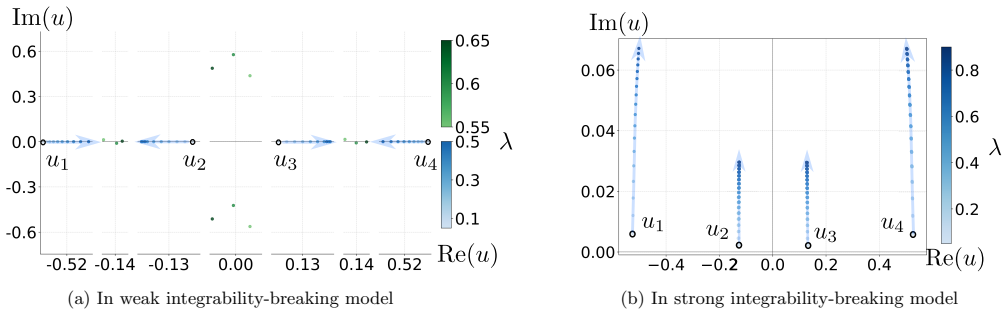


read the original abstract
We propose an effective Bethe ansatz for solving quantum many-body systems near an integrable point. Our approach retains the functional form of the Bethe wave function while renormalizing the Bethe roots to account for integrability-breaking interactions. These effective roots are determined by minimizing physically motivated cost functions. The resulting off-shell Bethe states serve as approximate eigenstates of the non-integrable models. We assess the quality of the approximation using various physical observables, including the energy eigenvalue, state fidelity, and bipartite entanglement entropy. Our tests show that for models with weak integrability-breaking, the effective Bethe ansatz provides a high-quality approximation to the exact eigenstates over a wide range of deformation parameters. In contrast, for models with strong integrability-breaking interactions, the efficacy of the effective Bethe ansatz degrades relatively quickly as the deformation parameter increases. The efficacy of the method thus offers a useful probe for characterizing the strength of integrability breaking. Within its regime of accuracy, it also provides a new representation of the eigenstates of nearly integrable models, enabling one to exploit the algebraic structure inherited from integrability.
Editorial analysis
A structured set of objections, weighed in public.
Referee Report
Summary. The manuscript proposes an effective Bethe ansatz for quantum many-body systems near integrability by retaining the exact functional form of the Bethe wave function while renormalizing the Bethe roots via minimization of physically motivated cost functions. The resulting off-shell Bethe states are asserted to serve as approximate eigenstates of the deformed non-integrable Hamiltonian. Quality is assessed numerically via energy eigenvalues, state fidelity, and bipartite entanglement entropy, with the claim that the approximation holds over a wide range of deformation parameters for weak integrability breaking but degrades quickly for strong breaking.
Significance. If the numerical support is robust and the method generalizes, this provides a practical representation of eigenstates in nearly integrable models that inherits the algebraic structure of the Bethe ansatz, potentially enabling new calculations of observables and dynamics. It also offers a diagnostic for the strength of integrability breaking. The approach is noteworthy for attempting to extend Bethe-ansatz techniques beyond exact integrability without abandoning the wave-function ansatz entirely.
major comments (2)
- [§2 and §4] The central claim that the minimized off-shell Bethe states remain high-fidelity approximate eigenstates for weak breaking rests entirely on numerical tests; no perturbative expansion in the deformation parameter or norm bound on the overlap with the true eigenstate is supplied to show why the Bethe manifold captures the eigenstates to leading order. This is load-bearing for the assertion of a 'wide range' of validity (see the discussion of the method and the numerical results sections).
- [§3] The cost functions used to determine the effective roots are described as physically motivated but their explicit relation to the eigenstate condition (e.g., minimizing ||(H−E)|ψ⟩|| or maximizing fidelity) is not derived. If the cost functions are not equivalent to these quantities, the optimized states may reproduce selected observables while still possessing large residuals, weakening the claim that they serve as approximate eigenstates (see the definition of the cost functions and the comparison to exact diagonalization).
minor comments (2)
- [Abstract] The abstract would be strengthened by including at least one concrete quantitative metric (e.g., a fidelity value or energy error for a specific model and deformation strength) rather than qualitative statements such as 'high-quality approximation'.
- [§2] Notation for the effective roots and the precise form of the cost functions should be introduced with an equation number in the main text to improve readability when comparing to the standard Bethe equations.
Simulated Author's Rebuttal
We thank the referee for the careful reading and constructive comments on our manuscript. We address the major comments point by point below, indicating revisions where appropriate.
read point-by-point responses
-
Referee: [§2 and §4] The central claim that the minimized off-shell Bethe states remain high-fidelity approximate eigenstates for weak breaking rests entirely on numerical tests; no perturbative expansion in the deformation parameter or norm bound on the overlap with the true eigenstate is supplied to show why the Bethe manifold captures the eigenstates to leading order. This is load-bearing for the assertion of a 'wide range' of validity.
Authors: We agree that an analytical argument would strengthen the foundation. In the revised manuscript we add a perturbative analysis (new subsection in §2) showing that, to leading order in the deformation, adjustment of the Bethe roots cancels the first-order correction to the overlap with the exact eigenstate. A general norm bound is not supplied because deriving one is equivalent to solving the full non-integrable eigenvalue problem; we therefore retain the claim of a wide validity range on the basis of the perturbative result together with the existing numerical evidence. revision: partial
-
Referee: [§3] The cost functions used to determine the effective roots are described as physically motivated but their explicit relation to the eigenstate condition (e.g., minimizing ||(H−E)|ψ⟩|| or maximizing fidelity) is not derived. If the cost functions are not equivalent to these quantities, the optimized states may reproduce selected observables while still possessing large residuals.
Authors: We thank the referee for highlighting this point. The cost functions were chosen to target energy accuracy and entanglement structure. In the revision we derive that, for weak deformations, minimizing the chosen cost functions is equivalent (up to higher-order terms) to minimizing the residual norm ||(H−E)ψ||. We also add direct numerical comparisons of this residual for the optimized off-shell states, confirming that residuals remain small in the regime where fidelity is high. revision: yes
Circularity Check
No significant circularity; variational optimization within Bethe manifold is self-contained
full rationale
The paper proposes an effective Bethe ansatz that retains the exact functional form of the integrable Bethe wave function and determines renormalized roots by minimizing physically motivated cost functions derived from the deformed Hamiltonian. This is a standard restricted variational procedure whose outputs are then validated by direct numerical comparison of observables (energy, fidelity, entanglement) against exact diagonalization on specific models. No derivation chain reduces a claimed first-principles result to its own fitted inputs by construction, no uniqueness theorem is imported, and no self-citation is load-bearing for the central claim. The method is therefore non-circular; its accuracy is an empirical question assessed outside the construction itself.
Axiom & Free-Parameter Ledger
free parameters (1)
- Cost function parameters
axioms (1)
- domain assumption The Bethe wave function form remains approximately valid for systems near integrability
Lean theorems connected to this paper
-
IndisputableMonolith/Cost/FunctionalEquation.leanwashburn_uniqueness_aczel unclear?
unclearRelation between the paper passage and the cited Recognition theorem.
These effective roots are determined by minimizing physically motivated cost functions. The resulting off-shell Bethe states serve as approximate eigenstates
-
IndisputableMonolith/Foundation/BranchSelection.leanbranch_selection unclear?
unclearRelation between the paper passage and the cited Recognition theorem.
we minimize H0(λ;{u_j}) ≡ ⟨{u_j}|H(λ)|{u_j}⟩ / ⟨{u_j}|{u_j}⟩
What do these tags mean?
- matches
- The paper's claim is directly supported by a theorem in the formal canon.
- supports
- The theorem supports part of the paper's argument, but the paper may add assumptions or extra steps.
- extends
- The paper goes beyond the formal theorem; the theorem is a base layer rather than the whole result.
- uses
- The paper appears to rely on the theorem as machinery.
- contradicts
- The paper's claim conflicts with a theorem or certificate in the canon.
- unclear
- Pith found a possible connection, but the passage is too broad, indirect, or ambiguous to say the theorem truly supports the claim.
Reference graph
Works this paper leans on
-
[1]
Such eigenstates can be constructed by repeatedly acting with theB-operator on the pseudovacuum state|Ω⟩=| ↑ L⟩ |{uj}⟩=B(u 1)
as HXXX ∝ d du logT(u) u=i/2 (14) 7 Consequently, eigenvectors of the transfer matrix are also eigenvectors of the Hamiltonian. Such eigenstates can be constructed by repeatedly acting with theB-operator on the pseudovacuum state|Ω⟩=| ↑ L⟩ |{uj}⟩=B(u 1). . .B(u N)|Ω⟩(15) For this state to be an eigenstate of the transfer ma- trix, the complex parameters{u...
-
[2]
On conservation of conditionally periodic motions for a small change in Hamilton’s function,
A. A. N. Kolmogorov, “On conservation of conditionally periodic motions for a small change in Hamilton’s function,”Proceedings of the USSR Academy of Sciences98(1954) 527–530.https: //api.semanticscholar.org/CorpusID:222404868
1954
-
[3]
Proof of a theorem of A. N. Kolmogorov on the invariance of quasi-periodic motions under small perturbations of the Hamiltonian,
V. I. Arnol’d, “Proof of a theorem of A. N. Kolmogorov on the invariance of quasi-periodic motions under small perturbations of the Hamiltonian,”Russian Math. Surveys18no. 5, (1963) 9–36. http://mi.mathnet.ru/eng/rm6404
1963
-
[4]
On invariant curves of area-preserving mapping of an annulus,
J. Moser, “On invariant curves of area-preserving mapping of an annulus,”Matematika6no. 5, (1962) 51–68.http://mi.mathnet.ru/mat236
1962
-
[5]
Boosting nearest-neighbour to long-range integrable spin chains
T. Bargheer, N. Beisert, and F. Loebbert, “Boosting Nearest-Neighbour to Long-Range Integrable Spin Chains,”J. Stat. Mech.0811(2008) L11001, arXiv:0807.5081 [hep-th]
-
[6]
Long-range deformations for integrable spin chains
T. Bargheer, N. Beisert, and F. Loebbert, “Long-Range Deformations for Integrable Spin Chains,”J. Phys. A 42(2009) 285205,arXiv:0902.0956 [hep-th]
-
[7]
Approximate conservation laws in perturbed integrable lattice models,
M. Mierzejewski, T. Prosen, and P. Prelovˇ sek, “Approximate conservation laws in perturbed integrable lattice models,”Phys. Rev. B92no. 19, (Nov., 2015) 195121,arXiv:1508.06385 [cond-mat.str-el]
-
[8]
Quasi-conserved quantities in the perturbed XXX spin chain,
S. Malikis, D. Kurlov, and V. Gritsev, “Quasi-conserved quantities in the perturbed XXX spin chain,”arXiv e-prints(July, 2020) arXiv:2007.01715, arXiv:2007.01715 [cond-mat.stat-mech]
-
[9]
Finite-size generators for weak integrability breaking perturbations in the Heisenberg chain,
S. Vanovac, F. M. Surace, and O. I. Motrunich, “Finite-size generators for weak integrability breaking perturbations in the Heisenberg chain,”Phys. Rev. B 110no. 14, (Oct., 2024) 144309,arXiv:2406.08730 [cond-mat.stat-mech]
-
[10]
Glimmers of a Quantum KAM Theorem: Insights from Quantum Quenches in One-Dimensional Bose Gases,
G. P. Brandino, J.-S. Caux, and R. M. Konik, “Glimmers of a Quantum KAM Theorem: Insights from Quantum Quenches in One-Dimensional Bose Gases,” Phys. Rev. X5(Dec, 2015) 041043.https: //link.aps.org/doi/10.1103/PhysRevX.5.041043
-
[11]
J. Berges, S. Borsanyi, and C. Wetterich, “Prethermalization,”Phys. Rev. Lett.93(2004) 142002, arXiv:hep-ph/0403234
-
[12]
Generalized Gibbs ensemble prediction of prethermalization plateaus and their relation to nonthermal steady states in integrable systems,
M. Kollar, F. A. Wolf, and M. Eckstein, “Generalized Gibbs ensemble prediction of prethermalization plateaus and their relation to nonthermal steady states in integrable systems,”Phys. Rev. B84no. 5, (Aug.,
- [13]
-
[14]
Prethermalization and universal dynamics in near-integrable quantum systems,
T. Langen, T. Gasenzer, and J. Schmiedmayer, “Prethermalization and universal dynamics in near-integrable quantum systems,”J. Stat. Mech.1606 no. 6, (2016) 064009,arXiv:1603.09385 [cond-mat.quant-gas]
-
[15]
Prethermalization and Thermalization in Isolated Quantum Systems,
K. Mallayya, M. Rigol, and W. D. Roeck, “Prethermalization and Thermalization in Isolated Quantum Systems,”Phys. Rev. X9no. 2, (2019) 021027,arXiv:1810.12320 [cond-mat.stat-mech]
-
[16]
Interaction Quench in the Hubbard Model,
M. Moeckel and S. Kehrein, “Interaction Quench in the Hubbard Model,”Phys. Rev. Lett.100no. 17, (2008) 175702
2008
-
[17]
Spin Transport in a One-Dimensional Anisotropic Heisenberg Model,
M. ˇZnidariˇ c, “Spin Transport in a One-Dimensional Anisotropic Heisenberg Model,”Phys. Rev. Lett.106 no. 22, (2011) 220601,arXiv:1103.4094 [cond-mat.str-el]
-
[18]
Multiple relaxation times in perturbed XXZ chain,
M. Mierzejewski, J. Paw lowski, P. Prelovsek, and J. Herbrych, “Multiple relaxation times in perturbed XXZ chain,”SciPost Physics13no. 2, (Aug., 2022) 013,arXiv:2112.08158 [cond-mat.str-el]
-
[19]
Spin conductivity in almost integrable spin chains,
P. Jung and A. Rosch, “Spin conductivity in almost integrable spin chains,”Phys. Rev. B76no. 24, (Dec.,
- [20]
-
[21]
Scaling of electrical and thermal conductivities in an almost integrable chain,
Y. Huang, C. Karrasch, and J. E. Moore, “Scaling of electrical and thermal conductivities in an almost integrable chain,”Phys. Rev. B88no. 11, (Sept., 2013) 115126,arXiv:1212.0012 [cond-mat.str-el]
-
[22]
Spin and thermal conductivity of quantum spin chains and ladders,
C. Karrasch, D. M. Kennes, and F. Heidrich-Meisner, “Spin and thermal conductivity of quantum spin chains and ladders,”Phys. Rev. B91no. 11, (Mar., 2015) 115130,arXiv:1412.6047 [cond-mat.str-el]
-
[23]
Heat Conductivity of the Heisenberg Spin-1 /2 Ladder: From Weak to Strong Breaking of Integrability,
R. Steinigeweg, J. Herbrych, X. Zotos, and W. Brenig, “Heat Conductivity of the Heisenberg Spin-1 /2 Ladder: From Weak to Strong Breaking of Integrability,”Phys. Rev. Lett.116no. 1, (Jan., 2016) 017202, arXiv:1503.03871 [cond-mat.str-el]
-
[24]
Nonequilibrium Dynamics and Weakly Broken Integrability,
J. Durnin, M. J. Bhaseen, and B. Doyon, “Nonequilibrium Dynamics and Weakly Broken Integrability,”Phys. Rev. Lett.127no. 13, (2021) 130601,arXiv:2004.11030 [cond-mat.stat-mech]
-
[25]
Hydrodynamics of weak integrability breaking,
A. Bastianello, A. De Luca, and R. Vasseur, “Hydrodynamics of weak integrability breaking,” Journal of Statistical Mechanics: Theory and Experiment2021no. 11, (Nov., 2021) 114003. http://dx.doi.org/10.1088/1742-5468/ac26b2
-
[26]
Integrals of Motion and S Matrix of the (Scaled) T=T(c) Ising Model with Magnetic Field,
A. B. Zamolodchikov, “Integrals of Motion and S Matrix of the (Scaled) T=T(c) Ising Model with Magnetic Field,”Int. J. Mod. Phys. A4(1989) 4235
1989
-
[27]
G. Delfino, G. Mussardo, and P. Simonetti, “Nonintegrable quantum field theories as perturbations of certain integrable models,”Nucl. Phys. B473(1996) 469–508,arXiv:hep-th/9603011
-
[28]
TRUNCATED-FERMIONIC-SPACE APPROACH TO THE CRITICAL 2D ISING MODEL WITH MAGNETIC FIELD,
V. YUROV and A. ZAMOLODCHIKOV, “TRUNCATED-FERMIONIC-SPACE APPROACH TO THE CRITICAL 2D ISING MODEL WITH MAGNETIC FIELD,”International Journal of Modern Physics A06no. 25, (1991) 4557–4578, https://doi.org/10.1142/S0217751X91002161. https://doi.org/10.1142/S0217751X91002161
-
[29]
TRUNCATED CONFORMAL SPACE APPROACH TO SCALING LEE-YANG MODEL,
V. P. Yurov and A. B. Zamolodchikov, “TRUNCATED CONFORMAL SPACE APPROACH TO SCALING LEE-YANG MODEL,”Int. J. Mod. Phys. A5(1990) 3221–3246
1990
-
[30]
P. Fonseca and A. Zamolodchikov, “Ising field theory in a magnetic field: Analytic properties of the free energy,”arXiv:hep-th/0112167
work page internal anchor Pith review arXiv
-
[31]
On the theory of metals. 1. Eigenvalues and eigenfunctions for the linear atomic chain,
H. Bethe, “On the theory of metals. 1. Eigenvalues and eigenfunctions for the linear atomic chain,”Z. Phys.71 (1931) 205–226
1931
-
[32]
Exact Analysis of an Interacting Bose Gas. I. The General Solution and the Ground State,
E. H. Lieb and W. Liniger, “Exact Analysis of an Interacting Bose Gas. I. The General Solution and the Ground State,”Phys. Rev.130(May, 1963) 1605–1616. https: //link.aps.org/doi/10.1103/PhysRev.130.1605
-
[33]
Some exact results for the many body problems in one dimension with repulsive delta function interaction,
C.-N. Yang, “Some exact results for the many body problems in one dimension with repulsive delta function interaction,”Phys. Rev. Lett.19(1967) 1312–1314
1967
-
[34]
R. J. Baxter,Exactly solved models in statistical 9 mechanics. 1982
1982
-
[35]
In fact, for a sufficiently large deformation parameter, all perturbations lead to strong integrability breaking
So far, a rigorous definition of weak and strong integrability-breaking perturbations is still lacking. In fact, for a sufficiently large deformation parameter, all perturbations lead to strong integrability breaking. In this context, the distinction between weak and strong should be understood qualitatively. For the same deformation parameter, some pertu...
-
[36]
Weak integrability breaking perturbations of integrable models,
F. M. Surace and O. Motrunich, “Weak integrability breaking perturbations of integrable models,”Phys. Rev. Res.5no. 4, (2023) 043019,arXiv:2302.12804 [cond-mat.stat-mech]
-
[37]
T¯T-deformation and long range spin chains,
B. Pozsgay, Y. Jiang, and G. Tak´ acs, “T¯T-deformation and long range spin chains,”JHEP03(2020) 092, arXiv:1911.11118 [hep-th]
-
[38]
T ¯T Deformations and Integrable Spin Chains,
E. Marchetto, A. Sfondrini, and Z. Yang, “T ¯T Deformations and Integrable Spin Chains,”Phys. Rev. Lett.124no. 10, (2020) 100601,arXiv:1911.12315 [hep-th]
-
[39]
The Space of Integrable Systems from Generalised T ¯T-Deformations,
B. Doyon, J. Durnin, and T. Yoshimura, “The Space of Integrable Systems from Generalised T ¯T-Deformations,”SciPost Phys.13no. 3, (2022) 072, arXiv:2105.03326 [hep-th]
-
[40]
Transport in Almost Integrable Models: Perturbed Heisenberg Chains,
P. Jung, R. W. Helmes, and A. Rosch, “Transport in Almost Integrable Models: Perturbed Heisenberg Chains,”Phys. Rev. Lett.96no. 6, (Feb., 2006) 067202, arXiv:cond-mat/0509615 [cond-mat.str-el]
-
[41]
Prethermalization, thermalization, and Fermi’s golden rule in quantum many-body systems,
K. Mallayya and M. Rigol, “Prethermalization, thermalization, and Fermi’s golden rule in quantum many-body systems,”Phys. Rev. B104(2021) 184302, arXiv:2109.01705 [cond-mat.stat-mech]
- [42]
-
[43]
Crossover from Poisson to Wigner-Dyson level statistics in spin chains with integrability breaking,
D. A. Rabson, B. N. Narozhny, and A. J. Millis, “Crossover from Poisson to Wigner-Dyson level statistics in spin chains with integrability breaking,” Phys. Rev. B69(Feb, 2004) 054403.https: //link.aps.org/doi/10.1103/PhysRevB.69.054403
-
[44]
Onset of quantum chaos in one-dimensional bosonic and fermionic systems and its relation to thermalization,
L. F. Santos and M. Rigol, “Onset of quantum chaos in one-dimensional bosonic and fermionic systems and its relation to thermalization,”Phys. Rev. E81no. 3, (2010) 036206
2010
-
[45]
Energy Level Distribution of Perturbed Conformal Field Theories,
G. P. Brandino, R. M. Konik, and G. Mussardo, “Energy Level Distribution of Perturbed Conformal Field Theories,”J. Stat. Mech.1007(2010) P07013, arXiv:1004.4844 [cond-mat.stat-mech]
-
[46]
Quasiparticle breakdown in the quasi-one-dimensional Ising ferromagnet CoNb 2O6,
N. J. Robinson, F. H. L. Essler, I. Cabrera, and R. Coldea, “Quasiparticle breakdown in the quasi-one-dimensional Ising ferromagnet CoNb 2O6,” Phys. Rev. B90no. 17, (Nov., 2014) 174406, arXiv:1407.2794 [cond-mat.str-el]
-
[47]
Two-dimensional Ising Field Theory in a Magnetic Field: Breakup of the Cut in the Two Point Function,
B. M. McCoy and T. T. Wu, “Two-dimensional Ising Field Theory in a Magnetic Field: Breakup of the Cut in the Two Point Function,”Phys. Rev. D18(1978) 1259
1978
-
[48]
Ising spectroscopy. I. Mesons at T<T(c),
P. Fonseca and A. Zamolodchikov, “Ising spectroscopy. I. Mesons at T<T(c),”arXiv:hep-th/0612304
- [49]
-
[50]
Confinement of spinons in the XXZ spin-1/2 chain in presence of a transverse magnetic field,
S. B. Rutkevich, “Confinement of spinons in the XXZ spin-1/2 chain in presence of a transverse magnetic field,”Phys. Rev. B109no. 1, (Jan., 2024) 014411, arXiv:2307.08328 [cond-mat.str-el]
-
[51]
Quenches and confinement in a Heisenberg–Ising spin ladder,
G. Lagnese, F. M. Surace, M. Kormos, and P. Calabrese, “Quenches and confinement in a Heisenberg–Ising spin ladder,”J. Phys. A55no. 12, (2022) 124003,arXiv:2110.09472 [cond-mat.stat-mech]
-
[52]
Mesons in a quantum Ising ladder,
Y. Gao, Y. Jiang, and J. Wu, “Mesons in a quantum Ising ladder,”JHEP07(2025) 072,arXiv:2502.15463 [hep-th]
-
[53]
Meson mass spectrum in Ising field theory,
A. Litvinov, P. Meshcheriakov, and E. Shestopalov, “Meson mass spectrum in Ising field theory,”Phys. Rev. D112no. 8, (2025) 085021,arXiv:2507.15766 [hep-th]
-
[54]
The Fate of the False Vacuum. 1. Semiclassical Theory,
S. R. Coleman, “The Fate of the False Vacuum. 1. Semiclassical Theory,”Phys. Rev. D15(1977) 2929–2936. [Erratum: Phys.Rev.D 16, 1248 (1977)]
1977
-
[55]
The Fate of the False Vacuum. 2. First Quantum Corrections,
C. G. Callan, Jr. and S. R. Coleman, “The Fate of the False Vacuum. 2. First Quantum Corrections,”Phys. Rev. D16(1977) 1762–1768
1977
-
[56]
False vacuum decay in quantum spin chains,
G. Lagnese, F. M. Surace, M. Kormos, and P. Calabrese, “False vacuum decay in quantum spin chains,”Phys. Rev. B104no. 20, (2021) L201106, arXiv:2107.10176 [cond-mat.stat-mech]
-
[57]
False vacuum decay in the (1+1)-dimensionalφ4 theory,
D. Sz´ asz-Schagrin and G. Tak´ acs, “False vacuum decay in the (1+1)-dimensionalφ4 theory,”Phys. Rev. D106 no. 2, (2022) 025008,arXiv:2205.15345 [hep-th]
-
[58]
On Next-Nearest-Neighbor Interaction in Linear Chain. I,
C. K. Majumdar and D. K. Ghosh, “On Next-Nearest-Neighbor Interaction in Linear Chain. I,” J. Math. Phys.10no. 8, (1969) 1388
1969
-
[59]
F. D. M. Haldane, “Spontaneous dimerization in the S= 1 2 Heisenberg antiferromagnetic chain with competing interactions,”Phys. Rev. B25(Apr, 1982) 4925–4928.https: //link.aps.org/doi/10.1103/PhysRevB.25.4925
-
[60]
T. Tonegawa and I. Harada, “Ground-State Properties of the One-Dimensional Isotropic Spin-1/2 Heisenberg Antiferromagnet with Competing Interactions,”Journal of the Physical Society of Japan56no. 6, (1987) 2153–2167.https://doi.org/10.1143/JPSJ.56.2153
-
[61]
Quantum entanglement and quantum phase transitions in frustrated Majumdar–Ghosh model,
G.-H. Liu, C.-H. Wang, and X.-Y. Deng, “Quantum entanglement and quantum phase transitions in frustrated Majumdar–Ghosh model,”Physica B: Condensed Matter406no. 1, (2011) 100–103. https://www.sciencedirect.com/science/article/ pii/S0921452610009634. [59]±0.5 are Bethe roots in the XXX integrable model for L= 4, M= 1
2011
-
[62]
Exact solution of the one-dimensional isotropic Heisenberg chain with arbitrary spin S,
H. M. Babujian, “Exact solution of the one-dimensional isotropic Heisenberg chain with arbitrary spin S,”Phys. Lett. A90(1982) 479–482
1982
-
[63]
The picture of low-lying excitations in the isotropic Heisenberg chain of arbitrary spins,
L. A. Takhtajan, “The picture of low-lying excitations in the isotropic Heisenberg chain of arbitrary spins,” Phys. Lett. A87(1982) 479–482
1982
-
[64]
Rigorous Results on Valence Bond Ground States in Antiferromagnets,
I. Affleck, T. Kennedy, E. H. Lieb, and H. Tasaki, “Rigorous Results on Valence Bond Ground States in Antiferromagnets,”Phys. Rev. Lett.59(1987) 799
1987
-
[65]
Valence Bond Ground States in Isotropic Quantum Antiferromagnets,
I. Affleck, T. Kennedy, E. H. Lieb, and H. Tasaki, “Valence Bond Ground States in Isotropic Quantum Antiferromagnets,”Commun. Math. Phys.115(1988) 10 477
1988
-
[66]
Effective Bethe Ansatz for Spin-1 Non-integrable Models,
Z. Wang and R.-D. Zhu, “Effective Bethe Ansatz for Spin-1 Non-integrable Models,”to appear(2026)
2026
-
[67]
Algebraic Aspects of the Bethe Ansatz
L. D. Faddeev, “Algebraic aspects of Bethe Ansatz,” Int. J. Mod. Phys. A10(1995) 1845–1878, arXiv:hep-th/9404013
- [68]
discussion (0)
Sign in with ORCID, Apple, or X to comment. Anyone can read and Pith papers without signing in.