Phonon-phonon interaction as a control knob for multimode splitting in a two mirror parametrically assisted optomechanical cavity
Pith reviewed 2026-05-10 19:53 UTC · model grok-4.3
The pith
Phonon-phonon coupling mixes a weakly visible mode into the spectrum of a two-mirror optomechanical cavity.
A machine-rendered reading of the paper's core claim, the machinery that carries it, and where it could break.
Core claim
Although the linearized system supports three hybrid modes, in the absence of direct mechanical coupling one collective mechanical mode contributes only weakly to the optical response, leading to an apparent two-peak structure. We show that finite phonon-phonon coupling mixes this weakly participating mode with the optically visible modes, making a third resonance clearly resolvable. This change appears in the mirror displacement spectrum, the output-field spectrum, and the output quadrature spectra, and becomes more pronounced with increasing coupling strength and drive power.
What carries the argument
The direct phonon-phonon coupling term between the two mechanical resonators, treated as a tunable interaction that hybridizes collective mechanical modes and alters their participation in the optical response.
Load-bearing premise
The linearized quantum Langevin equations remain valid and the direct phonon-phonon coupling can be treated as an independent tunable parameter without back-action on the optical parametric amplifier or cavity decay rates.
What would settle it
Measuring the output quadrature spectra at increasing values of phonon-phonon coupling strength and checking whether a third distinct resonance peak emerges only when the coupling is finite.
Figures


read the original abstract
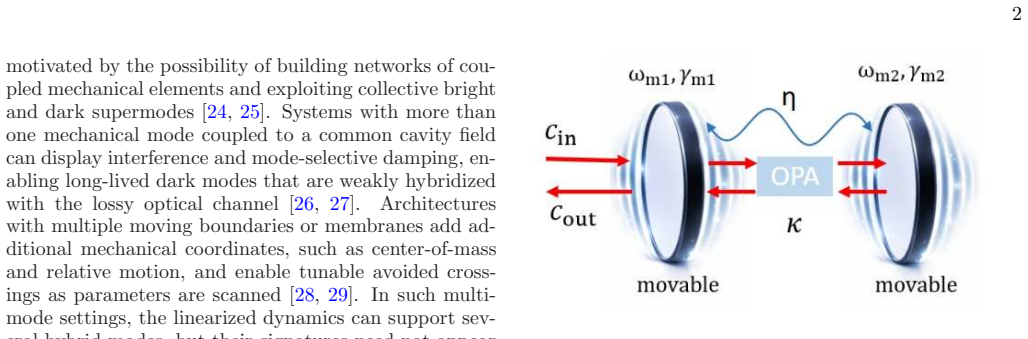
We study a driven optomechanical cavity with two movable mirrors and an intracavity optical parametric amplifier, focusing on how direct phonon-phonon coupling changes the observed normal-mode spectrum. Although the linearized system supports three hybrid modes, in the absence of direct mechanical coupling one collective mechanical mode contributes only weakly to the optical response, leading to an apparent two-peak structure. We show that finite phonon-phonon coupling mixes this weakly participating mode with the optically visible modes, making a third resonance clearly resolvable. This change appears in the mirror displacement spectrum, the output-field spectrum, and the output quadrature spectra, and becomes more pronounced with increasing coupling strength and drive power. Our results show that direct mechanical coupling provides a useful way to tune spectral visibility and multimode hybridization in two-mirror optomechanical cavity with intracavity parametric amplification.
Editorial analysis
A structured set of objections, weighed in public.
Referee Report
Summary. The manuscript studies a driven two-mirror optomechanical cavity containing an intracavity optical parametric amplifier. The linearized quantum Langevin equations yield three hybrid modes, but without direct phonon-phonon coupling one collective mechanical mode participates only weakly in the optical response, producing an apparent two-peak spectrum. Finite bilinear phonon-phonon coupling mixes this mode into the optically visible subspace, rendering a third resonance resolvable in the mirror displacement spectrum, output-field spectrum, and output quadrature spectra; the splitting grows with coupling strength and drive power. The authors conclude that phonon-phonon interaction provides a tunable control knob for multimode hybridization and spectral visibility.
Significance. If the spectra calculations are correct, the result supplies a concrete, experimentally accessible mechanism for controlling the number of visible resonances in a parametrically assisted multimode optomechanical system without modifying cavity or drive parameters. The work rests on a standard linearized model augmented by one mechanical interaction term and supplies falsifiable predictions for three distinct spectra, which strengthens its utility for quantum optomechanics and multimode sensing applications.
major comments (2)
- [§3] §3 (Linearized equations): the claim that the third mode is rendered visible solely by the added phonon-phonon term requires explicit demonstration that the 6×6 drift matrix eigenvalues and the optical coupling vector produce the reported mixing; without the explicit form of the mechanical block or the participation ratios before/after coupling, it is impossible to confirm that the visibility change is not an artifact of parameter choice.
- [§4] §4 (Spectra): the output-field and quadrature spectra are stated to show the third peak, yet no quantitative measure (e.g., peak height relative to noise or integrated weight) is provided to substantiate that the resonance becomes “clearly resolvable” rather than merely present at a low level; this weakens the central claim that the coupling acts as an effective control knob.
minor comments (2)
- [Abstract] The abstract and introduction should state the explicit form of the phonon-phonon interaction Hamiltonian (e.g., g_m (b1†b2 + h.c.)) so that readers can immediately reproduce the mechanical block of the drift matrix.
- [Figures] Figure captions for the spectra plots should include the precise values of the phonon-phonon coupling strength, drive power, and detuning used, together with the linearization validity condition (e.g., |α| ≪ √(κ/γ_m)).
Simulated Author's Rebuttal
We thank the referee for the careful reading, the positive assessment of the work, and the recommendation for minor revision. We address each major comment below and will incorporate the requested clarifications and quantitative details into the revised manuscript.
read point-by-point responses
-
Referee: [§3] §3 (Linearized equations): the claim that the third mode is rendered visible solely by the added phonon-phonon term requires explicit demonstration that the 6×6 drift matrix eigenvalues and the optical coupling vector produce the reported mixing; without the explicit form of the mechanical block or the participation ratios before/after coupling, it is impossible to confirm that the visibility change is not an artifact of parameter choice.
Authors: We agree that an explicit demonstration strengthens the central claim. In the revised manuscript we will display the complete 6×6 drift matrix, isolate the mechanical block that incorporates the bilinear phonon-phonon term, and report both the eigenvalues of the drift matrix and the participation ratios (i.e., the projections of each hybrid mode onto the optical coupling vector) for the cases with and without direct mechanical coupling. These additions will make the mode-mixing mechanism transparent and rule out parameter-specific artifacts. revision: yes
-
Referee: [§4] §4 (Spectra): the output-field and quadrature spectra are stated to show the third peak, yet no quantitative measure (e.g., peak height relative to noise or integrated weight) is provided to substantiate that the resonance becomes “clearly resolvable” rather than merely present at a low level; this weakens the central claim that the coupling acts as an effective control knob.
Authors: We accept that quantitative metrics would better substantiate resolvability. In the revised version we will supplement the spectra figures with explicit measures: peak heights normalized to the local noise floor and integrated spectral weights of the third resonance, evaluated in the mirror-displacement, output-field, and quadrature spectra. These quantities will be shown versus phonon-phonon coupling strength and drive power, thereby quantifying the tunable visibility of the third mode. revision: yes
Circularity Check
No significant circularity; derivation is self-contained
full rationale
The paper's central result follows from solving the linearized Langevin equations for a standard two-mirror optomechanical system augmented by an explicit bilinear phonon-phonon coupling term. The three hybrid modes arise from diagonalizing the 6x6 drift matrix; the weak participation of one mode without coupling is a direct consequence of the optical coupling matrix elements, and the mixing is produced by the added mechanical off-diagonal terms. No step reduces a prediction to a fitted parameter, renames a known result, or relies on a self-citation chain for the uniqueness or form of the interaction. The phonon-phonon coupling is introduced as an independent tunable parameter, consistent with the modeling choice stated in the abstract. The spectra (displacement, output field, quadratures) are computed from the same linear response and exhibit the expected hybridization without circular re-use of data.
Axiom & Free-Parameter Ledger
free parameters (2)
- phonon-phonon coupling strength
- optical drive power
axioms (2)
- domain assumption Linearization of the quantum Langevin equations around the steady-state amplitudes remains valid for the parameter regime studied.
- domain assumption The direct phonon-phonon coupling can be added as an independent term without altering cavity decay rates or parametric gain.
Lean theorems connected to this paper
-
IndisputableMonolith/Cost/FunctionalEquation.leanwashburn_uniqueness_aczel unclear?
unclearRelation between the paper passage and the cited Recognition theorem.
the linearized quantum Langevin equations for the fluctuation operators take the form ... matrix A is given by [6x6 drift matrix with η terms]
-
IndisputableMonolith/Foundation/RealityFromDistinction.leanreality_from_one_distinction unclear?
unclearRelation between the paper passage and the cited Recognition theorem.
We show that finite phonon-phonon coupling mixes this weakly participating mode ... third resonance clearly resolvable
What do these tags mean?
- matches
- The paper's claim is directly supported by a theorem in the formal canon.
- supports
- The theorem supports part of the paper's argument, but the paper may add assumptions or extra steps.
- extends
- The paper goes beyond the formal theorem; the theorem is a base layer rather than the whole result.
- uses
- The paper appears to rely on the theorem as machinery.
- contradicts
- The paper's claim conflicts with a theorem or certificate in the canon.
- unclear
- Pith found a possible connection, but the passage is too broad, indirect, or ambiguous to say the theorem truly supports the claim.
Reference graph
Works this paper leans on
-
[1]
In the high-temperature limit KBT ≫ ℏω m, we use coth( ℏω/ 2KBT ) = 2 KBT / ℏω
The parameters are λ = 1064 nm, L = 25 mm, m = 145 ng, κ/ 2π = 215 × 103 Hz, ω m/ 2π = 947 × 103 Hz, T = 300 mK, and mechanical quality fac- tor Q ′ = ω m/γ m = 6700. In the high-temperature limit KBT ≫ ℏω m, we use coth( ℏω/ 2KBT ) = 2 KBT / ℏω . We first assess the stability of the extended optome- chanical setup containing an intracavity OPA, two mov- a...
-
[2]
15 ω m, while panel (b) shows the stronger coupling case η = 0
Panel (a) corresponds to η = 0. 15 ω m, while panel (b) shows the stronger coupling case η = 0 . 3 ω m. The figure illustrates how increasing η shifts the eigenvalue real parts and modifies the stability range of the system. The behavior shown in Fig. 3 can be understood in terms of how the motion of the two mirrors is transferred to the cavity field. When η...
work page 2023
-
[3]
M. Aspelmeyer, T. J. Kippenberg, and F. Marquardt, Rev. Mod. Phys. 86, 1391 (2014)
work page 2014
-
[4]
T. J. Kippenberg and K. J. Vahala, science 321, 1172 (2008) . 11
work page 2008
-
[5]
C. M. Caves, Phys. Rev. D 23, 1693 (1981)
work page 1981
-
[6]
V. B. Braginsky and F. Y. Khalili, Quantum measure- ment (Cambridge University Press, 1995)
work page 1995
-
[7]
F. Marquardt and S. M. Girvin, arXiv preprint arXiv:0905.0566 (2009)
-
[8]
I. Wilson-Rae, N. Nooshi, W. Zwerger, and T. J. Kip- penberg, Phys. Rev. Lett. 99, 093901 (2007)
work page 2007
-
[9]
J. D. Teufel, T. Donner, D. Li, J. W. Harlow, M. Allman, K. Cicak, A. J. Sirois, J. D. Whittaker, K. W. Lehnert, and R. W. Simmonds, Nature 475, 359 (2011)
work page 2011
-
[10]
J. Chan, T. M. Alegre, A. H. Safavi-Naeini, J. T. Hill, A. Krause, S. Gr¨ oblacher, M. Aspelmeyer, and O. Painter, Nature 478, 89 (2011)
work page 2011
-
[11]
A. A. Clerk, M. H. Devoret, S. M. Girvin, F. Marquardt, and R. J. Schoelkopf, Rev. Mod. Phys. 82, 1155 (2010)
work page 2010
-
[12]
C. Gardiner and P. Zoller, Quantum noise: a handbook of Markovian and non-Markovian quantum stochastic meth- ods with applications to quantum optics (Springer Science & Business Media, 2004)
work page 2004
- [13]
-
[14]
F. Marquardt, J. P. Chen, A. A. Clerk, and S. M. Girvin, Phys. Rev. Lett. 99, 093902 (2007)
work page 2007
-
[15]
S. Weis, R. Rivi` ere, S. Del´ eglise, E. Gavartin, O. Arcizet, A. Schliesser, and T. J. Kippenberg, science 330, 1520 (2010)
work page 2010
-
[16]
G. S. Agarwal and S. Huang, Phys. Rev. A 81, 041803 (2010)
work page 2010
-
[17]
A. H. Safavi-Naeini, T. M. Alegre, J. Chan, M. Eichen- field, M. Winger, Q. Lin, J. T. Hill, D. E. Chang, and O. Painter, Nature 472, 69 (2011)
work page 2011
-
[18]
E. Verhagen, S. Del´ eglise, S. Weis, A. Schliesser, and T. J. Kippenberg, Nature 482, 63 (2012)
work page 2012
-
[19]
J. M. Dobrindt, I. Wilson-Rae, and T. J. Kippenberg, Phys. Rev. Lett. 101, 263602 (2008)
work page 2008
-
[20]
S. Gr¨ oblacher, K. Hammerer, M. R. Vanner, and M. As- pelmeyer, Nature 460, 724 (2009)
work page 2009
-
[21]
T. Palomaki, J. Harlow, J. Teufel, R. Simmonds, and K. W. Lehnert, Nature 495, 210 (2013)
work page 2013
- [22]
-
[23]
A. Kronwald, F. Marquardt, and A. A. Clerk, Phys. Rev. A 88, 063833 (2013)
work page 2013
- [24]
-
[25]
G. S. Agarwal, Quantum optics (Cambridge University Press, 2012)
work page 2012
-
[26]
G. Heinrich, M. Ludwig, J. Qian, B. Kubala, and F. Mar- quardt, Phys. Rev. Lett. 107, 043603 (2011)
work page 2011
- [27]
- [28]
-
[29]
A. B. Shkarin, N. E. Flowers-Jacobs, S. W. Hoch, A. D. Kashkanova, C. Deutsch, J. Reichel, and J. G. E. Harris, Phys. Rev. Lett. 112, 013602 (2014)
work page 2014
-
[30]
J. Thompson, B. Zwickl, A. Jayich, F. Marquardt, S. Girvin, and J. Harris, Nature 452, 72 (2008)
work page 2008
- [31]
- [32]
- [33]
-
[34]
J. T. Hill, A. H. Safavi-Naeini, J. Chan, and O. Painter, Nature communications 3, 1196 (2012)
work page 2012
-
[35]
H. Okamoto, A. Gourgout, C.-Y. Chang, K. Onomitsu, I. Mahboob, E. Y. Chang, and H. Yamaguchi, Nature Physics 9, 480 (2013)
work page 2013
- [36]
- [37]
- [38]
- [39]
- [40]
-
[41]
M. O. Scully and M. S. Zubairy, Quantum optics (Cam- bridge university press, 1997)
work page 1997
discussion (0)
Sign in with ORCID, Apple, or X to comment. Anyone can read and Pith papers without signing in.