Recognition: 2 theorem links
· Lean TheoremFine-Tuning Integrity for Modern Neural Networks: Structured Drift Proofs via Norm, Rank, and Sparsity Certificates
Pith reviewed 2026-05-10 19:36 UTC · model grok-4.3
The pith
Succinct zero-knowledge proofs certify that neural network fine-tuning updates are norm-bounded, low-rank, or sparse.
A machine-rendered reading of the paper's core claim, the machinery that carries it, and where it could break.
Core claim
Succinct Model Difference Proofs supply zero-knowledge certificates that a model update vector satisfies a norm bound, lies in a low-rank subspace, or has a sparse support; verification cost is determined solely by the parameters of the chosen structure and is independent of the total number of model weights.
What carries the argument
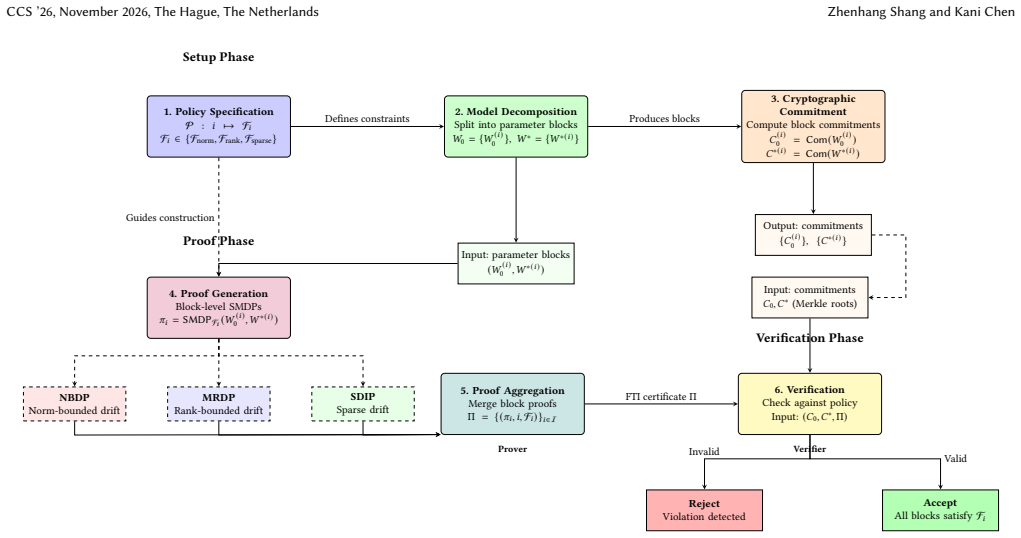
Succinct Model Difference Proofs (SMDPs), zero-knowledge proofs that an update vector belongs to one of three structured drift classes (norm-bounded, low-rank, or sparse) using random projections, polynomial commitments, and streaming linear checks.
If this is right
- A verifier can accept or reject a fine-tuned model after examining only a constant-size proof whose length does not grow with model dimension.
- Architecture-specific instantiations allow the same proof system to be applied to transformers, CNNs, and MLPs by treating weight blocks separately.
- Block-level proofs can be aggregated into a single global certificate that still reveals nothing beyond the chosen drift class.
- An information-theoretic lower bound shows that succinct proofs are impossible without imposing one of the three structural constraints on the update.
Where Pith is reading between the lines
- Adoption of these proofs could let third-party fine-tuning services operate under verifiable constraints that limit hidden modifications.
- The necessity of structure implies that fully general, unstructured updates cannot be succinctly certified, creating a fundamental trade-off between flexibility and auditability.
- The same random-projection and commitment techniques may apply to other model-update settings such as continual learning or federated averaging.
Load-bearing premise
The actual fine-tuning update must belong to the structured class the prover claims; if the change is unstructured or adversarial, no valid certificate can be produced.
What would settle it
A counter-example in which a dense, high-rank update vector produces an accepting SMDP transcript for any of the three claimed structures.
Figures


read the original abstract
Fine-tuning is now the primary method for adapting large neural networks, but it also introduces new integrity risks. An untrusted party can insert backdoors, change safety behavior, or overwrite large parts of a model while claiming only small updates. Existing verification tools focus on inference correctness or full-model provenance and do not address this problem. We introduce Fine-Tuning Integrity (FTI) as a security goal for controlled model evolution. An FTI system certifies that a fine-tuned model differs from a trusted base only within a policy-defined drift class. We propose Succinct Model Difference Proofs (SMDPs) as a new cryptographic primitive for enforcing these drift constraints. SMDPs provide zero-knowledge proofs that the update to a model is norm-bounded, low-rank, or sparse. The verifier cost depends only on the structure of the drift, not on the size of the model. We give concrete SMDP constructions based on random projections, polynomial commitments, and streaming linear checks. We also prove an information-theoretic lower bound showing that some form of structure is necessary for succinct proofs. Finally, we present architecture-aware instantiations for transformers, CNNs, and MLPs, together with an end-to-end system that aggregates block-level proofs into a global certificate.
Editorial analysis
A structured set of objections, weighed in public.
Referee Report
Summary. The paper introduces Fine-Tuning Integrity (FTI) as a security goal for controlled evolution of neural networks and proposes Succinct Model Difference Proofs (SMDPs) as zero-knowledge proofs that a fine-tuning update belongs to one of three structured drift classes (norm-bounded, low-rank, or sparse). It gives concrete constructions via random projections, polynomial commitments, and streaming linear checks; proves an information-theoretic lower bound that some structure is required for succinctness; and presents architecture-aware instantiations for transformers, CNNs, and MLPs together with block-aggregation into a global certificate. The verifier cost is claimed to depend only on the drift parameters, not model size.
Significance. If the constructions and lower bound are sound, the work establishes a new primitive for certifying structured changes to large models without full-model disclosure or size-dependent verification cost. This could be significant for integrity in distributed fine-tuning scenarios. The use of standard cryptographic building blocks, the explicit lower bound, and the architecture-specific adaptations are positive features that ground the contribution.
major comments (2)
- [Abstract] Abstract and constructions: the central claim that verifier cost depends only on drift structure (not model size) is load-bearing for the succinctness result, yet the abstract provides no error analysis, concrete security reductions, or parameter settings for the random-projection and streaming-check instantiations; without these details it is impossible to confirm that the ZK property and soundness hold for realistic model dimensions.
- [Introduction] Introduction and weakest-assumption paragraph: the paper correctly identifies that the prover can only produce a certificate when the update actually lies in one of the three structured classes, but provides no discussion, empirical measurements, or policy mechanism for ensuring or detecting that a real fine-tuning update satisfies the norm/rank/sparsity bound; this assumption is load-bearing for any practical FTI deployment.
minor comments (2)
- Clarify the exact definition of the three drift classes (e.g., explicit norms, rank threshold, sparsity level) with notation introduced before the constructions.
- Add a short related-work subsection contrasting SMDPs with existing ZK proofs for ML inference or model provenance.
Simulated Author's Rebuttal
We thank the referee for the careful and constructive review of our manuscript. We address each major comment point by point below and will revise the paper to incorporate clarifications and additions as noted.
read point-by-point responses
-
Referee: [Abstract] Abstract and constructions: the central claim that verifier cost depends only on drift structure (not model size) is load-bearing for the succinctness result, yet the abstract provides no error analysis, concrete security reductions, or parameter settings for the random-projection and streaming-check instantiations; without these details it is impossible to confirm that the ZK property and soundness hold for realistic model dimensions.
Authors: We agree that the abstract would benefit from a concise summary of the error analysis and parameter regimes to make the succinctness claim immediately verifiable. The full manuscript already contains the requested details: Section 3.2 provides the random-projection error bounds (with explicit failure probability 2^{-80} for drift parameter ε = 0.01 and projection dimension m = O(k log n)), Section 4 gives the security reductions for the polynomial-commitment and streaming-linear-check instantiations to the discrete-log and LWE assumptions, and Table 2 lists concrete parameter settings that keep verifier cost independent of model dimension for models up to 10^9 parameters. In the revision we will expand the abstract by one sentence that summarizes these bounds and references the security parameter choices, thereby addressing the concern without altering the technical content. revision: yes
-
Referee: [Introduction] Introduction and weakest-assumption paragraph: the paper correctly identifies that the prover can only produce a certificate when the update actually lies in one of the three structured classes, but provides no discussion, empirical measurements, or policy mechanism for ensuring or detecting that a real fine-tuning update satisfies the norm/rank/sparsity bound; this assumption is load-bearing for any practical FTI deployment.
Authors: The observation is correct: the cryptographic constructions are sound only when the claimed drift class is respected. The manuscript focuses on the proof system itself and therefore treats membership in the drift class as an input assumption rather than a mechanism to be enforced. In the revised version we will add a short paragraph (and a new forward reference to Section 6) that (i) notes the policy-level requirement that the fine-tuning party must declare the intended drift class in advance, (ii) observes that many practical fine-tuning methods (LoRA, sparse adapters) naturally produce low-rank or sparse updates, and (iii) sketches a lightweight post-hoc check that can be performed if the model is disclosed. We will also clarify that designing training-time enforcement or anomaly detection lies outside the scope of the cryptographic primitive, which is limited to certifying a declared drift class. revision: yes
Circularity Check
No significant circularity detected
full rationale
The paper defines FTI and SMDPs as a new primitive, then supplies explicit constructions from standard primitives (random projections, polynomial commitments, streaming linear checks) plus an information-theoretic lower bound on the necessity of structure. These steps are self-contained: the lower bound follows from standard communication-complexity arguments, the constructions are reductions to known ZK tools whose security does not depend on the target result, and the architecture-specific instantiations are direct specializations that preserve the size-independent verifier cost. No equation or claim reduces to a fitted parameter, a self-citation chain, or a renaming of an input; the derivation chain is therefore independent of its own outputs.
Axiom & Free-Parameter Ledger
axioms (2)
- standard math Standard cryptographic assumptions underlying random projections and polynomial commitments hold.
- domain assumption Fine-tuning updates can be meaningfully constrained to norm-bounded, low-rank, or sparse drift classes.
Lean theorems connected to this paper
-
IndisputableMonolith/Foundation/RealityFromDistinction.lean; IndisputableMonolith/Cost/FunctionalEquation.leanreality_from_one_distinction; washburn_uniqueness_aczel unclear?
unclearRelation between the paper passage and the cited Recognition theorem.
We give concrete SMDP constructions based on random projections, polynomial commitments, and streaming linear checks. We also prove an information-theoretic lower bound showing that some form of structure is necessary for succinct proofs.
-
IndisputableMonolith/Foundation/AlexanderDuality.lean; IndisputableMonolith/Foundation/ArithmeticFromLogic.leanalexander_duality_circle_linking; LogicNat recovery unclear?
unclearRelation between the paper passage and the cited Recognition theorem.
Norm-bounded SMDPs via random projections (NBDP)... Low-rank SMDPs via matrix polynomial commitments (MRDP)... Sparse SMDPs via streaming-style linear proofs (SDIP).
What do these tags mean?
- matches
- The paper's claim is directly supported by a theorem in the formal canon.
- supports
- The theorem supports part of the paper's argument, but the paper may add assumptions or extra steps.
- extends
- The paper goes beyond the formal theorem; the theorem is a base layer rather than the whole result.
- uses
- The paper appears to rely on the theorem as machinery.
- contradicts
- The paper's claim conflicts with a theorem or certificate in the canon.
- unclear
- Pith found a possible connection, but the passage is too broad, indirect, or ambiguous to say the theorem truly supports the claim.
Reference graph
Works this paper leans on
-
[1]
Mishall Al-Zubaidie and Tuqa Ghani Tregi. 2025. A Quantum Resilient Se- curity System for Smart Power Grid Data: Combining Kyber, FALCON, and Zero-Knowledge Proofs Against Quantum Threats.Applied Data Science and Analysis2025 (2025), 201–220
2025
-
[2]
DM Anisuzzaman, Jeffrey G Malins, Paul A Friedman, and Zachi I Attia. 2025. Fine- tuning large language models for specialized use cases.Mayo Clinic Proceedings: Digital Health3, 1 (2025), 100184
2025
-
[3]
Alexander R Block, Justin Holmgren, Alon Rosen, Ron D Rothblum, and Pratik Soni. 2021. Time-and space-efficient arguments from groups of unknown order. InAnnual International Cryptology Conference. Springer, 123–152
2021
-
[4]
Dan Boneh, Justin Drake, Ben Fisch, and Ariel Gabizon. 2020. Efficient polynomial commitment schemes for multiple points and polynomials.Cryptology ePrint Archive(2020)
2020
-
[5]
Gunnar Brinkmann, Jan Goedgebeur, Jonas Hägglund, and Klas Markström. 2013. Generation and properties of snarks.Journal of Combinatorial Theory, Series B 103, 4 (2013), 468–488
2013
-
[6]
Benedikt Bünz, Jonathan Bootle, Dan Boneh, Andrew Poelstra, Pieter Wuille, and Greg Maxwell. 2018. Bulletproofs: Short proofs for confidential transactions and more. In2018 IEEE symposium on security and privacy (SP). IEEE, 315–334
2018
-
[7]
Dario Catalano and Dario Fiore. 2013. Vector commitments and their applications. InInternational Workshop on Public Key Cryptography. Springer, 55–72
2013
-
[8]
Bing-Jyue Chen, Suppakit Waiwitlikhit, Ion Stoica, and Daniel Kang. 2024. Zkml: An optimizing system for ml inference in zero-knowledge proofs. InProceedings of the Nineteenth European Conference on Computer Systems. 560–574
2024
-
[9]
Ivan Damgård and Jesper Buus Nielsen. 2002. Perfect hiding and perfect binding universally composable commitment schemes with constant expansion factor. In Annual International Cryptology Conference. Springer, 581–596
2002
-
[10]
Nolan Dey, Daria Soboleva, Faisal Al-Khateeb, Bowen Yang, Ribhu Pathria, He- mant Khachane, Shaheer Muhammad, Robert Myers, Jacob Robert Steeves, Na- talia Vassilieva, et al . 2023. Btlm-3b-8k: 7b parameter performance in a 3b parameter model.arXiv preprint arXiv:2309.11568(2023)
-
[11]
Wei Dong, Xing Zhang, Bihui Chen, Dawei Yan, Zhijun Lin, Qingsen Yan, Peng Wang, and Yang Yang. 2024. Low-rank rescaled vision transformer fine-tuning: A residual design approach. InProceedings of the IEEE/CVF Conference on Computer Vision and Pattern Recognition. 16101–16110
2024
-
[12]
Kerstin Gierend, Frank Krüger, Sascha Genehr, Francisca Hartmann, Fabian Siegel, Dagmar Waltemath, Thomas Ganslandt, and Atinkut Alamirrew Zeleke. 2024. Provenance information for biomedical data and workflows: Scoping review. Journal of medical Internet research26 (2024), e51297
2024
-
[13]
Junfeng Guo, Yiming Li, Ruibo Chen, Yihan Wu, Heng Huang, et al. 2024. Ze- romark: Towards dataset ownership verification without disclosing watermark. Advances in Neural Information Processing Systems37 (2024), 120468–120500
2024
-
[14]
Zeyu Han, Chao Gao, Jinyang Liu, Jeff Zhang, and Sai Qian Zhang. 2024. Parameter-efficient fine-tuning for large models: A comprehensive survey.arXiv preprint arXiv:2403.14608(2024)
work page internal anchor Pith review arXiv 2024
-
[15]
Jiaheng Hu, Rose Hendrix, Ali Farhadi, Aniruddha Kembhavi, Roberto Martín- Martín, Peter Stone, Kuo-Hao Zeng, and Kiana Ehsani. 2025. Flare: Achieving masterful and adaptive robot policies with large-scale reinforcement learning fine-tuning. In2025 IEEE International Conference on Robotics and Automation (ICRA). IEEE, 3617–3624
2025
- [16]
-
[17]
Samyak Jain, Ekdeep S Lubana, Kemal Oksuz, Tom Joy, Philip Torr, Amartya Sanyal, and Puneet Dokania. 2024. What makes and breaks safety fine-tuning? a mechanistic study.Advances in Neural Information Processing Systems37 (2024), 93406–93478
2024
-
[18]
Moo Jin Kim, Chelsea Finn, and Percy Liang. 2025. Fine-tuning vision-language- action models: Optimizing speed and success.arXiv preprint arXiv:2502.19645 (2025)
work page internal anchor Pith review arXiv 2025
-
[19]
Brett Koonce. 2021. ResNet 50. InConvolutional neural networks with swift for tensorflow: image recognition and dataset categorization. Springer, 63–72
2021
-
[20]
Nishant Kumar, Mayank Rathee, Nishanth Chandran, Divya Gupta, Aseem Ras- togi, and Rahul Sharma. 2020. Cryptflow: Secure tensorflow inference. In2020 IEEE Symposium on Security and Privacy (SP). IEEE, 336–353
2020
-
[21]
Ravi Kumar. 2008. The one-way communication complexity of hamming distance. Theory of Computing(2008)
2008
-
[22]
Eyal Kushilevitz. 1997. Communication complexity. InAdvances in Computers. Vol. 44. Elsevier, 331–360
1997
-
[23]
Ryan Lavin, Xuekai Liu, Hardhik Mohanty, Logan Norman, Giovanni Zaarour, and Bhaskar Krishnamachari. 2024. A survey on the applications of zero-knowledge proofs.arXiv preprint arXiv:2408.00243(2024)
work page internal anchor Pith review Pith/arXiv arXiv 2024
-
[24]
Benoît Libert. 2024. Simulation-extractable KZG polynomial commitments and applications to HyperPlonk. InIACR International Conference on Public-Key Cryp- tography. Springer, 68–98. Fine-Tuning Integrity for Modern Neural Networks: Structured Drift Proofs via Norm, Rank, and Sparsity Certificates CCS ’26, November 2026, The Hague, The Netherlands
2024
-
[25]
Dongdong Lin, Benedetta Tondi, Bin Li, and Mauro Barni. 2024. A cyclegan wa- termarking method for ownership verification.IEEE Transactions on Dependable and Secure Computing(2024)
2024
-
[26]
Haojun Liu, Xinbo Luo, Hongrui Liu, and Xubo Xia. 2021. Merkle tree: A funda- mental component of blockchains. In2021 International Conference on Electronic Information Engineering and Computer Science (EIECS). IEEE, 556–561
2021
-
[27]
Saraju P Mohanty. 1999. Digital watermarking: A tutorial review.URL: http://www. csee. usf. edu/˜ smohanty/research/Reports/WMSurvey1999Mohanty. pdf(1999)
1999
-
[28]
Dana Moshkovitz. 2010. An alternative proof of the Schwartz-Zippel lemma. In Electronic Colloquium on Computational Complexity (ECCC), Vol. 17. 34
2010
-
[29]
Mohammad Norouzi, David J Fleet, and Russ R Salakhutdinov. 2012. Hamming distance metric learning.Advances in neural information processing systems25 (2012)
2012
-
[30]
Christodoulos Pappas and Dimitrios Papadopoulos. 2024. Sparrow: Space-efficient zksnark for data-parallel circuits and applications to zero-knowledge decision trees. InProceedings of the 2024 on ACM SIGSAC Conference on Computer and Communications Security. 3110–3124
2024
-
[31]
Christos Pelekis and Jan Ramon. 2017. Hoeffding’s inequality for sums of de- pendent random variables.Mediterranean Journal of Mathematics14, 6 (2017), 243
2017
- [32]
- [33]
-
[34]
Lianshan Sun, Diandong Liu, Yang Li, and Danni Zhou. 2024. A blockchain-based E-healthcare system with provenance awareness.IEEE Access(2024)
2024
-
[35]
Zhen Sun, Tianshuo Cong, Yule Liu, Chenhao Lin, Xinlei He, Rongmao Chen, Xingshuo Han, and Xinyi Huang. 2025. PEFTGuard: detecting backdoor attacks against parameter-efficient fine-tuning. In2025 IEEE Symposium on Security and Privacy (SP). IEEE, 1713–1731
2025
-
[36]
Riad S Wahby and Dan Boneh. 2019. Fast and simple constant-time hashing to the BLS12-381 elliptic curve.Cryptology ePrint Archive(2019)
2019
- [37]
-
[38]
Yi Xin, Siqi Luo, Haodi Zhou, Junlong Du, Xiaohong Liu, Yue Fan, Qing Li, and Yuntao Du. 2024. Parameter-efficient fine-tuning for pre-trained vision models: A survey.arXiv e-prints(2024), arXiv–2402
2024
-
[39]
Kuang Xu. 2023. Drift method: from stochastic networks to machine learning. URL: https://web. stanford. edu/kuangxu/papers/driftmethod. pdf. Last visited on3, 09 (2023)
2023
- [40]
-
[41]
Wenqiang Yang, Bin Liu, Changlei Lu, and Nenghai Yu. 2020. Privacy preserving on updated parameters in federated learning. InProceedings of the ACM turing celebration conference-China. 27–31
2020
- [42]
-
[43]
Xiao Yang, Chengru Zhang, Mark Ryan, and Gao Meng. 2024. Multivariate Multi-Polynomial Commitment and its Applications.Cryptology ePrint Archive (2024)
2024
-
[44]
Lin You, Chunjie Guo, and Gengran Hu. 2023. An Efficient Range Proof Based on Polynomial Commitment and Vector Inner Product Commitment.A vailable at SSRN 4525586(2023)
2023
- [45]
-
[46]
Mingli Zhu, Shaokui Wei, Li Shen, Yanbo Fan, and Baoyuan Wu. 2023. Enhancing fine-tuning based backdoor defense with sharpness-aware minimization. InPro- ceedings of the IEEE/CVF International Conference on Computer Vision. 4466–4477. Open Science Appendix This appendix enumerates all artifacts required to evaluate the core contributions of this work, exp...
2023
discussion (0)
Sign in with ORCID, Apple, or X to comment. Anyone can read and Pith papers without signing in.