ACHEM: A Real-Time Digital Twin Framework with Channel and Radio Emulation
Pith reviewed 2026-05-10 18:54 UTC · model grok-4.3
The pith
ACHEM enables full I/Q-level emulation of any USRP-based wireless system entirely in software.
A machine-rendered reading of the paper's core claim, the machinery that carries it, and where it could break.
Core claim
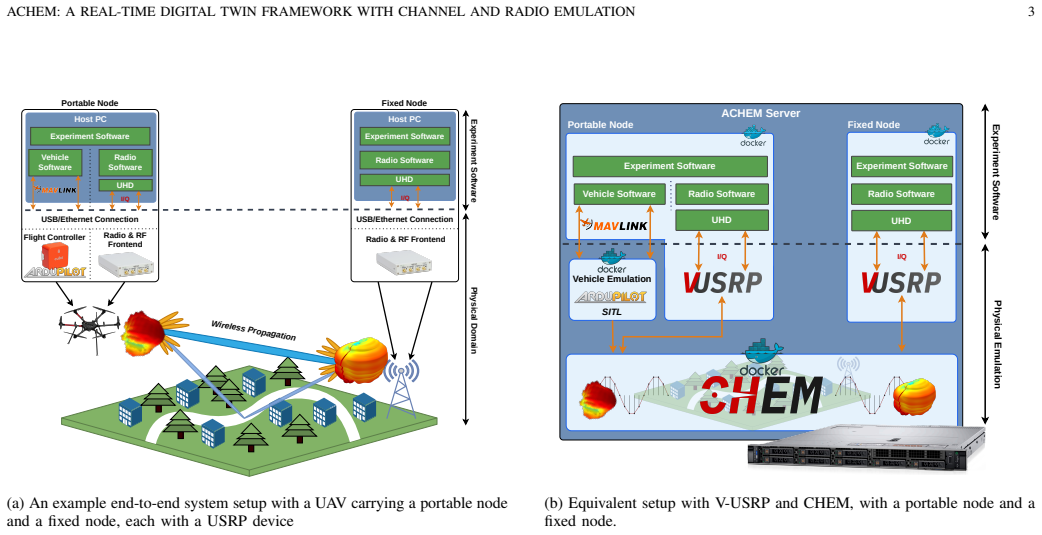
ACHEM is the first software-based end-to-end wireless channel emulation environment that lets any USRP-based system run at the I/Q level in a pure digital environment, supporting multiple transmitters and receivers, MIMO, multiple frequencies, heterogeneous sampling rates, real-time vehicle mobility, antenna patterns, and standard channel models.
What carries the argument
The ACHEM I/Q processing pipeline that applies radio-emulation blocks and channel models to digital samples to replicate real wireless links.
If this is right
- Any existing USRP application can execute its full production code inside the emulator without physical hardware.
- Real-time mobility scenarios including vehicles become testable in software for protocols like 4G/5G.
- The framework integrates directly with popular open-source stacks including GNU Radio, srsRAN, and OpenAirInterface.
- Wireless digital twins can be built and iterated on more quickly for design and optimization tasks.
Where Pith is reading between the lines
- The method could allow testing of rare or dangerous scenarios that are impractical to reproduce with physical equipment.
- It may support automated design loops where the emulator provides feedback to tune system parameters.
- Similar I/Q-level digital twins might extend to other real-time hardware domains beyond wireless communications.
Load-bearing premise
The selected channel models, radio blocks, and mobility simulations generate I/Q samples close enough to real-world behavior for the intended applications.
What would settle it
Run an identical protocol on physical USRPs and in ACHEM under matched conditions, then compare metrics such as bit error rate or throughput; large differences would show the emulation lacks sufficient fidelity.
Figures




read the original abstract
Digital twins are becoming an important tool for designing, developing, testing, and optimizing next-generation wireless communication systems. Over the past decade, system softwarization has become a reality, and wireless communication systems are no exception. Software-Defined Radios (SDRs), in general, and Universal Software Radio Peripherals (USRPs), in particular, are often used for prototyping and testing advanced wireless systems. Unfortunately, there is currently no end-to-end, software-based, general-purpose testing environment for SDR-based systems: developers often rely on benchtop setups or even small testbeds, but those are costly and cumbersome to build. At the other end of the spectrum, simulations often rely on simplified channel/radio models and typically do not execute full-stack production code, which can increase development effort and reduce fidelity. In this paper, we propose ACHEM (A Channel Emulator), the first software-based, end-to-end wireless channel emulation environment and toolset for communication systems based on SDRs, specifically USRPs. With the proposed emulator and toolkit, any USRP-based system can be fully emulated at the I/Q level in a pure digital environment without requiring specialized hardware (e.g., vehicles, USRPs, FPGAs, or GPUs). The proposed emulator supports multiple transmitters and receivers, MIMO communications, multiple frequencies, heterogeneous sampling rates, real-time node mobility through vehicle emulation, antenna radiation patterns, and various channel models. ACHEM facilitates wireless digital twin development and deployment. ACHEM is validated with several popular open-source USRP-based wireless communication applications, including GNU Radio, srsRAN 4G/5G, and OpenAirInterface.
Editorial analysis
A structured set of objections, weighed in public.
Referee Report
Summary. The paper presents ACHEM, a software-based real-time digital twin framework for end-to-end wireless channel and radio emulation targeted at USRP-based SDR systems. It claims to support multi-transmitter/receiver MIMO setups, heterogeneous sampling rates, real-time node mobility via vehicle emulation, antenna radiation patterns, and multiple channel models, enabling full I/Q-level emulation of any USRP-based system in a pure digital environment without physical hardware. The framework is validated through integration with GNU Radio, srsRAN 4G/5G, and OpenAirInterface.
Significance. If the generated I/Q samples prove sufficiently faithful, ACHEM could lower barriers to wireless system development by replacing costly physical testbeds with a reproducible digital twin environment that runs production full-stack code. The real-time capability and direct compatibility with open-source SDR stacks represent practical strengths for prototyping and optimization workflows.
major comments (2)
- [Validation section] Validation section (and abstract): The manuscript states that ACHEM was 'validated with' GNU Radio, srsRAN, and OpenAirInterface, yet supplies no quantitative fidelity metrics such as EVM, I/Q NMSE, throughput deltas, or packet-error-rate curves comparing emulated versus physical-hardware runs under identical mobility and channel traces. This evidence is load-bearing for the central claim that any USRP-based system can be 'fully emulated at the I/Q level' such that production code exhibits identical MAC/PHY behavior.
- [§3] §3 (Emulation Architecture) and mobility subsection: The real-time vehicle-emulation and time-varying channel blocks are described at a high level, but no analysis is given of how Doppler, phase noise, and multipath statistics are preserved under the chosen sampling-rate heterogeneity and real-time constraints; without such characterization, it is unclear whether the I/Q output statistics remain close enough for the 'full emulation' guarantee.
minor comments (2)
- Figure captions and architecture diagrams would benefit from explicit labels indicating data-flow direction and sampling-rate conversion points to improve readability for readers implementing the toolkit.
- [Abstract] The abstract's phrasing that the framework is 'the first' such environment should be tempered with a brief related-work comparison to existing channel emulators (e.g., those based on ns-3 or MATLAB) to clarify the precise novelty.
Simulated Author's Rebuttal
We thank the referee for the constructive feedback and the recommendation for major revision. We address each major comment point by point below and will revise the manuscript accordingly to strengthen the validation and analysis sections.
read point-by-point responses
-
Referee: [Validation section] Validation section (and abstract): The manuscript states that ACHEM was 'validated with' GNU Radio, srsRAN, and OpenAirInterface, yet supplies no quantitative fidelity metrics such as EVM, I/Q NMSE, throughput deltas, or packet-error-rate curves comparing emulated versus physical-hardware runs under identical mobility and channel traces. This evidence is load-bearing for the central claim that any USRP-based system can be 'fully emulated at the I/Q level' such that production code exhibits identical MAC/PHY behavior.
Authors: We agree that the current validation, which demonstrates successful integration and identical higher-layer behavior with production stacks, would be strengthened by direct quantitative fidelity metrics. The manuscript's emphasis was on end-to-end compatibility without physical hardware, but to address this load-bearing concern we will add comparative experiments in the revised validation section. These will include EVM and I/Q NMSE for controlled waveforms, plus throughput and PER curves for srsRAN under matched emulated versus physical channel and mobility traces. revision: yes
-
Referee: [§3] §3 (Emulation Architecture) and mobility subsection: The real-time vehicle-emulation and time-varying channel blocks are described at a high level, but no analysis is given of how Doppler, phase noise, and multipath statistics are preserved under the chosen sampling-rate heterogeneity and real-time constraints; without such characterization, it is unclear whether the I/Q output statistics remain close enough for the 'full emulation' guarantee.
Authors: The architecture applies standard statistical channel models (tapped-delay-line multipath and Jakes Doppler spectrum) at the native rate before resampling via interpolation for heterogeneous sampling rates; this construction preserves the target statistics. Real-time constraints are met through efficient buffering and threading without altering the generated processes. To provide the requested characterization we will expand §3 with analytical derivations of preserved Doppler spread and multipath autocorrelation, plus numerical verification of phase-noise and output statistics under rate heterogeneity. revision: yes
Circularity Check
No circularity; software framework description with no derivations or self-referential predictions
full rationale
The paper presents ACHEM as an implemented software toolkit for I/Q-level channel and radio emulation of USRP systems. No equations, fitted parameters, predictions, or derivation chains appear in the abstract or described content. Claims rest on the existence and features of the code (MIMO support, mobility emulation, channel models) rather than any reduction of outputs to inputs by construction. Validation is asserted via compatibility with GNU Radio, srsRAN, and OAI, but this is an engineering claim, not a mathematical prediction that collapses to a fit. No self-citations or uniqueness theorems are invoked as load-bearing steps. The absence of any derivation chain makes circularity analysis inapplicable; the contribution is self-contained as a tool description.
Axiom & Free-Parameter Ledger
axioms (1)
- domain assumption Standard statistical channel models and antenna patterns are adequate proxies for real propagation and hardware behavior in the targeted scenarios.
Lean theorems connected to this paper
-
IndisputableMonolith/Cost/FunctionalEquation.leanwashburn_uniqueness_aczel unclear?
unclearRelation between the paper passage and the cited Recognition theorem.
The proposed emulator supports multiple transmitters and receivers, MIMO communications, multiple frequencies, heterogeneous sampling rates, real-time node mobility through vehicle emulation, antenna radiation patterns, and various channel models.
-
IndisputableMonolith/Foundation/RealityFromDistinction.leanreality_from_one_distinction unclear?
unclearRelation between the paper passage and the cited Recognition theorem.
yr[n] = sum ... ht,r,ℓ[n] ... e^{jωt,r n} + wr[n]
What do these tags mean?
- matches
- The paper's claim is directly supported by a theorem in the formal canon.
- supports
- The theorem supports part of the paper's argument, but the paper may add assumptions or extra steps.
- extends
- The paper goes beyond the formal theorem; the theorem is a base layer rather than the whole result.
- uses
- The paper appears to rely on the theorem as machinery.
- contradicts
- The paper's claim conflicts with a theorem or certificate in the canon.
- unclear
- Pith found a possible connection, but the passage is too broad, indirect, or ambiguous to say the theorem truly supports the claim.
Reference graph
Works this paper leans on
-
[1]
G ¨urses,ACHEM: Aerpaw channel emulator, ver- sion 0.1.0, 2025
A. G ¨urses,ACHEM: Aerpaw channel emulator, ver- sion 0.1.0, 2025. [Online]. Available: https : / / github. com/anilgurses/achem
work page 2025
-
[2]
The Universal Software Radio Peripheral (USRP) family of low-cost SDRs,
M. Ettus and M. Braun, “The Universal Software Radio Peripheral (USRP) family of low-cost SDRs,” inOp- portunistic Spectrum Sharing and White Space Access. John Wiley & Sons, Ltd, 2015, ch. 1, pp. 3–23
work page 2015
-
[3]
Design and imple- mentation for a USRP – based visible light communi- cations transceiver,
O. R. B. Sayco and A. C. Gordillo, “Design and imple- mentation for a USRP – based visible light communi- cations transceiver,” in2019 UNSA International Sym- posium on Communications (UNSA ISCOMM), 2019, pp. 1–5
work page 2019
-
[4]
Hardware for your software radio
S. Cass. “Hardware for your software radio. ”[Online]. Available: https://spectrum.ieee.org/hardware-for-your- software-radio
-
[5]
OpenAirInterface: A flexible platform for 5G research,
N. Nikaein, M. K. Marina, S. Manickam, A. Dawson, R. Knopp, and C. Bonnet, “OpenAirInterface: A flexible platform for 5G research,”SIGCOMM Comput. Com- mun. Rev., vol. 44, no. 5, pp. 33–38, Oct. 2014
work page 2014
- [6]
-
[7]
C. Qian, X. Liu, C. Ripley, M. Qian, F. Liang, and W. Yu, “Digital twin—cyber replica of physical things: Ar- chitecture, applications and future research directions,” Future Internet, vol. 14, no. 2, p. 64, 2022
work page 2022
-
[8]
G. F. Riley and T. R. Henderson, “The ns-3 network simulator,” inModeling and Tools for Network Simula- tion. Springer Berlin Heidelberg, 2010, pp. 15–34
work page 2010
-
[9]
Repeatable and realistic wireless experimentation through physical emulation,
G. Judd and P. Steenkiste, “Repeatable and realistic wireless experimentation through physical emulation,” SIGCOMM Comput. Commun. Rev., vol. 34, no. 1, pp. 63–68, Jan. 2004
work page 2004
-
[10]
Designing a hardware in the loop wireless digital channel emulator for software defined radio,
J. Matai, P. Meng, L. Wu, B. Weals, and R. Kastner, “Designing a hardware in the loop wireless digital channel emulator for software defined radio,” in2012 International Conference on Field-Programmable Tech- nology, 2012, pp. 206–214
work page 2012
-
[11]
PropSim Platforms - Channel Emulators for Wire- less Communication,
“PropSim Platforms - Channel Emulators for Wire- less Communication,” Keysight Technologies. [Online]. Available: https://www.keysight.com/us/en/products/ channel-emulators/propsim-platforms.html
-
[12]
Colosseum, the world’s largest wireless network emulator,
T. Melodia et al., “Colosseum, the world’s largest wireless network emulator,” inProceedings of the 27th Annual International Conference on Mobile Computing and Networking, ser. MobiCom ’21, Association for Computing Machinery, 2021, pp. 860–861
work page 2021
-
[13]
NVIDIA Aerial Omniverse Digital Twin,
“NVIDIA Aerial Omniverse Digital Twin,” NVIDIA Corporation. [Online]. Available: https : / / developer . nvidia.com/aerial-omniverse-digital-twin
- [14]
-
[15]
ArduPilot - Unmanned vehicle autopilot software suite
“ArduPilot - Unmanned vehicle autopilot software suite. ”[Online]. Available: https://ardupilot.org/
-
[16]
“PX4 Autopilot.” The open source software for drones and other unmanned vehicles. [Online]. Available: https: //px4.io
-
[17]
MA VLink - Micro air vehicle communication protocol
“MA VLink - Micro air vehicle communication protocol. ”[Online]. Available: https://mavlink.io/en/
-
[18]
“USRP Hardware driver,” Ettus Research. [Online]. Available: https://github.com/EttusResearch/uhd
-
[19]
AERPAW: Aerial Experimentation and Research Plat- form for Advanced Wireless
“AERPAW: Aerial Experimentation and Research Plat- form for Advanced Wireless.” NSF PAWR testbed, AERPAW. [Online]. Available: https://aerpaw.org
-
[20]
srsLTE: An open- source platform for LTE evolution and experimenta- tion,
I. Gomez-Miguelez, A. Garcia-Saavedra, P. D. Sutton, P. Serrano, C. Cano, and D. J. Leith, “srsLTE: An open- source platform for LTE evolution and experimenta- tion,” inProceedings of the Tenth ACM International Workshop on Wireless Network Testbeds, Experimental Evaluation, and Characterization, ser. WiNTECH ’16, Association for Computing Machinery, 2016...
work page 2016
-
[21]
Software defined radio testbed setup and experimen- tation,
A. Hematian, J. Nguyen, C. Lu, W. Yu, and D. Ku, “Software defined radio testbed setup and experimen- tation,” inProceedings of the International Confer- ence on Research in Adaptive and Convergent Systems, ser. RACS ’17, Association for Computing Machinery, 2017, pp. 172–177
work page 2017
-
[22]
P. S. Upadhyaya, A. S. Abdalla, V . Marojevic, J. H. Reed, and V . K. Shah, “Prototyping next-generation O-RAN research testbeds with SDRs,”arXiv preprint arXiv:2205.13178, 2022.DOI: 10.48550/arXiv.2205. 13178 [Online]. Available: https://arxiv.org/abs/2205. 13178
-
[23]
POWDER: Platform for open wireless data-driven experimental research,
J. Breen et al., “POWDER: Platform for open wireless data-driven experimental research,” inProceedings of the 14th International Workshop on Wireless Network Testbeds, Experimental Evaluation & Characterization, ser. WiNTECH’20, Association for Computing Machin- ery, 2020, pp. 17–24
work page 2020
-
[24]
ETSI, “Lte; evolved universal terrestrial radio access (e- utra); user equipment (ue) radio transmission and recep- tion,” European Telecommunications Standards Insti- tute, Technical Specification ETSI TS 136 101 V9.4.0, 2010
work page 2010
-
[25]
MGEN: The multi-generator toolset,
“MGEN: The multi-generator toolset,” Naval Research Laboratory. [Online]. Available: https://www.nrl.navy. mil/itd/ncs/products/mgen
-
[26]
“Open Source implementation for 5G Core and EPC, i.e. the core network of LTE/NR network (Release-17),” Open5GS. [Online]. Available: https://open5gs.org/
-
[27]
Nr; user equipment (ue) radio transmission and reception (3gpp ts 38.101 version 16.6.0 release 16),
ETSI, “Nr; user equipment (ue) radio transmission and reception (3gpp ts 38.101 version 16.6.0 release 16),” European Telecommunications Standards Institute, Technical Specification, 2020, 3GPP TS 38.101 version 16.6.0 Release 16. ACHEM: A REAL-TIME DIGITAL TWIN FRAMEWORK WITH CHANNEL AND RADIO EMULATION 14
work page 2020
- [28]
-
[29]
J. Hoydis et al.,Sionna, 2022. [Online]. Available: https: //nvlabs.github.io/sionna/
work page 2022
-
[30]
RF-SITL: A software-in-the- loop channel emulator for UA V swarm networks,
N. Mastronarde et al., “RF-SITL: A software-in-the- loop channel emulator for UA V swarm networks,” in 2022 IEEE 23rd International Symposium on a World of Wireless, Mobile and Multimedia Networks (WoW- MoM), 2022, pp. 489–494
work page 2022
-
[31]
T. Iye et al., “Open wireless digital twin: End-to-end 5g mobility emulation with openairinterface and ray tracing,”IEEE Access, vol. 13, pp. 175 109–175 122, 2025.DOI: 10 . 1109 / access . 2025 . 3619105 [Online]. Available: http://dx.doi.org/10.1109/ACCESS.2025. 3619105
-
[32]
“Vertex Channel Emulation,” Spirent Communications. [Online]. Available: https://www.spirent.com/products/ vertex-channel-emulation
-
[33]
5G mmWave module for the ns-3 network simulator,
M. Mezzavilla, S. Dutta, M. Zhang, M. R. Akdeniz, and S. Rangan, “5G mmWave module for the ns-3 network simulator,” inProceedings of the 18th ACM Interna- tional Conference on Modeling, Analysis and Simula- tion of Wireless and Mobile Systems, ser. MSWiM ’15, Association for Computing Machinery, 2015, pp. 283– 290
work page 2015
-
[34]
Val- idation of the ns-3 802.11ax OFDMA implementa- tion,
D. Magrin, S. Avallone, S. Roy, and M. Zorzi, “Val- idation of the ns-3 802.11ax OFDMA implementa- tion,” inProceedings of the 2021 Workshop on Ns-3, ser. WNS3 ’21, Association for Computing Machinery, 2021, pp. 1–8
work page 2021
-
[35]
Ub-anc emulator: An emulation framework for multi-agent drone networks,
J. Modares, N. Mastronarde, and K. Dantu, “Ub-anc emulator: An emulation framework for multi-agent drone networks,” in2016 IEEE International Confer- ence on Simulation, Modeling, and Programming for Autonomous Robots (SIMPAR), 2016, pp. 252–258
work page 2016
-
[36]
Spectrum Collaboration Challenge (SC2)
DARPA. “Spectrum Collaboration Challenge (SC2). ”[Online]. Available: https://www.darpa.mil/program/ spectrum-collaboration-challenge
-
[37]
Colosseum: Large-scale wireless experimentation through hardware-in-the-loop network emulation,
L. Bonati et al., “Colosseum: Large-scale wireless experimentation through hardware-in-the-loop network emulation,” in2021 IEEE International Symposium on Dynamic Spectrum Access Networks (DySPAN), 2021, pp. 105–113
work page 2021
-
[38]
RFNest - Advanced Radio Frequency (RF) Planning Software,
“RFNest - Advanced Radio Frequency (RF) Planning Software,” BlueHalo. [Online]. Available: https : / / bluehalo.com/product/rfnest/
-
[39]
“ACHEM project website. ”[Online]. Available: https: //www.digitaltwin.sh BIOGRAPHIES Anıl G¨ursesAnıl G ¨urses received the B.S. degree in Electrical and Electronics Engineering from ˙Istanbul Medeniyet University. He is currently a PhD student in Electrical Engineering at NC State University. His research focuses on digital twins, wireless channel emula...
work page 1995
discussion (0)
Sign in with ORCID, Apple, or X to comment. Anyone can read and Pith papers without signing in.