Recognition: 2 theorem links
· Lean TheoremConstraining the PeV gamma-ray emission zone of Cygnus X-3 with contemporaneous GeV timing and spectral observations
Pith reviewed 2026-05-10 20:11 UTC · model grok-4.3
The pith
The GeV emission zone in Cygnus X-3 cannot accelerate protons to PeV energies, requiring a separate inner region for the ultra-high-energy gamma rays.
A machine-rendered reading of the paper's core claim, the machinery that carries it, and where it could break.
Core claim
Joint modeling of the contemporaneous Fermi-LAT spectrum and orbital light curve with a one-zone leptonic scenario dominated by anisotropic external inverse-Compton scattering places the GeV emission region at H approximately 2.8 times 10 to the 11 centimeters and constrains BH less than or equal to 10 to the 13.3 Gauss-centimeters at the 3 sigma level. This implies a maximum proton energy of only about 0.3 PeV from the Hillas criterion, far below that required by the observed PeV emission. Therefore the GeV zone cannot be the main PeV acceleration site. Instead, the PeV emission should originate from a more compact inner region, and the jet magnetic field must dissipate rapidly between the
What carries the argument
One-zone leptonic model with anisotropic external inverse-Compton scattering, which fits the GeV spectrum and orbital light curve to locate the emission region size and magnetic field product, then applies the Hillas criterion to bound the maximum proton energy.
Load-bearing premise
The one-zone leptonic model with anisotropic external inverse-Compton scattering fully accounts for the contemporaneous GeV spectrum and orbital modulation, and the Hillas criterion sets the relevant limit on proton acceleration.
What would settle it
A detection showing that the PeV gamma-ray timing or spectrum matches the GeV orbital modulation in detail would indicate a shared zone and contradict the required separation.
Figures
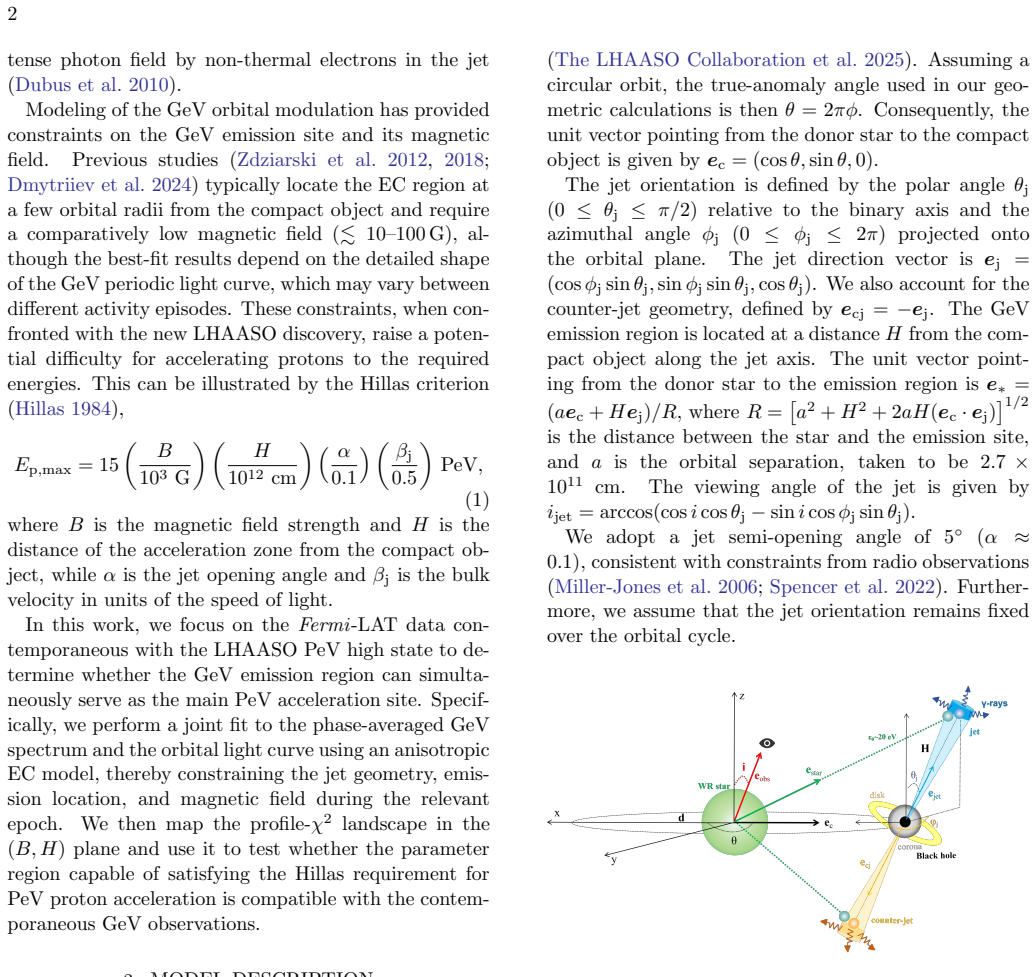


read the original abstract
Cygnus X-3 has recently been established as a variable ultra-high-energy(UHE) gamma-ray source with photons detected up to 3.7~PeV. The temporal correlation between its PeV activity and GeV flares, together with the possible orbital modulation, suggests that the emission is produced within or close to the binary system. In this work, we test whether the contemporaneous GeV emission zone can also host the acceleration of the parent protons responsible for the multi-PeV photons. We jointly model the contemporaneous \textit{Fermi}-LAT spectrum and orbital light curve with a one-zone leptonic scenario dominated by anisotropic external inverse-Compton scattering. The fit places the GeV emission region at $H\sim2.8\times10^{11}\,$cm and constrains the magnetic field--size product to $BH\lesssim10^{13.3}\,$G\,cm at the $3\sigma$ level. This implies a maximum proton energy of only $\sim0.3$~PeV from the Hillas criterion, far below that required by the observed PeV emission. We therefore conclude that the GeV zone cannot be the main PeV acceleration site. Instead, the PeV emission should originate from a more compact inner region, and the jet magnetic field must dissipate rapidly between the PeV and GeV emitting zones.
Editorial analysis
A structured set of objections, weighed in public.
Referee Report
Summary. The paper claims that by fitting a one-zone leptonic model dominated by anisotropic external inverse-Compton scattering to the contemporaneous Fermi-LAT GeV spectrum and orbital light curve of Cygnus X-3, the emission region is constrained to H ≈ 2.8 × 10^{11} cm with BH ≲ 10^{13.3} G cm at 3σ. This leads to a Hillas-limited maximum proton energy of only ~0.3 PeV, insufficient for the observed 3.7 PeV photons, implying the PeV emission originates from a more compact inner region with rapid magnetic field dissipation in the jet.
Significance. If the one-zone leptonic fit is robust, this result is significant for multi-messenger astrophysics as it constrains the acceleration sites in Cygnus X-3, a prototypical microquasar. It demonstrates that GeV and PeV emissions likely arise from distinct zones, with implications for jet physics and particle acceleration mechanisms. The strength lies in the use of orbital modulation to pin down the geometry, offering clear, falsifiable predictions for future multi-wavelength campaigns.
major comments (2)
- [Abstract and modeling section] The central conclusion rests on the 3σ upper limit BH ≲ 10^{13.3} G cm derived from the joint fit. However, no details are provided on the fit quality, such as the chi-squared value, number of degrees of freedom, or the posterior distribution for the parameters H and B. This makes it difficult to assess potential degeneracies that might weaken the BH constraint.
- [Hillas criterion discussion] The derivation of E_p,max ≈ 0.3 PeV from the fitted parameters assumes the Hillas limit applies directly with the size scale set by H. The manuscript should specify the exact formula used (e.g., involving the gyro-radius) and justify why the emission region height H is the relevant confinement scale in the context of a relativistic jet, as this step is load-bearing for excluding the GeV zone as the PeV site.
minor comments (4)
- [Abstract] The approximate value H ∼ 2.8 × 10^{11} cm is given without uncertainties or the best-fit value with errors; this should be included to allow readers to gauge the precision.
- [Introduction] While the PeV detection is referenced, a specific citation to the observation reporting the 3.7 PeV photon would improve traceability.
- [Figure captions] The orbital modulation plot and spectral energy distribution figures would benefit from inclusion of residual panels or explicit goodness-of-fit indicators to enhance clarity.
- [Discussion] The claim of rapid magnetic field dissipation between zones is qualitative; a brief estimate of the required dissipation length scale or rate would make the argument more quantitative.
Simulated Author's Rebuttal
We thank the referee for their constructive comments and for recommending minor revision. Their feedback has helped us improve the clarity of the modeling details and the Hillas criterion discussion. We address each major comment below and have incorporated the corresponding revisions into the manuscript.
read point-by-point responses
-
Referee: [Abstract and modeling section] The central conclusion rests on the 3σ upper limit BH ≲ 10^{13.3} G cm derived from the joint fit. However, no details are provided on the fit quality, such as the chi-squared value, number of degrees of freedom, or the posterior distribution for the parameters H and B. This makes it difficult to assess potential degeneracies that might weaken the BH constraint.
Authors: We agree that quantitative details on fit quality are necessary to evaluate the robustness of the BH constraint. In the revised manuscript, we now report the chi-squared value and degrees of freedom for the joint fit to the Fermi-LAT spectrum and orbital light curve. We also include a description of the posterior distributions for H and B (with 2D contour plots in an appendix), which show that parameter degeneracies do not weaken the 3σ upper limit on the product BH. revision: yes
-
Referee: [Hillas criterion discussion] The derivation of E_p,max ≈ 0.3 PeV from the fitted parameters assumes the Hillas limit applies directly with the size scale set by H. The manuscript should specify the exact formula used (e.g., involving the gyro-radius) and justify why the emission region height H is the relevant confinement scale in the context of a relativistic jet, as this step is load-bearing for excluding the GeV zone as the PeV site.
Authors: We have revised the text to specify the exact Hillas formula: E_{p,max} = Z e B R (in cgs units, with conversion to PeV), derived by requiring the gyro-radius r_L = E/(Z e B) to be smaller than the confinement scale R. Here R is set to the emission region height H, yielding the quoted ~0.3 PeV limit. We justify this choice by noting that the one-zone model treats the characteristic size of the acceleration region as comparable to its distance H from the compact object (tightly constrained by orbital modulation within the binary). For a relativistic jet with opening angle of order unity near the base, the transverse dimension is comparable to H, making this the appropriate confinement scale, consistent with standard microquasar jet modeling. revision: yes
Circularity Check
No significant circularity
full rationale
The derivation fits a standard one-zone leptonic model (anisotropic external IC) to contemporaneous Fermi-LAT GeV spectrum and orbital light curve, obtaining H ≈ 2.8 × 10^11 cm and BH ≲ 10^13.3 G cm. These parameters are then inserted into the independent Hillas confinement criterion to bound E_p,max ≈ 0.3 PeV. The Hillas limit is an external physical constraint unrelated to the fit equations; the exclusion of the GeV zone as PeV site follows from the numerical comparison without any self-definition, fitted-input-as-prediction, or self-citation reduction. The modeling assumptions are stated explicitly and produce an internally consistent result against external benchmarks.
Axiom & Free-Parameter Ledger
free parameters (2)
- Emission region height H =
2.8e11 cm
- Magnetic field-size product BH =
10^13.3 G cm
axioms (2)
- domain assumption GeV emission is dominated by anisotropic external inverse-Compton scattering in a one-zone leptonic scenario
- standard math Hillas criterion gives the maximum proton energy as E_max ~ Z e B R
Forward citations
Cited by 1 Pith paper
-
The counterjet dominates the production of PeV photons from Cyg X-3
The counterjet dominates PeV photon production in Cyg X-3 due to longer interaction paths through the donor star's wind at low inclination.
Reference graph
Works this paper leans on
-
[1]
Alfaro, R., Alvarez, C., Arteaga-Vel´ azquez, J. C., et al. 2024, Nature, 634, 557, doi: 10.1038/s41586-024-07995-9
-
[2]
Antokhin, I. I., & Cherepashchuk, A. M. 2019, ApJ, 871, 244, doi: 10.3847/1538-4357/aafb38
-
[3]
Tatarnikov, A. M. 2022, ApJ, 926, 123, doi: 10.3847/1538-4357/ac4047
-
[4]
Bosch-Ramon, V., & Barkov, M. V. 2016, A&A, 590, A119, doi: 10.1051/0004-6361/201628564
-
[5]
2011, A&A, 529, A120, doi: 10.1051/0004-6361/201116581
Cerutti, B., Dubus, G., Malzac, J., et al. 2011, A&A, 529, A120, doi: 10.1051/0004-6361/201116581
-
[6]
Crowther, P. A. 2007, ARA&A, 45, 177, doi: 10.1146/annurev.astro.45.051806.110615
-
[7]
A., Malyshev, D., Bosch-Ramon, V ., & Chernyakova, M
Bosch-Ramon, V., & Chernyakova, M. 2024, ApJ, 972, 85, doi: 10.3847/1538-4357/ad6440
-
[8]
Dubus, G., Cerutti, B., & Henri, G. 2010, MNRAS, 404, L55, doi: 10.1111/j.1745-3933.2010.00834.x Fermi LAT Collaboration, Abdo, A. A., Ackermann, M., et al. 2009, Science, 326, 1512, doi: 10.1126/science.1182174
-
[9]
Giacconi, R., Gorenstein, P., Gursky, H., & Waters, J. R. 1967, ApJL, 148, L119, doi: 10.1086/180028
-
[10]
L., & Syrovatskii, S
Ginzburg, V. L., & Syrovatskii, S. I. 1964, The Origin of Cosmic Rays (Oxford: Pergamon Press)
1964
-
[11]
Hillas, A. M. 1984, ARA&A, 22, 425, doi: 10.1146/annurev.aa.22.090184.002233
-
[12]
Hjalmarsdotter, L., Zdziarski, A. A., Larsson, S., et al. 2008, MNRAS, 384, 278, doi: 10.1111/j.1365-2966.2007.12688.x
-
[13]
Khangulyan, D., Aharonian, F. A., & Kelner, S. R. 2014, ApJ, 783, 100, doi: 10.1088/0004-637X/783/2/100
-
[14]
2018, MNRAS, 481, 1455, doi: 10.1093/mnras/sty2356
Khangulyan, D., Bosch-Ramon, V., & Uchiyama, Y. 2018, MNRAS, 481, 1455, doi: 10.1093/mnras/sty2356
-
[15]
Kulikov, G. V., & Khristiansen, G. B. 1959, Soviet Physics JETP, 35, 441 LHAASO Collaboration. 2024, Science Bulletin, 69, 449, doi: 10.1016/j.scib.2023.12.040 —. 2025, National Science Review, 12, nwaf496, doi: 10.1093/nsr/nwaf496
-
[16]
Ling, Z., Zhang, S. N., & Tang, S. 2009, ApJ, 695, 1111, doi: 10.1088/0004-637X/695/2/1111
-
[17]
Miller-Jones, J. C. A., Blundell, K. M., Rupen, M. P., et al. 2004, ApJ, 600, 368, doi: 10.1086/379706
-
[18]
Miller-Jones, J. C. A., Fender, R. P., & Nakar, E. 2006, MNRAS, 367, 1432, doi: 10.1111/j.1365-2966.2006.10092.x
-
[19]
Miller-Jones, J. C. A., Sakari, C. M., Dhawan, V., et al. 2009, in 8th International e-VLBI Workshop, 17, doi: 10.22323/1.082.0017
-
[20]
Pooley, G. G., & Waltman, E. B. 2001, ApJ, 553, 766, doi: 10.1086/320965
-
[21]
Reid, M. J., & Miller-Jones, J. C. A. 2023, ApJ, 959, 85, doi: 10.3847/1538-4357/acfe0c
-
[22]
Spencer, R. E., Garrett, M., Bray, J. D., & Green, D. A. 2022, MNRAS, 512, 2618, doi: 10.1093/mnras/stac666
-
[23]
Cygnus X-3: A variable petaelectronvolt gamma-ray source
Tavani, M., Bulgarelli, A., Piano, G., et al. 2009, Nature, 462, 620, doi: 10.1038/nature08578 The LHAASO Collaboration, Cao, Z., Aharonian, F., et al. 2025, arXiv e-prints, arXiv:2512.16638, doi: 10.48550/arXiv.2512.16638
work page internal anchor Pith review Pith/arXiv arXiv doi:10.1038/nature08578 2009
-
[24]
2024b, Nature Astronomy, 8, 1031, doi: 10.1038/s41550-024-02294-9
Veledina, A., Muleri, F., Poutanen, J., et al. 2024, Nature Astronomy, 8, 1031, doi: 10.1038/s41550-024-02294-9
-
[25]
Waltman, E. B., Foster, R. S., Pooley, G. G., Fender, R. P., & Ghigo, F. D. 1996, AJ, 112, 2690, doi: 10.1086/118213
-
[26]
2018, PhRvD, 97, 103016, doi: 10.1103/PhysRevD.97.103016
Wang, J.-S., Liu, R.-Y., Aharonian, F., & Dai, Z.-G. 2018, PhRvD, 97, 103016, doi: 10.1103/PhysRevD.97.103016
-
[27]
Wei, Y.-J., Murase, K., & Zhang, B. T. 2025, arXiv e-prints, arXiv:2512.23231, doi: 10.48550/arXiv.2512.23231
-
[28]
2015, ApJ, 801, 55, doi: 10.1088/0004-637X/801/1/55
Yoon, D., & Heinz, S. 2015, ApJ, 801, 55, doi: 10.1088/0004-637X/801/1/55
-
[29]
Zdziarski, A. A., Sikora, M., Dubus, G., et al. 2012, MNRAS, 421, 2956, doi: 10.1111/j.1365-2966.2012.20519.x
-
[30]
A., Malyshev, D., Dubus, G., et al
Zdziarski, A. A., Malyshev, D., Dubus, G., et al. 2018, MNRAS, 479, 4399, doi: 10.1093/mnras/sty1618
discussion (0)
Sign in with ORCID, Apple, or X to comment. Anyone can read and Pith papers without signing in.