Recognition: 2 theorem links
· Lean TheoremQCommute: a tool for symbolic computation of nested commutators in quantum many-body spin-1/2 systems
Pith reviewed 2026-05-10 19:23 UTC · model grok-4.3
The pith
QCommute computes nested commutators symbolically for spin-1/2 systems on lattices in the thermodynamic limit while keeping all Hamiltonian parameters symbolic.
A machine-rendered reading of the paper's core claim, the machinery that carries it, and where it could break.
Core claim
QCommute performs algebraic symbolic computation of nested commutators between Hamiltonians and local observables in spin-1/2 systems on hypercubic lattices, executed exactly in the thermodynamic limit with all Hamiltonian parameters retained as symbols so that one computation spans the entire parameter space, and with built-in support for parallel execution to maintain performance at high nesting depths.
What carries the argument
The QCommute C++ implementation, which algebraically manipulates spin-1/2 operators on lattices to produce symbolic nested commutator expressions without numerical approximation or fixed parameter values.
If this is right
- Time-evolution operators can be expanded in Taylor series to arbitrary order for any coupling strength without perturbative truncation.
- The recursion method becomes applicable to dynamical correlation functions in regimes where perturbative expansions break down.
- Exact series for observables can be derived for one-, two-, and three-dimensional spin models while covering all values of the coupling constants in a single symbolic run.
- Parallel execution allows deeper nesting orders to be reached than manual or non-parallel symbolic approaches typically permit.
Where Pith is reading between the lines
- Series expansions generated by the tool could serve as benchmarks for approximate numerical methods such as tensor networks or quantum Monte Carlo in the same models.
- The symbolic output might be combined with resummation techniques to obtain approximate closed-form expressions for dynamics at intermediate times.
- The approach could be adapted to extract sum rules or conservation laws directly from the structure of the commutator hierarchy.
Load-bearing premise
The algebraic manipulation of nested commutators can be executed correctly and without the expressions growing too complex to store or process for arbitrary nesting depths while remaining in the thermodynamic limit.
What would settle it
Compute the first several nested commutators for the one-dimensional Heisenberg Hamiltonian using QCommute and verify that they exactly match the same expressions obtained by hand or by an independent symbolic algebra system.
Figures


read the original abstract
We present QCommute, a software tool implemented in C++ for symbolic computation of nested commutators between a Hamiltonian and local observables in quantum many-body spin-1/2 systems on one-, two-, and three-dimensional hypercubic lattices. The computation is performed algebraically directly in the thermodynamic limit, and the Hamiltonian parameters are kept symbolic. Importantly, this way the entire parameter space is covered in a single run. The implementation supports extensive parallelization to achieve high computational performance. QCommute enables the investigation of quantum dynamics in strongly correlated regimes that are inaccessible to perturbative approaches, either through direct Taylor expansion in time or via advanced techniques such as the recursion method.
Editorial analysis
A structured set of objections, weighed in public.
Referee Report
Summary. The manuscript introduces QCommute, a C++ software tool for the algebraic, symbolic computation of nested commutators [H,[H,…O…]] between a Hamiltonian and local observables in spin-1/2 models on 1D, 2D, and 3D hypercubic lattices. All calculations are performed directly in the thermodynamic limit while retaining every Hamiltonian coupling as a symbolic parameter, so that the full parameter space is covered in one run; extensive parallelization is claimed to deliver high performance. The stated purpose is to enable non-perturbative investigations of quantum dynamics via direct time Taylor expansion or the recursion method in regimes inaccessible to perturbation theory.
Significance. If the implementation is shown to be correct and scalable, QCommute would constitute a useful addition to the toolbox for many-body spin systems by supplying exact symbolic high-order commutators without finite-size artifacts or the need to fix numerical values of couplings. The approach aligns with established techniques (Taylor series, recursion method) and could therefore support reproducible, parameter-free derivations in the thermodynamic limit. At present, however, the absence of any verification, benchmarks, or example outputs leaves the practical significance unestablished.
major comments (2)
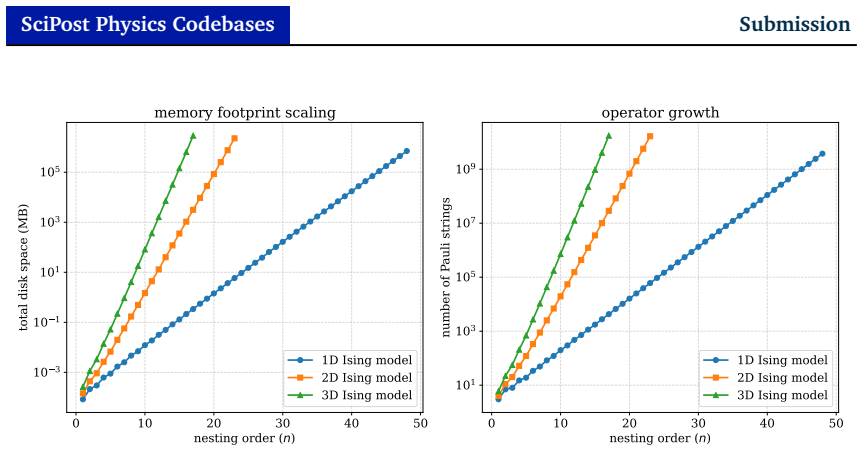
- [Abstract] Abstract: the central claim that nested commutators can be evaluated 'algebraically directly in the thermodynamic limit' to depths useful for Taylor expansion or the recursion method is unsupported by any reported term counts, expression-size scaling, runtime benchmarks versus nesting depth, or cross-checks against known closed-form results for small orders. Without such evidence the assertion that the tool reaches 'strongly correlated regimes that are inaccessible to perturbative approaches' remains unverified.
- [Implementation] Implementation description: no information is supplied on the internal operator-string representation, the simplification rules that must cancel the rapidly proliferating terms on an infinite lattice, or the handling of symbolic parameters during commutator evaluation. These algorithmic details are load-bearing for the claim that arbitrary nesting depths can be reached without truncation or algebraic errors while keeping all couplings symbolic.
minor comments (1)
- [Abstract] The abstract states that 'the entire parameter space is covered in a single run' but does not clarify whether this includes all possible lattice geometries or only the three hypercubic cases explicitly listed.
Simulated Author's Rebuttal
We thank the referee for the careful and constructive review of our manuscript on QCommute. We provide point-by-point responses to the major comments below, and we will incorporate revisions to address the concerns raised.
read point-by-point responses
-
Referee: [Abstract] Abstract: the central claim that nested commutators can be evaluated 'algebraically directly in the thermodynamic limit' to depths useful for Taylor expansion or the recursion method is unsupported by any reported term counts, expression-size scaling, runtime benchmarks versus nesting depth, or cross-checks against known closed-form results for small orders. Without such evidence the assertion that the tool reaches 'strongly correlated regimes that are inaccessible to perturbative approaches' remains unverified.
Authors: We acknowledge that the abstract's claims would be more convincing with quantitative support. While the manuscript includes some examples of computed commutators, we agree that systematic benchmarks are missing. In the revised manuscript, we will add a new section presenting term counts and expression sizes as a function of nesting depth for representative models, runtime performance data on multi-core systems, and explicit cross-checks against known results for low-order expansions in the 1D Ising and Heisenberg models. These additions will demonstrate the tool's reach into non-perturbative regimes. revision: yes
-
Referee: [Implementation] Implementation description: no information is supplied on the internal operator-string representation, the simplification rules that must cancel the rapidly proliferating terms on an infinite lattice, or the handling of symbolic parameters during commutator evaluation. These algorithmic details are load-bearing for the claim that arbitrary nesting depths can be reached without truncation or algebraic errors while keeping all couplings symbolic.
Authors: We agree with the referee that additional implementation details are necessary to fully substantiate the claims of correctness and scalability. The original submission provided only a high-level description. We will revise the manuscript to include a comprehensive account of the operator-string data structure, the algebraic simplification rules leveraging lattice symmetries and commutator identities to manage term proliferation, and the symbolic parameter handling using exact arithmetic. We will also elaborate on the parallelization strategy and error-checking mechanisms to ensure no truncation or algebraic mistakes occur. revision: yes
Circularity Check
No circularity: tool description with no load-bearing derivations or self-referential claims
full rationale
The paper presents a software tool (QCommute) for symbolic computation of nested commutators on lattices, with claims limited to implementation capabilities, parallelization, and coverage of parameter space in one run. No physical predictions, fitted parameters, or derivations are made that could reduce to inputs by construction. The central assertions concern code correctness and efficiency, which are externally verifiable via benchmarks or reproduction rather than internal self-definition or self-citation chains. No steps match the enumerated circularity patterns.
Axiom & Free-Parameter Ledger
Lean theorems connected to this paper
-
IndisputableMonolith/Foundation/AlexanderDuality.leanalexander_duality_circle_linking unclear?
unclearRelation between the paper passage and the cited Recognition theorem.
QCommute … symbolic computation of nested commutators … on one-, two-, and three-dimensional hypercubic lattices … directly in the thermodynamic limit … Hamiltonian parameters kept symbolic
-
IndisputableMonolith/Cost/FunctionalEquation.leanwashburn_uniqueness_aczel unclear?
unclearRelation between the paper passage and the cited Recognition theorem.
The core computational primitive … evaluation of commutators [H,A] … recursion method … Taylor expansion
What do these tags mean?
- matches
- The paper's claim is directly supported by a theorem in the formal canon.
- supports
- The theorem supports part of the paper's argument, but the paper may add assumptions or extra steps.
- extends
- The paper goes beyond the formal theorem; the theorem is a base layer rather than the whole result.
- uses
- The paper appears to rely on the theorem as machinery.
- contradicts
- The paper's claim conflicts with a theorem or certificate in the canon.
- unclear
- Pith found a possible connection, but the passage is too broad, indirect, or ambiguous to say the theorem truly supports the claim.
Reference graph
Works this paper leans on
-
[1]
, " * write output.state after.block =
ENTRY address archive author booktitle chapter doi edition editor eid eprint howpublished institution isbn journal key month note number organization pages publisher school series title type url volume year label INTEGERS output.state before.all mid.sentence after.sentence after.block FUNCTION init.state.consts #0 'before.all := #1 'mid.sentence := #2 'af...
-
[2]
write newline
" write newline "" before.all 'output.state := FUNCTION n.dashify 't := "" t empty not t #1 #1 substring "-" = t #1 #2 substring "--" = not "--" * t #2 global.max substring 't := t #1 #1 substring "-" = "-" * t #2 global.max substring 't := while if t #1 #1 substring * t #2 global.max substring 't := if while FUNCTION word.in bbl.in capitalize " " * FUNCT...
-
[3]
QCommute , https://github.com/QCommute (2026)
2026
-
[4]
U. Schollw\"ock, The density-matrix renormalization group in the age of matrix product states, Annals of Physics 326(1), 96 (2011), doi:https://doi.org/10.1016/j.aop.2010.09.012, January 2011 Special Issue
-
[5]
M. Fishman, S. R. White and E. M. Stoudenmire, The ITensor Software Library for Tensor Network Calculations , SciPost Phys. Codebases p. 4 (2022), doi:10.21468/SciPostPhysCodeb.4
-
[6]
Codebases4–r0.3 URL https://scipost.org/10.21468/SciPostPhysCodeb.4-r0.3
M. Fishman, S. R. White and E. M. Stoudenmire, Codebase release 0.3 for ITensor , SciPost Phys. Codebases pp. 4--r0.3 (2022), doi:10.21468/SciPostPhysCodeb.4-r0.3
-
[7]
J. Dziarmaga, Time evolution of an infinite projected entangled pair state: A gradient tensor update in the tangent space, Phys. Rev. B 106, 014304 (2022), doi:10.1103/PhysRevB.106.014304
-
[8]
T. Hashizume, I. P. McCulloch and J. C. Halimeh, Dynamical phase transitions in the two-dimensional transverse-field ising model, Phys. Rev. Res. 4, 013250 (2022), doi:10.1103/PhysRevResearch.4.013250
-
[9]
S. De Nicola, A. A. Michailidis and M. Serbyn, Entanglement and precession in two-dimensional dynamical quantum phase transitions, Phys. Rev. B 105, 165149 (2022), doi:10.1103/PhysRevB.105.165149
-
[10]
R. Kaneko and I. Danshita, Dynamics of correlation spreading in low-dimensional transverse-field ising models, Phys. Rev. A 108, 023301 (2023), doi:10.1103/PhysRevA.108.023301
-
[11]
G. Park, J. Gray and G. K.-L. Chan, Simulating quantum dynamics in two-dimensional lattices with tensor network influence functional belief propagation, Phys. Rev. B 112, 174310 (2025), doi:10.1103/7jzt-xhn6
-
[12]
L. Pave s s i c \' c , D. Jaschke and S. Montangero, Constrained dynamics and confinement in the two-dimensional quantum ising model, Phys. Rev. B 111, L140305 (2025), doi:10.1103/PhysRevB.111.L140305
- [13]
-
[14]
J. Vovrosh, S. Juli \`a -Farr \'e , W. Krinitsin, M. Kaicher, F. Hayes, E. Gottlob, A. Kshetrimayum, K. Bidzhiev, S. B. J \"a ger, M. Schmitt et al., Simulating dynamics of the two-dimensional transverse-field ising model: a comparative study of large-scale classical numerics, arXiv:2511.19340 (2025)
-
[15]
M. Schmitt and M. Heyl, Quantum many-body dynamics in two dimensions with artificial neural networks, Phys. Rev. Lett. 125, 100503 (2020), doi:10.1103/PhysRevLett.125.100503
-
[16]
F. Vicentini, D. Hofmann, A. Szabó, D. Wu, C. Roth, C. Giuliani, G. Pescia, J. Nys, V. Vargas-Calderón, N. Astrakhantsev and G. Carleo, NetKet 3: Machine Learning Toolbox for Many-Body Quantum Systems , SciPost Phys. Codebases p. 7 (2022), doi:10.21468/SciPostPhysCodeb.7
-
[17]
F. Vicentini, D. Hofmann, A. Szabó, D. Wu, C. Roth, C. Giuliani, G. Pescia, J. Nys, V. Vargas-Calderón, N. Astrakhantsev and G. Carleo, Codebase release 3.4 for NetKet , SciPost Phys. Codebases pp. 7--r3.4 (2022), doi:10.21468/SciPostPhysCodeb.7-r3.4
-
[18]
Time-dependent Neural Galerkin Method for Quantum Dynamics
A. Sinibaldi, D. Hendry, F. Vicentini and G. Carleo, Time-dependent neural galerkin method for quantum dynamics, arXiv:2412.11778 (2024)
work page internal anchor Pith review Pith/arXiv arXiv 2024
- [19]
-
[20]
G. A. Starkov and B. V. Fine, Hybrid quantum-classical method for simulating high-temperature dynamics of nuclear spins in solids, Phys. Rev. B 98, 214421 (2018), doi:10.1103/PhysRevB.98.214421
-
[21]
D. E. Parker, X. Cao, A. Avdoshkin, T. Scaffidi and E. Altman, A universal operator growth hypothesis, Phys. Rev. X 9, 041017 (2019), doi:10.1103/PhysRevX.9.041017
-
[22]
V. Khemani, A. Vishwanath and D. A. Huse, Operator spreading and the emergence of dissipative hydrodynamics under unitary evolution with conservation laws, Phys. Rev. X 8, 031057 (2018), doi:10.1103/PhysRevX.8.031057
-
[23]
T. Rakovszky, C. W. von Keyserlingk and F. Pollmann, Dissipation-assisted operator evolution method for capturing hydrodynamic transport, Phys. Rev. B 105, 075131 (2022), doi:10.1103/PhysRevB.105.075131
-
[24]
C. D. White, Effective dissipation rate in a liouvillian-graph picture of high-temperature quantum hydrodynamics, Phys. Rev. B 107, 094311 (2023), doi:10.1103/PhysRevB.107.094311
-
[25]
F. Uskov and O. Lychkovskiy, Quantum dynamics in one and two dimensions via the recursion method, Phys. Rev. B 109, L140301 (2024), doi:10.1103/PhysRevB.109.L140301
-
[26]
I. Ermakov, O. Lychkovskiy and T. Byrnes, Unified framework for efficiently computable quantum circuits, arXiv:2401.08187 (2024)
-
[27]
N. Loizeau, B. Bu c c a and D. Sels, Opening krylov space to access all-time dynamics via dynamical symmetries, Phys. Rev. Lett. 135, 200401 (2025), doi:10.1103/qpyp-1mfj
-
[28]
Simulating quantum circuits with arbitrary local noise using Pauli Propagation
A. Angrisani, A. A. Mele, M. S. Rudolph, M. Cerezo and Z. Holmes, Simulating quantum circuits with arbitrary local noise using pauli propagation, arXiv preprint arXiv:2501.13101 (2025)
work page internal anchor Pith review Pith/arXiv arXiv 2025
-
[29]
T. Begušić, J. Gray and G. K.-L. Chan, Fast and converged classical simulations of evidence for the utility of quantum computing before fault tolerance, Science Advances 10(3), eadk4321 (2024), doi:10.1126/sciadv.adk4321
-
[30]
T. Begu s s i c \' c and G. K.-L. Chan, Real-time operator evolution in two and three dimensions via sparse pauli dynamics, PRX Quantum 6, 020302 (2025), doi:10.1103/PRXQuantum.6.020302
-
[31]
A. Teretenkov, F. Uskov and O. Lychkovskiy, Pseudomode expansion of many-body correlation functions, Phys. Rev. B 111, 174308 (2025), doi:10.1103/PhysRevB.111.174308
-
[32]
Recursion method for out-of-equilibrium many-body dynamics: strengths and limitations
I. Shirokov, V. Khrushchev, F. Uskov, I. Dudinets, I. Ermakov and O. Lychkovskiy, Quench dynamics via recursion method, arXiv:2503.24362 (2025)
work page internal anchor Pith review Pith/arXiv arXiv 2025
-
[33]
I. Ermakov and O. Lychkovskiy, Symbolic recursion method for strongly correlated fermions in two and three dimensions, arXiv preprint arXiv:2512.23678 (2025)
-
[34]
H. Mori, A continued-fraction representation of the time-correlation functions, Progress of Theoretical Physics 34(3), 399 (1965), doi:10.1143/PTP.34.399
-
[35]
Viswanath and G
V. Viswanath and G. M \"u ller, The Recursion Method: Application to Many-Body Dynamics, vol. 23, Springer Science & Business Media (2008)
2008
-
[36]
N. Loizeau, J. C. Peacock and D. Sels, Quantum many-body simulations with PauliStrings.jl , SciPost Phys. Codebases p. 54 (2025), doi:10.21468/SciPostPhysCodeb.54
-
[37]
N. Loizeau, J. C. Peacock and D. Sels, Codebase release 1.5 for PauliStrings.jl , SciPost Phys. Codebases pp. 54--r1.5 (2025), doi:10.21468/SciPostPhysCodeb.54-r1.5
-
[38]
Loizeau, PauliStrings , https://paulistrings.org, Accessed: 2026-04-08
N. Loizeau, PauliStrings , https://paulistrings.org, Accessed: 2026-04-08
2026
- [39]
-
[40]
Begu s i \'c , Sparse Pauli Dynamics (SPD) Python implementation , https://github.com/tbegusic/spd/tree/main/spd, Accessed: 2026-03-25
T. Begu s i \'c , Sparse Pauli Dynamics (SPD) Python implementation , https://github.com/tbegusic/spd/tree/main/spd, Accessed: 2026-03-25
2026
-
[41]
J. Roldan, B. M. McCoy and J. H. Perk, Dynamic spin correlation functions of the xyz chain at infinite temperature: A study based on moments, Physica A: Statistical Mechanics and its Applications 136(2), 255 (1986), doi:https://doi.org/10.1016/0378-4371(86)90254-2
-
[42]
J. Florencio, S. Sen and Z. Cai, Quantum spin dynamics of the transverse ising model in two dimensions, Journal of Low Temperature Physics 89, 561 (1992), doi:10.1007/BF00694087
-
[43]
N. H. Lindner and A. Auerbach, Conductivity of hard core bosons: A paradigm of a bad metal, Phys. Rev. B 81, 054512 (2010), doi:10.1103/PhysRevB.81.054512
-
[44]
E. W. Huang, R. Sheppard, B. Moritz and T. P. Devereaux, Strange metallicity in the doped hubbard model, Science 366(6468), 987 (2019), doi:10.1126/science.aau7063
-
[45]
A. De, U. Borla, X. Cao and S. Gazit, Stochastic sampling of operator growth dynamics, Phys. Rev. B 110, 155135 (2024), doi:10.1103/PhysRevB.110.155135
-
[46]
Ermakov, Operator growth in many-body systems of higher spins, arXiv:2504.07833 (2025)
I. Ermakov, Operator growth in many-body systems of higher spins, arXiv:2504.07833 (2025)
-
[47]
T. Prosen, Exact time-correlation functions of quantum ising chain in a kicking transversal magnetic field: Spectral analysis of the adjoint propagator in H eisenberg picture , Progress of Theoretical Physics Supplement 139, 191 (2000), doi:10.1143/PTPS.139.191
-
[48]
O. Lychkovskiy, Closed hierarchy of Heisenberg equations in integrable models with Onsager algebra , SciPost Phys. 10, 124 (2021), doi:10.21468/SciPostPhys.10.6.124
-
[49]
O. Gamayun and O. Lychkovskiy, Out-of-equilibrium dynamics of the Kitaev model on the Bethe lattice via coupled Heisenberg equations , SciPost Phys. 12, 175 (2022), doi:10.21468/SciPostPhys.12.5.175
-
[50]
A. Teretenkov and O. Lychkovskiy, Exact dynamics of quantum dissipative XX models: W annier- S tark localization in the fragmented operator space , Physical Review B 109(14), L140302 (2024), doi:10.1103/PhysRevB.109.L140302
-
[51]
I. Ermakov, T. Byrnes and O. Lychkovskiy, Polynomially restricted operator growth in dynamically integrable models, Phys. Rev. B 111, 094314 (2025), doi:10.1103/PhysRevB.111.094314
-
[52]
P. Penc and F. H. L. Essler, Linear response and exact hydrodynamic projections in Lindblad equations with decoupled Bogoliubov hierarchies , SciPost Phys. 20, 058 (2026), doi:10.21468/SciPostPhys.20.2.058
-
[53]
O. Gamayun, M. A. Mir, O. Lychkovskiy and Z. Ristivojevic, Exactly solvable models for universal operator growth, J. High Energ. Phys. 2025, 256 (2025), doi:10.1007/JHEP07(2025)256
-
[54]
N. Angelinos, D. Chakraborty and A. Dymarsky, Temperature dependence in krylov space, arXiv preprint arXiv:2508.19233 (2025)
-
[55]
Araki, Gibbs states of a one dimensional quantum lattice, Communications in Mathematical Physics 14, 120 (1969)
H. Araki, Gibbs states of a one dimensional quantum lattice, Communications in Mathematical Physics 14, 120 (1969)
1969
-
[56]
Khrushchev, O
V. Khrushchev, O. Lychkovskiy and I. Shirokov, COMMUTE source code repository , https://gitlab.com/viacheslav_hrushev/commutators (2025)
2025
-
[57]
J. D. Noh, Operator growth in the transverse-field ising spin chain with integrability-breaking longitudinal field, Phys. Rev. E 104, 034112 (2021), doi:10.1103/PhysRevE.104.034112
-
[58]
N. Loizeau and B. Bu c c a, Krylov space perturbation theory for quantum synchronization in closed systems, arXiv:2602.11431 (2026)
- [59]
-
[60]
J. Eckseler, M. Pieper and J. Schnack, Escaping the krylov space during the finite-precision lanczos algorithm, Phys. Rev. E 112, 025306 (2025), doi:10.1103/k94p-vls8
-
[61]
H. A. Bethe, Zur Theorie der Metalle. i. Eigenwerte und Eigenfunktionen der linearen Atomkette , Zeit. f \"u r Phys. 71 , 205 (1931), 10.1007\
1931
-
[62]
Ginsparg, It was twenty years ago today
P. Ginsparg, It was twenty years ago today... , http://arxiv.org/abs/1108.2700
discussion (0)
Sign in with ORCID, Apple, or X to comment. Anyone can read and Pith papers without signing in.