Recognition: 2 theorem links
· Lean TheoremGlueballs, Constituent Gluons and Instantons
Pith reviewed 2026-05-10 19:15 UTC · model grok-4.3
The pith
The scalar glueball is a compact two-gluon state whose radius equals the instanton size of about one-third of a fermi.
A machine-rendered reading of the paper's core claim, the machinery that carries it, and where it could break.
Core claim
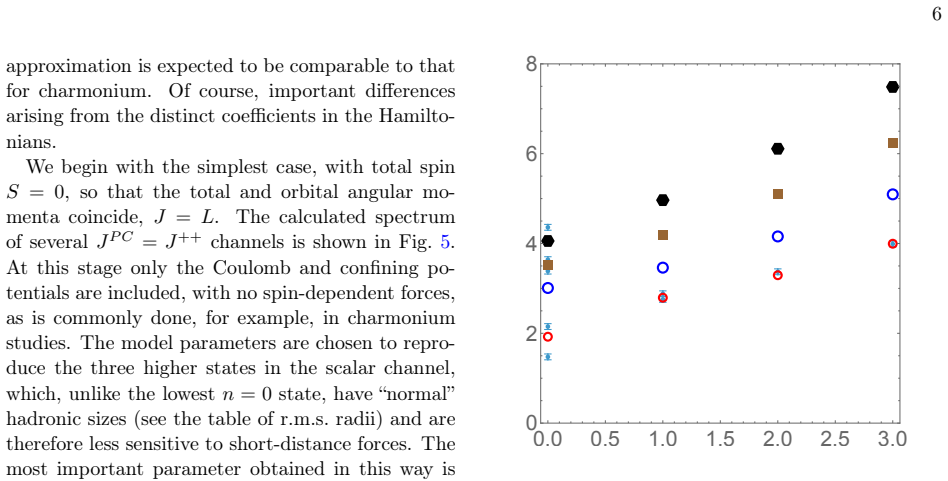
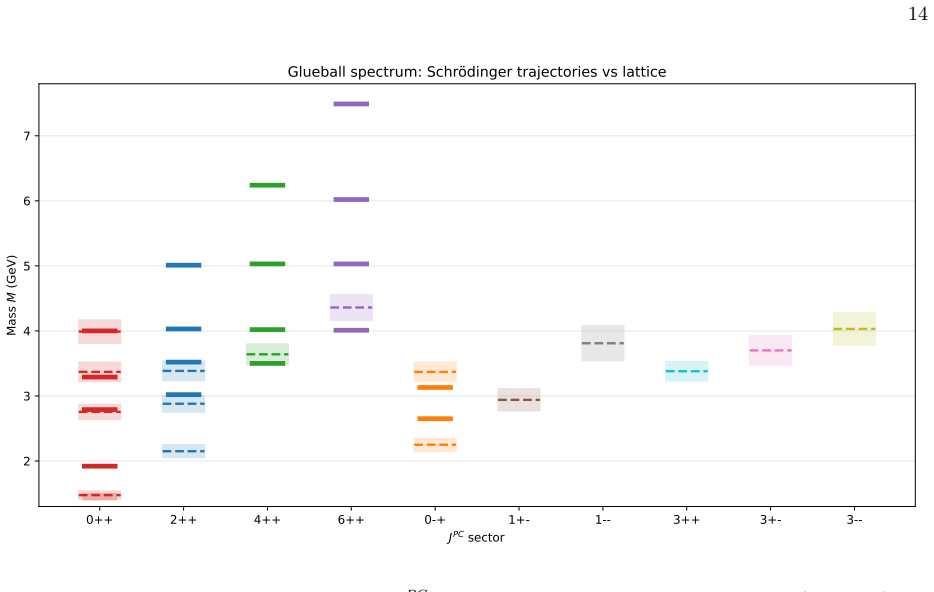
We present a constituent two-gluon description of the lowest-lying glueball states in pure Yang-Mills theory, calibrated against quenched lattice results. The framework incorporates an instanton-induced dynamical gluon mass, Casimir-scaled adjoint confinement, the short-distance adjoint Coulomb interaction, and instanton-induced central and tensor forces. The scalar 0++ glueball is found to be exceptionally compact, with a radius of order the instanton size, ρ ∼ 1/3 fm, consistent with lattice indications. By contrast, the tensor 2++ state remains spatially extended due to the centrifugal barrier. We also discuss the role of S-D mixing. A semiclassical analysis further supports Regge behav
What carries the argument
The two-gluon wave function solved with an instanton-generated dynamical mass, adjoint Casimir confinement, short-range Coulomb force, and additional instanton central and tensor potentials.
If this is right
- The tensor glueball stays spatially extended because the centrifugal barrier prevents it from sampling the short-range instanton attraction.
- S-D mixing modifies the wave functions of both states.
- Excited glueballs exhibit Regge trajectories whose slopes match those seen on the lattice.
Where Pith is reading between the lines
- Instantons, rather than the long-range confining string, would dominate the binding energy of the ground-state glueball.
- The same short-distance instanton forces could influence glueball-meson mixing once light quarks are restored.
- Higher radial excitations should show a characteristic pattern of sizes that future finer lattice simulations could check.
Load-bearing premise
The two-gluon picture calibrated solely to quenched lattice data remains accurate even when higher Fock components or dynamical quarks are present.
What would settle it
A lattice computation that measures the scalar glueball radius to be substantially larger than one-third of a fermi, or that shows the size is insensitive to the instanton density, would falsify the central claim.
Figures





read the original abstract
We present a constituent two-gluon description of the lowest-lying glueball states in pure Yang--Mills theory, calibrated against quenched lattice results. The framework incorporates an instanton-induced dynamical gluon mass, Casimir-scaled adjoint confinement, the short-distance adjoint Coulomb interaction, and instanton-induced central and tensor forces. The scalar $0^{++}$ glueball is found to be exceptionally compact, with a radius of order the instanton size, $\rho \sim \frac 13\,\mathrm{fm}$, consistent with lattice indications. By contrast, the tensor $2^{++}$ state remains spatially extended due to the centrifugal barrier. We also discuss the role of $S$-$D$ mixing. A semiclassical analysis further supports Regge behavior for excited states, in agreement with lattice results.
Editorial analysis
A structured set of objections, weighed in public.
Referee Report
Summary. The manuscript develops a non-relativistic constituent two-gluon model for the lowest-lying glueball states in pure Yang-Mills theory. It incorporates an instanton-induced dynamical gluon mass, Casimir-scaled adjoint linear confinement, short-distance adjoint Coulomb interaction, and instanton-induced central and tensor forces. Parameters are calibrated to quenched lattice glueball masses. The model yields a compact 0++ ground state with rms radius of order the instanton size (∼1/3 fm), while the 2++ state is spatially extended due to the centrifugal barrier; S-D mixing and semiclassical Regge trajectories for excited states are also discussed.
Significance. If the two-gluon truncation and calibration hold, the work supplies a transparent phenomenological link between instanton physics and lattice glueball structure, with the explicit radius prediction and Regge support as concrete outputs. The approach is valuable for interpreting lattice indications of compactness and for guiding phenomenology, though its predictive reach is constrained by the fitting procedure.
major comments (3)
- [§3] §3: The radial Schrödinger equation for the two-gluon system and the explicit functional form of the full potential (instanton-induced mass term, Casimir-scaled linear term, Coulomb term, and central/tensor instanton forces) are not written down. Without these, the reported rms radius of ∼1/3 fm for the 0++ state cannot be independently reproduced or checked for numerical stability.
- [§2–3] §2–3: The gluon mass, adjoint string tension, and instanton density are adjusted to reproduce the quenched lattice spectrum; the subsequent claim that the 0++ radius matches lattice indications therefore rests on the same data used for calibration, with no reported propagation of fit uncertainties or cross-validation against independent observables.
- [§4] §4: The two-gluon Fock-space truncation is adopted without any estimate of mixing amplitudes with three-gluon or instanton-molecule configurations. Given that the extracted radius is comparable to the instanton size, such admixtures could enlarge the spatial extent and must be quantified to support the central compactness claim.
minor comments (3)
- The abstract states consistency with lattice indications for the radius but cites no specific lattice reference or numerical value for comparison in the main text.
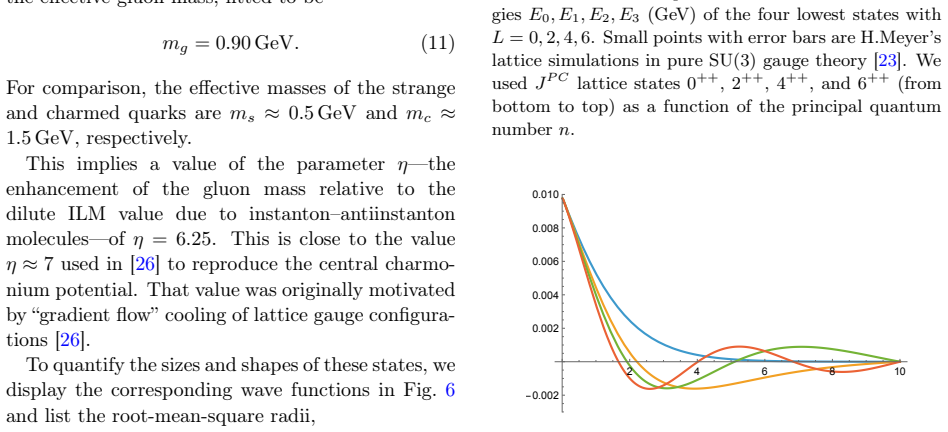
- [§3] Wave-function plots (presumably in §3) lack sensitivity bands showing radius variation under small changes in the fitted parameters.
- The definition of the tensor-force strength parameter appears without an equation label, complicating cross-reference.
Simulated Author's Rebuttal
We thank the referee for the constructive and detailed report. We address each major comment below and describe the revisions planned for the manuscript.
read point-by-point responses
-
Referee: [§3] §3: The radial Schrödinger equation for the two-gluon system and the explicit functional form of the full potential (instanton-induced mass term, Casimir-scaled linear term, Coulomb term, and central/tensor instanton forces) are not written down. Without these, the reported rms radius of ∼1/3 fm for the 0++ state cannot be independently reproduced or checked for numerical stability.
Authors: We agree that the explicit forms are required for reproducibility. In the revised manuscript we will add the radial Schrödinger equation for the two-gluon system together with the complete analytic expression for the potential, including the instanton-induced mass term, the Casimir-scaled adjoint linear term, the adjoint Coulomb interaction, and the central and tensor forces generated by instantons. This will permit independent numerical verification of the rms radius. revision: yes
-
Referee: [§2–3] §2–3: The gluon mass, adjoint string tension, and instanton density are adjusted to reproduce the quenched lattice spectrum; the subsequent claim that the 0++ radius matches lattice indications therefore rests on the same data used for calibration, with no reported propagation of fit uncertainties or cross-validation against independent observables.
Authors: The parameters are fitted to the lattice masses, as stated in the manuscript. The radius is nevertheless a derived observable obtained by solving the Schrödinger equation once the potential is fixed; its small value is directly tied to the instanton size scale. We will add to the revision a brief sensitivity analysis showing how the rms radius varies when the fitted parameters are shifted within their uncertainties. Cross-validation against independent quantities such as decay widths lies beyond the present scope but will be noted as a direction for future work. revision: partial
-
Referee: [§4] §4: The two-gluon Fock-space truncation is adopted without any estimate of mixing amplitudes with three-gluon or instanton-molecule configurations. Given that the extracted radius is comparable to the instanton size, such admixtures could enlarge the spatial extent and must be quantified to support the central compactness claim.
Authors: We acknowledge the limitation of the two-gluon truncation. A quantitative estimate of mixing amplitudes with three-gluon or instanton-molecule states would require a substantially enlarged Fock space and additional model ingredients that are outside the scope of this work. In the revision we will insert a short discussion of this approximation, emphasizing that the leading two-gluon component already produces a compact state whose size is set by the instanton scale and is consistent with existing lattice indications. Further quantification is left for future study. revision: partial
Circularity Check
No significant circularity: radius derived from wavefunction after mass calibration, not reduced to inputs by construction
full rationale
The paper calibrates a two-gluon Schrödinger model (with instanton mass, Casimir confinement, Coulomb and tensor forces) to quenched lattice glueball masses. The 0++ radius is then obtained as an output from the resulting ground-state wavefunction and compared to separate lattice indications of size. This is a standard phenomenological derivation, not a self-definitional loop or a fitted quantity renamed as prediction. No equations reduce the radius to the input masses by construction, and no load-bearing self-citations or ansatz smuggling are quoted. The chain remains self-contained against the external lattice benchmarks.
Axiom & Free-Parameter Ledger
free parameters (3)
- instanton-induced gluon mass
- adjoint string tension
- instanton density and size
axioms (2)
- domain assumption Quenched lattice results provide a reliable benchmark for pure Yang-Mills glueball spectrum and sizes.
- domain assumption Two-gluon Fock space is sufficient for the lowest glueball states.
invented entities (1)
-
constituent gluon with instanton-induced mass
no independent evidence
Lean theorems connected to this paper
-
IndisputableMonolith/Cost/FunctionalEquation.leanwashburn_uniqueness_aczel unclear?
unclearRelation between the paper passage and the cited Recognition theorem.
The framework incorporates an instanton-induced dynamical gluon mass, Casimir-scaled adjoint confinement, the short-distance adjoint Coulomb interaction, and instanton-induced central and tensor forces.
-
IndisputableMonolith/Foundation/AbsoluteFloorClosure.leanreality_from_one_distinction unclear?
unclearRelation between the paper passage and the cited Recognition theorem.
The scalar 0++ glueball is found to be exceptionally compact, with a radius of order the instanton size, ρ ∼ 1/3 fm
What do these tags mean?
- matches
- The paper's claim is directly supported by a theorem in the formal canon.
- supports
- The theorem supports part of the paper's argument, but the paper may add assumptions or extra steps.
- extends
- The paper goes beyond the formal theorem; the theorem is a base layer rather than the whole result.
- uses
- The paper appears to rely on the theorem as machinery.
- contradicts
- The paper's claim conflicts with a theorem or certificate in the canon.
- unclear
- Pith found a possible connection, but the passage is too broad, indirect, or ambiguous to say the theorem truly supports the claim.
Forward citations
Cited by 1 Pith paper
-
Hybrid hadrons at rest and on the light front
A constituent-gluon Born-Oppenheimer model is used to derive light-front wave functions and gluon PDFs for hybrid hadrons ccg and qqqg.
Reference graph
Works this paper leans on
-
[1]
Normalized trial wavefunctions For simplicity, we will use variational estimates of matrix elements using simplified wave functions. TheS-wave Gaussian trial function is ψS(r) = β2 S π 3/4 e−β2 S r2/2,(E1) with radial part RS(r) = 2β3 S√π 1/2 e−β2 S r2/2.(E2) TheD-wave trial function is ψD,m(r) =N D r2e−β2 Dr2/2Y2m(ˆr),(E3) with normalization fixed by 1 =...
-
[2]
Kinetic and confining expectation values Using standard Gaussian integrals, ⟨p2⟩S = 3 2 β2 S,⟨p 2⟩D = 7 2 β2 D.(E7) The linear confinement expectation values are ⟨r⟩S = 2√π 1 βS ,⟨r⟩ D = 16 3√π 1 βD .(E8) The corresponding rms radii are ⟨r2⟩S = 3 2β2 S ,⟨r 2⟩D = 7 2β2 D .(E9)
-
[3]
Coulomb expectation values For the Coulomb potentialVC(r) =−3α eff s /r, one finds 1 r S = 2βS√π ,(E10) and for theD-wave, 1 r D = 8 3√π βD.(E11) ThustheCoulombtermisparametricallysuppressed in the tensor channel by angular momentum
-
[4]
Instanton central attraction The scalar instanton term yields D e−r2/ρ2E S = β2 S β2 S +ρ −2 3/2 .(E12) For theD-wave, D e−r2/ρ2E D = β2 D β2 D +ρ −2 7/2 ,(E13) showing that instanton attraction is strongly sup- pressed for higher partial waves
-
[5]
Spin-spin contact term With the Gaussian regulator δ(3) Λ (r) = Λ2 π 3/2 e−Λ2r2 ,(E14) the contact expectation values are ⟨δ(3) Λ ⟩S = Λ2 Λ2 +β 2 S 3/2 β2 S π 3/2 ,(E15) and ⟨δ(3) Λ ⟩D = Λ2 Λ2 +β 2 D 7/2 β2 D π 3/2 15 8 .(E16) 20
-
[6]
Tensor matrix elements The tensor operator enters through VT (r) = CT (η) m2g(η) 1−e −r2/ρ2 r3 S12.(E17) The reduced angular matrix elements in the {5S2, 5D2}basis are ⟨5S2|S12|5S2⟩= 0,⟨ 5D2|S12|5D2⟩=− 2 7 ,⟨ 5S2|S12|5D2⟩= r 8 7 .(E18) The radial mixing integral is ISD = Z ∞ 0 dr RS(r)RD(r) 1−e −r2/ρ2 r .(E19) which yields ISD =C 1 (β2 S +β 2 D)1/2 − 1 (β...
-
[7]
Explicit 5S2-5D2 tensor Hamiltonian Inthecoupledbasis{| 5S2⟩,| 5D2⟩}thetensorglue- ball Hamiltonian takes the explicit2×2form H2++(η) = HSS(η)H SD(η) HSD(η)H DD(η) ,(E24) with the diagonalS-wave entry HSS(η) =E (0) S (βS;η) + CSS(η) m2g(η) D δ(3) Λ E S ,(E25) where⟨δ (3) Λ ⟩S is given in Eq. (E15). The diagonalD-wave entry reads HDD(η) =E (0) D (βD...
- [8]
- [9]
-
[10]
Chenet al., Glueball spectrum and matrix elements on anisotropic lattices, Phys
Y. Chenet al., Phys. Rev. D73, 014516 (2006), arXiv:hep-lat/0510074
-
[11]
A. Athenodorou and M. Teper, JHEP11, 172 (2020), arXiv:2007.06422 [hep-lat]
- [12]
-
[13]
Gravitational form fac- tors of glueballs in yang-mills theory,
R. Abbott, D. C. Hackett, D. A. Pefkou, F. Romero- López, and P. Shanahan, “Gravitational form fac- tors of glueballs in yang-mills theory,” (2025), arXiv:2410.02706 [hep-lat]
-
[14]
Morningstar, (2025), arXiv:2502.02547 [hep-ph]
C. Morningstar, (2025), arXiv:2502.02547 [hep-ph]
-
[15]
T. Schäfer and E. V. Shuryak, Phys. Rev. Lett.75, 1707 (1995), arXiv:hep-ph/9410372
-
[16]
T. Schafer and E. V. Shuryak, Rev. Mod. Phys.70, 323 (1998), arXiv:hep-ph/9610451
work page Pith review arXiv 1998
-
[17]
Exploring improved holographic theories for QCD: Part I
U. Gursoy and E. Kiritsis, JHEP02, 032 (2008), arXiv:0707.1324 [hep-th]
work page Pith review arXiv 2008
-
[18]
I. Iatrakis, A. Ramamurti, and E. Shuryak, Phys. Rev. D92, 014011 (2015), arXiv:1503.04759 [hep- ph]
- [19]
-
[20]
R. Alkofer and L. von Smekal, Phys. Rept.353, 281 (2001), arXiv:hep-ph/0007355
- [21]
- [22]
-
[24]
Isgur and J
N. Isgur and J. E. Paton, Phys. Rev. D31, 2910 (1985)
1985
-
[25]
Johnson and C
K. Johnson and C. B. Thorn, Phys. Rev. D13, 1934 (1976)
1934
-
[26]
F. Brunner, D. Parganlija, and A. Rebhan, Phys. Rev. D91, 106002 (2015), arXiv:1501.07906 [hep- ph]
- [27]
-
[29]
V. Mathieu, N. Kochelev, and V. Vento, Int. J. Mod. Phys. E18, 1 (2009), arXiv:0810.4453 [hep- ph]
- [30]
-
[31]
J. M. Cornwall and A. Soni, Phys. Lett. B120, 431 (1983)
1983
- [32]
-
[33]
E. Shuryak and I. Zahed, Phys. Rev. D107, 034023 (2023), arXiv:2110.15927 [hep-ph]
-
[34]
R. Abbott, D. C. Hackett, D. A. Pefkou, F. Romero-López, and P. E. Shanahan, (2025), arXiv:2508.21821 [hep-lat]
-
[35]
E. V. Shuryak, Nucl. Phys. B203, 93 (1982)
1982
-
[36]
E. Shuryak and I. Zahed, Phys. Rev. D107, 034025 (2023), arXiv:2112.15586 [hep-ph]
-
[37]
S. J. Brodsky, T. Huang, and G. P. Lepage, Conf. Proc. C810816, 143 (1981)
1981
discussion (0)
Sign in with ORCID, Apple, or X to comment. Anyone can read and Pith papers without signing in.