Recognition: no theorem link
Latent Profiles of AI Risk Perception and Their Differential Association with Community Driving Safety Concerns: A Person-Centered Analysis
Pith reviewed 2026-05-10 19:05 UTC · model grok-4.3
The pith
AI risk perceptions form four latent classes that predict different levels of concern about driving safety.
A machine-rendered reading of the paper's core claim, the machinery that carries it, and where it could break.
Core claim
Latent class analysis applied to nine AI risk-perception indicators from a nationally representative Pew survey (n = 5,255) identifies four profiles—Moderate Skeptics (17.5%), Concerned Pragmatists (42.8%), AI Ambivalent (10.6%), and Extreme Alarm (29.1%)—that differ significantly on all nine driving-safety outcomes. Higher AI concern maps monotonically onto greater perceived driving-hazard severity, while the exception of comparative AI versus human driving evaluation is driven by trust rather than concern level. The cross-domain links supply person-level evidence for worldview-based risk structuring.
What carries the argument
Latent class analysis of nine AI risk-perception indicators, followed by Bolck-Croon-Hagenaars corrected distal outcome analysis to test class differences on driving-safety measures.
If this is right
- Higher AI concern classes report greater perceived severity across most driving hazards.
- All nine driving-safety outcomes show statistically significant differences by class.
- Comparative judgments of AI versus human driving depend on trust levels separate from overall concern.
- The four-class structure supplies a segmentation framework for communications about autonomous vehicles.
- Demographic and ideological variables predict which AI risk profile an individual holds.
Where Pith is reading between the lines
- The profiles could be tested as predictors of support for specific AV regulations or usage intentions.
- Similar person-centered methods might reveal parallel cross-domain links for other technologies such as gene editing.
- If the classes prove stable over time, they could guide targeted interventions to address transportation risk perceptions.
- The monotonic pattern suggests that general efforts to build AI trust might reduce perceived driving hazards.
Load-bearing premise
The nine AI risk-perception indicators from the Pew survey capture stable underlying worldviews that structure risk perceptions without substantial measurement error or confounding by unmeasured demographics and ideology.
What would settle it
A replication study using a different set of AI risk questions or additional controls for ideology that finds no significant differences across classes on the driving safety outcomes.
Figures



read the original abstract
Public attitudes toward artificial intelligence (AI) and driving safety are typically studied in isolation using variable-centered methods that assume population homogeneity, yet risk perception theory predicts that these evaluations covary within individuals as expressions of underlying worldviews. This study identifies latent profiles of AI risk perception among U.S. adults and tests whether these profiles are differentially associated with community driving safety concerns. Latent class analysis was applied to nine AI risk-perception indicators from a nationally representative survey (Pew Research Center American Trends Panel Wave 152, n = 5,255); Bolck-Croon-Hagenaars corrected distal outcome analysis tested class differences on nine driving-safety outcomes, and survey-weighted multinomial logistic regression identified demographic and ideological predictors of class membership. Four classes emerged: Moderate Skeptics (17.5%), Concerned Pragmatists (42.8%), AI Ambivalent (10.6%), and Extreme Alarm (29.1%), with all nine driving-safety outcomes significantly differentiated across classes. Higher AI concern mapped monotonically onto greater perceived driving-hazard severity; the exception, comparative evaluation of AI versus human driving, was driven by trust rather than concern level. The cross-domain covariation provides person-level evidence for the worldview-based risk structuring posited by Cultural Theory of Risk and yields a four-class segmentation framework for AV communication that links AI risk orientation to transportation safety attitudes.
Editorial analysis
A structured set of objections, weighed in public.
Referee Report
Summary. The manuscript applies latent class analysis (LCA) to nine AI risk-perception indicators drawn from the Pew Research Center American Trends Panel Wave 152 (n=5,255 U.S. adults) to identify four latent profiles: Moderate Skeptics (17.5%), Concerned Pragmatists (42.8%), AI Ambivalent (10.6%), and Extreme Alarm (29.1%). Bolck-Croon-Hagenaars (BCH) corrected distal outcome analysis is used to test class differences on nine community driving-safety outcomes, while survey-weighted multinomial logistic regression identifies demographic and ideological predictors of class membership. Results show significant differentiation across all nine outcomes, with a generally monotonic increase in perceived driving-hazard severity as AI concern rises (except for comparative AI-versus-human driving evaluations, which the authors attribute to trust). The work interprets these patterns as person-level evidence for worldview-based risk structuring under Cultural Theory of Risk and proposes a four-class segmentation for autonomous-vehicle communication.
Significance. If the associations survive proper covariate adjustment, the study supplies useful descriptive evidence that AI risk perceptions and driving-safety concerns covary within individuals rather than across independent domains, extending Cultural Theory of Risk into a new substantive area. The nationally representative sample and standard application of LCA plus BCH methods give the descriptive segmentation reasonable credibility. The resulting four-class framework could inform targeted safety messaging, though the current lack of adjustment limits stronger claims about stable individual differences.
major comments (2)
- [Methods (BCH analysis) and Results (distal outcomes)] Methods, BCH distal outcome analysis: The BCH-corrected tests are described as examining raw class differences on the nine driving-safety outcomes. The manuscript separately reports survey-weighted multinomial logistic regression showing that age, education, political ideology, and other covariates predict class membership. Because these same covariates are established correlates of both AI risk perception and safety-hazard ratings, the reported significant differentiations and monotonic mappings may be confounded. This issue is load-bearing for the central claim that the profiles reflect stable, worldview-driven individual differences whose associations with driving outcomes are not artifacts of demographics.
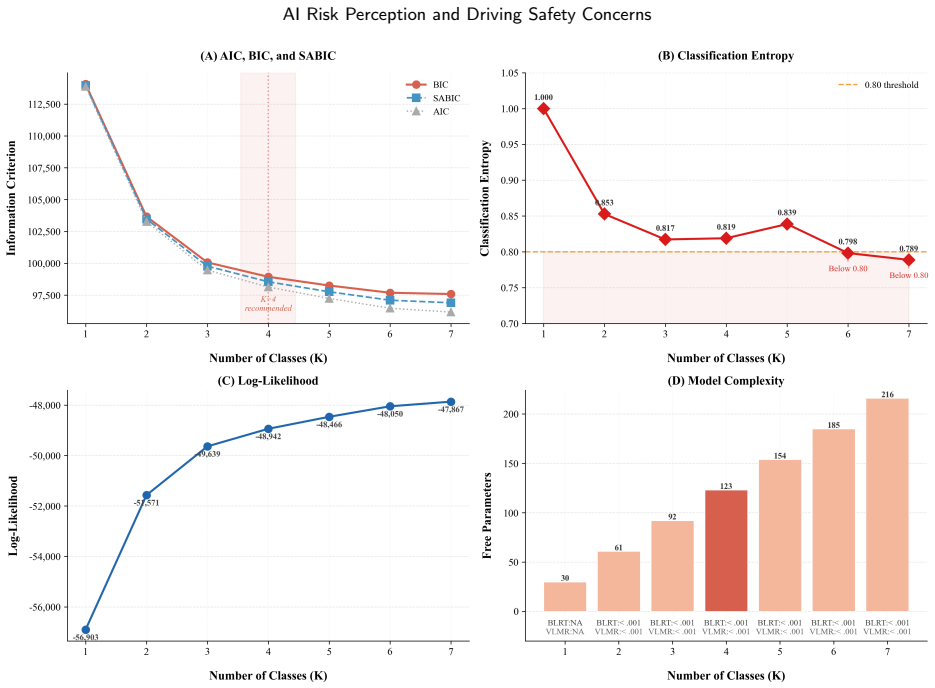
- [Results (latent class analysis)] Results, LCA model selection: The manuscript reports the four-class solution and class sizes but does not present standard fit statistics (BIC, AIC, entropy, Lo-Mendell-Rubin likelihood-ratio test) or robustness checks (alternative class numbers, split-sample replication). Without these, it is impossible to evaluate whether the four-class structure is optimal or stable, which directly affects the validity of all subsequent BCH and regression results.
minor comments (2)
- [Abstract] The abstract states that 'all nine driving-safety outcomes significantly differentiated across classes' but supplies neither p-values nor effect-size information, making it difficult for readers to judge practical significance.
- [Methods (measures)] Variable coding details for the nine AI risk-perception indicators and the nine driving-safety outcomes are not fully reported (e.g., exact item wording, response scales, or handling of missing data), which would aid reproducibility.
Simulated Author's Rebuttal
We thank the referee for their constructive and detailed comments, which highlight important issues for strengthening the manuscript. We address each major comment point by point below, indicating planned revisions where appropriate.
read point-by-point responses
-
Referee: Methods (BCH analysis) and Results (distal outcomes)] Methods, BCH distal outcome analysis: The BCH-corrected tests are described as examining raw class differences on the nine driving-safety outcomes. The manuscript separately reports survey-weighted multinomial logistic regression showing that age, education, political ideology, and other covariates predict class membership. Because these same covariates are established correlates of both AI risk perception and safety-hazard ratings, the reported significant differentiations and monotonic mappings may be confounded. This issue is load-bearing for the central claim that the profiles reflect stable, worldview-driven individual differences whose associations with driving outcomes are not artifacts of demographics.
Authors: We acknowledge that the BCH approach yields unadjusted distal outcome differences and that the covariates identified in the multinomial regression (age, education, political ideology) are known correlates of both AI risk perceptions and driving safety ratings. This creates a legitimate possibility of confounding for the reported class differences. We will revise the manuscript to explicitly discuss this limitation, reframe the primary interpretations as descriptive patterns of covariation rather than evidence of unconfounded stable individual differences, and add supplementary analyses that incorporate key covariates into the distal outcome models where methodologically feasible. These changes will clarify the scope of the claims while preserving the person-centered descriptive contribution of the profiles. revision: partial
-
Referee: Results (latent class analysis)] Results, LCA model selection: The manuscript reports the four-class solution and class sizes but does not present standard fit statistics (BIC, AIC, entropy, Lo-Mendell-Rubin likelihood-ratio test) or robustness checks (alternative class numbers, split-sample replication). Without these, it is impossible to evaluate whether the four-class structure is optimal or stable, which directly affects the validity of all subsequent BCH and regression results.
Authors: We agree that standard LCA fit indices and robustness checks are necessary to justify the four-class solution. These statistics were generated during model estimation but were omitted from the submitted version. In the revision we will insert a new table (or expanded methods/results subsection) reporting AIC, BIC, entropy, and Lo-Mendell-Rubin test values for the 1- through 6-class solutions, together with our model-selection rationale. We will also add split-sample replication results demonstrating class stability. These additions will directly resolve the concern and improve transparency. revision: yes
Circularity Check
No circularity: standard LCA on external survey data with no self-referential reductions
full rationale
The paper applies latent class analysis to nine indicators from an independent, publicly referenced Pew survey (n=5,255) and uses Bolck-Croon-Hagenaars correction plus multinomial logistic regression for associations and predictors. No equations, fitted parameters, or results are shown to reduce by construction to quantities defined within the paper itself. No self-citations appear as load-bearing premises, and the four-class solution plus monotonic associations are direct empirical outputs rather than tautological renamings or imported uniqueness claims. The derivation chain is self-contained against external benchmarks.
Axiom & Free-Parameter Ledger
free parameters (1)
- Number of latent classes
axioms (1)
- domain assumption AI risk perceptions covary within individuals as expressions of underlying worldviews rather than independent variables
Reference graph
Works this paper leans on
-
[1]
Alasmari,A.A.,Alruwaili,R.F.,Alotaibi,R.F.,Youssef,I.K.,Asklany,S.A.,2025. Demographicinfluencesontrustinartificialintelligenceacross cognitive domains: A statistical perspective. PLoS ONE 20, e0331003. doi:10.1371/journal.pone.0331003. Araujo, T., Brosius, A., Goldberg, A.C., Möller, J., de Vreese, C.,
-
[2]
Balancing innovation and safety: Public preferences for autonomous vehicle testing in Australia. Transport Policy 181, 104062. doi:10.1016/j.tranpol.2026.104062. Bakk, Z., Vermunt, J.K.,
-
[3]
Structural Equation Modeling: A Multidisciplinary Journal , author =
Robustness of stepwise latent class modeling with continuous distal outcomes. Structural Equation Modeling: A Multidisciplinary Journal 23, 20–31. doi:10.1080/10705511.2014.955104. Bansal, P., Kockelman, K.M., Singh, A.,
-
[4]
Transportation Research Part C: Emerging Technologies 67, 1–14
Assessing public opinions of and interest in new vehicle technologies: An Austin perspective. Transportation Research Part C: Emerging Technologies 67, 1–14. doi:10.1016/j.trc.2016.01.019. Bao, L., Calice, M.N., Brossard, D.,
-
[5]
Journal of Risk Research doi:10.1080/13669877.2025.2553077
AI scientists’ and lay publics’ views of AI’s social impacts: Segmentation analyses on risk and benefit perceptions. Journal of Risk Research doi:10.1080/13669877.2025.2553077. Bao, L., Krause, N.M., Calice, M.N., Scheufele, D.A., Wirz, C.D., Brossard, D., Newman, T.P., Xenos, M.A.,
-
[6]
Computers in Human Behavior 130, 107182
Whose AI? How different publics think about AI and its social impacts. Computers in Human Behavior 130, 107182. doi:10.1016/j.chb.2022.107182. Bartolucci,A.,Aquilino,M.C.,Bril,L.,Duncan,J.,VanSteen,T.,2023.Effectivenessofaudiencesegmentationininstructionalriskcommunication: A systematic literature review. International Journal of Disaster Risk Reduction 9...
-
[7]
Journal of Medical Internet Research 25, e40337
Surveying public perceptions of artificial intelligence in health care in the United States: Systematic review. Journal of Medical Internet Research 25, e40337. doi:10.2196/40337. Bergsma, W.,
-
[8]
Journal of the Korean Statistical Society 42, 323–328
A bias-correction for Cramér’s𝑉and Tschuprow’s𝑇. Journal of the Korean Statistical Society 42, 323–328. doi:10.1016/ j.jkss.2012.10.002. Bolck, A., Croon, M., Hagenaars, J.,
2012
-
[9]
Estimating latent structure models with categorical variables: One-step versus three-step estimators. Political Analysis 12, 3–27. doi:10.1093/pan/mph001. Brauner, P., Glawe, F., Liehner, G.L., Vervier, L., Ziefle, M.,
-
[10]
Technological Forecasting and Social Change 220, 124304
Mapping public perception of artificial intelligence: Expectations, risk–benefit tradeoffs, and value as determinants for societal acceptance. Technological Forecasting and Social Change 220, 124304. doi:10.1016/j.tech fore.2025.124304. Collins, L.M., Lanza, S.T.,
-
[11]
Latent Class and Latent Transition Analysis: With Applications in the Social, Behavioral, and Health Sciences. Wiley, Hoboken, NJ. doi:10.1002/9780470567333. Dake, K.,
-
[12]
Orienting dispositions in the perception of risk: An analysis of contemporary worldviews and cultural biases, in: Journal of Cross-Cultural Psychology. volume 22, pp. 61–82. doi:10.1177/0022022191221006. De-Santis, A., Torres-Toukoumidis, Á., Morejón-Vallejo, R.,
-
[13]
SocialSciences&HumanitiesOpen13,102562
Artificial intelligence in political communication and citizens’ perceptions of disinformationanddemocraticlegitimacyinEcuador. SocialSciences&HumanitiesOpen13,102562. doi:10.1016/j.ssaho.2026.102562. Dempster, A.P., Laird, N.M., Rubin, D.B.,
-
[14]
Maximum likelihood from incomplete data via the EM algorithm. Journal of the Royal Statistical Society: Series B (Methodological) 39, 1–38. doi:10.1111/j.2517-6161.1977.tb01600.x. Douglas, M., Wildavsky, A.,
-
[15]
University of California Press, Berkeley, CA
Risk and Culture: An Essay on the Selection of Technological and Environmental Dangers. University of California Press, Berkeley, CA. Dreksler,N.,Law,H.,Ahn,C.,Schiff,D.,Schiff,K.J.,2025. WhatdoesthepublicthinkaboutAI?anoverviewofthepublic’sattitudestowardsAI and a resource for future research. SSRN Electronic Journal doi:10.2139/ssrn.5108572. Dziak, J.J....
-
[16]
Comparing the performance of improved classify-analyze approaches for distal outcomes in latent profile analysis. Methodology 12, 107–116. doi:10.1027/1614-2241/a000114. Elliott,M.R.,Jacobsohn,L.,Winston,F.K.,Ginsburg,K.R.,2012. Determiningsubgroupsofteensfortargeteddrivinginjurypreventionstrategies: A latent class analysis approach. Traffic Injury Preven...
-
[17]
Transportation Research Part A: Policy and Practice 77, 167–181
Preparing a nation for autonomous vehicles: Opportunities, barriers and policy recommendations. Transportation Research Part A: Policy and Practice 77, 167–181. doi:10.1016/j.tra.2015.04.003. Hausman, J., McFadden, D.,
-
[18]
Specification tests for the multinomial logit model. Econometrica 52, 1219–1240. doi:10.2307/1910997. Hilgarter, K., Granig, P.,
-
[19]
Transportation Research Part F: Traffic Psychology and Behaviour 72, 226–243
Public perception of autonomous vehicles: A qualitative study based on interviews after riding an autonomous shuttle. Transportation Research Part F: Traffic Psychology and Behaviour 72, 226–243. doi:10.1016/j.trf.2020.05.012. Ho, S.S., Goh, T.J.,
-
[20]
Transportation Research Part F: Traffic Psychology and Behaviour 109, 1293–1312
Explicating multiple dimensions of public’s and technology developers’ mental models of risks and benefits of artificial intelligence in autonomous vehicles in Singapore. Transportation Research Part F: Traffic Psychology and Behaviour 109, 1293–1312. doi:10.1016/j.trf.2025.01.016. Rafe et al.: Page 19 of 21 AI Risk Perception and Driving Safety Concerns ...
-
[21]
Scandinavian Journal of Statistics 6, 65–70
A simple sequentially rejective multiple test procedure. Scandinavian Journal of Statistics 6, 65–70. Horowitz,M.C.,Kahn,L.,2021. Whatinfluencesattitudesaboutartificialintelligenceadoption:EvidencefromU.S.localofficials. PLoSONE16, e0257732. doi:10.1371/journal.pone.0257732. Hulse, L.M., Xie, H., Galea, E.R.,
-
[22]
Perceptions of autonomous vehicles: Relationships with road users, risk, gender and age. Safety Science 102, 1–13. doi:10.1016/j.ssci.2017.10.001. Kalambay, P., Novat, N., Kidando, E., Kutela, B., Kitali, A.,
-
[23]
doi:10.1016/j.samod.2025.1 00049
How do socio-demographic and political factors affect public acceptance of autonomous passenger vehicle technology for large trucks? Sustainability Analytics and Modeling 6, 100049. doi:10.1016/j.samod.2025.1 00049. Kish, L.,
-
[24]
Application of artificial intelligence: Risk perception and trust in the work context with different impact levels and task types. AI & Society 39, 2445–2456. doi:10.1007/s00146-023-01699-w. Krügel,S.,Uhl,M.,2025. Aninternationalsurveyonriskdistributionpreferencesforautonomousvehicles. TransportationResearchPartA:Policy and Practice 201, 104695. doi:10.10...
-
[25]
Transportation Research Part F: Traffic Psychology and Behaviour 32, 127–140
Public opinion on automated driving: Results of an international questionnaire among 5000 respondents. Transportation Research Part F: Traffic Psychology and Behaviour 32, 127–140. doi:10.1016/j.trf.2015.04.014. Labbo, M.S., Qu, L., Xu, C., Bai, W., Ayele Atumo, E., Jiang, X.,
-
[26]
Understanding risky driving behaviors among young novice drivers in Nigeria:A latentclassanalysiscoupled withassociationrule miningapproach. AccidentAnalysis&Prevention 200,107557. doi:10.1016/j. aap.2024.107557. Lee,D.,Hess,D.J.,2022. Publicconcernsandconnectedandautomatedvehicles:Safety,privacy,anddatasecurity. HumanitiesandSocialSciences Communications 9,
work page doi:10.1016/j 2024
-
[27]
Leiserowitz, A., Maibach, E.W., Roser-Renouf, C., Smith, N.,
doi:10.1057/s41599-022-01110-x. Leiserowitz, A., Maibach, E.W., Roser-Renouf, C., Smith, N.,
-
[28]
Testing the number of components in a normal mixture. Biometrika 88, 767–778. doi:10.1093/biom et/88.3.767. Lorenzo-Seva, U., ten Berge, J.M.F.,
-
[29]
Tucker’s congruence coefficient as a meaningful index of factor similarity. Methodology 2, 57–64. doi:10.1027/1614-2241.2.2.57. Mack, E.A., Miller, S.R., Chang, C.H., Van Fossen, J.A., Cotten, S.R., Savolainen, P.T., Mann, J.,
-
[30]
Telematics and Informatics 61, 101604
The politics of new driving technologies: Political ideology and autonomous vehicle adoption. Telematics and Informatics 61, 101604. doi:10.1016/j.tele.2021.101604. Magidson, J., Vermunt, J.K.,
-
[31]
Identifying like-minded audiences for global warming public engagement campaigns: An audience segmentation analysis and tool development. PLoS ONE 6, e17571. doi:10.1371/journal.pone.0017571. Mannering, F.L., Bhat, C.R.,
-
[32]
Analytic Methods in Accident Research 1, 1–22
Analytic methods in accident research: Methodological frontier and future directions. Analytic Methods in Accident Research 1, 1–22. doi:10.1016/j.amar.2013.09.001. Martínez-Buelvas,L.,Rakotonirainy,A.,Grant-Smith,D.,Haque,M.M.,Oviedo-Trespalacios,O.,2025. Publicperceptionsandsupportforpolicies enhancing safety and justice in connected and automated vehic...
-
[33]
Public perceptions of autonomous vehicle safety: An international comparison. Safety Science 127, 104763. doi:10.1016/j.ssci.2020.104763. Naiseh,M.,Clark,J.,Akarsu,T.,Hanoch,Y.,Brito,M.,2025. Trust,riskperception,andintentiontouseautonomousvehicles:Aninterdisciplinary bibliometric review. AI & Society 40, 1053–1073. doi:10.1007/s00146-024-01895-2. Nationa...
-
[34]
Accessed: 2025-03-29
https://crashstats.nhtsa.dot.gov/A pi/Public/ViewPublication/813561. Accessed: 2025-03-29. National Highway Traffic Safety Administration,
2025
-
[35]
Accessed: 2026-04-03
https: //crashstats.nhtsa.dot.gov/Api/Public/ViewPublication/813800. Accessed: 2026-04-03. Nazari, F., Noruzoliaee, M., Mohammadian, A.,
2026
-
[36]
Multimodal Transportation 5, 100252
Autonomous vehicle adoption behavior and safety concern: A study of public perception. Multimodal Transportation 5, 100252. doi:10.1016/j.multra.2025.100252. Nylund, K.L., Asparouhov, T., Muthén, B.O.,
-
[37]
Structural Equation Modeling: A Multidisciplinary Journal 14, 535–569
Deciding on the number of classes in latent class analysis and growth mixture modeling: A Monte Carlo simulation study. Structural Equation Modeling: A Multidisciplinary Journal 14, 535–569. doi:10.1080/10705510701575396. Othman, K.,
-
[38]
International Journal of Sustainable Transportation 18, 62–83
Segmenting the target audience for transportation demand management programs: An investigation between mode shift and individual characteristics. International Journal of Sustainable Transportation 18, 62–83. doi:10.1080/15568318.2023.2201941. Peng, Y.,
-
[39]
Public Understanding of Science 29, 436–451
The ideological divide in public perceptions of self-driving cars. Public Understanding of Science 29, 436–451. doi:10.1177/09 63662520917339. Peterson, C.M., Nelson, T.F., Pereira, M.A.,
-
[40]
Driver speeding typologies by roadway behaviours and beliefs: A latent class analysis with a multistate sample of U.S. adults. Transportation Research Part F: Traffic Psychology and Behaviour 81, 373–383. doi:10.1016/j.trf.2021 .06.016. Pew Research Center,
-
[41]
doi:10.1016/j.trip.2022.100594
Can a racial justice frame help overcome opposition to automated traffic enforcement? Transportation Research Interdisciplinary Perspectives 14, 100594. doi:10.1016/j.trip.2022.100594. Ren, Q., Xu, M.,
-
[42]
Heterogeneity in crash patterns of autonomous vehicles: The latent class analysis coupled with multinomial logit model. Accident Analysis & Prevention 209, 107827. doi:10.1016/j.aap.2024.107827. SAE International,
-
[43]
Taxonomy and Definitions for Terms Related to Driving Automation Systems for On-Road Motor Vehicles. Technical Report J3016_202104. SAE International. Schandl,F.,Fischer,P.,Hudecek,M.F.C.,2025. Predictingacceptanceofautonomousshuttlebusesbypersonalityprofiles:Alatentprofileanalysis. Transportation 52, 1–32. doi:10.1007/s11116-023-10447-4. Schwarz, G.,
-
[44]
The Annals of Statistics7(1), 1–26 (1979) https://doi.org/10.1214/aos/1176344552
Estimating the dimension of a model. Annals of Statistics 6, 461–464. doi:10.1214/aos/1176344136. Slovic, P.,
-
[45]
Perception of risk. Science 236, 280–285. doi:10.1126/science.3563507. Tennant, C., Stilgoe, J., Vucevic, S., Stares, S.,
-
[46]
Public anticipations of self-driving vehicles in the UK and US. Mobilities 20, 292–309. doi:10.1080/17450101.2024.2325386. Tyson, A., Kikuchi, E.,
-
[47]
Technical Report
Growing public concern about the role of artificial intelligence in daily life. Technical Report. Pew Research Center. URL: https://www.pewresearch.org/science/2023/08/28/growing-public-concern-about-the-role-of-artificial-intelligence-in-daily-life/. Vermunt, J.K.,
2023
-
[48]
International Journal of Human–Computer Interaction, 1–29 (2025) https://doi
Understanding risk preference and risk perception when adopting high-risk and low-risk AI technologies. International Journal of Human–Computer Interaction 41, 15295–15310. doi:10.1080/10447318.2025.2495844. World Health Organization,
-
[49]
Journalism & Mass Communication Quarterly 102, 382–406
In AI we trust: The interplay of media use, political ideology, and trust in shaping emerging AI attitudes. Journalism & Mass Communication Quarterly 102, 382–406. doi:10.1177/10776990231190868. Zhang, B., Dafoe, A.,
-
[50]
SSRN Electronic Journal doi:10.2139/ssrn.3312874
Artificial intelligence: American attitudes and trends. SSRN Electronic Journal doi:10.2139/ssrn.3312874. Zhang, Q., Wallbridge, C.D., Jones, D.M.,
-
[51]
Transportation Research Part A: Policy and Practice 179, 103921
Public perception of autonomous vehicle capability determines judgment of blame and trust in road traffic accidents. Transportation Research Part A: Policy and Practice 179, 103921. doi:10.1016/j.tra.2023.103921. Rafe et al.: Page 21 of 21
discussion (0)
Sign in with ORCID, Apple, or X to comment. Anyone can read and Pith papers without signing in.