Recognition: 2 theorem links
· Lean TheoremVanast: Virtual Try-On with Human Image Animation via Synthetic Triplet Supervision
Pith reviewed 2026-05-10 20:30 UTC · model grok-4.3
The pith
Vanast performs virtual try-on and human animation together in one unified step using synthetic triplet data to avoid identity drift and garment distortion.
A machine-rendered reading of the paper's core claim, the machinery that carries it, and where it could break.
Core claim
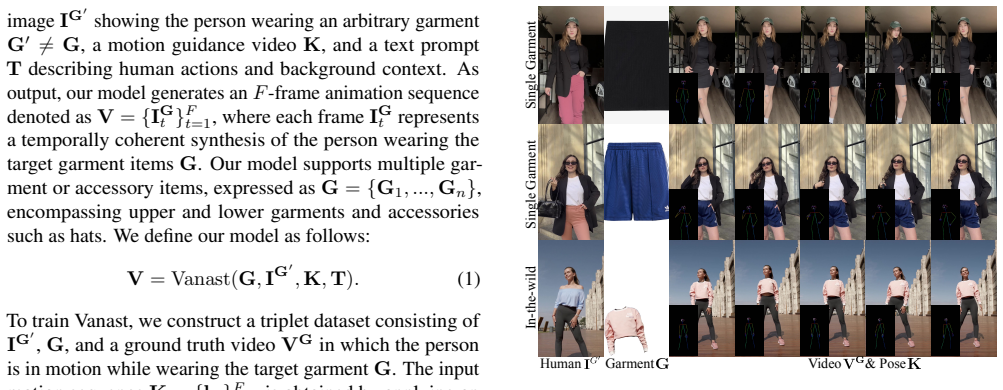
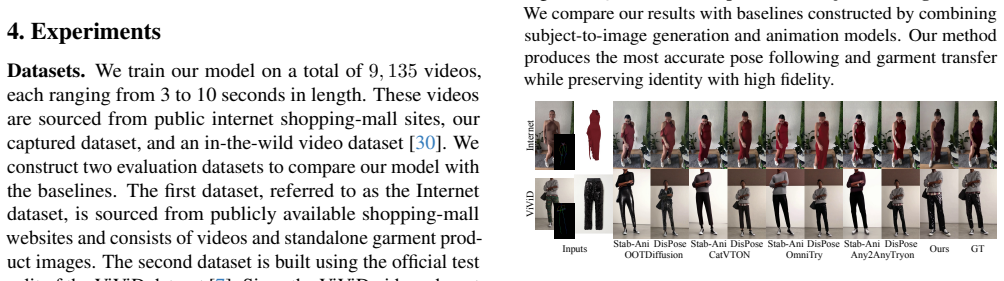
Vanast generates garment-transferred human animation videos directly from a single human image, garment images, and a pose guidance video by executing the entire process in one unified step rather than sequential try-on and animation stages, trained on synthetic triplets that supply identity-preserving alternative outfits and full upper-lower garment combinations, and realized through a Dual Module architecture in video diffusion transformers that stabilizes training, preserves pretrained quality, and improves garment accuracy, pose adherence, and identity preservation.
What carries the argument
Synthetic triplet supervision paired with a Dual Module architecture inside video diffusion transformers, where the dual modules stabilize training and improve garment accuracy, pose adherence, and identity preservation while supporting zero-shot interpolation.
If this is right
- Produces coherent videos without identity drift, garment distortion, or front-back inconsistency
- Handles both upper and lower garments in a single pass
- Supports zero-shot interpolation between different garments
- Maintains high generative quality from the pretrained diffusion model
- Works on diverse in-the-wild triplets without needing catalog images
Where Pith is reading between the lines
- A unified single-step model could reduce the number of separate processing stages needed for online clothing visualization tools
- The approach might generalize to longer or multi-view videos if the triplet pipeline is extended to include temporal consistency checks
- Further work could test whether the same synthetic data strategy applies to full-body or multi-person animation settings
Load-bearing premise
The synthetic triplet data generation pipeline produces realistic and diverse training examples that transfer to real-world garment images and videos without introducing artifacts or biases that harm identity preservation or garment accuracy.
What would settle it
Side-by-side visual comparison of Vanast outputs against real captured videos of the same person in the target garments, scored for identity match and garment fidelity, would show whether artifacts or drift appear in practice.
Figures





read the original abstract
We present Vanast, a unified framework that generates garment-transferred human animation videos directly from a single human image, garment images, and a pose guidance video. Conventional two-stage pipelines treat image-based virtual try-on and pose-driven animation as separate processes, which often results in identity drift, garment distortion, and front-back inconsistency. Our model addresses these issues by performing the entire process in a single unified step to achieve coherent synthesis. To enable this setting, we construct large-scale triplet supervision. Our data generation pipeline includes generating identity-preserving human images in alternative outfits that differ from garment catalog images, capturing full upper and lower garment triplets to overcome the single-garment-posed video pair limitation, and assembling diverse in-the-wild triplets without requiring garment catalog images. We further introduce a Dual Module architecture for video diffusion transformers to stabilize training, preserve pretrained generative quality, and improve garment accuracy, pose adherence, and identity preservation while supporting zero-shot garment interpolation. Together, these contributions allow Vanast to produce high-fidelity, identity-consistent animation across a wide range of garment types.
Editorial analysis
A structured set of objections, weighed in public.
Referee Report
Summary. The manuscript presents Vanast, a unified single-step framework for garment-transferred human animation video generation. Given a single reference human image, target garment images, and a pose guidance video, the method produces coherent output videos via a video diffusion transformer trained on large-scale synthetic triplets. The triplets are constructed through identity-preserving outfit variation, full upper/lower garment coverage, and in-the-wild assembly without catalog images. A Dual Module architecture is introduced to stabilize training, retain pretrained generative quality, and improve garment accuracy, pose adherence, and identity preservation while enabling zero-shot garment interpolation.
Significance. If the central claims hold, the work offers a meaningful advance over conventional two-stage virtual try-on plus animation pipelines by reducing identity drift, garment distortion, and front-back inconsistency through unified training. The synthetic triplet pipeline and Dual Module design constitute concrete technical contributions that could be adopted in related diffusion-based video synthesis tasks, provided the domain gap between synthetic training data and real inputs is shown to be manageable.
major comments (1)
- [§3] §3 (Synthetic Triplet Data Generation): The unified single-step claim and the headline performance on identity-consistent animation rest on the assertion that the synthetic pipeline produces training examples whose distribution is sufficiently close to real garment images and in-the-wild pose videos. No quantitative domain-gap measurements (e.g., FID, LPIPS, or perceptual user studies between synthetic and real triplets), no ablation of real-vs-synthetic training, and no error analysis of failure modes induced by lighting, fabric deformation, or body-shape mismatches are reported. This is load-bearing because any systematic mismatch would directly undermine the coherence advantages claimed over two-stage baselines.
minor comments (3)
- [§4.2] §4.2 (Dual Module): The interaction between the two modules and the precise conditioning mechanisms for garment, pose, and identity are described at a high level; explicit equations for the combined forward process or the zero-shot interpolation procedure would improve reproducibility.
- [Figure 3] Figure 3 and Table 1: Captions and axis labels should explicitly state whether metrics are computed on synthetic validation triplets or on held-out real videos to allow direct assessment of the transfer claim.
- [§2] §2 (Related Work): The discussion of prior virtual try-on and video diffusion methods is adequate but could more clearly delineate the precise novelty of the full-upper/lower triplet construction relative to existing paired try-on datasets.
Simulated Author's Rebuttal
We thank the referee for the constructive feedback and for recognizing the potential of our unified framework and technical contributions. We address the major comment on the synthetic triplet pipeline below and will strengthen the manuscript accordingly.
read point-by-point responses
-
Referee: [§3] §3 (Synthetic Triplet Data Generation): The unified single-step claim and the headline performance on identity-consistent animation rest on the assertion that the synthetic pipeline produces training examples whose distribution is sufficiently close to real garment images and in-the-wild pose videos. No quantitative domain-gap measurements (e.g., FID, LPIPS, or perceptual user studies between synthetic and real triplets), no ablation of real-vs-synthetic training, and no error analysis of failure modes induced by lighting, fabric deformation, or body-shape mismatches are reported. This is load-bearing because any systematic mismatch would directly undermine the coherence advantages claimed over two-stage baselines.
Authors: We agree that quantifying the domain gap is essential to substantiate the benefits of unified single-step training. The synthetic triplet pipeline was explicitly engineered to narrow this gap through identity-preserving outfit variation, full upper/lower garment coverage, and in-the-wild assembly from diverse sources. However, the initial submission indeed omitted the requested quantitative metrics, ablations, and error analysis. In the revised manuscript we will add: (1) FID and LPIPS comparisons between our synthetic triplets and real garment-pose sequences; (2) an ablation study reporting performance when training on synthetic data alone versus any obtainable real or mixed triplets; and (3) a dedicated error-analysis subsection with qualitative examples of failure modes arising from lighting mismatches, fabric deformation, and body-shape variations. These additions will directly support the coherence and identity-preservation claims relative to two-stage baselines. revision: yes
Circularity Check
No significant circularity in the Vanast derivation chain
full rationale
The paper introduces a unified single-step framework for garment-transferred human animation, enabled by an explicitly constructed synthetic triplet data generation pipeline (identity-preserving alternative outfits, full upper/lower garment triplets, in-the-wild assembly) and a new Dual Module video diffusion transformer architecture. These elements are presented as novel contributions rather than derivations that reduce by construction to fitted parameters, self-definitions, or self-cited uniqueness theorems. No equations or load-bearing self-citations appear in the abstract or described claims; the method trains on generated data in a standard non-circular ML manner, with performance claims resting on external experimental validation rather than internal renaming or forced equivalence.
Axiom & Free-Parameter Ledger
Lean theorems connected to this paper
-
IndisputableMonolith/Foundation/RealityFromDistinction.leanreality_from_one_distinction unclearWe present Vanast, a unified framework that generates garment-transferred human animation videos directly from a single human image, garment images, and a pose guidance video... Dual Module architecture for video diffusion transformers
-
IndisputableMonolith/Cost/FunctionalEquation.leanwashburn_uniqueness_aczel unclearOur data generation pipeline includes generating identity-preserving human images in alternative outfits... Dual Module architecture... zero-shot garment interpolation
Reference graph
Works this paper leans on
-
[1]
S. Bai, K. Chen, X. Liu, J. Wang, W. Ge, S. Song, K. Dang, P. Wang, S. Wang, J. Tang, et al. Qwen2.5-vl technical report. arXiv preprint arXiv:2502.13923, 2025. 4, 5
work page internal anchor Pith review Pith/arXiv arXiv 2025
-
[2]
H. Cha, B. Kim, and H. Joo. Pegasus: Personalized generative 3d avatars with composable attributes. InCVPR, 2024. 2
2024
-
[3]
H. Cha, B. Kim, and H. Joo. Durian: Dual reference image-guided portrait animation with attribute transfer.arXiv preprint arXiv:2509.04434, 2025. 2
work page internal anchor Pith review Pith/arXiv arXiv 2025
-
[4]
H. Cha, I. Lee, and H. Joo. Perse: Personalized 3d generative avatars from a single portrait. InCVPR, 2025. 4, 5
2025
-
[5]
Z. Chong, X. Dong, H. Li, S. Zhang, W. Zhang, X. Zhang, H. Zhao, D. Jiang, and X. Liang. Catvton: Concatenation is all you need for virtual try-on with diffusion models.arXiv preprint arXiv:2407.15886, 2024. 1, 2, 6
-
[6]
H. Dong, X. Liang, X. Shen, B. Wu, B.-C. Chen, and J. Yin. Fw-gan: Flow-navigated warping gan for video virtual try-on. InICCV, 2019. 2
2019
- [7]
- [8]
- [9]
-
[10]
Y . Guo, C. Yang, A. Rao, Z. Liang, Y . Wang, Y . Qiao, M. Agrawala, D. Lin, and B. Dai. Animatediff: Animate your personalized text-to-image diffusion models without specific tuning.arXiv preprint arXiv:2307.04725, 2023. 3
work page internal anchor Pith review arXiv 2023
-
[11]
LTX-Video: Realtime Video Latent Diffusion
Y . HaCohen, N. Chiprut, B. Brazowski, D. Shalem, D. Moshe, E. Richardson, E. Levin, G. Shiran, N. Zabari, O. Gordon, et al. Ltx-video: Realtime video latent diffusion.arXiv preprint arXiv:2501.00103, 2024. 3
work page internal anchor Pith review arXiv 2024
-
[12]
Heusel, H
M. Heusel, H. Ramsauer, T. Unterthiner, B. Nessler, and S. Hochreiter. Gans trained by a two time-scale update rule converge to a local nash equilibrium.NeurIPS, 2017. 6
2017
-
[13]
L. Hu. Animate anyone: Consistent and controllable image- to-video synthesis for character animation. InCVPR, 2024. 1, 3
2024
-
[14]
Jiang, C
Z. Jiang, C. Mao, Z. Huang, A. Ma, Y . Lv, Y . Shen, D. Zhao, and J. Zhou. Res-tuning: A flexible and efficient tuning paradigm via unbinding tuner from backbone.NeurIPS, 2023. 5
2023
-
[15]
Vace: All-in-one video creation and editing.arXiv preprint arXiv:2503.07598, 2025
Z. Jiang, Z. Han, C. Mao, J. Zhang, Y . Pan, and Y . Liu. Vace: All-in-one video creation and editing.arXiv preprint arXiv:2503.07598, 2025. 2, 3, 5, 6
-
[16]
J. Kim, G. Gu, M. Park, S. Park, and J. Choo. Stablevi- ton: Learning semantic correspondence with latent diffusion model for virtual try-on. InCVPR, 2024. 1, 2
2024
-
[17]
B. F. Labs. Flux. https://github.com/black- forest-labs/flux, 2024. 4, 5, 6
2024
- [18]
- [19]
- [20]
-
[21]
Nguyen, Q
H. Nguyen, Q. Q.-V . Nguyen, K. Nguyen, and R. Nguyen. Swifttry: Fast and consistent video virtual try-on with diffu- sion models. InAAAI, 2025. 2, 8
2025
-
[22]
Chatgpt (gpt-5)
OpenAI. Chatgpt (gpt-5). https://chat.openai.com,
-
[23]
SDXL: Improving Latent Diffusion Models for High-Resolution Image Synthesis
D. Podell, Z. English, K. Lacey, A. Blattmann, T. Dockhorn, J. M¨uller, J. Penna, and R. Rombach. Sdxl: Improving latent diffusion models for high-resolution image synthesis.arXiv preprint arXiv:2307.01952, 2023. 4
work page internal anchor Pith review Pith/arXiv arXiv 2023
-
[24]
Redmon, S
J. Redmon, S. Divvala, R. Girshick, and A. Farhadi. You only look once: Unified, real-time object detection. InCVPR,
-
[25]
Rombach, A
R. Rombach, A. Blattmann, D. Lorenz, P. Esser, and B. Om- mer. High-resolution image synthesis with latent diffusion models. InCVPR, 2022. 3
2022
- [26]
-
[27]
S. Tu, Z. Xing, X. Han, Z.-Q. Cheng, Q. Dai, C. Luo, and Z. Wu. Stableanimator: High-quality identity-preserving human image animation. InCVPR, 2025. 1, 3, 6
2025
-
[28]
T. Wan, A. Wang, B. Ai, B. Wen, C. Mao, C.-W. Xie, D. Chen, F. Yu, H. Zhao, J. Yang, et al. Wan: Open and advanced large-scale video generative models.arXiv preprint arXiv:2503.20314, 2025. 2, 3, 5
work page internal anchor Pith review Pith/arXiv arXiv 2025
-
[29]
X. Wang, S. Zhang, C. Gao, J. Wang, X. Zhou, Y . Zhang, L. Yan, and N. Sang. Unianimate: Taming unified video diffu- sion models for consistent human image animation.Science China Information Sciences, 2025. 3
2025
-
[30]
Z. Wang, Y . Li, Y . Zeng, Y . Fang, Y . Guo, W. Liu, J. Tan, K. Chen, T. Xue, B. Dai, et al. Humanvid: Demystifying training data for camera-controllable human image animation. NeurIPS, 2024. 5, 6
2024
- [31]
-
[32]
E. Xie, W. Wang, Z. Yu, A. Anandkumar, J. M. Alvarez, and P. Luo. Segformer: Simple and efficient design for semantic segmentation with transformers.NeurIPS, 2021. 5
2021
-
[33]
Y . Xu, T. Gu, W. Chen, and A. Chen. Ootdiffusion: Outfitting fusion based latent diffusion for controllable virtual try-on. InAAAI, 2025. 2, 6
2025
- [34]
-
[35]
H. Yang, R. Zhang, X. Guo, W. Liu, W. Zuo, and P. Luo. To- wards photo-realistic virtual try-on by adaptively generating- preserving image content. InCVPR, 2020. 2
2020
-
[36]
S. Yang, H. Li, J. Wu, M. Jing, L. Li, R. Ji, J. Liang, H. Fan, and J. Wang. Megactor-σ: Unlocking flexible mixed-modal control in portrait animation with diffusion transformer, 2025. 3
2025
-
[37]
Z. Yang, A. Zeng, C. Yuan, and Y . Li. Effective whole-body pose estimation with two-stages distillation. InICCV, 2023. 4
2023
-
[38]
S. Yuan, J. Huang, X. He, Y . Ge, Y . Shi, L. Chen, J. Luo, and L. Yuan. Identity-preserving text-to-video generation by frequency decomposition. InCVPR, 2025. 3
2025
-
[39]
Zhang, Y
K. Zhang, Y . Zhou, X. Xu, B. Dai, and X. Pan. Diffmor- pher: Unleashing the capability of diffusion models for image morphing. InCVPR, 2024. 5
2024
-
[40]
S. Zhu, J. L. Chen, Z. Dai, Y . Xu, X. Cao, Y . Yao, H. Zhu, and S. Zhu. Champ: Controllable and consistent human image animation with 3d parametric guidance. InECCV, 2024. 1, 3 10
2024
discussion (0)
Sign in with ORCID, Apple, or X to comment. Anyone can read and Pith papers without signing in.