Recognition: 2 theorem links
· Lean TheoremInduced-current magnetophoresis
Pith reviewed 2026-05-14 22:24 UTC · model grok-4.3
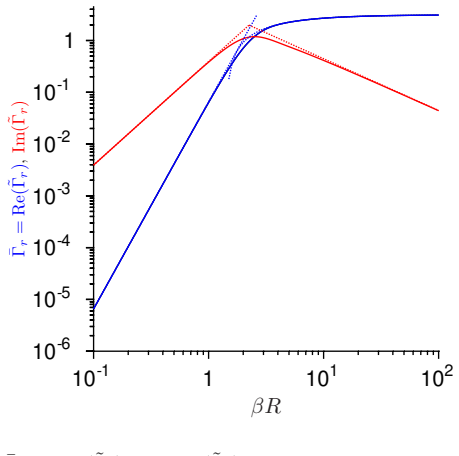
The pith
Oscillating inhomogeneous magnetic fields exert steady forces on electrically conducting non-magnetic particles through induced eddy currents.
A machine-rendered reading of the paper's core claim, the machinery that carries it, and where it could break.
Core claim
When an electrically conducting non-magnetic particle is subjected to a spatially varying and oscillating applied magnetic field of amplitude H + G · x and frequency omega, an oscillating eddy current is induced. The Lorentz force density has a steady component that produces a net force on a sphere of radius R proportional to -mu0 R^3 G · H and on a thin rod of radius R and length L proportional to -mu0 R^2 L (G · H - 1/2 (G · o-hat)(H · o-hat)). A torque mu0 R^2 L (o-hat × H)(o-hat · H) acts on the rod and tends to align it with the field. The coefficients depend on the dimensionless ratio beta R = sqrt(mu0 omega kappa R^2). The effect of particle interactions appears as an anisotropic term
What carries the argument
The time-averaged Lorentz force density formed by the cross product of the induced current density and the applied magnetic field, which yields a nonzero steady component only when the applied field is spatially inhomogeneous.
Load-bearing premise
The applied magnetic field is taken to vary linearly in space while the particle is treated as non-magnetic and perfectly conducting at the driving frequency, with no back-reaction on the external field or fluid flow.
What would settle it
Place a conducting sphere or rod of known radius in a controlled oscillating magnetic field with measured gradient G and field H, record its steady velocity or torque, and check whether the observed force matches the predicted scaling with R^3 G · H or the rod expressions.
Figures




read the original abstract
When an electrically conducting non-magnetic particle is subjected to a spatially varying and oscillating applied magnetic field of amplitude $\mathcal{H} + \mathcal{G} \cdot x$ and frequency $\omega$, an oscillating eddy current is induced. The Lorentz force density, the cross product of the current density and the magnetic field, consists of a steady component and a component with frequency $2 \omega$. If there is a spatial variation in the applied field, there is a steady force on a sphere of radius $R$ proportional to $- \mu_0 R^3 \mathcal{G} \cdot \mathcal{H} $, and a steady force on a thin rod of radius $R$ and length $L$ proportional to $- \mu_0 R^2 L (\mathcal{G} \cdot \mathcal{H} - \tfrac{1}{2} (\mathcal{G} \cdot \hat o)(\mathcal{H} \cdot \hat o))$, where $\mu_0$ is the magnetic permeability. There is torque proportional to $\mu_0 R^2 L (\hat o \times \mathcal{H} ) (\hat o \cdot \mathcal{H} )$ on a thin rod which tends to align the rod direction of the magnetic field. The coefficients in the force and torque expressions are functions of the dimensionless ratio of the radius and the penetration depth of the magnetic field, $\beta R = \sqrt{\mu_0 \omega \kappa R^2}$, where $\kappa$ is the electrical conductivity. It is shown that the effect of particle interactions can be expressed as an anisotropic diffusion term in the equation for the particle number density. The diffusion coefficient is negative, and concentration fluctuations are amplified, in the plane perpendicular to the magnetic field.
Editorial analysis
A structured set of objections, weighed in public.
Referee Report
Summary. The manuscript derives the steady component of the Lorentz force arising from induced eddy currents on electrically conducting non-magnetic particles in a linearly varying oscillating magnetic field H + G · x. For a sphere the steady force is proportional to −μ₀ R³ G · H; for a thin rod of radius R and length L the force is proportional to −μ₀ R² L (G · H − ½ (G · ô)(H · ô)) with an aligning torque μ₀ R² L (ô × H)(ô · H). Both sets of coefficients are functions of the dimensionless parameter βR = √(μ₀ ω κ R²). Particle interactions are shown to produce an anisotropic diffusion term in the number-density equation whose coefficient is negative in the plane perpendicular to the applied field, implying amplification of concentration fluctuations.
Significance. If the central expressions hold, the work supplies a parameter-free derivation, starting from Maxwell’s equations and the Lorentz force, of a magnetophoretic mechanism that does not require intrinsic particle magnetism. The explicit force, torque, and interaction-induced diffusion expressions constitute falsifiable predictions that could be tested in microfluidic or low-Reynolds-number experiments. The predicted perpendicular instability is a distinctive feature with potential implications for controlled assembly or separation of conducting particles.
major comments (1)
- [Derivation of steady force and interaction model] The force and torque expressions (abstract and the derivations leading to the sphere and rod results) are obtained by integrating the Lorentz force density J × B while taking the internal magnetic field to be exactly the imposed linear form H + G · x. The first-order correction to B produced by the eddy currents themselves is omitted. Because the interaction model constructs the effective field on one particle from the perturbation generated by its neighbors, the same omitted correction appears at leading order in the mean-field interaction; if it is not parametrically smaller than the retained G · H term, both the force coefficients and the sign of the perpendicular diffusion coefficient can be altered.
minor comments (2)
- [Notation and parameter definitions] The definition βR = √(μ₀ ω κ R²) is introduced in the abstract but should be restated explicitly when the coefficients are first plotted or tabulated in the main text.
- [Abstract] The abstract states that particle interactions 'can be expressed as an anisotropic diffusion term' but does not give the explicit form of the diffusion tensor or the section in which it is derived.
Simulated Author's Rebuttal
We thank the referee for their careful reading and insightful comments. We address the concern regarding the approximation used in deriving the force, torque, and interaction terms below.
read point-by-point responses
-
Referee: The force and torque expressions (abstract and the derivations leading to the sphere and rod results) are obtained by integrating the Lorentz force density J × B while taking the internal magnetic field to be exactly the imposed linear form H + G · x. The first-order correction to B produced by the eddy currents themselves is omitted. Because the interaction model constructs the effective field on one particle from the perturbation generated by its neighbors, the same omitted correction appears at leading order in the mean-field interaction; if it is not parametrically smaller than the retained G · H term, both the force coefficients and the sign of the perpendicular diffusion coefficient can be altered.
Authors: We acknowledge that our derivation approximates the internal magnetic field as the externally imposed linear field H + G · x when computing the induced current density J and the subsequent Lorentz force. This neglects the first-order correction δB generated by the eddy currents themselves. As noted, this correction is of relative order (βR)^2, where βR is the dimensionless parameter already appearing in our coefficients. For moderate values of βR (βR ≲ 1), the approximation remains accurate to leading order. In the interaction model, the effective field from neighboring particles is computed using the same consistent approximation for the induced perturbations, ensuring that the mean-field interaction is treated at the same level of accuracy. The anisotropic nature of the diffusion, leading to negative diffusion perpendicular to the field, arises from the directional dependence of the induced currents and torques, which we expect to persist even with higher-order corrections. Nevertheless, to address the referee's concern, we will add a dedicated paragraph in the discussion section clarifying the approximation, its validity range, and the potential impact of O((βR)^2) corrections on the force coefficients and diffusion sign for large βR. We do not anticipate changes to the central expressions but will include this caveat. revision: partial
Circularity Check
No significant circularity in derivation chain
full rationale
The paper derives the steady forces and torques by direct integration of the Lorentz force density J × B after solving the eddy-current problem for the imposed linear field H + G · x inside non-magnetic conducting particles. The interaction contribution is obtained by superposing the perturbation fields from neighboring particles to produce an anisotropic diffusion term in the number-density equation. No step reduces by construction to a fitted parameter renamed as a prediction, a self-definitional relation, or a load-bearing self-citation; the coefficients are explicit functions of the dimensionless ratio βR obtained from the Maxwell solution. The derivation is therefore self-contained against the stated assumptions.
Axiom & Free-Parameter Ledger
axioms (2)
- standard math Maxwell's equations in the quasi-static limit for conducting media
- domain assumption Linear spatial variation of the applied magnetic field amplitude
Lean theorems connected to this paper
-
IndisputableMonolith/Cost/FunctionalEquation.leanwashburn_uniqueness_aczel unclear?
unclearRelation between the paper passage and the cited Recognition theorem.
steady force on a sphere … proportional to −μ₀ R³ G·H … obtained by integrating the Maxwell stress … over SI
-
IndisputableMonolith/Foundation/AbsoluteFloorClosure.leanabsolute_floor_iff_bare_distinguishability unclear?
unclearRelation between the paper passage and the cited Recognition theorem.
effect of particle interactions … anisotropic diffusion term … negative … perpendicular to the magnetic field
What do these tags mean?
- matches
- The paper's claim is directly supported by a theorem in the formal canon.
- supports
- The theorem supports part of the paper's argument, but the paper may add assumptions or extra steps.
- extends
- The paper goes beyond the formal theorem; the theorem is a base layer rather than the whole result.
- uses
- The paper appears to rely on the theorem as machinery.
- contradicts
- The paper's claim conflicts with a theorem or certificate in the canon.
- unclear
- Pith found a possible connection, but the passage is too broad, indirect, or ambiguous to say the theorem truly supports the claim.
Reference graph
Works this paper leans on
-
[1]
Therefore, the amplitude of the oscillatory force and torque a re also obtained by the substitution ˜H ∗ → ˜H in the resulting expression. In the following analysis, the accent ˜ is used to denote complex varia bles, while real variables are written without the accent. The calligraphic font is use d for the applied magnetic field ( H) and the magnetic field...
-
[2]
There is a steady force on an electrically conducting spherical pa rticle of radius R in a spatially varying and oscillating applied magnetic field of amplitude H + G · x and frequency ω , where x is the position vector from the center of the particle. The steady magnetophoretic force on the particle is of the form ¯F = − ¯Γ sµ 0R3 ˜H · G, where the positi...
-
[3]
For a thin rod with radius R length L, high aspect ratio L ≫ R and orientation vector ˆo, the magnetophoretic force is ¯F = − ¯Γ rµ 0R2L(G · H − 1 2(G · ˆo)(H · ˆo)). The force is in the direction of decreasing magnetic field components parallel an d perpendicular to the orientation vector. In the viscous limit, the mobility of a particle (ratio of velocit...
-
[4]
In a viscous flow , the induced angular velocity is proportional to µ 0|H|2R2 ¯Γ r log (L/R )/ηL 2
There is a torque on a thin rod T = 1 2 µ 0R2L¯Γ r( ˆo × H)( ˆo ·H), which tends to align the rod in the direction parallel to the magnetic field. In a viscous flow , the induced angular velocity is proportional to µ 0|H|2R2 ¯Γ r log (L/R )/ηL 2. 36 The time scale for the alignment of the thin rod is compared to the tra nslation time over a distance compara...
-
[5]
The effect of far-field magnetic particle interactions and the mod ification of the applied magnetic field due to particle magnetisation is considered. For spher ical particles, when there is a small spatial variation in the particle number density, the effect of interactions reduces to an anisotropic diffusion term in the conserv ation equation 117 for the num...
-
[6]
For a suspension of thin rods, the effect of interactions can not be reduced to an anisotropic diffusion term in the conservation equation 132 for the n umber density. However, in this case, it is shown that number density variations are damped along the magnetic field and amplified perpendicular to the magnetic field. The diffusion coefficients are proportional ...
-
[7]
These 37 produce velocity fields that influence the dynamics of neighbouring p articles
There are also hydrodynamic interactions between the particle, because the Maxwell stress generates a force moment for each particle (equations 45 , 70 and 71). These 37 produce velocity fields that influence the dynamics of neighbouring p articles. However, the convective term in the number density conservation equation, 90, is zero because the velocity fie...
work page 2006
-
[8]
The cross section of the rod is a disk of unit radius in scaled co-ordinates centered at the origin
Dipole moment perpendicular to the axis In the plane perpendicular to the axis, two-dimensional polar harmo nics are used to determine the induced dipole moment. The cross section of the rod is a disk of unit radius in scaled co-ordinates centered at the origin. The x− y co-ordinate system is used, where r = √ x2 + y2 is the distance from the origin. The ...
-
[9]
Within the cylinder, there is a variation in the magnet ic field with radial position
Dipole moment parallel to the axis The component of the magnetic field H∥ parallel to the axis is uniform outside the con- ducting cylinder. Within the cylinder, there is a variation in the magnet ic field with radial position. The magnetic field has the same form as B8, with H ⊥ replaced by H ∥ . Since H ∥ is perpendicular to ˜ζ (2), the magnetic field is ex...
-
[10]
H. K. Moffatt. On the behaviour of a suspension of conductin g particles subjected to a time-periodic magnetic field. J. Fluid Mech. , 218:509–529, 1990. 45
work page 1990
-
[11]
H. K. Moffatt. Electromagnetic stirring. Phys. Fluids , 3:1336–1343, 1991
work page 1991
-
[12]
V. Kumaran. Rheology of a suspension of conducting parti cles in a magnetic field. J. Fluid Mech., 871:139–185, 2019
work page 2019
-
[13]
V. Kumaran. A suspension of conducting particles in a mag netic field - the maxwell stress. J. Fluid Mech. , 901:A36, 2020
work page 2020
-
[14]
V. Kumaran. Eddies driven by eddy currents: Magnetokine tic flow in a conducting drop due to an oscillating magnetic field. EPL, 148:63001, 2024
work page 2024
-
[15]
V. Kumaran. Flow in an electrically conducting drop due t o an oscillating magnetic field. J. Fluid Mech. , 1014:A36, 2025
work page 2025
-
[16]
M. Bu, T. B. Christensen, K. Smistrup, A. Wolff, and M. F. Mik kel F. Hansen. Characteriza- tion of a microfluidic magnetic bead separator for high-thro ughput applications. Sensors and Actuators A: Physical , 145-146:430–436, 2008
work page 2008
- [17]
-
[18]
Ozgun Civelekoglu, A. Bruno Frazier, and A. Fatih Sariog lu. The origins and the current applications of microfluidics-based magnetic cell separat ion technologies. Magnetochemistry, 8:10, 2022
work page 2022
- [19]
-
[20]
S. N. Murthy, S. M. Sammeta, and C. Bowers. Magnetophore sis for enhancing transdermal drug delivery: Mechanistic studies and patch design. Journal of Controlled Release , 148:197– 203, 2010
work page 2010
-
[21]
L. Shao, Z. Feng, Q. Du, L. Guangzheng Zou, and Z. Tan. Res earch advances in magne- tophoretic separation: Fundamentals and methodologies. Separation & Purification Reviews , 55:56–71, 2026
work page 2026
-
[22]
S. S. Leong, Z. Ahmad, S. C. Low, J. Camacho, J. Faraudo, a nd J.-K. Lim. Unified view of magnetic nanoparticle separation under magnetophoresis. Langmuir, 36:8033–8055, 2020
work page 2020
-
[23]
A. Munaz, Shiddiky M. J. A., and N. T. Nguyen. Recent adva nces and current challenges in magnetophoresis based micro magnetofluidics. Biomicrofluidics, 12:031501, 2018
work page 2018
-
[24]
F. Alnaimat, S. Dagher, B. Mathew, A. Hilal-Alnqbi, and S. Khashan. Microfluidics based magnetophoresis: A review. The Chemical Record, 18:1596–1612, 2018
work page 2018
-
[25]
V. Kumaran. The effect of inter-particle hydrodynamic an d magnetic interactions in a mag- netorheological fluid. J. Fluid Mech. , 944:A49, 2022
work page 2022
-
[26]
J. Toner and Y. Tu. Long-range order in a two-dimensiona l dynamical XY model: How birds fly together. Phys. Rev. Lett. , 75:4326–4329, 1995
work page 1995
-
[27]
R. A. Simha and S. Ramaswamy. Hydrodynamic fluctuations and instabilities in ordered suspensions of self-propelled particles. Phys. Rev. Lett. , 89:058101, 2002
work page 2002
- [28]
- [29]
-
[30]
A. Kolin. An electromagnetokinetic phenomenon involv ing migration of neutral particles. Science, 117:134–137, 1953
work page 1953
-
[31]
H. K. Moffatt and A. Sellier. Migration of an insulating pa rticle under the action of uniform ambient electric and magnetic fields. part 1. general theory . J. Fluid Mech. , 464:279–286, 2002
work page 2002
-
[32]
E. Yariv and T. Miloh. Electro-magneto-phoresis of sle nder bodies. J. Fluid Mech. , 577:331–340, 2007
work page 2007
-
[33]
V. G. Levich. Physicochemical Hydrodynamics. Prentice-Hall, Englewood Cliffs, New Jersey, USA., 1962
work page 1962
-
[34]
T. M. Squires and M. Z. Bazant. Induced-charge electro- osmosis. J. of Fluid Mech. , 509:217– 252, 2004
work page 2004
-
[35]
D. J. Griffiths. Introduction to electrodynamics; 4th ed. Pearson, Boston, MA, 2013
work page 2013
-
[36]
L. D. Landau, E. M. Lifshitz, and L. P. Pitaevskii. Electrodynamics of Continuous Media . Butterworth-Heinemann, Oxford, UK, 2014
work page 2014
-
[37]
H. Brenner. Rheology of a dilute suspension of axisymme tric brownian particles. Int. J. Multiphase Flow , 1:195–341, 1974
work page 1974
-
[38]
The direction reverses upon inversion between right- a nd left-handed co-ordinates
-
[39]
The direction does not change upon inversion between ri ght- and left-handed co-ordinates. 47
discussion (0)
Sign in with ORCID, Apple, or X to comment. Anyone can read and Pith papers without signing in.