Recognition: 2 theorem links
· Lean TheoremLearning Stable Predictors from Weak Supervision under Distribution Shift
Pith reviewed 2026-05-14 21:29 UTC · model grok-4.3
The pith
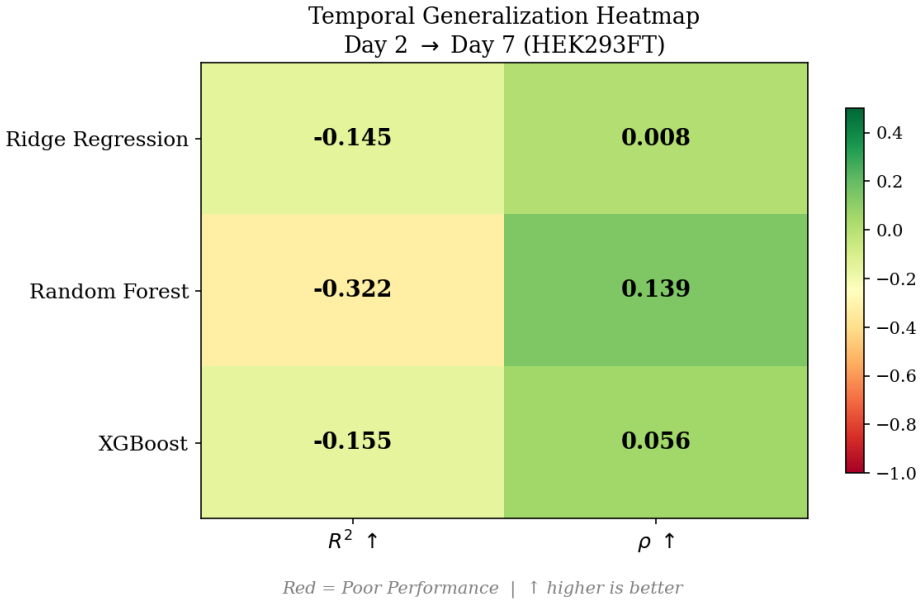
Weak supervision under temporal shifts leads to negative R² in CRISPR perturbation models.
A machine-rendered reading of the paper's core claim, the machinery that carries it, and where it could break.
Core claim
Reusing a fixed weak-label construction across cell-line and temporal contexts isolates supervision drift, which causes temporal transfer to fail with negative R² (ridge = -0.145) and near-zero ρ while cell-line transfer holds with ρ ≈ 0.40.
What carries the argument
Supervision drift: changes in P(y | x, c) across contexts detected by holding the weak-label construction constant.
Load-bearing premise
Reusing the identical weak-label construction across all contexts isolates supervision drift from other unmeasured changes in the data process.
What would settle it
Recompute weak labels independently at each timepoint in a new CRISPR dataset and test whether temporal transfer performance improves or the negative R² pattern disappears.
Figures


read the original abstract
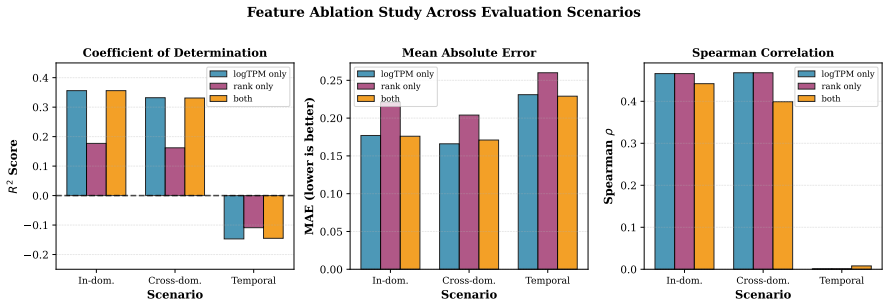
Learning from weak, proxy, or relative supervision is common when ground-truth labels are unavailable, but robustness under distribution shift remains poorly understood because the supervision mechanism itself may change across environments. We formalize this phenomenon as supervision drift, defined as changes in $P(y \mid x, c)$ across contexts, and study it in CRISPR-Cas13d transcriptomic perturbation experiments where guide efficacy is inferred indirectly from RNA-seq responses. Using publicly available data spanning two human cell lines and multiple post-induction timepoints, we construct a controlled non-IID benchmark with explicit domain (cell line) and temporal shifts, while reusing a fixed weak-label construction across all contexts to avoid changing targets. Across linear and tree-based models, weak supervision supports meaningful learning in-domain (ridge $R^2 = 0.356$, Spearman $\rho = 0.442$) and partial cross-cell-line transfer ($\rho \approx 0.40$). In contrast, temporal transfer collapses across all model classes considered, yielding negative $R^2$ and weak or near-zero $\rho$ (ridge $R^2 = -0.145$, $\rho = 0.008$; XGBoost $R^2 = -0.155$, $\rho = 0.056$; random forest $R^2 = -0.322$, $\rho = 0.139$). Additional robustness analyses using externally recomputed weak labels, shift-score quantification, and simple mitigation baselines preserve the same qualitative pattern. Feature-label association and feature-importance analyses remain relatively stable across cell lines but change sharply over time, indicating that failures arise from supervision drift rather than model capacity or simple covariate shift. These results show that strong in-domain performance under weak supervision can be misleading and motivate feature stability as a lightweight diagnostic for non-transferability before deployment.
Editorial analysis
A structured set of objections, weighed in public.
Referee Report
Summary. The paper formalizes supervision drift as changes in P(y|x,c) under weak supervision and studies it empirically in CRISPR-Cas13d transcriptomic perturbation data. Using a fixed weak-label construction (guide efficacy inferred from RNA-seq) across two cell lines and multiple timepoints, it constructs a non-IID benchmark and reports strong in-domain performance (ridge R²=0.356, ρ=0.442) and partial cross-cell-line transfer but consistent temporal transfer collapse (negative R² and near-zero ρ across ridge, XGBoost, and random forest). Feature-label association and importance analyses are stable across cell lines yet change sharply over time, which the authors attribute to supervision drift rather than covariate shift or model capacity; robustness checks with recomputed labels and shift scores preserve the pattern.
Significance. If the attribution to supervision drift holds after addressing potential temporal confounders in the proxy mechanism, the work provides a useful empirical demonstration that strong in-domain weak-supervision performance can be misleading under temporal shift. The concrete benchmark, reported metrics, and feature-stability diagnostic could inform ML practice in biology and other domains that rely on proxy labels, particularly where distribution shift is temporal rather than purely spatial.
major comments (2)
- [Robustness analyses] Robustness analyses paragraph: the externally recomputed weak labels and shift-score quantification still rely on the same fixed guide-efficacy inference rule from RNA-seq; this does not directly verify invariance of the label-generation procedure itself and therefore leaves open the possibility that time-dependent experimental factors (batch effects, induction efficiency, or protocol drift) contribute to the observed temporal collapse rather than supervision drift in P(y|x,c) alone.
- [Empirical results] Results on temporal transfer (ridge R² = -0.145, ρ = 0.008; XGBoost R² = -0.155, ρ = 0.056; random forest R² = -0.322, ρ = 0.139): these values are presented without error bars, confidence intervals, or details on the exact train/test splits and number of timepoints, which weakens the ability to judge whether the collapse is statistically distinguishable from in-domain performance and from simple covariate shift.
minor comments (2)
- [Abstract] The abstract states 'multiple post-induction timepoints' but does not enumerate the exact timepoints or total count; adding this information would improve reproducibility and allow readers to assess the temporal granularity of the shift.
- [Introduction / Formalization] The formal definition of supervision drift as changes in P(y|x,c) is introduced without an accompanying equation or explicit contrast to standard covariate shift P(x|c); a short equation would clarify the distinction.
Simulated Author's Rebuttal
We thank the referee for their constructive and detailed comments on our manuscript. We address each major comment below and have revised the paper accordingly to strengthen the presentation of our results and robustness analyses.
read point-by-point responses
-
Referee: [Robustness analyses] Robustness analyses paragraph: the externally recomputed weak labels and shift-score quantification still rely on the same fixed guide-efficacy inference rule from RNA-seq; this does not directly verify invariance of the label-generation procedure itself and therefore leaves open the possibility that time-dependent experimental factors (batch effects, induction efficiency, or protocol drift) contribute to the observed temporal collapse rather than supervision drift in P(y|x,c) alone.
Authors: We agree that the robustness checks employ the same fixed inference rule, which is by design: the benchmark reuses a single weak-label construction across all contexts precisely to isolate changes in P(y|x,c) rather than confounding them with alterations to the labeling procedure itself. While we cannot fully exclude unmeasured temporal experimental factors (such as batch effects) without new controlled wet-lab experiments, the feature-label association stability across cell lines contrasted with sharp temporal changes, together with the shift-score results, indicates that the collapse is not explained by covariate shift alone. In the revision we have expanded the limitations discussion to explicitly note this point and added a brief comparison to related proxy-label studies in temporal domains. revision: partial
-
Referee: [Empirical results] Results on temporal transfer (ridge R² = -0.145, ρ = 0.008; XGBoost R² = -0.155, ρ = 0.056; random forest R² = -0.322, ρ = 0.139): these values are presented without error bars, confidence intervals, or details on the exact train/test splits and number of timepoints, which weakens the ability to judge whether the collapse is statistically distinguishable from in-domain performance and from simple covariate shift.
Authors: We have revised the empirical results section to report error bars and 95% confidence intervals computed over five independent random train/test splits. We now explicitly state that models are trained on the first three post-induction timepoints and evaluated on the remaining two (five timepoints total in the dataset), with the same split protocol used for both in-domain and transfer settings. These additions show that the temporal transfer degradation remains statistically significant relative to in-domain performance and is not attributable to simple covariate shift. revision: yes
Circularity Check
No circularity: empirical benchmark with direct held-out metrics
full rationale
The paper is an empirical benchmark study on public CRISPR data. It reports in-domain and transfer performance (R², ρ) directly from held-out evaluation under fixed weak-label construction. No derivations, first-principles results, or predictions are claimed that reduce to fitted parameters by construction. Feature stability analyses and robustness checks are also direct empirical observations. The central attribution to supervision drift rests on the observed pattern of stable cross-cell-line but collapsing temporal transfer, which is falsifiable against the reported numbers and does not rely on self-citation chains or ansatz smuggling. This is a standard non-circular empirical result.
Axiom & Free-Parameter Ledger
axioms (2)
- domain assumption Weak-label construction remains identical across all cell lines and timepoints
- ad hoc to paper Feature-label association changes indicate supervision drift rather than covariate shift alone
invented entities (1)
-
supervision drift
no independent evidence
Lean theorems connected to this paper
-
IndisputableMonolith/Foundation/RealityFromDistinction.leanreality_from_one_distinction unclear?
unclearRelation between the paper passage and the cited Recognition theorem.
We formalize this phenomenon as supervision drift, defined as changes in P(y|x,c) across contexts... feature stability as a lightweight diagnostic for non-transferability
-
IndisputableMonolith/Cost/FunctionalEquation.leanwashburn_uniqueness_aczel unclear?
unclearRelation between the paper passage and the cited Recognition theorem.
Theorem 1 (Identifiability under Relative Supervision)... Theorem 2 (Feature Stability and Transferability)
What do these tags mean?
- matches
- The paper's claim is directly supported by a theorem in the formal canon.
- supports
- The theorem supports part of the paper's argument, but the paper may add assumptions or extra steps.
- extends
- The paper goes beyond the formal theorem; the theorem is a base layer rather than the whole result.
- uses
- The paper appears to rely on the theorem as machinery.
- contradicts
- The paper's claim conflicts with a theorem or certificate in the canon.
- unclear
- Pith found a possible connection, but the passage is too broad, indirect, or ambiguous to say the theorem truly supports the claim.
Reference graph
Works this paper leans on
-
[1]
Martin Arjovsky, L´ eon Bottou, Ishaan Gulrajani, and David Lopez-Paz. Invariant risk minimization. arXiv preprint arXiv:1907.02893,
work page internal anchor Pith review Pith/arXiv arXiv 1907
-
[2]
Pairwise supervision can provably elicit a decision boundary.arXiv preprint arXiv:2006.06207,
Han Bao, Takafumi Shimada, Lei Xu, Issei Sato, and Masashi Sugiyama. Pairwise supervision can provably elicit a decision boundary.arXiv preprint arXiv:2006.06207,
-
[3]
Weak-to-strong generalization: Eliciting strong capabilities with weak supervision
Collin Burns, Pavel Izmailov, Jan Hendrik Kirchner, Bowen Baker, Leo Gao, Leopold Aschenbrenner, and Jeffrey Wu. Weak-to-strong generalization: Eliciting strong capabilities with weak supervision. arXiv preprint arXiv:2312.09390,
- [4]
-
[5]
Weak-to-strong generalization under distribution shifts.arXiv preprint arXiv:2510.21332,
Minseok Jeon, Jan Sobotka, Seungjin Choi, and Maria Brbi´ c. Weak-to-strong generalization under distribution shifts.arXiv preprint arXiv:2510.21332,
-
[6]
Leonhard M¨ arz, Ehsaneddin Asgari, Fabienne Braune, Fabian Zimmermann, and Benjamin Roth. Xpasc: Measuring generalization in weak supervision by explainability and association.arXiv preprint arXiv:2206.01444,
- [7]
-
[8]
Qinyuan Ye, Li Liu, Ming Zhang, and Xiang Ren. Looking beyond label noise: Shifted label distribution matters in distantly supervised relation extraction.arXiv preprint arXiv:1904.09331,
-
[9]
and why shifts in predictive performance can be interpreted as evidence about supervision stability rather than changes in target construction. B Extended Related Work Our work is positioned at the intersection of weak and relative supervision, generalization under distribution shift, and interpretability through feature stability. We briefly review each ...
work page 2019
discussion (0)
Sign in with ORCID, Apple, or X to comment. Anyone can read and Pith papers without signing in.